

Accept software delivery only after the agreed business workflows pass documented tests, the delivered release matches those tests, and your team receives the access and handover materials required by the contract. A working demonstration is not acceptance evidence. Record unresolved defects and the acceptance decision in writing, and follow the contract’s payment terms rather than inventing new conditions at the final invoice.
- Finite Loop’s position: accept demonstrated business outcomes, not a polished demo.
- For software development company dubai testing, require workflow evidence, release identification, and documented handover.
- Test failed payments, duplicate events, permissions, and recovery—not just successful checkout.
- Separate delivery acceptance from payment obligations; follow the signed contract.
Why this matters
An ecommerce release can look finished while leaving your operations team unable to reconcile orders, retry failed integrations, or deploy a correction. Those gaps matter more than a tidy presentation. Your acceptance process should expose them before you sign off.
At Finite Loop, our software development position is direct: acceptance is a business decision supported by engineering evidence. Repository access alone does not establish contractual ownership; clarify who owns the code when you hire a Dubai software company alongside the testing requirements.
For a 2026 delivery, identify the exact release, environment, and acceptance record. Otherwise, the software you approve and the software deployed can become different things.
How do you accept a software delivery before the final payment?
Use the signed scope as the baseline, test the release against observable business outcomes, and document the result. Ask your technical lead and business owner to review the same evidence. Neither a developer’s completion report nor a business stakeholder’s visual approval covers the whole decision.
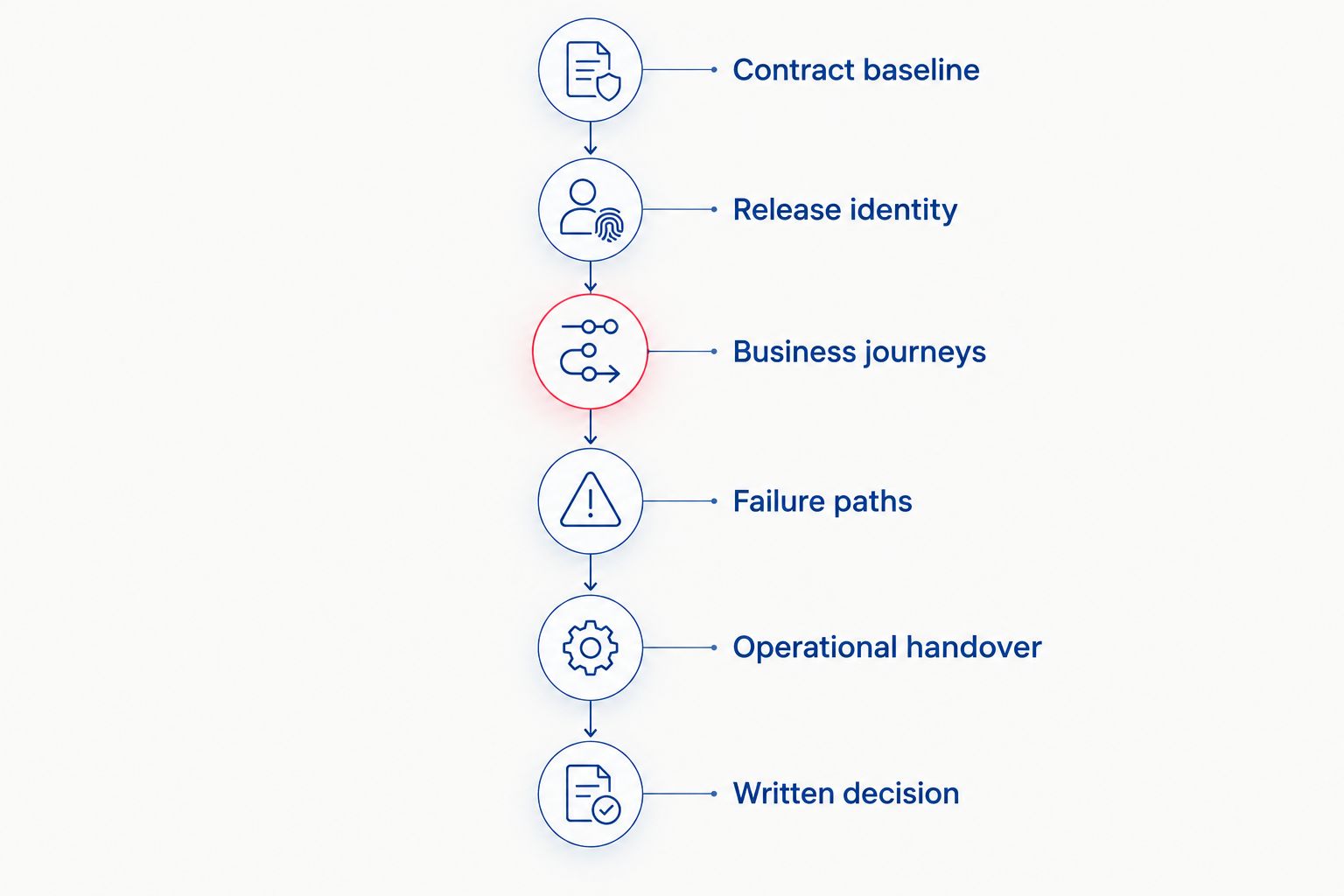
1. Contract baseline
Start with the agreement, approved scope, acceptance criteria, and recorded changes. Separate promised functionality from later requests. A missing agreed workflow is a delivery issue; a newly requested workflow belongs in change control.
Translate broad requirements into observable results. Instead of accepting “inventory integration complete,” specify the behavior: an approved stock change reaches the storefront, the correct item changes, and an integration failure becomes visible to the responsible operator.
Check the contractual acceptance procedure before testing starts. Identify who can approve delivery, what evidence they need, how defects are reported, and whether the agreement contains a deemed-acceptance provision. Ask legal counsel about ambiguous payment or acceptance wording rather than treating this checklist as a replacement for the contract.
2. Release identity
Record the application version or repository commit, test environment, deployment date, and relevant configuration. A commit identifies a particular saved state of the code. Configuration identifies the settings that affect how that code behaves.
Confirm that the release submitted for acceptance is the release intended for production. Document differences between environments, including payment credentials, integration endpoints, permissions, and scheduled tasks. Passing in a test environment does not establish that production configuration is correct.
Keep a 2026 release record with the test evidence. If the supplier changes the release after testing, identify the change and repeat the affected checks before approval.
3. Business journeys
Ask the people who run the business to execute the workflows they will own. For an ecommerce project, that means following an order through the relevant systems—not stopping when the confirmation page appears.
Write each test as an action and an expected result. For example: submit an eligible order, verify its payment state, confirm its appearance in the fulfillment workflow, and check that the customer receives the intended notification. Include refunds, cancellations, discounts, or account-specific ordering rules where they are in scope.
Use representative test accounts and products without exposing unnecessary customer information. Capture the actual result, supporting evidence, and the person who checked it. A screenshot proves a screen existed; it does not, by itself, prove that the downstream order was correct.
4. Failure paths
Test what happens when an operation fails or arrives twice. Payment callbacks, inventory updates, and fulfillment events need explicit failure checks when those integrations are included in the project.
For example, ask what happens when a payment confirmation is repeated, an external service is unavailable, or a customer retries an interrupted action. The acceptance condition should describe the business result: no duplicate fulfillment, a visible unresolved state, or a controlled retry, as appropriate to the agreed design.
Check permissions as well. Confirm that customers cannot access another customer’s records and that staff roles cannot perform actions outside their assigned responsibilities. Arrange authorized security testing; do not treat ordinary user acceptance testing as a substitute for a security assessment.
5. Operational handover
Verify that your nominated owners can access the repository, hosting accounts, deployment process, monitoring, and integration administration required by the agreement. Record who controls each account and how access is recovered. A password list is not an operational handover.
Ask the responsible operator to demonstrate the documented deployment or recovery procedure in an appropriate environment. Review backup restoration evidence where backup and recovery are in scope. A backup file existing is different from a restoration procedure working.
Document dependencies, licenses, recurring operational obligations, known limitations, and support boundaries. Do not demand a new operating model at handover if it was excluded from the contract. Resolve that gap explicitly rather than signing an acceptance statement that implies it has disappeared.
6. Written decision
Create an acceptance record naming the release, evidence reviewed, decision-maker, open defects, and contractual basis for the decision. Link each unresolved defect to the affected workflow and its retest requirement.
Approve delivery only when the evidence supports the agreed acceptance conditions. If conditional acceptance is permitted, state exactly what remains open, who owns it, and how closure will be confirmed. Do not use a vague “approved with comments” email for an unresolved checkout or data-integrity problem.
Then process payment according to the agreement. If delivery is disputed, document the failed criteria and use the contractual escalation process. Acceptance testing does not automatically create a right to withhold payment.
Which testing evidence belongs in the acceptance pack?
Different checks answer different questions. A developer’s automated tests, business acceptance tests, and operational checks complement each other; none proves everything. For your 2026 acceptance pack, map each agreed requirement to the evidence that actually demonstrates it.
| Check | Best for | Strength | Limitation |
|---|---|---|---|
| Automated tests | Repeatable code and integration checks | Catch specified failures when changes are made | Only cover the cases and assertions written |
| User acceptance testing | Confirming business workflows | Shows whether users can complete agreed tasks | Does not establish security or recovery readiness |
| Security assessment | Examining security risks within an authorized scope | Investigates issues ordinary workflow tests miss | Findings apply to the assessed scope and release |
| Operational rehearsal | Deployment, access, monitoring, and recovery | Shows whether the responsible team can operate the system | Does not prove every customer journey works |
Ask for evidence, not a percentage labeled “testing complete.” A useful record identifies the requirement, setup, expected result, actual result, release, and reviewer. Failed tests need a defect reference and a retest result after correction.
For performance requirements, use the agreed workload and environment. Do not introduce an arbitrary response-time target at final acceptance. If the original brief never defined expected traffic, transaction patterns, or acceptable behavior under load, record that scope gap and agree how to address it.
The same discipline belongs in your brief to a software development company in Dubai. Acceptance becomes easier when the buying document already describes observable outcomes.
What should GCC ecommerce teams test specifically?
Test the features your business actually commissioned. Do not add every regional requirement to every project. A wholesale portal, a consumer storefront, and an internal fulfillment dashboard have different acceptance boundaries.
Where relevant to the agreed scope, check:
- Checkout and payment: Verify successful, failed, interrupted, and refunded transaction states across the connected systems.
- Inventory and fulfillment: Confirm which system owns stock, how updates propagate, and how operators see failed updates.
- Language and currency: Test the configured languages, text direction, currencies, and rounding rules. Do not assume a translated homepage proves the checkout works.
- Business accounts: Check account-specific catalogs, permissions, approval flows, and order rules when included.
- Tax and documents: Validate configured calculations and document fields against requirements approved by your finance or tax adviser.
- Notifications: Check the intended recipient, trigger, content, and visible delivery failures for in-scope messages.
For your 2026 integration checks, trace a transaction across system boundaries using its identifier. When the storefront and back-office records disagree, identify the authoritative source and the correction procedure before sign-off.
Why software acceptance work varies
Acceptance effort follows the consequences of failure and the boundaries between systems. It should not be determined by the number of screens in a demonstration.
- Integration boundaries: Each connected service introduces behavior your application does not fully control. Define how failures become visible and recoverable.
- Business rules: Customer-specific ordering, approval logic, and pricing rules require distinct test cases where they are in scope.
- Data migration: Imported records need agreed validation and reconciliation checks, not just a successful import message.
- Access boundaries: More roles create more permitted and prohibited actions to verify.
- Operational responsibility: Acceptance must distinguish what your team operates from what the supplier or another provider operates.
- AI behavior: An AI feature needs task-specific evaluation criteria because a plausible response is not evidence of a correct business outcome.
These factors justify different evidence, not an undefined acceptance phase. Ask the supplier to connect each proposed check to a requirement, risk, and accountable owner.
Can you accept delivery with bugs still open?
You can accept delivery with open defects only when the agreement permits it and the acceptance conditions remain satisfied. Document the business impact, workaround, responsible owner, and closure process. Do not let a low-priority label substitute for an explanation of what is broken.
A cosmetic alignment issue and an order duplication defect have different consequences. Define severity by business impact: blocked trading, incorrect data, unauthorized access, or inconvenience. Agree those definitions before they become a payment argument.
Conditional acceptance is not suitable when the unresolved issue defeats a required business workflow. Equally, an unrelated enhancement request should not be relabeled as a defect to reopen the agreed scope.
Does an AI feature need separate acceptance tests?
An AI feature needs task-specific acceptance tests in addition to application workflow tests. For a support assistant, evaluate whether responses use approved information, respect access boundaries, and transfer unresolved requests through the agreed escalation path. For an order-taking assistant, confirm that downstream actions obey the same authorization and validation rules as other interfaces.
Define the evaluation examples and pass conditions before reviewing the final demonstration. Include incorrect requests, missing information, and attempts to access restricted content. Record the model configuration and relevant knowledge sources so the result is tied to the delivered system.
For a 2026 AI release, a convincing conversation is not a sufficient acceptance test. Our position at Finite Loop is to evaluate the useful task, not the novelty of the interface.
FAQ
What should I check before making the final software payment?
Check the contract’s payment trigger, the agreed acceptance evidence, the delivered release, unresolved defects, and required handover. Follow the signed payment terms and use the contractual dispute process when acceptance is contested.
Is a software demonstration enough to accept delivery?
A demonstration alone is not sufficient evidence of software acceptance. Test agreed business journeys, failure behavior, and operational responsibilities against the release submitted for approval.
Who should sign off a software delivery?
The person authorized by your agreement should sign off delivery after reviewing business and technical evidence. Business owners should validate workflows, while the responsible technical owner reviews release identity and operational handover.
Can I refuse final payment because I found a bug?
A bug does not automatically establish a right to refuse final payment. Its effect depends on the contract, acceptance criteria, and applicable legal obligations; obtain legal advice where the position is disputed.
Do I need source code access before accepting the project?
Verify source code access before acceptance when the contract requires that handover. Repository access and intellectual-property ownership are separate matters, so confirm both against the agreement.
What is the difference between user acceptance testing and security testing?
User acceptance testing checks whether agreed business workflows work; security testing examines security risks within an authorized scope. Passing one does not establish that the other has been completed.
How should I accept an ecommerce integration?
Accept an ecommerce integration against agreed end-to-end outcomes, including failure handling. Trace representative transactions across connected systems and verify that operators can identify and resolve exceptions.
One last thing
Ask the person who will operate the software—not the presenter—to demonstrate an agreed recovery task using the handover instructions. That check separates a documented procedure from usable operational knowledge.
Finite Loop’s software development position: sign off the release your business can use and operate, not the presentation you liked. This recommendation does not justify an unnecessary rebuild or new requirements at the final milestone. Keep acceptance tied to the agreed scope, evidence, and ownership.
Related guides
- When should a Dubai software project use fixed pricing?
- What should a Dubai software maintenance agreement cover?
- What belongs in your first software release in Dubai?
Your project next
Let’s build what matters
Schedule a consultation to discuss your goals and technical needs.
15 thoughts on “How to accept a software delivery before the final payment”