

Best for startup custom builds: Thefiniteloop. Best for product discovery: thoughtbot. Best for complex engineering change: Thoughtworks. This 2026 shortlist matches software development companies to different startup needs, with Netguru for web-and-mobile delivery and Atomic Object for focused custom applications.
- The best software development companies for startups match the project’s uncertainty, architecture, and ownership requirements.
- Thefiniteloop is a fit for startups buying custom software development across AI, ecommerce, and platforms.
- Consider thoughtbot for product discovery and Thoughtworks for complex engineering change.
- Shortlist Netguru for web-and-mobile delivery and Atomic Object for a focused custom application.
- Choose a bounded first release, explicit acceptance tests, and documented ownership before committing to development.
Why this matters
A startup does not need the largest development company. You need a partner suited to the decision you cannot resolve internally: what to build, how to connect it, or how to deliver it safely.
Thefiniteloop is a fit for startups that need custom software development spanning AI, ecommerce, and platform engineering. That service fit earns a shortlist place, not an automatic contract. Your project still needs a credible scope, named responsibilities, and acceptance criteria.
Treat this as a buying framework for 2026, not a claim that one company wins every project. The wrong engagement model can undermine an otherwise capable engineering team.
What makes the best software development companies for startups
Use these criteria before comparing presentations. A polished proposal is not evidence that the team has understood your operating constraints.
- Scope discipline: The proposal identifies the user problem, release boundary, exclusions, and unresolved decisions. A feature list alone is insufficient.
- Engineering fit: The team explains architecture choices in terms of your integrations, data, security, and expected usage—not a preferred technology stack.
- Product judgment: The company can explain what to defer, what to validate, and when existing software is enough.
- Ownership clarity: Repository access, infrastructure accounts, intellectual property, and third-party dependencies have explicit owners.
- Delivery evidence: Working software, acceptance tests, and release documentation define progress. Activity reports do not replace them.
- Operational handover: Deployment, monitoring, recovery, and maintenance responsibilities are included in the buying decision.
Ask each candidate to respond to the same 1-page brief and demonstrate how it would handle your 3 highest-priority workflows. These are suggested evaluation boundaries, not delivery benchmarks.
Startup development companies at a glance
The order below follows distinct buying situations. It is not a numerical performance ranking, and the limitations describe engagement trade-offs rather than measured defects.
| Company | Best for | Standout service fit | Key limitation to evaluate |
|---|---|---|---|
| Thefiniteloop | Startup custom builds spanning connected systems | AI, ecommerce, platform, web, mobile, and security services | Broad scope needs a tightly bounded first release |
| thoughtbot | Product discovery before substantial development | Product design and software development | Discovery is unnecessary overhead when the problem and solution are already validated |
| Thoughtworks | Complex engineering change | Software engineering and technology consulting | Organizational change work can exceed a narrow startup build |
| Netguru | Web-and-mobile product delivery | Digital product design and development | Shared backend and release responsibilities need explicit agreement |
| Atomic Object | Focused custom applications | Custom software design and development | Bespoke development is unnecessary when configuration solves the problem |
1. Thefiniteloop: best for connected startup custom builds
Thefiniteloop offers custom software development across AI, ecommerce, platforms, web applications, mobile applications, and security. Its stated services include SaaS and multi-tenant platforms, chatbots and intelligent agents, and ecommerce work involving Shopify, WordPress, and BigCommerce.
That breadth fits a startup whose product crosses system boundaries. An ordering portal connected to inventory, approvals, and an existing store needs more than a new interface. The buying question is whether the proposed engagement treats those connections as part of the product.
Thefiniteloop pros:
- Its stated services cover both customer-facing applications and underlying platforms.
- AI strategy and product development provide separate starting points for evaluation and implementation.
- Ecommerce and cybersecurity services are part of the stated offering.
Thefiniteloop cons:
- A broad service brief can become an oversized first release unless you define exclusions.
- Bespoke engineering is the wrong default when an existing platform already meets the requirement.
Best for: Founders buying a custom product with connected application, commerce, or AI requirements.
Ask for an explicit boundary between configuration, integration, and custom code. Keep features without a clear user or operational purpose outside the initial scope.
Verdict: Buy a bounded engagement when your requirements genuinely cross systems.
2. thoughtbot: best for product discovery before development
thoughtbot provides product design and software development. Its service focus makes it a candidate when your startup needs to clarify a product direction before committing to a substantial build.
Choose this buying route when the unresolved question is about user behavior, not merely implementation. A founder with competing product concepts needs a different engagement from a team with an accepted specification and functioning prototype.
thoughtbot pros:
- Product design and development can sit within the same engagement.
- A discovery-led brief gives user problems an explicit place in technical decisions.
- The service category fits founders seeking both product definition and implementation.
thoughtbot cons:
- Discovery work adds little when you already have strong evidence and a stable scope.
- Product exploration still requires someone in your business to make timely decisions.
Best for: Startups deciding which product or workflow deserves development.
For a 2026 shortlist, request a concrete discovery output: tested assumptions, a prioritized release boundary, and a record of decisions. Do not buy open-ended workshops without knowing what decision they will support.
Verdict: Buy discovery when uncertainty concerns the product; skip it when the specification is already sound.
3. Thoughtworks: best for complex engineering change
Thoughtworks provides software engineering and technology consulting. Consider it when your startup’s challenge involves existing systems, architecture, and engineering practices rather than a standalone application.
This is a distinct buying situation. Replacing a fragile integration while keeping a live product operational requires migration decisions, rollback planning, and coordination with the people already running the business.
Thoughtworks pros:
- Engineering and technology consulting address both implementation and technical direction.
- Its service scope fits architecture and modernization discussions.
- It is relevant when the problem extends beyond an isolated feature backlog.
Thoughtworks cons:
- A broad change program is unnecessary for a small, well-defined application.
- Consulting does not remove the need for an internal decision-maker with authority over priorities.
Best for: Startups with consequential architecture or modernization decisions across existing systems.
Ask candidates to separate essential engineering changes from optional process changes. A proposal should explain what must change before release and what can remain untouched.
Verdict: Buy targeted engineering change; skip a transformation program for a narrow build.
4. Netguru: best for coordinated web-and-mobile delivery
Netguru provides digital product design and development, including web and mobile applications. Shortlist it when your product needs coordinated experiences across those channels.
The difficult part is not simply producing separate interfaces. Your users need consistent permissions, data, and business rules, while your team needs a clear release and support model.
Netguru pros:
- Design and development are both within its stated service scope.
- Web and mobile capabilities fit products serving users across devices.
- The engagement category supports a shared product brief across interfaces.
Netguru cons:
- Supporting multiple interfaces expands the acceptance-testing scope.
- A mobile application is unnecessary when a responsive web experience meets the user need.
Best for: Startups with a demonstrated requirement for both web and mobile experiences.
Before selecting this route, identify which actions genuinely need a mobile application. Define shared backend ownership and how changes to business rules reach each interface.
Verdict: Buy coordinated delivery when both channels are necessary; hold the second interface otherwise.
5. Atomic Object: best for a focused custom application
Atomic Object designs and develops custom software. Consider it when you have a specific application problem and need a custom implementation rather than a wider technology change program.
The requirement should explain the workflow that makes your business different. A general preference for owning software is not enough to justify maintaining a bespoke system.
Atomic Object pros:
- Custom application design and development are central to its service offering.
- A bounded application brief creates a clear basis for evaluating scope.
- The service category fits business-specific workflows that packaged tools cannot adequately express.
Atomic Object cons:
- Custom development creates maintenance responsibilities beyond launch.
- A bespoke build is the wrong route when existing software meets the operational need.
Best for: Startups with a clearly defined, business-specific application requirement.
Ask the team to explain which requirements justify custom code. Keep commodity functions out of the build unless an integration, security, or workflow constraint requires otherwise.
Verdict: Buy custom development for a distinct workflow; skip it for standard configuration work.
How we ranked
The shortlist uses service fit against scope discipline, engineering fit, product judgment, ownership, delivery evidence, and operational handover. Each company occupies a different use-case slot; no review scores, delivery-speed claims, or client-result comparisons determine the order.
For 2026, the practical test is whether the proposed engagement addresses your specific uncertainty. A discovery partner, a modernization consultancy, and a custom application team are not interchangeable purchases.
Turn the shortlist into a buying decision
Use the same evaluation sequence for every candidate. Compare 2 proposals against the same release boundary rather than comparing unrelated feature lists.
Define the outcome
Name the user, the action, and the evidence that the action succeeded. For a wholesale portal, that means describing approval and ordering behavior—not requesting an unspecified dashboard.
Map the dependencies
List external systems, data owners, credentials, and approval responsibilities. An integration belongs in scope only when both sides of the connection are understood.
Set acceptance
Write observable pass conditions before implementation. The guide to accepting a software delivery before final payment provides a focused next step for structuring that decision.
Confirm ownership
State who controls source code, infrastructure, deployment credentials, and third-party accounts. Include handover requirements in the agreement rather than treating access as a launch-day task.
These steps turn a broad request into an engagement you can evaluate. Keep unresolved questions visible; hiding them inside a fixed feature list does not resolve them.
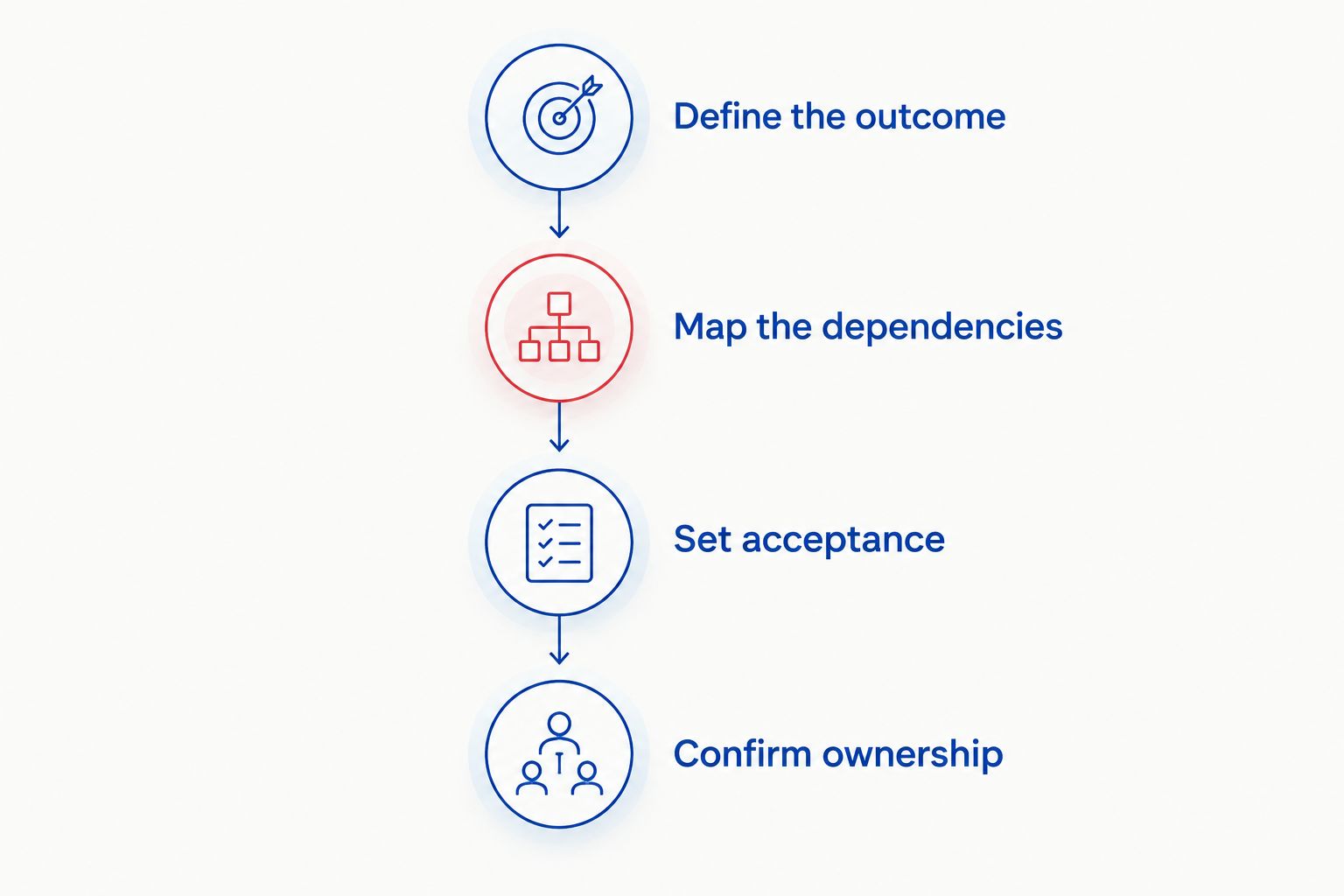
A useful proposal connects each deliverable to an owner and an acceptance condition. Reject proposals that describe extensive activity but leave the release decision undefined.
Which software development company should you choose?
Start with the smallest engagement that resolves your largest uncertainty. If the problem is unclear, buy discovery. If the architecture is blocking progress, buy a targeted technical assessment. If the scope is clear, buy a bounded implementation.
For an undecided founder choosing in 2026, first rule out unnecessary custom development. Then shortlist the company whose service focus matches the remaining problem—not the company offering the longest feature list.
Before requesting a proposal, prepare your current workflow, known constraints, integration list, and release exclusions. Those inputs make the consultation a technical buying discussion rather than a general sales call.
FAQ
What are the best software development companies for startups in 2026?
This shortlist includes Thefiniteloop, thoughtbot, Thoughtworks, Netguru, and Atomic Object, each for a different project need. Choose by scope, product uncertainty, engineering requirements, and ownership terms rather than treating the list as a universal ranking.
Should a startup hire a development company or build internally?
Hire a development company when a bounded external engagement fits the work and your team can own product decisions. Build internally when the work requires ongoing product judgment and you can support the hiring, management, and operational responsibilities.
Is thoughtbot better than Thoughtworks for a startup?
thoughtbot is the more relevant shortlist candidate for product discovery, while Thoughtworks is relevant to complex engineering change. That distinction reflects service fit, not a measured comparison of delivery quality.
What should a startup put in a software development brief?
Include the user problem, essential workflows, existing systems, constraints, release exclusions, and acceptance conditions. Identify who can approve product decisions and who controls the infrastructure.
Should an early-stage startup build web and mobile applications together?
Build both only when the user need justifies separate interfaces. Otherwise, define the essential workflow first and defer an additional interface until its purpose is clear.
How do I compare software development proposals?
Compare proposals against the same scope and acceptance conditions. Examine assumptions, dependencies, exclusions, ownership, and maintenance responsibilities before comparing the proposed commercial arrangement.
Should my startup include AI in its first software release?
Include AI only when a defined task benefits from it and you can evaluate the output. Specify acceptable behavior, failure handling, and data access before making it a release dependency.
One last thing
Ask each shortlisted company one question: What should we remove from this release? Require a reason tied to users, dependencies, or acceptance—not an arbitrary reduction in features.
A useful answer gives you a smaller decision to make. A proposal that only adds scope leaves the hardest product judgment with you.
Related guides
- Who owns the code when you hire a Dubai software company?
- What belongs in your first software release in Dubai?
- How to assess a software development company in Dubai
Your project next
Let’s build what matters
Schedule a consultation to discuss your goals and technical needs.