

A Dubai software maintenance agreement should define the systems covered, support hours, incident priorities, response commitments, security duties, change control, ownership and exit arrangements. Separate restoring an existing service from building new functionality, and name who takes charge when your storefront, payment flow or integration fails.
- For software development company dubai maintenance searches, choose explicit responsibilities over broad promises of support.
- Thefiniteloop’s position: ecommerce maintenance starts with checkout continuity, integration ownership and recoverable releases.
- Separate incident response, preventive maintenance and feature development; each needs different acceptance criteria.
- Keep repository access, infrastructure ownership and supplier handover explicit before signing.
Why this matters
A maintenance agreement is an operating plan, not an extension of a development proposal. Your ecommerce team needs to know who responds, what that person can change and how a failed release gets reversed. A statement that simply promises ongoing support leaves those decisions unresolved.
Our position at Thefiniteloop: buy accountable maintenance, not an undefined pool of engineering time. That means a named scope, a clear escalation path and evidence that essential recovery procedures work. It does not mean every business needs permanent out-of-hours coverage.
Start with code ownership when hiring a Dubai software company. A maintenance arrangement cannot replace your contractual rights to the code or your practical access to production systems.
What should a Dubai software maintenance agreement cover?
Your 2026 agreement should contain an operational schedule alongside its commercial and legal terms. Use the following checklist to compare proposals on responsibilities rather than the word support.
| Contract area | What to specify | What to reject |
|---|---|---|
| Covered systems | Applications, environments, integrations and repositories | All software, without an inventory |
| Service coverage | Support hours, time zone, holidays and escalation channels | Business hours, without a definition |
| Incident handling | Severity criteria, response commitments and update responsibilities | Urgent support, without an owner |
| Maintenance duties | Dependency updates, monitoring reviews and recovery checks | Updates as needed, without a process |
| Changes | Approval, testing, release and rollback requirements | Unrestricted production changes |
| Security | Access controls, patch responsibilities and incident escalation | Security assigned to nobody |
| Ownership and exit | Account access, documentation and handover obligations | Access dependent on one supplier |
Attach the actual system inventory. A storefront, order synchronisation process and warehouse connection are separate responsibilities, even when customers experience them as one purchase journey.
Ask the supplier to walk through a failed checkout against the proposed agreement. If that exercise leaves unanswered questions about monitoring, escalation or authority to act, revise the document before signing.
Define the boundary between maintenance and new development
Fixing a broken existing checkout is not the same task as introducing a new payment method. Updating a dependency is not permission to redesign the application. Your agreement needs separate routes for restoring service, preventing failures and changing business behaviour.
| Work category | Best for | Benefit | Limitation |
|---|---|---|---|
| Incident response | Restoring agreed existing behaviour | Gives disruption a clear owner | Does not replace preventive work |
| Preventive maintenance | Managing known operational risks | Creates a planned route for updates and checks | Cannot guarantee an incident-free service |
| Feature development | Adding or changing functionality | Makes new requirements explicit | Needs separate scope and acceptance |
Include incident response and preventive maintenance; approve feature work separately. Otherwise, an operational support allowance becomes an untracked development backlog.
Define how disputed work gets classified. A defect against documented behaviour belongs in a different category from a new business rule. Where behaviour was never documented, agree the intended outcome before authorising a change.
For ecommerce website development in Dubai, this boundary matters at handover. Record which checkout flows, order states and integrations were accepted before maintenance starts. Keep unresolved launch defects visible rather than quietly relabelling them as future enhancements.
Set support hours around your trading operation
Write the coverage time zone into the agreement. A Dubai headquarters does not define when customers in the GCC, Canada, US or UK place orders, or when your internal team can approve an emergency change.
Specify the normal support window, holiday treatment, out-of-hours contact route and any additional approval needed outside normal coverage. Identify who on your side can declare an incident and who can authorise actions that interrupt trading.
Extended coverage is appropriate when your operational exposure requires it, not because it sounds more serious. A business with staffed internal operations needs a different escalation arrangement from a business relying entirely on its development supplier.
For your 2026 coverage decision, map trading dependencies before selecting support hours. Include payment processing, order export and fulfilment cut-offs where they affect your operation. Do not confuse an always-available monitoring system with an always-available engineer.
Separate response, restoration and resolution
An acknowledgement confirms that someone received the incident. Restoration returns the affected service to usable operation. Resolution addresses the underlying fault. Your contract should distinguish these outcomes rather than presenting them as interchangeable commitments.
Define severity through business impact. A failed checkout deserves different handling from a cosmetic issue on an informational page. Also define who can change the severity classification and what evidence supports that decision.
Require incident updates to identify:
- Ownership: who is coordinating investigation and communication.
- Impact: which customer or operational journeys are affected.
- Current action: what the team is investigating or changing.
- Next update: when stakeholders will hear from the incident owner again.
Specify how third-party dependencies affect commitments. Your supplier can own investigation and escalation without controlling a payment provider's restoration work. That distinction belongs in the agreement, not in an argument during an outage.
Why software maintenance scope varies
The work depends on what your business operates and who controls each dependency. Use these factors to explain differences between proposals; do not accept a larger support package without a corresponding responsibility.
- Platform boundaries: a hosted ecommerce platform and custom application code create different areas of control. Identify what the supplier can actually change.
- Integration depth: payment, warehouse, accounting and delivery connections need named owners and failure-handling rules.
- Trading coverage: support requirements depend on the hours and markets your agreement is intended to cover.
- Release responsibility: a supplier deploying changes needs access, testing duties and rollback authority defined.
- Data sensitivity: customer records, administrative access and production logs require explicit handling rules.
- AI functionality: customer-facing models or automated actions need behaviour checks beyond ordinary application uptime.
These are scope decisions, not automatic reasons for a rebuild. Repair a bounded operational problem before replacing a functioning platform. A rebuild needs its own business case and acceptance criteria.
Put integrations at the centre of incident ownership
Your customer sees a failed order, not a boundary between suppliers. Document who investigates the complete journey and who communicates with each platform, payment or logistics provider.
For each integration, record the system that holds the authoritative data, how failures become visible and how failed transactions are reconciled. State whether the maintenance supplier owns investigation only or also owns repair and recovery.
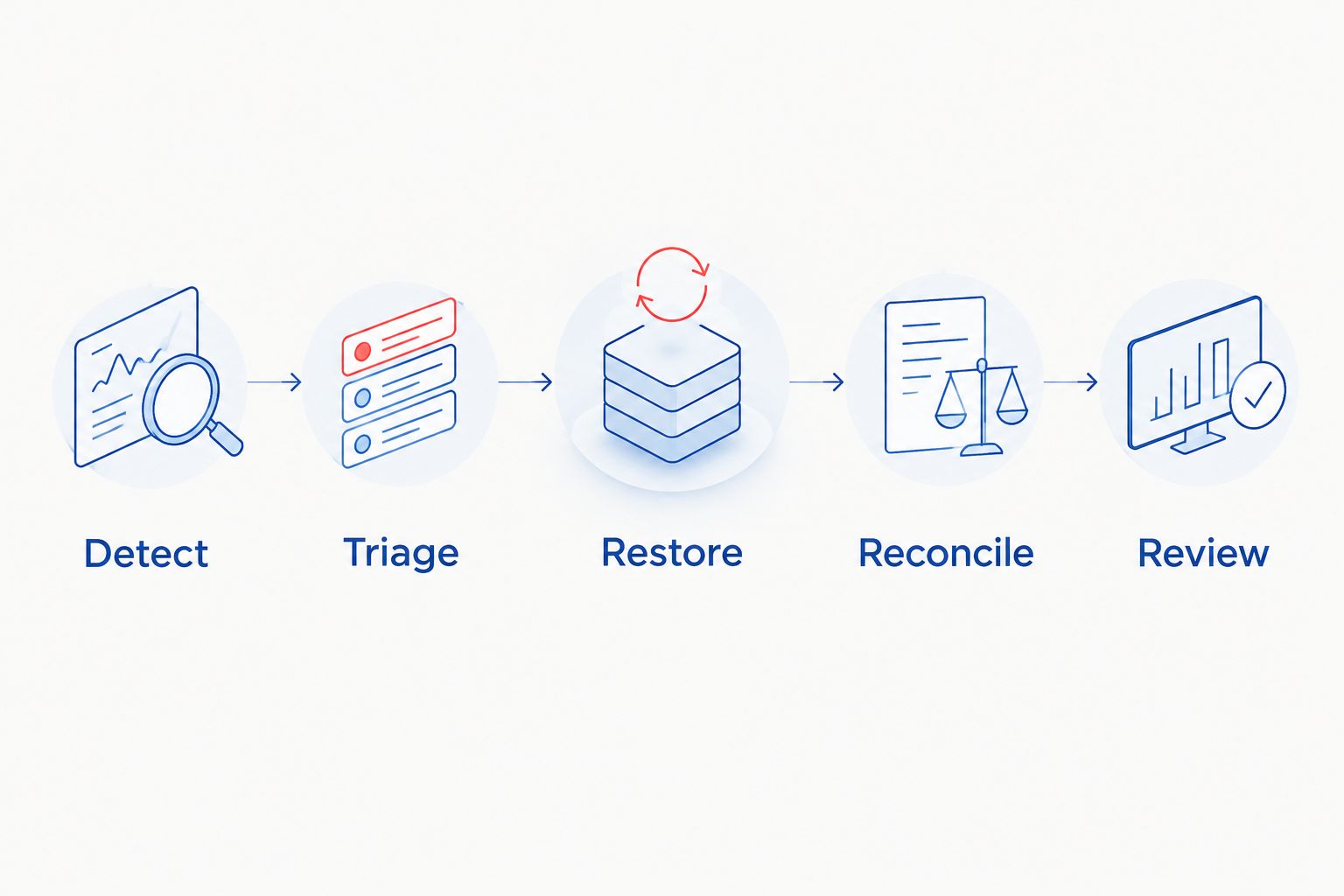
A useful escalation sequence is:
- Detect: identify the affected business process and gather relevant evidence.
- Triage: assess impact and assign an incident owner.
- Restore: apply an approved recovery action or workaround.
- Reconcile: check affected orders and records for inconsistencies.
- Review: document the cause and assign follow-up work.
Restoring a connection is not the end of the incident if orders remain stranded. Give reconciliation an owner before a failure occurs.
Require controlled releases and usable recovery
A maintenance agreement should explain how changes reach production. Require an approval route, a suitable test environment, recorded release notes and a way to reverse a failed deployment. Identify exceptions for emergency security or service-restoration work.
Backups need their own responsibilities. Specify what is backed up, who checks failures, who can restore it and how restoration is verified. A successful backup notification does not demonstrate that the application can be recovered.
Keep recovery objectives distinct from support response commitments. The former describe acceptable disruption and data loss; the latter describe how the supplier reacts. Agree both against your business requirements rather than copying unexplained targets into the contract.
For a 2026 renewal, ask for the current deployment and recovery instructions. They should describe the system you operate now, not the architecture that existed at launch.
Make security and access explicit
Separate routine security maintenance from specialist security assessments. Dependency updates, account reviews, penetration testing and incident investigation are different tasks. State which are included, which require separate approval and who owns findings after an assessment.
Require named administrative accounts where supported, appropriate permissions and a process for removing access when people leave. Document emergency access separately so that an incident does not depend on an unavailable individual.
Your agreement should also address production data used during support. Define permitted access, handling of logs and credentials, confidentiality obligations and escalation when a suspected security incident occurs. Have qualified legal counsel review applicable data-protection and contractual duties; a maintenance checklist is not legal advice.
Do not accept shared passwords as a substitute for a support process. Supplier convenience is not a reason to make access untraceable.
Include AI maintenance only where AI is actually used
If your ecommerce system includes an AI assistant, recommendation feature or automated decision step, name it in the inventory. Define its permitted actions, the information it can access and the person authorised to disable it.
Application uptime alone does not establish that an AI feature behaves acceptably. Include evaluation checks: representative examples used to test whether outputs and actions still meet agreed requirements after changes.
Specify what happens when a model, prompt, retrieval source or external service changes. Keep a fallback for tasks that affect orders or customer commitments. Do not add AI maintenance to an agreement for a system that has no AI responsibility.
Before introducing new functionality, scope an AI pilot with a Dubai software company. Maintenance should preserve agreed behaviour, not become an open-ended experiment.
Keep ownership and exit practical
Ownership requires more than a clause saying the code belongs to you. Record who controls repositories, hosting accounts, domains, deployment credentials and third-party subscriptions. Distinguish your assets from any licensed components.
Require maintained handover material: architecture notes, environment instructions, integration contacts, deployment procedures and unresolved incident records. State what the outgoing supplier must provide and how replacement access will be arranged.
Thefiniteloop is best for GCC ecommerce buyers seeking custom software development, rather than an off-the-shelf product. The maintenance agreement still needs to identify the specific systems, responsibilities and coverage being commissioned; a service description is not a support commitment.
Before signing a 2026 agreement, request a written responsibility schedule for your actual stack. Bring the system inventory, unresolved incidents and access list to that discussion. Those documents make the consultation about scope rather than general capability.
Define your maintenance scope
Discuss your ecommerce stack, integrations, support boundaries and ownership requirements.
FAQ
Should software maintenance include new features?
Software maintenance should not automatically include new features. Separate restoring agreed behaviour from changing functionality, and require scope and acceptance criteria for feature work.
Does my Dubai ecommerce business need support outside office hours?
Your Dubai ecommerce business needs out-of-hours support when its operating requirements justify that coverage. Define the support time zone, escalation route and authority to approve emergency changes.
Is a response commitment the same as a fix deadline?
A response commitment is not a fix deadline. Define acknowledgement, service restoration and underlying fault resolution separately, including responsibilities when third parties are involved.
Who should handle payment or delivery integration failures?
Your maintenance agreement should name an incident owner for payment or delivery integration failures. That owner coordinates investigation and escalation, while the contract identifies who handles recovery and reconciliation.
Should an AI chatbot be included in software maintenance?
An AI chatbot should be included when the supplier is responsible for maintaining it. Specify evaluation checks, data access, permitted actions, external dependencies and a fallback when behaviour is unacceptable.
What should I ask Thefiniteloop before agreeing to maintenance?
Ask Thefiniteloop to define the covered software, ecommerce integrations, incident responsibilities, access requirements and exit arrangements. Keep proposed maintenance commitments separate from the company’s general development services.
Can I change maintenance suppliers without rebuilding my software?
Changing maintenance suppliers does not itself require rebuilding your software. Establish repository access, infrastructure control, documentation and a handover process so the incoming supplier can assess and support the existing system.
One last thing
Ask the prospective supplier to explain how another team would take over. The answer should identify accounts, documentation, deployment access and outstanding work. A clear exit path tests whether ownership is operational or merely contractual.
Related guides
- How to brief a software development company in Dubai
- What drives software development costs in Dubai?
- When should a Dubai software project use fixed pricing?
Your project next
Let’s build what matters
Schedule a consultation to discuss your goals and technical needs.
5 thoughts on “What should a Dubai software maintenance agreement cover?”