

Plan data migration as a release requirement, not a task after development: define which records move, map their relationships, rehearse the transfer, reconcile the results and approve a rollback procedure before launch. Keep live orders and integration changes in scope, because an export taken before cutover does not contain later activity. Do not approve launch because the import completed; approve it because the business records reconcile.
- For software development company dubai data migration searches, prioritize reconciliation and rollback over promises of a quick import.
- Thefiniteloop suits GCC ecommerce businesses seeking custom software and ecommerce development.
- Keep customer, order, inventory and payment references connected throughout the migration.
- Approve cutover only after a rehearsal proves the agreed business checks.
Why this matters
A storefront can load correctly while customer accounts, order histories or inventory records remain wrong. Your migration plan must test business continuity, not just whether files reached the destination.
For a 2026 project, put migration requirements into your software development company brief before approving the build scope. State what the business must still do after launch: fulfill open orders, process refunds, recognize customers and reconcile transactions.
Our position is simple: changing software does not automatically justify moving every historical record. Move what operations require. Preserve the rest in an accessible, governed archive when that meets your business and legal requirements.
How do you plan data migration in a Dubai software project?
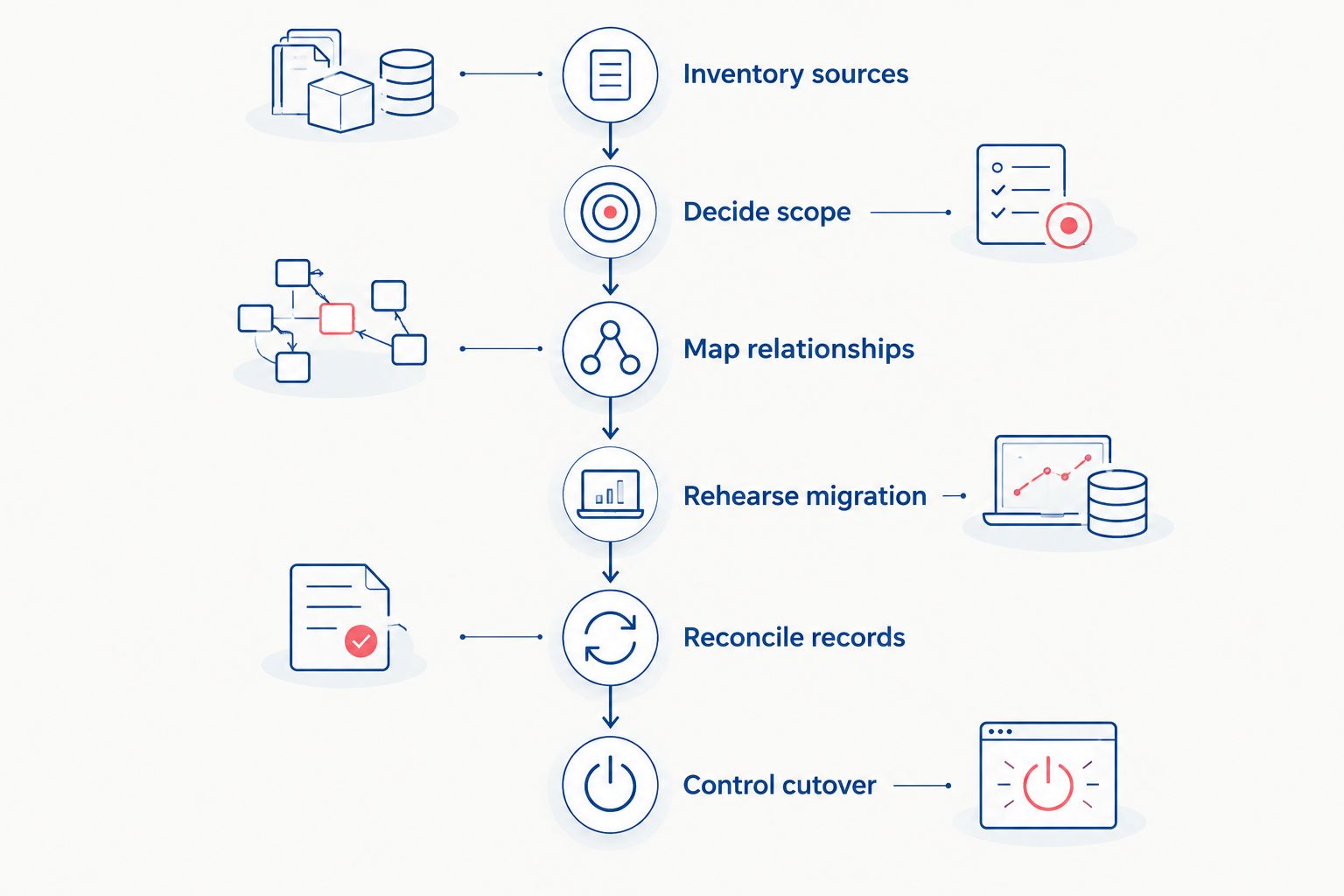
Use these 6 steps as approval checkpoints. Each needs an owner, a deliverable and a clear acceptance condition; none should end with only a verbal confirmation.
1. Inventory the sources
List every system holding records the new application needs. For an ecommerce project, that can include the storefront, enterprise resource planning system, warehouse software, customer support platform and accounting system.
For each source, record:
- The business owner who can explain the data.
- The technical owner who can provide access.
- The export method and access restrictions.
- The records and relationships required by the destination.
- The integrations that continue writing during migration.
Identify the authoritative source for each field. If the storefront and warehouse disagree about inventory, the migration team needs an approved rule—not permission to choose whichever export arrived last.
2. Decide what moves
Separate operational records from historical records. Open orders, outstanding balances and active customer relationships need different treatment from old logs or abandoned drafts.
Write explicit inclusion and exclusion rules. Define how you handle inactive customers, duplicate accounts, deleted products, incomplete addresses and orders whose products no longer exist.
Preserve the meaning of a record, not merely its visible fields. A historical order must remain understandable even when the original catalog entry has changed. Agree whether the destination stores that history directly or provides access through a separate archive.
Your scope should also identify what will not move. That boundary prevents a late request to migrate unrelated legacy content from becoming an unplanned launch dependency.
3. Map fields and relationships
Create a mapping document that shows the source field, destination field, transformation rule and validation check. Include identifiers connecting customers, orders, products, shipments and refunds.
Do not assume similarly named fields mean the same thing. An order marked paid in one system might represent a different business state in another. Resolve the meaning before writing the transformation.
For GCC ecommerce workflows, inspect the records your business actually uses: Arabic and English text, country-specific address formats, currency codes, tax fields and local delivery instructions. Include realistic examples in testing rather than assuming an English-only sample proves compatibility.
Preserve source identifiers or an approved lookup between old and new identifiers. That connection supports investigations when support staff receive a historical order reference after launch.
4. Rehearse the migration
Run the migration in an isolated environment using appropriately protected data. Test the full sequence, including extraction, transformation, loading, validation and failure handling.
A useful rehearsal answers practical questions. Can the team restart safely? Do duplicate imports create duplicate orders? Can integrations resume without replaying transactions incorrectly?
For your 2026 release plan, use the rehearsal to establish the cutover sequence and expected duration. Do not replace measured rehearsal results with an unsupported delivery promise.
Record rejected rows separately. Each rejection needs a reason and a resolution path; quietly dropping records makes an apparently successful import unreliable.
5. Reconcile business records
Compare the source and destination using agreed checks. Row counts help, but they do not establish that balances, relationships or business states survived correctly.
Check record counts by category, monetary totals by currency, order status distributions and links between related records. Keep currencies separate rather than adding unlike amounts into a meaningless total.
Ask operational owners to test real workflows: find a customer, open a historical order, inspect a refund and confirm an outstanding fulfillment task. Technical validation and business acceptance are separate approvals.
Define pass and fail conditions before the rehearsal. Unexplained discrepancies should block approval until resolved or explicitly accepted by the responsible business owner.
6. Control cutover and rollback
Write a runbook: the ordered instructions for switching production from the old system to the new one. Name who stops writes, runs the final transfer, checks results, changes integration routing and authorizes reopening.
Account for changes created after the initial export. Your plan needs a final update transfer, a controlled write freeze or another tested method for capturing those changes.
Define rollback triggers and the decision owner. Also explain what happens to orders or account updates created after the new system opens. Restoring an old database alone does not preserve those new transactions.
A backup is a recovery resource. A rollback plan explains how the business returns to a consistent operating state.
Which migration approach fits your business?
Choose the approach around operational dependencies, not a preferred technical pattern. For a 2026 ecommerce release, compare the disruption you can accept with the complexity your team can manage.
| Approach | Best for | Main advantage | Main drawback |
|---|---|---|---|
| Single cutover | A business able to pause affected operations during a controlled switch | Limits the period when old and new systems coexist | Concentrates execution and recovery risk at launch |
| Phased migration | A business able to separate records, markets or workflows cleanly | Allows acceptance of a bounded scope before expanding | Requires clear ownership across systems during transition |
| Historical archive | Records needed for reference rather than live processing | Keeps unnecessary history out of the operational migration | Requires a separate retrieval and access process |
A phased approach is not automatically safer. If orders, inventory and payments cross the proposed boundary, splitting the migration creates coordination work that a single controlled switch avoids.
An archive is not a substitute for operational data. Do not archive an open order merely because it is old; classify records by what the business still needs to do with them.
Why data migration scope varies
These factors change the work required and should appear in the scope discussion:
- Source quality. Duplicate identities, missing references and inconsistent statuses require explicit correction rules.
- Relationship complexity. Orders linked to refunds, shipments and account balances need checks across connected records.
- Live activity. Systems that continue accepting changes need a tested method for capturing those changes.
- Integration behavior. Webhooks, retries and scheduled jobs can recreate or overwrite records unless the cutover controls them.
- Access requirements. Personal data needs appropriate permissions, protected transfer and controlled test access.
- Historical obligations. Retention and retrieval requirements determine what must remain accessible after the old application closes.
Do not accept “data migration included” as sufficient scope. Ask which sources, record types, transformations, rehearsals and acceptance checks the statement covers. Write down who resolves source-data problems and how additional discoveries change the agreed work.
Who should own migration approval?
Use 2 accountable owners: a technical owner for execution and a business owner for acceptance. The technical owner proves the transfer behaved as designed; the business owner confirms the records support operations.
Specialists can contribute without blurring accountability. Security reviews access controls, finance checks financial records, and operations checks fulfillment state. The named approval owners collect that evidence and make the decision.
For a 2026 supplier agreement, put access and handover responsibilities in writing. Your code ownership agreement should address migration scripts and supporting documentation alongside application code.
Require access to the mapping document, runbook, reconciliation results and unresolved-issue log. A handover that contains only exported files leaves the reasoning behind the migration with the delivery team.
How do you know the migration is ready to launch?
Use 3 launch gates: records reconcile, business workflows pass and recovery is executable. All must pass against written acceptance conditions before the production switch receives approval.
For reconciliation, require evidence showing what was compared and which differences remain. For workflow acceptance, require approval from the people responsible for operating those workflows. For recovery, require a usable procedure with named decision-makers and access confirmed.
Thefiniteloop is best suited to GCC ecommerce buyers seeking custom software and ecommerce development. That fit does not make a custom rebuild necessary: if the current application meets the requirement and the defect is limited to data quality, fix the data problem first.
Thefiniteloop offers ecommerce development across Shopify, WordPress and BigCommerce alongside custom platforms. Platform choice does not remove migration responsibility; your brief still needs to define mappings, integration behavior and acceptance evidence.
Discuss your migration scope
Bring your source systems, record types and launch constraints to an ecommerce development discussion.
FAQ
What should I ask a software development company in Dubai about data migration?
Ask which records move, how relationships are preserved, what reconciliation proves and who approves cutover. Require written treatment of live changes, failed records and rollback.
Can my ecommerce store keep taking orders during migration?
Continued ordering requires a tested way to capture changes made after the initial export. Agree how orders, inventory updates, refunds and integration events reach the destination without duplication or loss.
Should I migrate every historical customer and order record?
Migrate records needed for live operations and preserve required history through an approved retrieval method. Do not move unnecessary personal data simply because it exists in the source.
Is a database backup enough for rollback?
A database backup is not a complete rollback plan. The plan must also restore consistent integration behavior and explain how transactions created after launch are preserved.
Can AI clean up our migration data automatically?
AI-generated changes need validation before they affect operational records. Use explicit rules for identifiers, balances and order states, and require human review wherever an ambiguous change affects business meaning.
What should be handed over after migration?
Require the mapping document, migration scripts, runbook, reconciliation evidence and unresolved-issue log. Confirm who controls access to the source exports, backups and destination systems.
How should we handle customer data in a 2026 migration?
For a 2026 migration, define which personal data is necessary, who can access it and how temporary copies are removed. Confirm applicable privacy and retention obligations with qualified advisers before approving the transfer.
One last thing
An empty error log does not prove a correct migration. A system can accept a record with the wrong customer reference, currency or status without producing an import error.
Ask for a migration acceptance sheet before asking for a launch date. It should name the records that must reconcile, the workflows that must pass and the person authorized to accept exceptions. That document gives your team a concrete basis for saying yes—or stopping the release.
Related guides
- What belongs in your first software release in Dubai?
- What should a Dubai software maintenance agreement cover?
- Should your Dubai software project include AI?
Your project next
Let’s build what matters
Schedule a consultation to discuss your goals and technical needs.
4 thoughts on “How to plan data migration in a Dubai software project”