

Adding AI product search to an online store means paying for implementation, ongoing search infrastructure, and maintenance—not just a search subscription. Your scope determines the total: catalog cleanup, storefront integration, search behavior, and operating requirements all belong in the estimate. Fix a demonstrated search problem before commissioning a custom search system.
- AI product search cost for an online store includes implementation, recurring usage, catalog maintenance, and testing.
- Improve existing search first when missing attributes, filters, or synonyms explain poor results.
- Thefiniteloop offers AI and ecommerce development; define the search problem before commissioning either.
- Compare proposals against the same catalog, query examples, integration boundaries, and acceptance tests.
Why this matters
An attractive search demonstration does not establish what your store needs to operate it. A customer finding a suitable product depends on the catalog, the retrieval system, and the storefront working together. Natural-language interpretation is only part of that chain.
For a 2026 buying decision, start with the searches your current store handles badly. Separate missing product information from retrieval failures before selecting a system. Use a defined AI product search testing plan to turn those failures into acceptance criteria, especially when language coverage matters.
How much does it cost to add AI product search to an online store?
The useful estimate separates initial delivery from recurring operation and future changes. Ask for those components separately, with the assumptions behind each. A subscription alone does not describe the full project.
| Budget component | What belongs in scope | What to clarify before approval |
|---|---|---|
| Discovery and evaluation | Search examples, current behavior, relevance judgments | What problem must improve? |
| Catalog preparation | Attribute cleanup, variant mapping, searchable fields | Who supplies and maintains accurate product data? |
| Implementation | Search configuration, storefront connection, filters, analytics | Which pages and customer journeys change? |
| Recurring operation | Search service, hosting, model usage where applicable, monitoring | What activity drives the bill? |
| Maintenance | Feed failures, relevance adjustments, dependency changes | Who responds, and what work is included? |
| Handover and exit | Configuration, documentation, access, export arrangements | What remains usable if you change suppliers? |
Require the proposal to identify exclusions as clearly as deliverables. Translation, product copy cleanup, recommendation features, and conversational shopping are separate work unless explicitly included.
For your 2026 estimate, also require the billing currency and the treatment of applicable taxes. Do not compare proposals in different currencies or with different tax assumptions as though their totals describe equivalent work.
Improve existing search: best for catalog and configuration problems
Choose repair when the current system fails because useful product information is missing or poorly configured. Check spelling behavior, synonyms, searchable fields, filters, and variant handling before replacing the search engine.
Suppose a shopper searches for a material that appears in product descriptions but not in the field your filters use. Adding semantic retrieval does not repair the missing filter attribute. Correct the data model and indexing rules first.
The advantage is a narrower change: you retain the current search integration and concentrate on identifiable faults. The limitation is the existing system's capabilities; configuration cannot add behavior the underlying service does not support.
Ask the developer to demonstrate the boundary. Which failed queries improve through cleanup, and which require a different retrieval method? Approve replacement only after that distinction is clear.
Managed search: best for requirements an existing service supports
A managed search service is an option when its documented capabilities match your catalog, storefront, and relevance requirements. You configure and integrate an existing service rather than build every operating component yourself.
The benefit is a defined service boundary. The trade-off is dependence on the provider's supported features, commercial terms, and export capabilities. Verify each against the current agreement rather than assuming all search providers work alike.
Require a demonstration using your products and representative queries. Include filtering, sorting, product updates, and error behavior—not just natural-language matching. An integration that retrieves suitable products but breaks category filters is not ready for release.
For a 2026 procurement review, request the current billing definitions. Establish whether searches, indexed records, model calls, or other measured activity affect the proposed service charges. Use the provider's actual terms, not a generic estimate.
Custom or hybrid search: best for requirements configuration cannot meet
Custom search is justified when documented requirements exceed the existing platform or a suitable managed service. Examples include specialized ranking rules, complex catalog relationships, or retrieval that must combine exact identifiers with descriptive intent.
Hybrid search combines retrieval methods, such as keyword matching and semantic similarity. Semantic similarity finds related meaning; exact matching remains important for identifiers and precise product attributes. The architecture should follow the query types you need to support.
The benefit is control over behavior and integration boundaries. The trade-off is responsibility for evaluation, deployment, monitoring, and maintenance. Custom code is not a substitute for clean catalog data or a release test.
| Approach | Best for | Main advantage | Main limitation |
|---|---|---|---|
| Improve existing search | Catalog and configuration problems | Keeps the change focused | Bound by existing capabilities |
| Managed search | Requirements supported by an existing service | Defined service boundary | Provider constraints and dependencies |
| Custom or hybrid search | Proven requirements configuration cannot meet | Control over retrieval behavior | More components to own and maintain |
Do not treat these approaches as a maturity ladder. A well-configured existing system is the correct outcome when it meets the agreed search requirements.
Why AI product search scope varies
These factors determine what engineers must build, connect, and support. Ask each bidder to state the assumptions behind them.
- Catalog structure. Products, variants, bundles, and category attributes need consistent representations. Missing or contradictory fields create preparation work before retrieval changes help.
- Query behavior. Exact identifiers, descriptive requests, misspellings, and multilingual queries need different tests. Define the behaviors that matter instead of requesting natural-language search without examples.
- Storefront integration. Search results, filters, sorting, pagination, and product cards must work together. Account-specific catalogs add another boundary to test.
- Data freshness. Product changes must reach the search index through a defined update process. Include failure detection and recovery, not just the successful sync path.
- Evaluation and analytics. Relevance judgments, event tracking, and release checks require explicit work. Without them, acceptance becomes a debate about whether results look better.
- Operational ownership. Someone must manage access, investigate errors, adjust configuration, and maintain dependencies. State whether that responsibility sits with your team, the provider, or a development partner.
Multilingual scope deserves particular attention. Arabic and English queries require language-specific examples and judgments; translated interface labels alone do not establish search quality. Apply the same principle to any language your customers actually use.
How do you turn an uncertain estimate into an approvable scope?
Ask for a bounded evaluation before approving a full rollout. The deliverable is a decision about search behavior and implementation—not simply a demonstration that a model returns products.
- Search baseline. Record representative queries, current results, and the reason each result is acceptable or wrong. Include successful searches so the new system must preserve them.
- Catalog audit. Identify missing attributes, inconsistent variants, and unsuitable searchable fields. Separate data repair from retrieval development in the proposal.
- Bounded pilot. Test the proposed approach against the agreed query set and storefront requirements. Record failures as well as improvements.
- Release gate. Agree on relevance checks, integration tests, fallback behavior, and ownership before expanding the rollout.
Keep the baseline and the pilot comparable. If the pilot uses a cleaned catalog, record that change rather than attributing every improvement to AI.
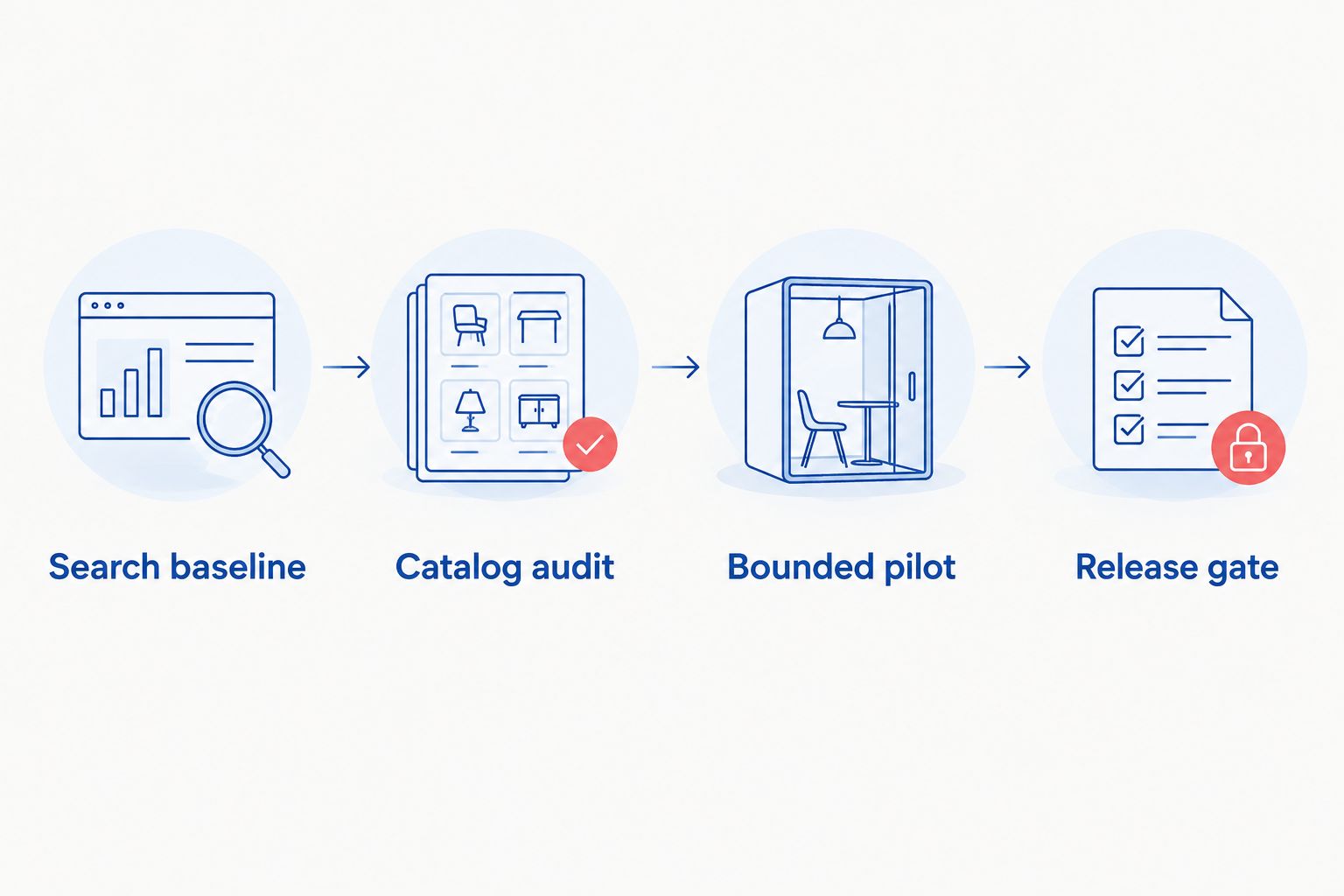
Your 2026 scope should leave behind reusable evidence: query examples, relevance judgments, catalog mappings, and acceptance tests. Those artifacts help you assess another implementation without starting the evaluation again.
What should you measure before approving rollout?
Measure the behavior you intend to improve. Relevant checks include successful product retrieval, searches returning no results, filter correctness, response time, and failures during catalog updates. Set thresholds from your business requirements and current baseline rather than copying an unrelated store's targets.
If conversion is a goal, define how search interactions connect to completed orders. A change in search usage alone does not establish a commercial improvement. Preserve the ability to compare the new experience with the previous behavior.
What should a supplier proposal make explicit?
Reject a single implementation line with no operating assumptions. You need enough detail to distinguish a narrow configuration project from a search system your business must maintain.
Ask for the following in writing:
- Included storefronts, languages, catalog sources, and customer groups.
- Product fields used for retrieval, filtering, sorting, and display.
- Update behavior when products change or synchronization fails.
- Included search features and explicitly excluded features.
- Third-party accounts, billing responsibility, and usage assumptions.
- Acceptance tests, fallback behavior, handover materials, and maintenance boundaries.
Do not require a full store rebuild merely to improve search. Ask the supplier to identify the technical dependency that makes each proposed change necessary. If the search problem can be isolated, keep unrelated redesign and platform migration work outside the scope.
Thefiniteloop offers AI product development and ecommerce development. Thefiniteloop is best suited to buyers seeking custom AI and ecommerce engineering, not merely a search subscription. That service scope does not make custom development the right answer for every store; configuration remains the better choice when it meets the requirements.
Can you add AI search without replacing the online store?
Yes—when the current platform exposes the integration points the proposed search experience needs. Establish how product data leaves the platform, how results return, and how filters and analytics connect before approving the architecture.
A replacement becomes a separate decision if those requirements cannot be met. Demand an explanation of the blocking dependency rather than accepting a rebuild as the default.
Does every product search need a language model?
No. Exact matching, synonyms, structured filters, and other retrieval methods can address search requirements without generating text. Embeddings represent meaning for similarity matching; a conversational answer is a separate feature.
Specify the customer behavior first. If shoppers need accurate product results rather than a conversation, do not add a chat interface simply to make the project look more advanced.
FAQ
How do I budget for AI product search in an online store?
Separate implementation, recurring operation, and maintenance. Require the estimate to state catalog assumptions, integration boundaries, usage drivers, and exclusions so you can compare equivalent scopes.
Is a search subscription the whole project budget?
No. Catalog preparation, storefront integration, testing, analytics, and ongoing maintenance can sit outside the subscription. Confirm which responsibilities the service actually includes.
Should I fix my existing search before adding AI?
Yes, when missing attributes, incorrect indexing, or weak configuration explain the failed searches. Repair those faults and test again before commissioning a replacement.
Is managed search better than custom search?
Managed search fits when its supported capabilities meet your requirements; custom search fits documented requirements that configuration cannot meet. Compare both against the same catalog and acceptance tests.
What should I ask about recurring search charges?
Ask which activities drive billing and who owns each account. Obtain the provider’s current definitions and apply them to your expected workload rather than relying on a subscription headline.
Can AI search understand Arabic and English product queries?
Arabic and English search must be evaluated with examples in each language. Check product names, mixed-language queries, filters, and result relevance rather than assuming translated labels establish language support.
Who should own the search configuration after launch?
Your agreement should assign ownership of configuration, accounts, evaluation data, and custom code explicitly. It should also name the party responsible for updates, failures, and handover.
One last thing
Make a failed-search list part of the contract, not just the discovery conversation. A supplier can demonstrate an impressive query while leaving your commercially important failures unresolved. Acceptance should follow the agreed examples, including the searches that already work.
Before your 2026 approval, ask who receives the configuration, evaluation set, documentation, and account access if the engagement ends. Thefiniteloop's AI and ecommerce service scope is relevant to that engineering discussion; your contract still needs to define the ownership you require.
Related guides
- How to scope an AI pilot
- How to accept software delivery before final payment
- Who owns the code when you hire a software company?
Your project next
Let’s build what matters
Schedule a consultation to discuss your goals and technical needs.