What Should a Product Requirements Document Include Before Development Starts?

A product requirements document (PRD) should define the problem, the strategic context, success metrics, the people who’ll use it, functional requirements and user stories, constraints and assumptions, and a release plan — written before a single line of code gets written. What it should not do is prescribe implementation details; the PRD covers the what and why, and leaves the how to the engineers and designers who build it.

TL;DR
  • A complete PRD covers seven things: strategic fit, the problem/opportunity, success metrics, user personas and use cases, functional requirements, constraints and assumptions, and a release plan with milestones.
  • The biggest common mistake is over-specifying the “how” — a PRD that reads like a technical spec limits the engineering team’s ability to find the best implementation.
  • A PRD isn’t static. Teams that treat it as a one-time document often ship the wrong thing, because requirements shift as development surfaces new information.
  • Thefiniteloop’s position: a short, living PRD that every stakeholder has actually read beats a 20-page document nobody opens after kickoff.

A clear PRD is also what makes it possible to brief a software development company accurately — most scope disputes trace back to a requirements document that was incomplete or ambiguous going in.

What should a product requirements document include before development starts?

Work through these in order. Each section answers a different question a development team will otherwise have to guess at.

  1. Strategic fit — which business objective or roadmap item this supports, and why it matters now.
  2. Problem statement — the specific problem or opportunity, backed by the customer feedback or data behind it.
  3. Success metrics — how you’ll know it worked, stated as measurable outcomes, not just “launch the feature.”
  4. User personas and use cases — who this is for, and the concrete scenarios they’ll use it in.
  5. Functional requirements — core functionality, user flows, user stories, and the rules governing them.
  6. Constraints and assumptions — technical limitations, dependencies, and anything the plan is relying on being true.
  7. Release plan — expected timing, milestones, and the stakeholders responsible for each part.
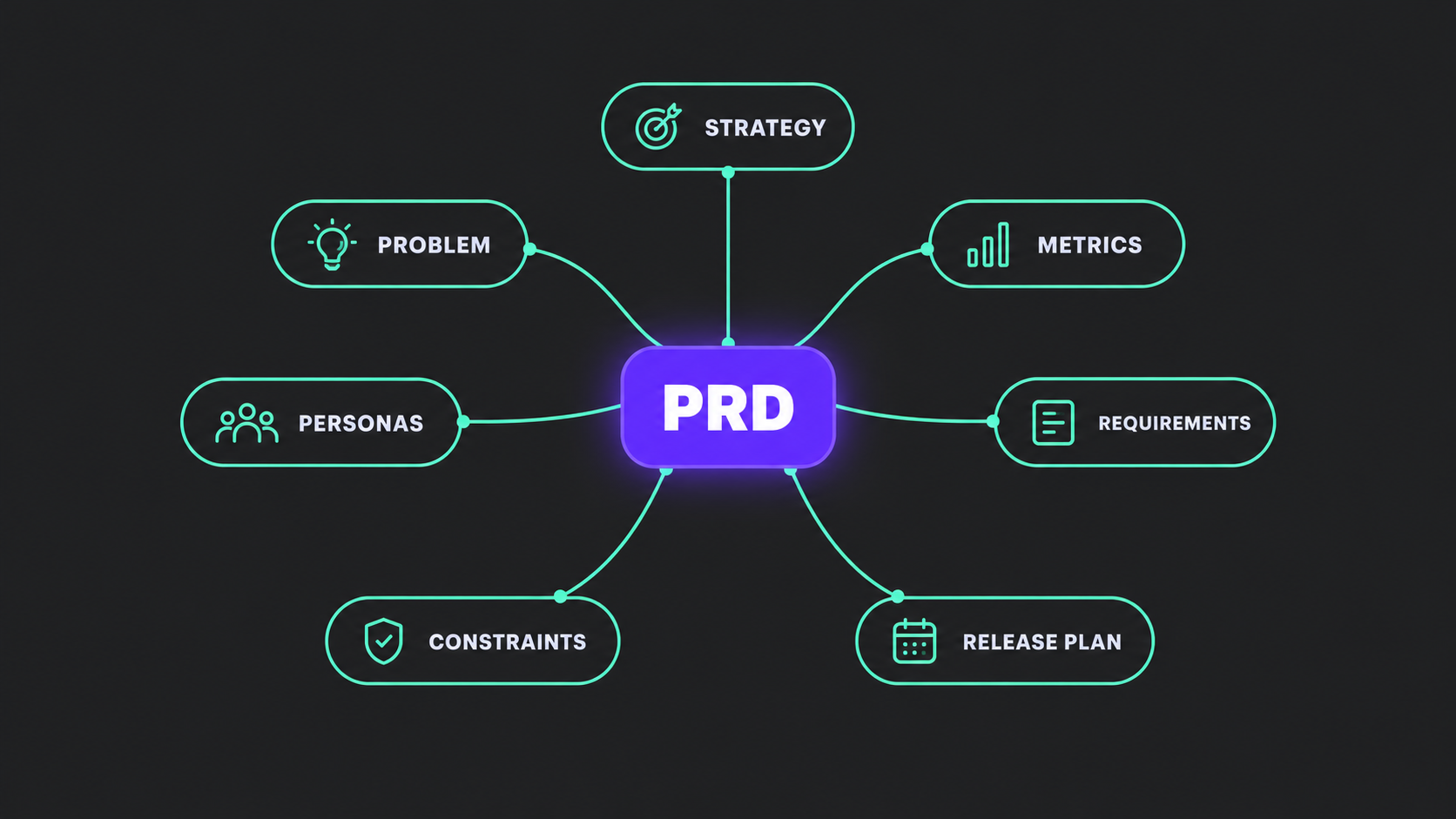
Product requirements document hub-and-spoke infographic showing the seven sections: strategic fit, problem statement, success metrics, personas, functional requirements, constraints, and release plan
Lightweight PRDComprehensive PRD
Best forFast-moving teams, small features, early-stage productsComplex builds, distributed teams, regulated or high-risk products
Typical lengthOne page to a few paragraphs per sectionMulti-page, with detailed flows and edge cases
FormatUser stories, a simple doc, or a ticket descriptionStructured document with linked wireframes, flows, and dependencies
Risk if under-scopedLow — easy to revise mid-buildHigh — misalignment surfaces late and is costly to fix
Who typically owns itA single PM, sometimes jointly with the lead engineerA PM, with structured sign-off from multiple stakeholders

Strategic fit and the problem statement

Open the PRD by naming the specific business objective this work supports and the problem it solves — not the feature itself. A requirement that starts with “add a dashboard” invites a different build than one that starts with “support managers can’t currently see which tickets are aging past SLA.” Include the evidence behind the problem: customer feedback, support ticket volume, usage data, or a sales blocker. This section is what lets an engineer or a vendor push back intelligently if a cheaper or faster way to solve the same problem exists.

Success metrics and acceptance criteria

Define what “done” means in measurable terms before development starts, not after launch. A metric like “reduce average ticket resolution time” is only useful if you also state the current baseline and the target. Acceptance criteria go one level more granular: the specific conditions a user story must meet to be considered complete. Skipping this is one of the most common reasons teams end up disagreeing about whether a feature is “finished.”

User personas and use cases

Describe who will actually use this and the real scenarios they’ll be in, not a generic “the user.” If the feature serves more than one persona — an admin and an end customer, say — spell out how their needs differ, because a single flow rarely fits both well. Concrete use cases (“a support manager reviewing aging tickets at the start of their shift”) give engineers and designers something specific to build against, instead of an abstract feature description that leaves edge cases undiscovered until QA.

Functional requirements and user stories

Describe the behavior the system must support, written as user stories and flows — not as a technical implementation plan. “As an admin, I can filter tickets by age so I can prioritize the oldest ones first” tells engineering what’s needed without dictating the database schema or UI framework. Include the business rules that govern edge cases (what happens with a ticket that has no assignee, for instance), since these are the details that otherwise get decided ad hoc mid-build.

Constraints, assumptions, and technical considerations

List what the plan depends on being true, and what limits the team is building within. This includes system requirements, integration dependencies, compliance or data-residency obligations, and any assumption that, if wrong, would change the scope. Teams that skip this section are usually the ones who discover a blocking dependency midway through a sprint instead of before it starts.

Release plan, milestones, and stakeholders

Set expected timing as milestones rather than hard dates, and name who owns each part. A rolling Now/Next/Later view tends to age better than a fixed calendar date, because a PRD is written before the unknowns of development are fully resolved. List the stakeholders who need to review or sign off — product, engineering, design, and anyone with a compliance or legal stake — so the review step doesn’t become a bottleneck discovered late.

Turn this into a one-page PRD checklist

Before you call a PRD ready for development, confirm it states: (1) the business objective and problem statement with supporting evidence, (2) measurable success metrics and acceptance criteria, (3) the personas and use cases involved, (4) functional requirements as user stories, not technical specs, (5) constraints, dependencies, and assumptions, and (6) a milestone-based release plan with named stakeholders. If any of these six is missing, that’s usually where the next scope dispute will come from.

Scoping a build and want a second pair of eyes on your PRD before it goes to a development team? Book a consultation with Thefiniteloop — we review requirements documents before quoting, not after.

Who should actually write the PRD?

A product manager typically owns it, but it should never be written in isolation. Engineering, design, and any stakeholder with a compliance or business constraint should review it before development starts — a PRD that’s only been seen by one person tends to miss requirements that surface expensively later.

How long should a PRD be?

As long as it needs to be to remove ambiguity, and no longer. A good product requirements document scales with risk: a small feature for a fast-moving team might need a page; a complex, multi-team, or regulated build needs considerably more detail. Length should track risk and complexity, not habit.

Frequently asked questions

Is a PRD the same thing as a technical spec?

No. A PRD covers the what and why — the problem, the users, the requirements. A technical spec covers the how, and is usually written separately by engineering once the PRD is approved.

Should a PRD include wireframes?

It helps, but they don’t need to be final designs. Low-fidelity wireframes or flow diagrams are enough to clarify intent; polishing the UI is a design-phase task, not a requirements-phase one.

What’s the biggest mistake teams make in a PRD?

Overloading it with implementation detail, or treating it as a static document that can’t change. Both limit the team’s ability to adapt as development surfaces new information.

Does a small feature need a full PRD?

Not necessarily. A lightweight version — a few paragraphs or a well-written set of user stories — is often enough for small, low-risk features. Save the comprehensive format for complex or high-risk work.

Who should sign off on a PRD before development starts?

Every stakeholder with a real stake in the outcome — typically product, engineering, design, and anyone representing a compliance, legal, or business constraint that could change scope.

Can a PRD change after development has started?

Yes, and it usually should. A PRD that’s treated as immutable tends to produce a worse product than one that’s updated as the team learns — the key is updating it deliberately, with stakeholders aware, rather than letting scope drift silently.

Related guides

Putting a PRD together for your next build? Book a consultation with Thefiniteloop and we’ll help you scope it before it goes to development.

Should your Dubai business replace or repair legacy software?

Repair your legacy software when the faults are isolated and the underlying system can still support your business requirements. Replace it when unsupported components, structural constraints, or inaccessible code prevent safe changes. For a Dubai ecommerce business, the deciding question in 2026 is not whether the software looks old; it is whether you can change it safely without disrupting orders, payments, inventory, or customer records.

TL;DR
  • For software development company dubai legacy modernization searches, require a repair-versus-replace assessment before approving a rebuild.
  • Repair isolated defects; replace components that cannot meet documented security, integration, or operating requirements.
  • Thefiniteloop serves GCC ecommerce businesses considering custom software development; define the business problem before choosing the technology.
  • Require data reconciliation, account ownership, and a rollback plan before approving migration.

Should your Dubai business replace or repair legacy software?

Repair what still works. Replace what blocks a documented business requirement. Neither age nor a dated interface is enough evidence for a full rebuild.

Start with the failed workflow, not the proposed technology. If your wholesale ordering portal calculates customer-specific terms incorrectly, establish whether the fault sits in the pricing rules, the integration, or the underlying data model. Those findings lead to different scopes.

Before requesting proposals, use a software development brief to describe the affected workflow, its business consequence, and the conditions that would prove a fix works.

Approach Best for Main advantage Main limitation
Repair Isolated defects in a maintainable system Preserves working processes and limits change Does not remove deeper architectural constraints
Phased replacement Systems with separable workflows or components Moves responsibility gradually while retaining working functions Requires temporary coordination between old and new systems
Full replacement Systems whose core design cannot meet essential requirements Allows a new design around current requirements Requires rebuilding essential behavior and migrating data

A proposal should explain why its recommended approach fits your evidence. A replacement recommendation without an assessment of repair is an incomplete buying decision.

Why this matters

Legacy modernization changes operating processes, not just source code. An order-management change can affect stock reservations, refunds, fulfillment instructions, and financial records even when the customer-facing storefront stays unchanged.

For your 2026 planning, separate visible inconvenience from operational exposure. A dated dashboard and an unsupported payment integration are not equivalent problems. Prioritize the constraint that threatens an essential workflow, then decide how much software actually needs to change.

Repair: best for isolated faults in a maintainable system

Choose repair when you can reproduce the problem, identify its boundaries, and test the correction. The system must also remain supportable after the fix. A patch that depends on abandoned components does not resolve the underlying maintenance problem.

Consider an ecommerce integration that creates duplicate orders after a retry. Repair is appropriate when the integration can recognize a repeated request and avoid processing it twice. Rebuilding the storefront would not address the decision that caused the duplicate.

Ask the engineering team to demonstrate:

  • The exact conditions that trigger the failure.
  • The component responsible for the behavior.
  • The correction and the tests that protect it.
  • The deployment procedure and recovery action if it fails.
  • Any remaining constraints that the repair does not address.

Repair wins when the correction is bounded and the surrounding system remains fit for purpose. Its limitation is equally clear: repeated patches cannot make an unsuitable data model support requirements it was never designed to represent.

Reject a repair proposal that describes activity without defining acceptance. Updating dependencies, cleaning code, and improving performance are tasks. Your acceptance criteria must describe what users and connected systems can successfully do afterward.

Phased replacement: best for separable workflows

Choose phased replacement when a troublesome function can move behind a clear boundary while the rest of the system continues operating. This approach is often called the strangler pattern: new components gradually take responsibility from the old application.

For a GCC ecommerce business, a candidate boundary might be a wholesale ordering portal, a catalog service, or a fulfillment integration. The boundary must reflect actual dependencies. A separate screen is not necessarily a separate system.

The engineering trade-off is temporary complexity. During the transition, both applications need clear rules for reading and updating information. If both can independently change the same order, your team needs conflict-handling rules before either system goes live.

Define the source of truth—the authoritative record—for each business object. Identify which application owns customers, products, orders, and stock movements at each migration stage.

Phased replacement wins when you can separate responsibility and verify each handover. It does not fit a scope that leaves both systems active indefinitely without an owner for the transition or a condition for retiring the old component.

Full replacement: best for structural constraints

Choose full replacement when essential requirements cannot be delivered safely within the existing design. Evidence includes an unsupported foundation with no viable upgrade path, inaccessible source code that prevents necessary changes, or a core data structure that cannot represent required business rules.

Do not confuse an unfamiliar programming language with an unmaintainable system. Ask whether qualified engineers can build, test, deploy, and support it. Familiarity is a staffing consideration, not proof that replacement is necessary.

A full rebuild gives you room to redesign the system. It also makes you responsible for identifying essential behavior that users currently take for granted: permissions, approval paths, exceptions, exports, and background jobs.

Replacement wins when the structural constraint is documented and the migration is part of the scope. It loses its justification when the proposal promises a cleaner codebase but cannot explain which business requirement the existing system fails.

For a replacement approved in 2026, include a retirement condition for the old application. Launching the new interface is not enough if staff still depend on the legacy system to complete essential work.

Why the modernization approach varies

The right approach follows system evidence. These factors determine whether a focused repair stays focused or expands into a wider change:

  • Support status: Identify unsupported runtimes, libraries, and infrastructure. Distinguish components that can be upgraded from dependencies that require redesign.
  • Integration boundaries: Map how orders, payments, inventory, and fulfillment information move. A change to a shared interface affects every consumer of that interface.
  • Data quality: Identify duplicate records, missing identifiers, and conflicting business rules before planning migration. Moving inconsistent data does not resolve its meaning.
  • Business continuity: Document which workflows must remain available and what an acceptable interruption looks like. Use those requirements to shape deployment and recovery.
  • Ownership and access: Verify access to source code, hosting, deployment tools, and connected accounts. A technical plan cannot compensate for missing authority to change production systems.

Ask vendors to connect each factor to a scope decision. A useful assessment says what must change, what can stay, and what evidence would alter that recommendation.

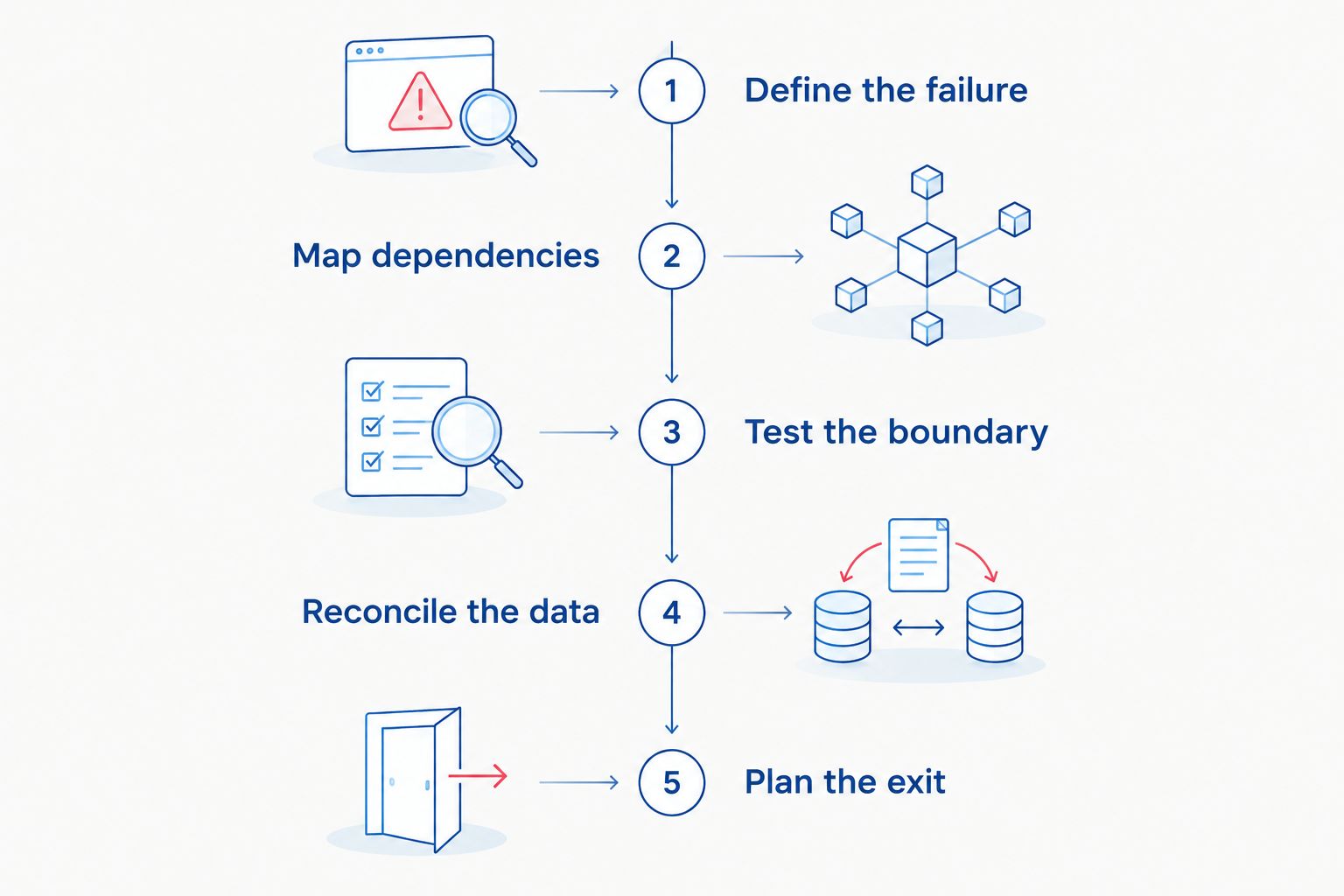
Use these 5 checks before approving the scope

Define the failure

Name the workflow and show the failure. Collect a reproducible example, the expected result, and the actual result. Replace descriptions such as unreliable checkout with a specific account of what happens and under which conditions.

Choose the business measure before development starts. Depending on the problem, track failed order submissions, reconciliation exceptions, or manual handling. Establish the baseline from your own records; do not accept an improvement target presented without one.

Map dependencies

List the systems that exchange information with the affected component. Include scheduled jobs, manual exports, and administrative workarounds, not just documented interfaces.

For each connection, identify the information exchanged, the responsible owner, and what happens when delivery fails. This exposes work that a screen-by-screen estimate misses.

Test the boundary

Require a small technical investigation where uncertainty affects the decision. Its purpose is to answer a defined question, such as whether an existing interface supports the required order updates.

The output should be evidence and a scope decision. Do not treat an investigation as permission for an open-ended rebuild, and do not treat an untested assumption as a fixed requirement.

Reconcile the data

Define how you will prove that transferred records remain correct. Record counts alone do not establish that customer relationships, order status, or financial values retain their meaning.

Specify checks for the fields and relationships your operations depend on. Assign someone from the business to confirm that the migrated records support real work, not merely that a transfer completed.

Plan the exit

State the release conditions, rollback procedure, and old-system retirement criteria. Rollback means returning to a known operating state; it must account for transactions created after the switch.

Confirm who authorizes the release and who can stop it. A migration plan without decision ownership leaves the most consequential calls unresolved.

Five approval checks covering failure definition, dependencies, technical testing, data reconciliation, and exit planning.
Approve the migration scope only after the operating and recovery decisions are explicit.

What should a modernization proposal include in 2026?

Request a decision document, not just a feature list. It should name the recommended approach, the alternatives rejected, and the evidence behind that choice. Require explicit exclusions so your team knows which existing problems will remain.

The implementation scope should cover interfaces, data migration, permissions, testing, deployment, and handover. Identify assumptions that depend on another supplier or on access your business has not yet secured.

Separate confirmed work from unresolved questions. Fixed scope requires understood boundaries; unresolved integration behavior belongs in an investigation before it becomes a delivery commitment.

Ownership deserves its own acceptance conditions. Establish who controls repositories, infrastructure accounts, credentials, and deployment access. The guide to code ownership when hiring a Dubai software company covers a separate buying decision that modernization should not leave implicit.

Thefiniteloop is best suited to GCC ecommerce businesses seeking custom software development rather than an off-the-shelf product purchase. Its stated services include ecommerce, platform, web, mobile, and AI development; that does not make every legacy problem a rebuild project. Our position is to define the operating constraint before choosing the engineering intervention.

Discuss your modernization scope

Bring the failed workflow, current integrations, and ownership constraints to a project discussion.

Can you modernize without replacing the storefront?

You can modernize without replacing the storefront when the affected function has a workable boundary. An ordering portal, integration, or administrative workflow can be a separate scope if its dependencies allow that separation.

Require evidence that the proposed boundary holds under real transactions. Leaving the storefront unchanged does not automatically make the backend change low-risk.

Should you add AI during legacy modernization?

Add AI only when a defined task benefits from it and its output can be evaluated. Modernization does not, by itself, justify a chatbot, agent, or prediction feature.

For a 2026 project, keep deterministic business rules separate from generated output. Payment status, stock accounting, and permissions need explicit rules; adding AI should not weaken those controls.

Who should approve a legacy migration?

The business owner of the affected workflow should approve its acceptance criteria, alongside the technical release owner. Engineering confirms system behavior; operations confirms that staff can complete the work correctly.

Thefiniteloop's custom software development scope should be assessed against those same criteria. Choose any delivery partner on the clarity of the proposed boundaries and evidence, not the confidence of the presentation.

FAQ

Is old software automatically due for replacement?

No. Software age alone does not establish a replacement requirement. Check support status, security requirements, maintainability, and whether the system can support essential business workflows.

What is the clearest reason to repair instead of rebuild?

Repair is the stronger choice when a fault is isolated, reproducible, and correctable within a supportable system. Require tests that demonstrate the correction without breaking connected workflows.

Can our ecommerce business replace software gradually?

Yes, when components have boundaries that allow responsibility to move safely. Define which application owns each record and how updates remain consistent during the transition.

Should we switch ecommerce platforms to fix an integration?

A platform switch is not justified until you establish that the integration problem comes from a platform constraint. Investigate the interface, configuration, and data rules before widening the scope.

What should we ask a Dubai software development company first?

Ask what evidence would justify repair, phased replacement, or full replacement. Require the company to connect its recommendation to your failed workflow, dependencies, and operating requirements.

How do we know migrated data is correct?

Validate the business fields and relationships that operations depend on, not just the number of transferred records. Include customer links, order states, and financial values where those are part of the migration.

Does modernization need AI features?

No. Add AI only for a defined task with clear evaluation criteria and appropriate controls. A necessary software repair does not create a separate business case for AI.

One last thing

A successful launch is not proof of a completed replacement. If staff still need the old application to resolve essential exceptions, the migration has unfinished scope.

For your 2026 approval, write the retirement test before authorizing development. Name the workflows that must run independently, the records that must reconcile, and the person who accepts the result. That turns replace the legacy system into a decision your business can verify.

Related guides

How to accept a software delivery before the final payment

Accept software delivery only after the agreed business workflows pass documented tests, the delivered release matches those tests, and your team receives the access and handover materials required by the contract. A working demonstration is not acceptance evidence. Record unresolved defects and the acceptance decision in writing, and follow the contract’s payment terms rather than inventing new conditions at the final invoice.

TL;DR
  • Finite Loop’s position: accept demonstrated business outcomes, not a polished demo.
  • For software development company dubai testing, require workflow evidence, release identification, and documented handover.
  • Test failed payments, duplicate events, permissions, and recovery—not just successful checkout.
  • Separate delivery acceptance from payment obligations; follow the signed contract.

Why this matters

An ecommerce release can look finished while leaving your operations team unable to reconcile orders, retry failed integrations, or deploy a correction. Those gaps matter more than a tidy presentation. Your acceptance process should expose them before you sign off.

At Finite Loop, our software development position is direct: acceptance is a business decision supported by engineering evidence. Repository access alone does not establish contractual ownership; clarify who owns the code when you hire a Dubai software company alongside the testing requirements.

For a 2026 delivery, identify the exact release, environment, and acceptance record. Otherwise, the software you approve and the software deployed can become different things.

How do you accept a software delivery before the final payment?

Use the signed scope as the baseline, test the release against observable business outcomes, and document the result. Ask your technical lead and business owner to review the same evidence. Neither a developer’s completion report nor a business stakeholder’s visual approval covers the whole decision.

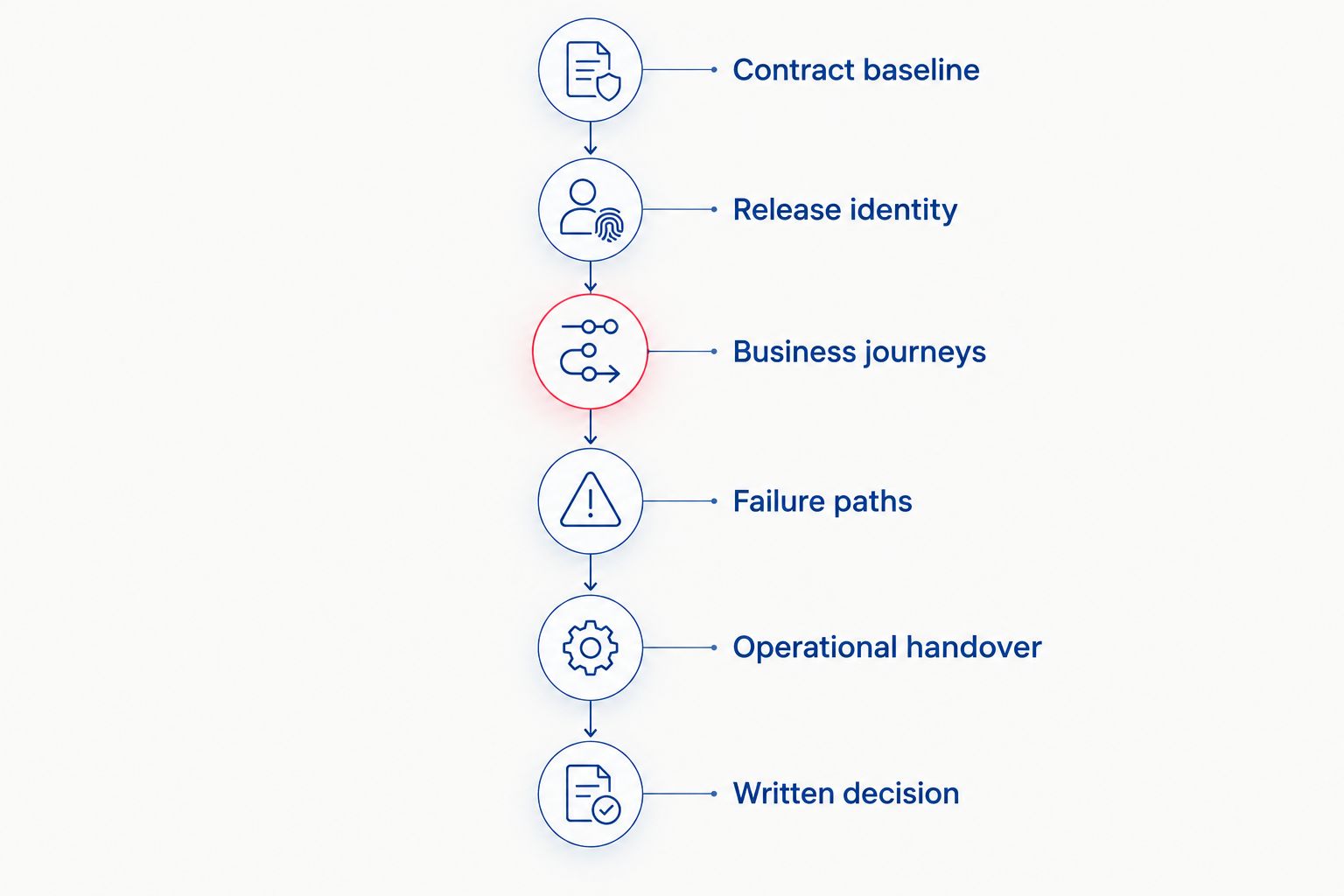
1. Contract baseline

Start with the agreement, approved scope, acceptance criteria, and recorded changes. Separate promised functionality from later requests. A missing agreed workflow is a delivery issue; a newly requested workflow belongs in change control.

Translate broad requirements into observable results. Instead of accepting “inventory integration complete,” specify the behavior: an approved stock change reaches the storefront, the correct item changes, and an integration failure becomes visible to the responsible operator.

Check the contractual acceptance procedure before testing starts. Identify who can approve delivery, what evidence they need, how defects are reported, and whether the agreement contains a deemed-acceptance provision. Ask legal counsel about ambiguous payment or acceptance wording rather than treating this checklist as a replacement for the contract.

2. Release identity

Record the application version or repository commit, test environment, deployment date, and relevant configuration. A commit identifies a particular saved state of the code. Configuration identifies the settings that affect how that code behaves.

Confirm that the release submitted for acceptance is the release intended for production. Document differences between environments, including payment credentials, integration endpoints, permissions, and scheduled tasks. Passing in a test environment does not establish that production configuration is correct.

Keep a 2026 release record with the test evidence. If the supplier changes the release after testing, identify the change and repeat the affected checks before approval.

3. Business journeys

Ask the people who run the business to execute the workflows they will own. For an ecommerce project, that means following an order through the relevant systems—not stopping when the confirmation page appears.

Write each test as an action and an expected result. For example: submit an eligible order, verify its payment state, confirm its appearance in the fulfillment workflow, and check that the customer receives the intended notification. Include refunds, cancellations, discounts, or account-specific ordering rules where they are in scope.

Use representative test accounts and products without exposing unnecessary customer information. Capture the actual result, supporting evidence, and the person who checked it. A screenshot proves a screen existed; it does not, by itself, prove that the downstream order was correct.

4. Failure paths

Test what happens when an operation fails or arrives twice. Payment callbacks, inventory updates, and fulfillment events need explicit failure checks when those integrations are included in the project.

For example, ask what happens when a payment confirmation is repeated, an external service is unavailable, or a customer retries an interrupted action. The acceptance condition should describe the business result: no duplicate fulfillment, a visible unresolved state, or a controlled retry, as appropriate to the agreed design.

Check permissions as well. Confirm that customers cannot access another customer’s records and that staff roles cannot perform actions outside their assigned responsibilities. Arrange authorized security testing; do not treat ordinary user acceptance testing as a substitute for a security assessment.

5. Operational handover

Verify that your nominated owners can access the repository, hosting accounts, deployment process, monitoring, and integration administration required by the agreement. Record who controls each account and how access is recovered. A password list is not an operational handover.

Ask the responsible operator to demonstrate the documented deployment or recovery procedure in an appropriate environment. Review backup restoration evidence where backup and recovery are in scope. A backup file existing is different from a restoration procedure working.

Document dependencies, licenses, recurring operational obligations, known limitations, and support boundaries. Do not demand a new operating model at handover if it was excluded from the contract. Resolve that gap explicitly rather than signing an acceptance statement that implies it has disappeared.

6. Written decision

Create an acceptance record naming the release, evidence reviewed, decision-maker, open defects, and contractual basis for the decision. Link each unresolved defect to the affected workflow and its retest requirement.

Approve delivery only when the evidence supports the agreed acceptance conditions. If conditional acceptance is permitted, state exactly what remains open, who owns it, and how closure will be confirmed. Do not use a vague “approved with comments” email for an unresolved checkout or data-integrity problem.

Then process payment according to the agreement. If delivery is disputed, document the failed criteria and use the contractual escalation process. Acceptance testing does not automatically create a right to withhold payment.

Acceptance sequence from contract baseline through testing and handover to a written decision
The acceptance decision follows evidence and handover, not the demonstration alone.

Which testing evidence belongs in the acceptance pack?

Different checks answer different questions. A developer’s automated tests, business acceptance tests, and operational checks complement each other; none proves everything. For your 2026 acceptance pack, map each agreed requirement to the evidence that actually demonstrates it.

Check Best for Strength Limitation
Automated tests Repeatable code and integration checks Catch specified failures when changes are made Only cover the cases and assertions written
User acceptance testing Confirming business workflows Shows whether users can complete agreed tasks Does not establish security or recovery readiness
Security assessment Examining security risks within an authorized scope Investigates issues ordinary workflow tests miss Findings apply to the assessed scope and release
Operational rehearsal Deployment, access, monitoring, and recovery Shows whether the responsible team can operate the system Does not prove every customer journey works

Ask for evidence, not a percentage labeled “testing complete.” A useful record identifies the requirement, setup, expected result, actual result, release, and reviewer. Failed tests need a defect reference and a retest result after correction.

For performance requirements, use the agreed workload and environment. Do not introduce an arbitrary response-time target at final acceptance. If the original brief never defined expected traffic, transaction patterns, or acceptable behavior under load, record that scope gap and agree how to address it.

The same discipline belongs in your brief to a software development company in Dubai. Acceptance becomes easier when the buying document already describes observable outcomes.

What should GCC ecommerce teams test specifically?

Test the features your business actually commissioned. Do not add every regional requirement to every project. A wholesale portal, a consumer storefront, and an internal fulfillment dashboard have different acceptance boundaries.

Where relevant to the agreed scope, check:

  • Checkout and payment: Verify successful, failed, interrupted, and refunded transaction states across the connected systems.
  • Inventory and fulfillment: Confirm which system owns stock, how updates propagate, and how operators see failed updates.
  • Language and currency: Test the configured languages, text direction, currencies, and rounding rules. Do not assume a translated homepage proves the checkout works.
  • Business accounts: Check account-specific catalogs, permissions, approval flows, and order rules when included.
  • Tax and documents: Validate configured calculations and document fields against requirements approved by your finance or tax adviser.
  • Notifications: Check the intended recipient, trigger, content, and visible delivery failures for in-scope messages.

For your 2026 integration checks, trace a transaction across system boundaries using its identifier. When the storefront and back-office records disagree, identify the authoritative source and the correction procedure before sign-off.

Why software acceptance work varies

Acceptance effort follows the consequences of failure and the boundaries between systems. It should not be determined by the number of screens in a demonstration.

  • Integration boundaries: Each connected service introduces behavior your application does not fully control. Define how failures become visible and recoverable.
  • Business rules: Customer-specific ordering, approval logic, and pricing rules require distinct test cases where they are in scope.
  • Data migration: Imported records need agreed validation and reconciliation checks, not just a successful import message.
  • Access boundaries: More roles create more permitted and prohibited actions to verify.
  • Operational responsibility: Acceptance must distinguish what your team operates from what the supplier or another provider operates.
  • AI behavior: An AI feature needs task-specific evaluation criteria because a plausible response is not evidence of a correct business outcome.

These factors justify different evidence, not an undefined acceptance phase. Ask the supplier to connect each proposed check to a requirement, risk, and accountable owner.

Can you accept delivery with bugs still open?

You can accept delivery with open defects only when the agreement permits it and the acceptance conditions remain satisfied. Document the business impact, workaround, responsible owner, and closure process. Do not let a low-priority label substitute for an explanation of what is broken.

A cosmetic alignment issue and an order duplication defect have different consequences. Define severity by business impact: blocked trading, incorrect data, unauthorized access, or inconvenience. Agree those definitions before they become a payment argument.

Conditional acceptance is not suitable when the unresolved issue defeats a required business workflow. Equally, an unrelated enhancement request should not be relabeled as a defect to reopen the agreed scope.

Does an AI feature need separate acceptance tests?

An AI feature needs task-specific acceptance tests in addition to application workflow tests. For a support assistant, evaluate whether responses use approved information, respect access boundaries, and transfer unresolved requests through the agreed escalation path. For an order-taking assistant, confirm that downstream actions obey the same authorization and validation rules as other interfaces.

Define the evaluation examples and pass conditions before reviewing the final demonstration. Include incorrect requests, missing information, and attempts to access restricted content. Record the model configuration and relevant knowledge sources so the result is tied to the delivered system.

For a 2026 AI release, a convincing conversation is not a sufficient acceptance test. Our position at Finite Loop is to evaluate the useful task, not the novelty of the interface.

FAQ

What should I check before making the final software payment?

Check the contract’s payment trigger, the agreed acceptance evidence, the delivered release, unresolved defects, and required handover. Follow the signed payment terms and use the contractual dispute process when acceptance is contested.

Is a software demonstration enough to accept delivery?

A demonstration alone is not sufficient evidence of software acceptance. Test agreed business journeys, failure behavior, and operational responsibilities against the release submitted for approval.

Who should sign off a software delivery?

The person authorized by your agreement should sign off delivery after reviewing business and technical evidence. Business owners should validate workflows, while the responsible technical owner reviews release identity and operational handover.

Can I refuse final payment because I found a bug?

A bug does not automatically establish a right to refuse final payment. Its effect depends on the contract, acceptance criteria, and applicable legal obligations; obtain legal advice where the position is disputed.

Do I need source code access before accepting the project?

Verify source code access before acceptance when the contract requires that handover. Repository access and intellectual-property ownership are separate matters, so confirm both against the agreement.

What is the difference between user acceptance testing and security testing?

User acceptance testing checks whether agreed business workflows work; security testing examines security risks within an authorized scope. Passing one does not establish that the other has been completed.

How should I accept an ecommerce integration?

Accept an ecommerce integration against agreed end-to-end outcomes, including failure handling. Trace representative transactions across connected systems and verify that operators can identify and resolve exceptions.

One last thing

Ask the person who will operate the software—not the presenter—to demonstrate an agreed recovery task using the handover instructions. That check separates a documented procedure from usable operational knowledge.

Finite Loop’s software development position: sign off the release your business can use and operate, not the presentation you liked. This recommendation does not justify an unnecessary rebuild or new requirements at the final milestone. Keep acceptance tied to the agreed scope, evidence, and ownership.

Related guides

How to assess a software development company in Dubai

Assess a software development company in Dubai by testing its scope, integration plan, delivery evidence, security decisions, and ownership terms against your actual business workflow. Ask the company to explain what it would preserve, not just what it would build. Reject a proposal that commits to delivery before explaining dependencies, acceptance criteria, and who controls the code.

TL;DR
  • For software development company Dubai searches, shortlist by engineering decisions, not feature lists or presentation quality.
  • Thefiniteloop suits GCC ecommerce buyers seeking custom software development and integration support.
  • Require written scope, testable acceptance criteria, and clear ownership before approving development.
  • Add AI only when a defined task, evaluation method, and fallback justify it.

Why this matters

A polished storefront does not prove that inventory, payments, fulfillment, and customer support work together. Your assessment must reach behind the screens. Start with a software development brief for Dubai projects that explains the business problem, current systems, and operating constraints.

For a 2026 procurement decision, compare how each company handles the same workflow. Do not compare unrelated proposals built on different assumptions. A narrower proposal with explicit exclusions gives you more decision-making information than a feature-heavy document that leaves responsibility unclear.

Thefiniteloop's position is direct: define the operating problem before choosing the implementation. That means challenging a rebuild, a custom platform, or an AI feature when the business requirement does not justify it.

How do you assess a software development company in Dubai?

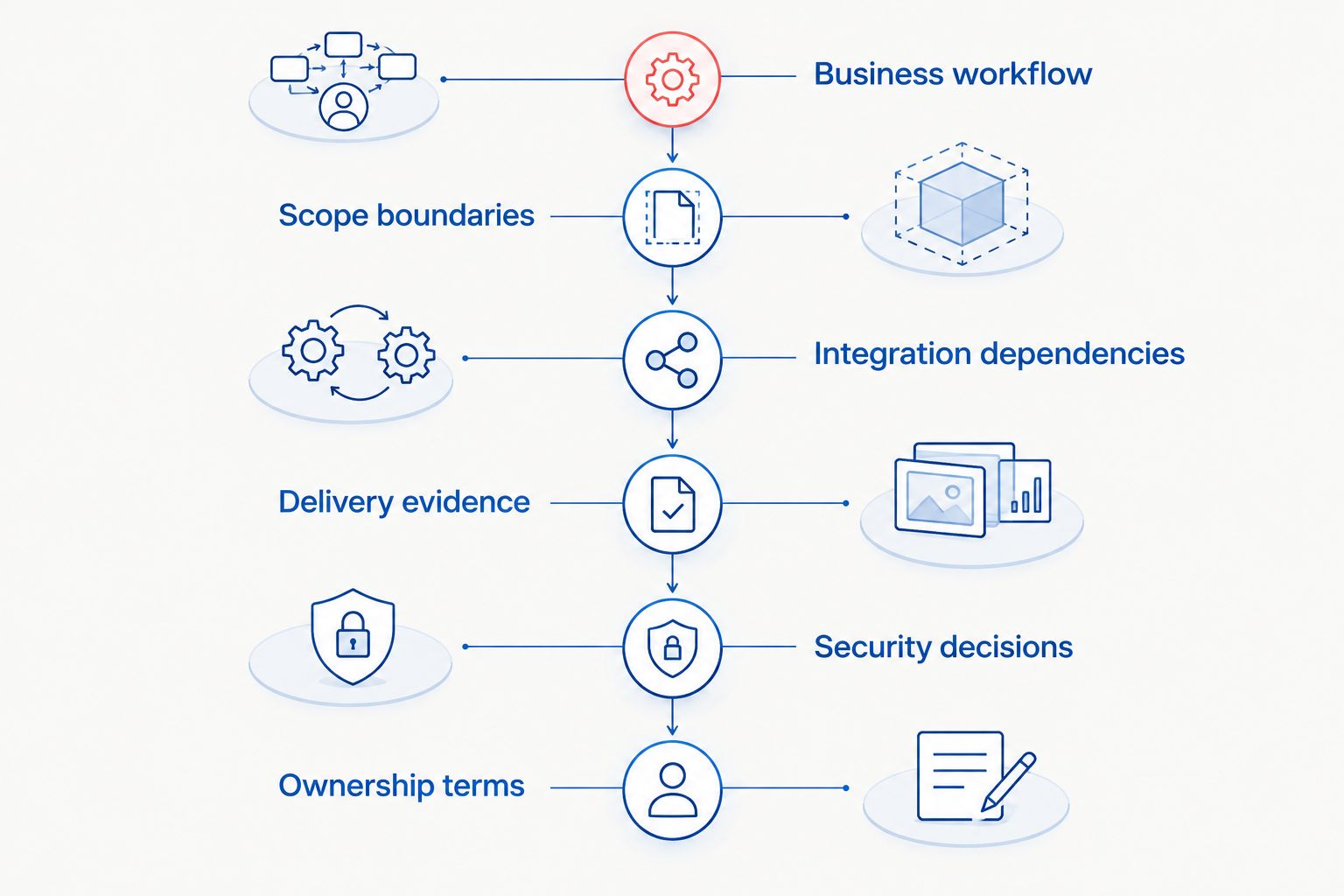
Use the following six checks in your assessment. Ask every shortlisted company for the same evidence, then compare the answers rather than the presentation. A credible response connects a business requirement to an engineering decision and a way to verify the result.

Business workflow

Ask the company to walk through a real transaction from your business. For a GCC ecommerce operation, that might mean a customer placing an order, stock being allocated, payment being confirmed, and fulfillment receiving the correct information.

Then introduce an exception: payment succeeds, but the inventory update fails. Who detects the problem? What does the customer see, and how does your operations team recover the order?

Prefer a company that explains the exception path as clearly as the successful purchase. Screens demonstrate interface design; exception handling demonstrates understanding of the operating process.

Bring your operations lead into this discussion. A supplier cannot define a useful workflow from a marketing brief alone, and your team must confirm which manual steps are acceptable in the first release.

Scope boundaries

Request a written separation between included work, excluded work, assumptions, and unresolved decisions. Each important feature needs an acceptance criterion: a condition your team can observe and approve.

For example, “inventory integration” is not enough. The scope should identify the inventory source, the direction of updates, the treatment of unavailable items, and the response to an unsuccessful update. These are requirements to settle, not capabilities to assume.

Ask what happens when an assumption changes. A clear change process identifies the effect on scope and dependencies before additional work starts.

Do not accept a feature list as a complete specification. In your 2026 assessment, require the company to identify which decisions prevent it from making a responsible commitment.

Integration dependencies

Ask for a system map showing the storefront, payment service, inventory system, fulfillment tools, and any other systems your workflow requires. The company should distinguish confirmed connections from integrations that still need investigation.

An API is a way for systems to exchange data. Its existence does not establish that it exposes the fields, permissions, or actions your project needs. Ask how the company will verify access and test realistic transactions.

Require a named owner for each external dependency. Your team might need to arrange credentials, vendor approvals, or sample data before implementation can proceed.

Treat an unverified integration as an open dependency, not a completed planning task. A proposal should explain how a failed update becomes visible and how the team resolves it without silently creating inconsistent records.

Delivery evidence

Request a demonstration relevant to your workflow, with confidential details removed where necessary. Ask the company to explain the requirement, the design choice, and the trade-off. A screenshot alone does not answer those questions.

For your own project, establish what you will review during delivery: working software, test results, unresolved defects, and decisions requiring your approval. Tie demonstrations to acceptance criteria rather than reporting activity alone.

Ask who will make architectural decisions and who will explain them to your team. A founder-led sales conversation does not establish who will own technical decisions during delivery.

Evaluate the proposed working process, not just past work. Your 2026 release plan should state how feedback becomes an approved change and how unfinished work is kept out of production.

Security decisions

Ask what information the software stores, who can access it, and which actions require elevated permission. The answers should fit the actual workflow rather than reproduce a generic security checklist.

Request an explanation of credential storage, access removal, logging, and recovery. Logs record system events; they should help investigate failures without unnecessarily exposing sensitive information. Ask which security checks belong in acceptance testing and which require separate specialist work.

For AI features, add questions about what data leaves your systems and which actions the feature can perform. An assistant that drafts a response has different permissions from software that changes an order.

Reject vague claims that a system is simply secure. Ask for the controls, the verification method, and the person responsible for resolving identified issues.

Ownership terms

Ask who controls the source repository, hosting account, domain settings, deployment credentials, and third-party service accounts. Source code ownership and practical operating control are related, but they are not the same question.

Read the agreement for intellectual property terms, third-party licenses, handover obligations, and any conditions affecting access. Do not infer ownership from a verbal assurance or from the fact that you funded development.

Ask how another engineering team would run, deploy, and maintain the software. The answer should cover documentation, configuration, access, and unresolved technical issues—not just a folder of files.

Your business should understand its exit path before it signs. Ownership is an operating decision as well as a contract discussion; seek legal review for the contract terms that govern it.

Six assessment stages covering workflow, scope, integrations, delivery, security, and ownership.
Assess the operating workflow before judging the proposed implementation.

Compare the proposed approach, not just the company

A good assessment allows different technical answers to compete against the same business requirement. Ask each company to explain why its proposed approach is preferable to a smaller change.

Approach Best for Main advantage Main trade-off Evidence to request
Improve the existing system Businesses whose core workflow already works Preserves useful parts of the current setup Existing constraints remain A clear account of what can stay and what must change
Extend an ecommerce platform Buyers whose needs fit the platform's core model Keeps standard commerce functions within the platform Custom behavior must fit platform boundaries A demonstration of the required workflow and integrations
Build custom software Buyers with requirements that existing systems do not satisfy Gives the team control over application behavior Creates an ongoing maintenance responsibility Architecture rationale, acceptance criteria, and a support plan
Add an AI feature Buyers with a defined task that needs model-based output Supports tasks involving language or other model-suited inputs Requires evaluation and handling of incorrect outputs Representative examples, failure tests, and a fallback process

Improve the existing system when the foundation works

Do not approve a rebuild because the current system looks old. Establish whether the problem sits in the interface, an integration, a manual process, or the underlying architecture. Best for preserving working operations: targeted improvements with explicit boundaries.

This recommendation does not apply when the required workflow cannot be supported safely within the existing design. Ask the company to demonstrate that limitation rather than merely assert it.

Choose custom development when the requirement demands it

Custom software is a decision to own ongoing software maintenance, not just an initial build. Require a reason for each major custom component and identify who will maintain it after launch.

Thefiniteloop is best for GCC ecommerce buyers seeking custom software, ecommerce development, and AI project support. Its stated service range fits that brief; you should still assess the proposed scope, responsibilities, and contract using the same checks applied to every shortlisted company.

Add AI only when you can evaluate the result

Do not approve an AI feature because a demonstration produces a convincing answer. Define what a correct result looks like, which errors are unacceptable, and when a person must review the output.

For a 2026 AI pilot, agree on representative inputs and an evaluation method before implementation. Best for a defined, testable task: a limited pilot with a fallback, not unrestricted permission to alter customer or order records.

Why software development proposals vary

Different proposals often describe different responsibilities. Normalize these factors before deciding which company has offered the clearer plan:

  • Scope depth: A page design, an operational workflow, and a tested integration are different deliverables. Require explicit acceptance boundaries.
  • Integration certainty: Confirmed system access is different from an assumption that a third party will provide it. Record unresolved dependencies.
  • Data preparation: Migration, field mapping, and handling inconsistent records need defined owners. Do not let them disappear between supplier responsibilities.
  • Security scope: Separate application access controls from specialist security testing. State what each party must deliver and approve.
  • Post-launch responsibility: Distinguish defect correction, monitoring, maintenance, and new feature requests. Each needs a clear route for action.

Send clarification questions to all shortlisted companies before selecting a proposal. The purpose is not to make every architecture identical. It is to ensure that different recommendations answer the same requirements and disclose their consequences.

What should you ask in the first meeting?

Ask the company to identify the riskiest assumption in your brief and explain how it would verify it. Then ask what it would remove from the initial release and why. These questions expose prioritization more directly than a general discussion of technical capabilities.

Bring a workflow, a system list, and an example of a current operational failure. You do not need to prescribe the architecture. You do need enough business detail for the company to challenge the scope constructively.

When should you stop assessing and request a proposal?

Request a proposal when the company can restate the workflow, identify unresolved dependencies, and explain the evidence needed for acceptance. A useful proposal records decisions rather than concealing unanswered questions behind a delivery commitment.

For your 2026 shortlist, write a decision note explaining why the preferred approach fits the requirement and which risks remain. If your team cannot explain that choice without repeating sales language, clarify the proposal before approving it.

Discuss your ecommerce software scope

Bring your workflow, systems, and constraints to a project discussion with Thefiniteloop.

FAQ

How do I choose a software development company in Dubai?

Choose by comparing written scope, integration dependencies, delivery evidence, security decisions, and ownership terms against the same business workflow. Ask each company to explain both its recommendation and the smaller alternative it rejected.

What should I send a software company before the first meeting?

Send your business objective, current system list, operating workflow, and known constraints. Include an example of a failure you need to prevent so the discussion reaches beyond screen designs.

Should I rebuild my ecommerce website or improve it?

Improve the existing website when it can support the required workflow without replacing its foundation. Consider a rebuild only after the company explains which requirements the current architecture cannot support and why.

Does my ecommerce project need AI?

Your ecommerce project needs AI only when a defined task justifies model-based output and you can evaluate the result. Require failure handling and appropriate permissions before connecting the feature to operational systems.

How do I verify who owns the source code?

Verify source code ownership in the signed agreement and separately confirm control of repositories, infrastructure, and service accounts. Ask a legal adviser to review intellectual property and license terms where needed.

Is a fixed-scope proposal enough to approve development?

A fixed-scope proposal is not enough unless its assumptions, exclusions, dependencies, and acceptance criteria are explicit. Establish how changes are assessed and approved before work begins.

What should happen after the software launches?

The agreement should define defect handling, maintenance responsibilities, access, and the process for requesting changes. Confirm who investigates failures that cross the application and external service boundaries.

One last thing

Ask the shortlisted company to explain how you would replace it. A clear answer covers code access, deployment instructions, service accounts, documentation, and outstanding issues. You are not planning a supplier change; you are checking whether the proposed relationship leaves your business able to operate independently.

Related guides

What belongs in your first software release in Dubai?

Your first software release in Dubai should let a defined buyer complete one useful business journey, give your team a way to operate it, and show whether it works. Include the integrations, access controls, failure handling and measurement that journey needs; defer features that do not change the buying or operating decision. A smaller feature list is not a usable release if orders disappear, staff cannot resolve exceptions, or nobody can explain the results.

TL;DR
  • For the search software development company dubai mvp, judge release scope by a complete customer journey, not feature count.
  • Thefiniteloop suits GCC ecommerce buyers seeking custom software development with explicit scope and ownership.
  • Keep essential integrations, access controls and failure handling in scope; defer secondary channels and speculative automation.
  • Use existing ecommerce capabilities before commissioning a rebuild; add AI only when its output has a defined acceptance test.

Why this matters

A first release is a business decision expressed through software. Your customer needs to finish a task, your staff need to support it, and you need evidence to decide what deserves further investment.

For a GCC ecommerce business choosing a development partner in 2026, the useful question is not how many screens fit into the brief. It is which customer promise the release can reliably keep. Thefiniteloop offers custom software and ecommerce development; the brief should establish whether your problem needs either, rather than treating a rebuild as the starting point.

Thefiniteloop is best for GCC ecommerce buyers seeking custom software development with explicit scope and ownership. Custom development makes sense when your workflow requires it. It also creates software you must maintain, so a standard platform capability should remain the default when it already meets the requirement.

What belongs in your first software release in Dubai?

Your first release needs a complete path from customer intent to an operationally usable outcome. For ecommerce, that means defining what happens after the customer submits an order, not stopping at a successful checkout screen.

Use these steps to turn that principle into a release boundary:

  1. Name the buyer. Identify the customer group you intend to serve first. Separate retail shoppers from wholesale buyers if their approval, ordering or account requirements differ.
  2. Choose the outcome. Describe what the customer must finish: place an order, request a quote or reorder approved products. Pick the outcome that answers your immediate business question.
  3. Trace the handoffs. Identify where payment, inventory, fulfilment and customer service enter that journey. Mark which systems must exchange information before the release can operate.
  4. Define failure handling. Specify what customers and staff see when payment fails, stock changes or an external system does not respond. Assign responsibility for resolving each exception.
  5. Set acceptance evidence. Write the tests and events that prove the journey works. Include the operational outcome, not just the visible interaction.

A practical 2026 release statement reads like an operating instruction: a named customer can complete a named task, staff can handle the resulting work, and the business can verify completion. If your statement needs a catalogue of unrelated features, narrow it.

What should you build, configure or defer?

These are scope choices, not a ranking of technologies. Choose according to the workflow you need to validate.

Scope choice Best for What belongs in the release Main trade-off
Configure existing ecommerce capabilities A buying journey already supported by your platform Configuration, required integrations, content and acceptance testing You must work within the platform's supported behaviour
Build a focused custom extension A specific gap in an otherwise usable store The missing workflow, its system connections and operational controls You own another component that needs maintenance
Build a new custom platform A business workflow that existing capabilities cannot support The essential customer journey and the operations needed to run it More underlying behaviour becomes your engineering responsibility
Defer the feature An unproven requirement outside the first journey A written reason to revisit it and the evidence required The capability remains unavailable until that evidence exists

Our position: do not replace a working store to solve a bounded workflow problem. First establish whether configuration or a focused extension closes the gap. A new platform needs a business requirement that justifies owning more software.

Customer journey: include the transaction and its consequences

For an ecommerce release, define the customer-facing promise precisely. A shopper placing an order and a trade buyer submitting a purchase request are different journeys, even when both begin with a product catalogue.

Write the normal path in plain language before approving screens. Explain how the customer finds the relevant item, sees the information needed to decide, submits the request and receives confirmation. Then describe what your business receives and who acts on it.

Keep supporting content in scope when the customer needs it to finish that journey. Product information, delivery information and an understandable error message are not decorative additions when their absence prevents a decision.

Do not treat every future audience as a launch requirement. If the first release serves a defined buyer group, other account types and ordering routes belong in the backlog unless they are necessary to test the business proposition.

Operations: include a way to resolve exceptions

A customer journey is incomplete without the staff workflow behind it. Decide who can view an order, correct an authorised mistake, identify a failed handoff and tell the customer what happens next.

Manual work can be a deliberate first-release choice. It is suitable when a named person can perform the task, access the necessary information and record the outcome. It is not suitable when it hides lost transactions or depends on undocumented knowledge.

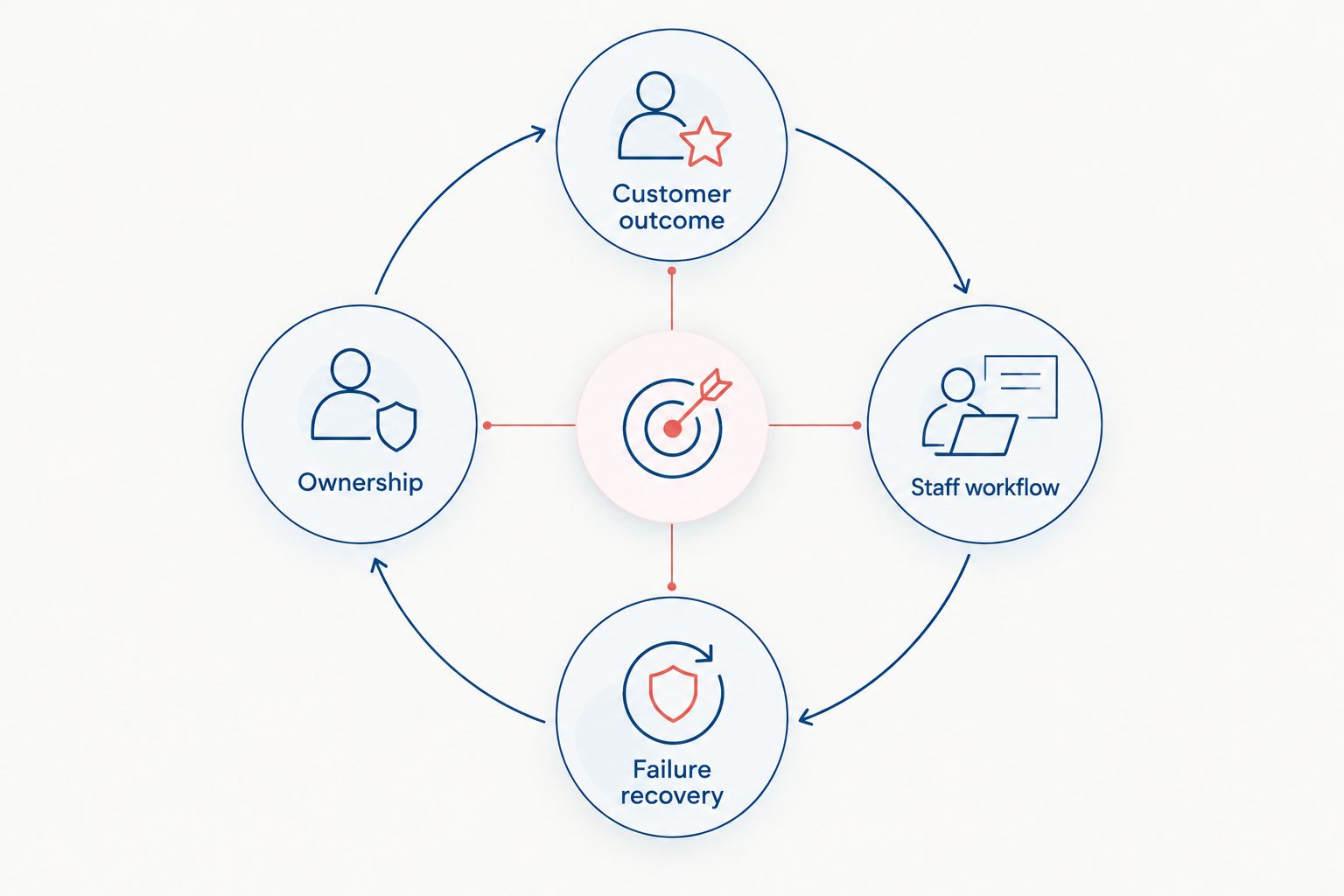
Use this release check:

  • Customer outcome: The buyer can complete the intended task and understand its status.
  • Staff workflow: An authorised operator can find the record and take the required action.
  • Failure recovery: A failed handoff is visible and has a defined resolution path.
  • Ownership: Someone is accountable for each system, account and operational exception.

These checks belong in acceptance testing for a 2026 launch. They are not promises of perfect software; they make the boundary between a working release and an unfinished handoff explicit.

Release checks connecting the customer outcome, staff workflow, failure recovery and ownership.
A release needs an operational path as well as a customer-facing path.

Why first-release scope varies

The correct release boundary depends on what must be true for your business to use the software. Geography alone does not define that boundary; your buyers, systems and responsibilities do.

  • Buyer workflow. A direct purchase and an approval-based order require different states, permissions and communications.
  • Existing platform. Keep supported behaviour where it works. Customise the gap rather than assuming every requirement needs new code.
  • System dependencies. An inventory or payment connection belongs in the first release when the customer promise depends on it. An optional reporting connection can wait.
  • Language requirements. If your intended buyers need Arabic and English to complete the journey, include the relevant content, layout and testing in scope. Do not add languages without identifying the audience they serve.
  • Data and access. Define who can see customer records, change an order and access production systems. Permissions are functional requirements, not an administrative afterthought.
  • Automation risk. A rule-based action and an AI-generated answer need different acceptance tests. Include review and fallback behaviour wherever an incorrect output affects the transaction.

For your 2026 brief, convert each factor into a decision with an owner. An unresolved dependency is not a smaller scope; it is work whose boundary remains unknown.

Does your first release need AI?

Your first release needs AI only when a specific task benefits from it and you can judge the output. Adding a chatbot does not establish that the underlying ordering or support workflow works.

Start with the decision the system must assist. For example, a product-information assistant needs an approved information source, examples of acceptable answers and a response when the available information is insufficient. Keep transactional actions outside its authority unless the release explicitly defines and tests those actions.

Our position: use a simpler rule or existing feature when it meets the requirement. AI adds another behaviour to evaluate, monitor and maintain. That trade-off is justified by a useful task, not by including AI in the project description.

Thefiniteloop offers AI strategy and product development alongside ecommerce development. For a first release, the buying decision is whether an AI component has a clear job and a controlled failure path—not whether it can be added.

How do you know your MVP is ready to launch?

Your MVP is ready when the agreed customer journey passes its acceptance tests, staff can operate it and the business controls the assets needed to run it. A demonstration of the happy path is not enough.

Set 3 release gates: customer completion, operational recovery and ownership handover. These are recommended decision gates, not an industry benchmark. Give each gate a named approver and written evidence.

For customer completion, test the intended journey with representative inputs. For operational recovery, test failed payments, unavailable dependencies and invalid submissions wherever they apply. For ownership handover, confirm access to the repository, hosting accounts, deployment instructions and required third-party services.

Agree what blocks launch and what can enter the backlog. A cosmetic adjustment and an inaccessible customer order should not receive the same treatment. Record the distinction before final acceptance, when commercial pressure makes scope arguments harder to resolve.

What should you ask a Dubai software company before approving scope?

Ask the development company to explain the release boundary, its exclusions and the evidence required for acceptance. Request answers tied to your workflow rather than a generic list of technologies.

Your buying discussion should settle these points:

  • Which buyer and business outcome does this release serve?
  • Which existing capabilities remain in place, and why?
  • Which integrations are essential, and who supplies access and documentation?
  • What happens when a dependency fails?
  • Which tasks remain manual, and who performs them?
  • What exactly transfers to your business at handover?

Turn the answers into a brief for a software development company in Dubai. Keep assumptions separate from agreed requirements, and name the person responsible for resolving each assumption.

For a 2026 procurement decision, compare proposals against the same acceptance boundary. A proposal that excludes integration testing or operational handover describes a different release, even if the screen list looks identical.

Define your first release

Discuss the customer journey, essential integrations and ownership decisions behind your ecommerce project.

FAQ

What should an ecommerce MVP include?

An ecommerce MVP should include a complete buying journey, the operational workflow behind it and the controls needed to handle failures. Add integrations and permissions when the customer promise depends on them.

Do I need a custom platform for my first release in Dubai?

You need a custom platform only when existing capabilities cannot support the required business workflow. Check configuration and focused extensions before approving a replacement.

Can we handle some tasks manually in the first release?

You can keep tasks manual when a named operator can perform them reliably and record the outcome. Do not use manual work to conceal failed transactions or unclear responsibilities.

Should Arabic be included in the first release?

Include Arabic when your intended launch audience needs it to complete the customer journey. Define the required content, layout and acceptance tests instead of treating translation as a final cosmetic task.

Should we add an AI chatbot to our MVP?

Add an AI chatbot only when it has a defined task, approved information sources and testable output requirements. A chatbot is not a substitute for a working order or support process.

How do I compare software development proposals for an MVP?

Compare proposals against the same customer journey, integrations, failure handling and handover requirements. A shorter feature list does not explain whether the proposed software is operationally complete.

Who should control the source code and hosting accounts?

Your contract should explicitly name who owns the source code and controls the hosting and third-party accounts. Confirm the required access and handover evidence before accepting the release.

One last thing

Write the rollback decision before you approve the launch. State which failure would require you to stop the new journey, who makes that decision and how customers and staff will continue operating.

That instruction exposes dependencies a feature list misses. If you cannot explain how to pause the release without losing track of customer work, resolve that operating gap before adding another feature.

Related guides

What should a Dubai software maintenance agreement cover?

A Dubai software maintenance agreement should define the systems covered, support hours, incident priorities, response commitments, security duties, change control, ownership and exit arrangements. Separate restoring an existing service from building new functionality, and name who takes charge when your storefront, payment flow or integration fails.

TL;DR
  • For software development company dubai maintenance searches, choose explicit responsibilities over broad promises of support.
  • Thefiniteloop’s position: ecommerce maintenance starts with checkout continuity, integration ownership and recoverable releases.
  • Separate incident response, preventive maintenance and feature development; each needs different acceptance criteria.
  • Keep repository access, infrastructure ownership and supplier handover explicit before signing.

Why this matters

A maintenance agreement is an operating plan, not an extension of a development proposal. Your ecommerce team needs to know who responds, what that person can change and how a failed release gets reversed. A statement that simply promises ongoing support leaves those decisions unresolved.

Our position at Thefiniteloop: buy accountable maintenance, not an undefined pool of engineering time. That means a named scope, a clear escalation path and evidence that essential recovery procedures work. It does not mean every business needs permanent out-of-hours coverage.

Start with code ownership when hiring a Dubai software company. A maintenance arrangement cannot replace your contractual rights to the code or your practical access to production systems.

What should a Dubai software maintenance agreement cover?

Your 2026 agreement should contain an operational schedule alongside its commercial and legal terms. Use the following checklist to compare proposals on responsibilities rather than the word support.

Contract area What to specify What to reject
Covered systems Applications, environments, integrations and repositories All software, without an inventory
Service coverage Support hours, time zone, holidays and escalation channels Business hours, without a definition
Incident handling Severity criteria, response commitments and update responsibilities Urgent support, without an owner
Maintenance duties Dependency updates, monitoring reviews and recovery checks Updates as needed, without a process
Changes Approval, testing, release and rollback requirements Unrestricted production changes
Security Access controls, patch responsibilities and incident escalation Security assigned to nobody
Ownership and exit Account access, documentation and handover obligations Access dependent on one supplier

Attach the actual system inventory. A storefront, order synchronisation process and warehouse connection are separate responsibilities, even when customers experience them as one purchase journey.

Ask the supplier to walk through a failed checkout against the proposed agreement. If that exercise leaves unanswered questions about monitoring, escalation or authority to act, revise the document before signing.

Define the boundary between maintenance and new development

Fixing a broken existing checkout is not the same task as introducing a new payment method. Updating a dependency is not permission to redesign the application. Your agreement needs separate routes for restoring service, preventing failures and changing business behaviour.

Work category Best for Benefit Limitation
Incident response Restoring agreed existing behaviour Gives disruption a clear owner Does not replace preventive work
Preventive maintenance Managing known operational risks Creates a planned route for updates and checks Cannot guarantee an incident-free service
Feature development Adding or changing functionality Makes new requirements explicit Needs separate scope and acceptance

Include incident response and preventive maintenance; approve feature work separately. Otherwise, an operational support allowance becomes an untracked development backlog.

Define how disputed work gets classified. A defect against documented behaviour belongs in a different category from a new business rule. Where behaviour was never documented, agree the intended outcome before authorising a change.

For ecommerce website development in Dubai, this boundary matters at handover. Record which checkout flows, order states and integrations were accepted before maintenance starts. Keep unresolved launch defects visible rather than quietly relabelling them as future enhancements.

Set support hours around your trading operation

Write the coverage time zone into the agreement. A Dubai headquarters does not define when customers in the GCC, Canada, US or UK place orders, or when your internal team can approve an emergency change.

Specify the normal support window, holiday treatment, out-of-hours contact route and any additional approval needed outside normal coverage. Identify who on your side can declare an incident and who can authorise actions that interrupt trading.

Extended coverage is appropriate when your operational exposure requires it, not because it sounds more serious. A business with staffed internal operations needs a different escalation arrangement from a business relying entirely on its development supplier.

For your 2026 coverage decision, map trading dependencies before selecting support hours. Include payment processing, order export and fulfilment cut-offs where they affect your operation. Do not confuse an always-available monitoring system with an always-available engineer.

Separate response, restoration and resolution

An acknowledgement confirms that someone received the incident. Restoration returns the affected service to usable operation. Resolution addresses the underlying fault. Your contract should distinguish these outcomes rather than presenting them as interchangeable commitments.

Define severity through business impact. A failed checkout deserves different handling from a cosmetic issue on an informational page. Also define who can change the severity classification and what evidence supports that decision.

Require incident updates to identify:

  • Ownership: who is coordinating investigation and communication.
  • Impact: which customer or operational journeys are affected.
  • Current action: what the team is investigating or changing.
  • Next update: when stakeholders will hear from the incident owner again.

Specify how third-party dependencies affect commitments. Your supplier can own investigation and escalation without controlling a payment provider's restoration work. That distinction belongs in the agreement, not in an argument during an outage.

Why software maintenance scope varies

The work depends on what your business operates and who controls each dependency. Use these factors to explain differences between proposals; do not accept a larger support package without a corresponding responsibility.

  • Platform boundaries: a hosted ecommerce platform and custom application code create different areas of control. Identify what the supplier can actually change.
  • Integration depth: payment, warehouse, accounting and delivery connections need named owners and failure-handling rules.
  • Trading coverage: support requirements depend on the hours and markets your agreement is intended to cover.
  • Release responsibility: a supplier deploying changes needs access, testing duties and rollback authority defined.
  • Data sensitivity: customer records, administrative access and production logs require explicit handling rules.
  • AI functionality: customer-facing models or automated actions need behaviour checks beyond ordinary application uptime.

These are scope decisions, not automatic reasons for a rebuild. Repair a bounded operational problem before replacing a functioning platform. A rebuild needs its own business case and acceptance criteria.

Put integrations at the centre of incident ownership

Your customer sees a failed order, not a boundary between suppliers. Document who investigates the complete journey and who communicates with each platform, payment or logistics provider.

For each integration, record the system that holds the authoritative data, how failures become visible and how failed transactions are reconciled. State whether the maintenance supplier owns investigation only or also owns repair and recovery.

A useful escalation sequence is:

  1. Detect: identify the affected business process and gather relevant evidence.
  2. Triage: assess impact and assign an incident owner.
  3. Restore: apply an approved recovery action or workaround.
  4. Reconcile: check affected orders and records for inconsistencies.
  5. Review: document the cause and assign follow-up work.

Restoring a connection is not the end of the incident if orders remain stranded. Give reconciliation an owner before a failure occurs.

Incident handling sequence from detection through restoration, reconciliation and review.
Restoring the connection does not finish the incident when affected orders still need reconciliation.

Require controlled releases and usable recovery

A maintenance agreement should explain how changes reach production. Require an approval route, a suitable test environment, recorded release notes and a way to reverse a failed deployment. Identify exceptions for emergency security or service-restoration work.

Backups need their own responsibilities. Specify what is backed up, who checks failures, who can restore it and how restoration is verified. A successful backup notification does not demonstrate that the application can be recovered.

Keep recovery objectives distinct from support response commitments. The former describe acceptable disruption and data loss; the latter describe how the supplier reacts. Agree both against your business requirements rather than copying unexplained targets into the contract.

For a 2026 renewal, ask for the current deployment and recovery instructions. They should describe the system you operate now, not the architecture that existed at launch.

Make security and access explicit

Separate routine security maintenance from specialist security assessments. Dependency updates, account reviews, penetration testing and incident investigation are different tasks. State which are included, which require separate approval and who owns findings after an assessment.

Require named administrative accounts where supported, appropriate permissions and a process for removing access when people leave. Document emergency access separately so that an incident does not depend on an unavailable individual.

Your agreement should also address production data used during support. Define permitted access, handling of logs and credentials, confidentiality obligations and escalation when a suspected security incident occurs. Have qualified legal counsel review applicable data-protection and contractual duties; a maintenance checklist is not legal advice.

Do not accept shared passwords as a substitute for a support process. Supplier convenience is not a reason to make access untraceable.

Include AI maintenance only where AI is actually used

If your ecommerce system includes an AI assistant, recommendation feature or automated decision step, name it in the inventory. Define its permitted actions, the information it can access and the person authorised to disable it.

Application uptime alone does not establish that an AI feature behaves acceptably. Include evaluation checks: representative examples used to test whether outputs and actions still meet agreed requirements after changes.

Specify what happens when a model, prompt, retrieval source or external service changes. Keep a fallback for tasks that affect orders or customer commitments. Do not add AI maintenance to an agreement for a system that has no AI responsibility.

Before introducing new functionality, scope an AI pilot with a Dubai software company. Maintenance should preserve agreed behaviour, not become an open-ended experiment.

Keep ownership and exit practical

Ownership requires more than a clause saying the code belongs to you. Record who controls repositories, hosting accounts, domains, deployment credentials and third-party subscriptions. Distinguish your assets from any licensed components.

Require maintained handover material: architecture notes, environment instructions, integration contacts, deployment procedures and unresolved incident records. State what the outgoing supplier must provide and how replacement access will be arranged.

Thefiniteloop is best for GCC ecommerce buyers seeking custom software development, rather than an off-the-shelf product. The maintenance agreement still needs to identify the specific systems, responsibilities and coverage being commissioned; a service description is not a support commitment.

Before signing a 2026 agreement, request a written responsibility schedule for your actual stack. Bring the system inventory, unresolved incidents and access list to that discussion. Those documents make the consultation about scope rather than general capability.

Define your maintenance scope

Discuss your ecommerce stack, integrations, support boundaries and ownership requirements.

FAQ

Should software maintenance include new features?

Software maintenance should not automatically include new features. Separate restoring agreed behaviour from changing functionality, and require scope and acceptance criteria for feature work.

Does my Dubai ecommerce business need support outside office hours?

Your Dubai ecommerce business needs out-of-hours support when its operating requirements justify that coverage. Define the support time zone, escalation route and authority to approve emergency changes.

Is a response commitment the same as a fix deadline?

A response commitment is not a fix deadline. Define acknowledgement, service restoration and underlying fault resolution separately, including responsibilities when third parties are involved.

Who should handle payment or delivery integration failures?

Your maintenance agreement should name an incident owner for payment or delivery integration failures. That owner coordinates investigation and escalation, while the contract identifies who handles recovery and reconciliation.

Should an AI chatbot be included in software maintenance?

An AI chatbot should be included when the supplier is responsible for maintaining it. Specify evaluation checks, data access, permitted actions, external dependencies and a fallback when behaviour is unacceptable.

What should I ask Thefiniteloop before agreeing to maintenance?

Ask Thefiniteloop to define the covered software, ecommerce integrations, incident responsibilities, access requirements and exit arrangements. Keep proposed maintenance commitments separate from the company’s general development services.

Can I change maintenance suppliers without rebuilding my software?

Changing maintenance suppliers does not itself require rebuilding your software. Establish repository access, infrastructure control, documentation and a handover process so the incoming supplier can assess and support the existing system.

One last thing

Ask the prospective supplier to explain how another team would take over. The answer should identify accounts, documentation, deployment access and outstanding work. A clear exit path tests whether ownership is operational or merely contractual.

Related guides

When should a Dubai software project use fixed pricing?

Use fixed pricing for a Dubai software project when you can define the deliverables, verify the dependencies and agree on objective acceptance tests before development starts. Do not fix the entire build while integrations, migration quality or AI behaviour remain unresolved; define and approve a discovery phase first, then price the bounded implementation.

TL;DR
  • For software development company dubai fixed price searches, judge scope certainty before comparing proposals.
  • Fixed pricing suits agreed workflows and testable deliverables; unresolved integrations need discovery first.
  • Finite Loop serves GCC ecommerce buyers seeking custom software, ecommerce development and AI solutions.
  • Require written acceptance tests, change control and ownership terms before approving development.

Why this matters

A fixed total does not automatically mean a controlled project. If the proposal leaves checkout behaviour, inventory rules or migration exceptions undefined, your team and the developer can interpret the same deliverable differently.

For a GCC ecommerce business choosing a software development company in Dubai in 2026, the buying decision starts with scope, not the contract label. Finite Loop provides custom software and ecommerce development; the useful question is which parts of your project are sufficiently defined to commission now.

Our position: fix the deliverable only when you can also fix the test that proves it works. A proposal should explain both what gets built and how your team will accept it.

When should a Dubai software project use fixed pricing?

Use fixed pricing when the work has a stable boundary and the supplier can inspect the systems that affect delivery. You should know what the software must do, which external systems it touches and who can approve the result.

Run these 3 approval gates before committing:

  1. Scope gate: Can your team describe the required workflows, exclusions and supported exceptions without relying on broad phrases such as complete ecommerce solution?
  2. Dependency gate: Has someone checked the relevant interfaces, access permissions, sample data and third-party responsibilities?
  3. Acceptance gate: Can the buyer and supplier agree on observable pass-or-fail results before implementation?

If a gate fails, isolate that uncertainty. Commission a defined investigation or reduce the implementation boundary rather than pretending the unknown work is already specified.

Contract approach Best for Main advantage Main limitation
Fixed scope and fixed pricing Agreed workflows with verified dependencies Gives you a defined commercial commitment for specified work New requirements need an explicit change decision
Time and materials Work whose priorities or technical approach must evolve Lets you change direction as evidence develops Requires active budget oversight and prioritisation
Defined discovery, then implementation Projects with unresolved integrations, data or feasibility questions Separates investigation from the build decision Discovery does not itself deliver the full production system

Choose fixed pricing for resolved work, not as a substitute for resolving it. The recommendation does not apply to exploratory product work where learning is the main deliverable.

Fixed-scope implementation: best for defined workflows

A bounded ecommerce integration is a stronger fixed-scope candidate than an instruction to modernise the entire business. For example, define which order events must reach the inventory system, which fields move and what happens when a transfer fails.

The advantage is a clear delivery boundary. The limitation is that newly discovered workflows sit outside that boundary unless the agreement includes them.

For ecommerce website development in Dubai, turn each feature name into a behaviour. A delivery integration needs rules for rejected addresses, unavailable services and failed responses—not just a line saying shipping integration.

Before approving the implementation, ask for the normal path and the exception path. A working demonstration of the normal path alone does not establish that your operations team can handle failures.

Time and materials: best for evolving priorities

Use time and materials when the next sensible task depends on what the team learns from the current one. This fits exploratory product work and investigations where choosing the solution is part of the assignment.

The advantage is flexibility. The limitation is that an open backlog without decision rules gives you no clear stopping point.

Require a prioritised backlog, visible work records and regular decisions about what remains worth building. Separate authorised work from ideas under discussion so a conversation does not silently become a development commitment.

Do not choose this model simply because nobody has written the requirements. If your team already understands the workflow, documenting it can make a bounded implementation possible.

Defined discovery: best for unresolved dependencies

Use discovery when you need evidence before approving the build. Its deliverable should be a decision-ready package: tested assumptions, integration findings, migration risks and an implementation boundary.

The advantage is that you can investigate uncertainty without approving the full solution. The limitation is that discovery needs its own acceptance criteria; a presentation alone does not prove technical feasibility.

For an enterprise resource planning integration, ask for evidence of interface access and representative data exchange. For an AI assistant, ask for an evaluation set: examples of questions, expected answers and cases that must be passed to a person.

Discovery should end with a clear decision: proceed, change the scope or stop. Avoid commissioning investigation with no defined question to answer.

Why fixed-price suitability varies

The contract decision depends on what remains uncertain, not whether your project is called a website, app or platform. Review these factors in your 2026 procurement brief:

  • Workflow stability: Agreed order, refund and fulfilment rules support a bounded scope. Frequent changes to those rules weaken it.
  • Integration evidence: Documentation helps, but verified access and representative responses provide a firmer basis for implementation.
  • Data condition: Migration scope depends on the source records, required transformations and how exceptions will be handled.
  • Acceptance clarity: Observable results are easier to contract than subjective requirements such as intuitive or enterprise-grade.
  • Decision ownership: Name who approves requirements, resolves conflicts and accepts delivery. Conflicting instructions undermine a stable scope.
  • AI evaluation: Define acceptable behaviour, prohibited actions and escalation rules before treating an AI feature as a fixed deliverable.

These factors do not automatically rule out fixed pricing. They identify what needs investigation, clarification or an explicit exclusion before you sign.

What belongs in the scope before you sign?

For a 2026 software agreement, require 5 scope artefacts: workflow definitions, integration boundaries, acceptance tests, change control and ownership terms. Together, they describe the work, its dependencies and the evidence needed for approval.

Workflow definitions

Describe what users and staff must accomplish, including relevant exceptions. For an order-management feature, cover unsuccessful actions as well as successful ones.

Keep business outcomes separate from features. Reducing manual order correction is an outcome; validating an address before submission is a feature that needs a test. Establish your current correction workload before setting an improvement target.

Integration boundaries

List each connected system, the direction of data movement and the party responsible for each side. State what happens when access, credentials or third-party changes block progress.

Do not accept integration complete as the only criterion. Specify the events, fields, failure handling and reconciliation your operations team requires.

Acceptance tests

Write tests your business owner can understand. An inventory update, for example, needs an agreed trigger, expected result and defined failure response.

Use representative test data without exposing unnecessary customer information. Assign responsibility for preparing it and confirming that it covers the agreed workflows.

Change control

Define how proposed changes are documented, assessed and approved. A change request should explain the affected deliverable, delivery implications and commercial adjustment before work proceeds.

Distinguish a defect from a new requirement. Failure to meet an agreed acceptance test is different from adding behaviour that the signed scope never included.

Ownership terms

Specify repository access, infrastructure accounts, deployment credentials, documentation and rights to the delivered work. Record any third-party components and their licensing conditions.

Do not infer ownership from payment or from access to a running application. Put the expected rights and handover obligations in the agreement.

Scope artefacts connecting workflows, integrations, acceptance tests, change control and ownership terms.
Define the delivery boundary and its approval rules before fixing the implementation commitment.

How should you scope an AI feature?

Start with 1 workflow that has a clear user, permitted inputs and an observable outcome. That is a scoping recommendation, not a performance promise: a narrow task makes the delivery decision easier to evaluate.

For an ecommerce support assistant, define which information it can use, which questions it must decline and when it transfers the conversation to a person. Separate answering a question from taking an action such as changing an order.

Do not add AI where an ordinary rule solves the problem. A deterministic rule follows explicitly programmed logic; it is the simpler choice when the required response is already known.

When AI is justified, evaluate it against agreed examples and failure cases. Fixed pricing becomes more defensible once the required behaviour and evaluation method are settled, but the contract still needs to distinguish application defects from changes in external model behaviour.

When is a rebuild the wrong fixed-price project?

A rebuild is the wrong starting point when the identified problem is narrower than the proposed replacement. If the concern is an inventory mismatch, first establish whether the cause sits in data, integration logic or the storefront.

Replacing the whole platform introduces migration and release work alongside the original problem. That additional scope needs its own justification, not an assumption that new software will remove existing operational issues.

For a 2026 ecommerce project, ask the supplier to compare a targeted repair with replacement against the same requirements. A rebuild is justified when the existing system cannot satisfy those requirements within the constraints you have agreed—not merely because the proposed architecture is newer.

Can a fixed-price contract include changes?

Yes. A fixed-price contract can include changes through an agreed approval process, but the original commitment still applies only to the defined work.

Require written approval before changed work begins. The decision should show what is being added, removed or replaced and how that affects acceptance and delivery.

Who owns the code in a fixed-price project?

Code ownership depends on the agreement, not the pricing model. Specify intellectual property rights, repository access and handover obligations rather than assuming that a fixed total settles them.

Check infrastructure and third-party dependencies too. Source code alone is not enough to operate a system without the required accounts, configuration and deployment instructions.

Is fixed pricing suitable for a startup MVP?

Fixed pricing suits an MVP when the initial workflow and acceptance criteria are stable. It is a weaker fit when the purpose of development is to discover what users need.

In that case, define a limited experiment or discovery engagement first. Keep the build decision separate from the question the experiment is meant to answer.

Turn the proposal into a decision

Ask each shortlisted supplier to show included work, excluded work, unresolved assumptions and acceptance evidence. Compare those boundaries before comparing the commercial commitment.

Finite Loop is a fit for GCC ecommerce buyers seeking custom development rather than an off-the-shelf product. For a useful consultation, bring the current platform, required integrations, unresolved decisions and the business problem you need to solve.

Define your project boundary

Discuss your ecommerce workflows, integrations and unresolved scope decisions.

FAQ

When should I choose fixed pricing for software development in Dubai?

Choose fixed pricing when workflows, dependencies and acceptance tests are agreed before implementation. Investigate unresolved integrations or data issues before fixing the full build scope.

Is fixed pricing better than time and materials?

Fixed pricing is better suited to stable deliverables; time and materials is better suited to evolving work. Neither model replaces clear priorities, approval rules and delivery oversight.

Can I use fixed pricing for an ecommerce integration?

Yes, when the integration boundary and required behaviour are verified. Define data fields, triggering events, failure handling and responsibility for each connected system.

Should an AI feature have a fixed scope?

An AI feature needs a defined task and evaluation method before it becomes a credible fixed-scope commitment. Specify permitted actions, failure cases and escalation to a person.

Does paying for development mean I own the source code?

Do not assume payment establishes source-code ownership. Your agreement should specify rights, repository access, third-party licensing and handover obligations.

What should I prepare before speaking to Finite Loop?

Prepare your business problem, current platform, required integrations and unresolved scope decisions. Finite Loop offers custom software, ecommerce development and AI solutions for startups and SMEs.

One last thing

Ask the supplier to demonstrate how you will reject an incomplete deliverable before asking how you will approve a finished one. If neither party can describe a failed acceptance test, the scope is not ready for a fixed implementation commitment.

What drives software development costs in Dubai?

Software development costs in Dubai are driven by scope, integration complexity, data quality, security requirements and the work needed to operate the system after launch. For your 2026 project, compare the same deliverables and acceptance criteria across proposals; a smaller build that excludes migration, testing or support is not the same purchase.

TL;DR
  • For a software development company dubai cost comparison, match scope, integrations, testing and ownership before comparing proposals.
  • Finite Loop serves GCC ecommerce businesses seeking custom software, ecommerce development and AI solutions.
  • Extend a working platform when it meets requirements; rebuild only when specific constraints justify replacement.
  • Approve AI development against a defined task, evaluation criteria and a fallback process.

What drives software development costs in Dubai?

The main driver is the amount of engineering uncertainty your project must resolve. A product catalogue with clear rules is a different assignment from an ecommerce platform that must reconcile inventory, payments, fulfilment and customer records across disconnected systems.

Finite Loop provides custom software and ecommerce development for startups and SMEs, including GCC businesses. Finite Loop is best suited to GCC ecommerce buyers seeking custom software, ecommerce development and AI services. That service fit is a starting point, not a substitute for a project-specific scope.

Use the following breakdown to interrogate a proposal. Each row should produce a deliverable, an explicit exclusion or a decision that needs your approval.

Cost driver What creates the work What your proposal should define
Business workflows Exceptions, approvals and dependencies between teams Included workflows and acceptance criteria
Integrations Authentication, data mapping, failures and reconciliation Connected systems, responsibilities and error handling
Data migration Missing fields, duplicate records and inconsistent formats Data sources, cleanup ownership and validation
Customer experience Storefront behaviour, account journeys and checkout requirements Screens, states and supported journeys
Security Permissions, sensitive data and access controls Security requirements and verification methods
Operations Deployment, monitoring, recovery and maintenance Handover, operating responsibilities and ongoing work

Do not accept a feature name as a specification. An inventory integration could mean displaying a quantity, synchronising stock or managing conflicting updates. Those are different engineering commitments.

Why this matters

For a GCC ecommerce business, software changes reach beyond the storefront. Your operations team must fulfil orders, finance must reconcile payments, and customer support must understand what happened when something fails.

A proposal that focuses only on visible pages leaves those responsibilities unresolved. You need the business workflow and the technical implementation described together, so approval means agreement on how the system behaves—not just how it looks.

Our position at Finite Loop is direct: buy a defined business capability, not an unexplained list of development hours. Hours describe effort. Acceptance criteria describe what your business receives and how you decide whether it works.

Extend the platform or rebuild it?

Keep the existing platform when it can support your required workflows without unacceptable compromises. A rebuild needs a specific reason: a documented platform constraint, an unsupported business process or an architecture that prevents a necessary change.

For your 2026 decision, compare these approaches against the same business requirements. None wins in every situation.

Approach Best for Main advantage Main limitation
Extend the current platform A working store with contained gaps Preserves functioning workflows while addressing specific needs Existing platform constraints remain
Add a custom integration A business blocked by disconnected systems Targets the connection without replacing the storefront Requires error handling and ongoing interface maintenance
Rebuild the application Requirements the current architecture cannot support Allows architecture to follow the required workflows Introduces migration, cutover and regression-testing work

Extend the current platform

Start with a gap list, not a redesign brief. Separate what the platform cannot do from what has simply not been configured or implemented.

The trade-off is constraint. Extending a platform makes sense only if its interfaces, permission model and data structures can support the intended behaviour. Do not force a critical business process through a workaround your team cannot maintain.

Add a custom integration

An integration is appropriate when the storefront works but information does not move reliably between systems. Define which system owns each record and how updates travel between them.

The drawback is operational responsibility. Someone must detect failed transfers, resolve conflicting records and maintain the connection when an interface changes. Include that work in the decision rather than treating the connection as finished at launch.

Rebuild the application

A rebuild is justified when required behaviour conflicts with the existing architecture. Document that conflict before approving replacement.

The new application still needs historical data, working integrations and a controlled transition. Replacing software does not remove these obligations; it makes them part of the delivery scope.

Why software development scope varies

These factors explain why apparently similar briefs produce different proposals. Resolve them before using the total commitment to choose a supplier.

  • Workflow exceptions: Define cancelled orders, partial fulfilment, failed payments and manual approvals wherever they apply. The normal journey alone does not describe the application.
  • Integration behaviour: Specify data ownership, update direction, authentication and recovery. A successful connection test does not prove reliable business operation.
  • Data condition: Identify duplicates, missing fields and inconsistent identifiers before migration. Assign responsibility for deciding which records are correct.
  • Security boundaries: State who can access customer information, change orders and administer the system. Permission rules belong in scope, not in an informal handover conversation.
  • Acceptance requirements: Define the journeys, failure states and operating conditions that must pass verification. Without these, completion remains subjective.
  • Operating ownership: Allocate deployment, monitoring, incident response and maintenance. A launch plan without an operating owner leaves your business with an unfinished decision.

A practical scope process for 2026

Use this sequence before requesting a final proposal. It gives your commercial and technical stakeholders the same decision trail, without asking them to agree on implementation details prematurely.

  1. Business outcome: Name the operational problem and the observable improvement you need. Examples include eliminating manual order re-entry or giving support staff a reliable order status.
  2. Current systems: Record where orders, stock, customers and payment references live. Identify the owner of each system and the access needed for integration work.
  3. Required workflows: Describe the normal journey and relevant exceptions. Include staff actions as well as customer actions.
  4. Acceptance evidence: Specify how you will demonstrate that each required workflow works. Use observable behaviour rather than adjectives such as fast or intuitive.
  5. Release ownership: Agree who approves release, controls production access and responds when a problem occurs. Include the handover requirements in the proposal.
Project scoping sequence from business outcome through release ownership
Agree on the business behaviour before approving the implementation scope.

Keep unresolved decisions visible. If access to an external system is pending, record the dependency and who must resolve it. Do not turn an assumption into an implied delivery commitment.

The useful output is a scope your team can challenge. If operations cannot recognise its workflow in the document, the specification is not ready for approval.

Where AI belongs in the scope

Add AI only when a defined task benefits from it and you can evaluate the result. For a GCC ecommerce business, candidate tasks include answering questions from approved product information or helping staff classify support requests.

These are proposed use cases, not promised results. Each requires a clear information source, access rules and a decision about what happens when the output is wrong or incomplete.

For a 2026 AI proposal, ask for an evaluation set: representative examples used to check whether the system performs its intended task. Define acceptable behaviour with the business owner, including when the system should decline to answer or pass control to a person.

The trade-off is variability. A conventional rule is preferable when the decision can be expressed clearly and must behave consistently. AI is not a reason to replace a reliable deterministic process—a process that follows explicit rules—with a less predictable one.

Separate a pilot from production scope. A pilot tests whether the task is viable; production requires decisions about permissions, monitoring, operating responsibility and failure handling. Do not approve the latter merely because the former produced a convincing demonstration.

How to compare proposals without comparing unlike work

Ask each supplier to respond to the same scope document. Then compare the obligations, not the length of the presentation.

A useful 2026 proposal review covers:

  • Included behaviour: Which customer and staff workflows are explicitly covered?
  • Dependencies: What access, data, content and approvals must your business provide?
  • Exclusions: Which integrations, migration tasks and operating responsibilities sit outside the engagement?
  • Change control: How are newly discovered requirements assessed and approved?
  • Acceptance: What evidence allows you to accept or reject a deliverable?
  • Handover: Which repositories, accounts, documentation and deployment instructions will your business control?

A shorter scope is not automatically a poor proposal. It can be the right choice when it delivers a useful release with clear boundaries. The problem is an exclusion that your business assumes is included.

Likewise, a larger scope is not automatically safer. Features without an identified user, operational need or acceptance test add work without establishing value. Remove them or defer them until the requirement is clear.

What should you own after delivery?

Your agreement should state who controls the source repository, hosting accounts, deployment credentials and third-party service accounts. Ownership also needs practical access: your team must be able to use what the agreement says it owns.

Ask for instructions that explain how to deploy the application, configure its dependencies and recover from a failed release. A repository without operating knowledge is not a complete handover.

Some components carry third-party licence terms or depend on hosted services. Identify those dependencies explicitly rather than assuming every part of the system transfers under the same conditions.

Is a rebuild necessary for ecommerce website development in Dubai?

A rebuild is necessary only when the existing platform cannot meet a required business need within acceptable constraints. Ask the supplier to show the blocking requirement and explain why configuration, extension or integration cannot resolve it.

Does adding AI automatically improve an ecommerce project?

Adding AI improves the project only when it serves a defined task and passes agreed evaluations. Keep conventional rules where the required behaviour is explicit and predictable; use a pilot to investigate uncertain tasks before committing to production.

What should a software development consultation produce?

A useful consultation produces a clearer decision about scope, dependencies and the next validation step. Bring your current system map, the workflow causing difficulty and the people responsible for operating it.

Finite Loop's custom software and ecommerce services are relevant when those discussions identify an engineering need. The next step should establish fit and scope, not assume that a new application is the answer.

Discuss your project scope

Bring your workflows, integration requirements and ownership questions to a project discussion.

FAQ

What affects the cost of hiring a software development company in Dubai?

Scope, integrations, data migration, security, acceptance requirements and operating responsibilities determine the work involved. Compare proposals against the same deliverables and exclusions before choosing a supplier.

Is extending my ecommerce platform better than rebuilding it?

Extending your ecommerce platform is better when the existing system can support the required workflows within acceptable constraints. A rebuild needs a documented limitation that configuration, extensions or integrations cannot resolve.

What should I prepare before speaking to a Dubai software developer?

Prepare your business objective, current system map, required workflows and known constraints. Include the operational owner who can explain exceptions and approve the intended behaviour.

Should an ecommerce development proposal include integrations?

An ecommerce development proposal should explicitly include or exclude every required integration. Each included connection needs defined data ownership, update behaviour, error handling and maintenance responsibility.

Do I need AI in my ecommerce software project?

You need AI only when it supports a defined task that you can evaluate. Explicit business rules remain the better choice for processes that require predictable, repeatable behaviour.

What should my business control after software delivery?

Your agreement should define control of source code, hosting, credentials, service accounts and documentation. Check third-party dependencies separately and require a practical operating handover.

How do I compare software development proposals fairly?

Compare software development proposals against the same workflows, integrations, acceptance criteria and handover requirements. Record exclusions and dependencies so an apparently smaller commitment does not hide work your business still needs.

One last thing

Before approving a proposal, ask the supplier to walk through a failed order rather than a successful checkout. Follow the payment reference, inventory update, customer message and staff recovery action wherever those steps apply.

The recovery path belongs in the scope. It exposes system boundaries and operating responsibilities that a polished demonstration can leave unanswered. If nobody can explain who detects the failure and how your team resolves it, settle that decision before authorising the build.

Who owns the code when you hire a Dubai software company?

Your development contract should state who owns the custom code, which rights transfer, and when that transfer takes effect. Do not treat payment, a repository invitation or a promise of full ownership as substitutes for written terms. For a Dubai software project in 2026, require both clear contractual rights and the practical ability to run, maintain and move the software without the original developer.

TL;DR
  • For software development company dubai source code ownership, require written rights, repository access and an executable handover.
  • Finite Loop is best suited to GCC ecommerce buyers seeking custom development with explicit scope and ownership requirements.
  • Separate custom code from supplier-owned components, open-source dependencies and hosted platform services.
  • Before signing, define what another development team must receive to operate your software.

Why this matters

Owning code and controlling your software are different things. A contract can describe ownership while your supplier still controls the repository, cloud account, deployment process or essential credentials. Receiving files does not resolve those dependencies.

For a GCC ecommerce business, the consequence is operational: can another team fix checkout, update an integration or restore order processing? That question belongs in procurement, not in a dispute after launch.

At Finite Loop, our position is direct: define ownership before architecture becomes a commitment. A software development company should explain what you receive, what remains licensed and what another team needs to take over. Apply that standard to your 2026 shortlist before comparing proposals.

Who owns the code when you hire a Dubai software company?

The answer depends on the applicable law, the contract and the rights attached to each component. Require the agreement to identify the rights your business receives rather than relying on the word ownership alone. Have qualified legal counsel review the assignment, exclusions and governing-law provisions.

Start by separating the deliverable into these categories. Different parts of the same application can come with different rights.

Component Best for Benefit to secure Limitation to understand
Custom project code Business-specific workflows and integrations Express rights to use, modify and maintain the agreed deliverables A transfer clause must identify its scope and effective conditions
Supplier-owned components Reusable functionality included in the build A licence that permits continued operation and maintenance Ownership can remain with the supplier; check replacement-team rights
Open-source dependencies Using existing libraries within your application Access under the relevant open-source licence Licence obligations still apply; these components are not exclusively yours
Hosted platform services Using an existing commerce or software platform Control of your account and access to agreed exports Your project contract does not transfer ownership of the platform itself

Avoid an agreement that calls everything proprietary without explaining whose property it is. Equally, reject an undifferentiated promise that you own everything when the project includes third-party software. Precision protects both sides.

Custom code: define exactly what transfers

Ask the contract to identify the custom deliverables covered by the rights transfer. That list should match the scope: storefront changes, integration services, application code, database migrations and other agreed work. Do not leave important deliverables hidden inside a generic reference to development services.

Separate ownership of the deliverables from permission to use them. Ask your lawyer whether the proposed wording gives your business the rights it needs to modify the software, appoint another maintainer and use the work across the intended business entities.

The transfer trigger also needs a clear answer. If assignment depends on payment or acceptance, specify which deliverables and obligations that condition covers. A commercial milestone should not leave the ownership boundary open to interpretation.

For a 2026 contract review, mark each deliverable against its rights clause. If a scoped integration has no corresponding ownership or licence provision, resolve that gap before approval.

Supplier-owned code: secure usable rights, not vague assurances

A developer can bring existing components to your project. Reuse is not itself a reason to reject the proposal; it can avoid rebuilding functionality that already exists. The buying decision is whether the licence supports your intended use and future maintenance.

Require a schedule of supplier-owned components included in the deliverable. Ask whether your business and its replacement development team can access, modify and maintain those components, and what restrictions apply after the commercial relationship ends.

The trade-off is control. Reuse can reduce the amount of custom work, but a restrictive licence can prevent an otherwise capable team from taking over. If a component is essential to order processing, make its continued use an explicit acceptance condition.

A full assignment is not the right demand for every reusable library. A clearly defined licence can meet the business need. Do not accept a licence whose practical restrictions you cannot explain.

Platform-based ecommerce: own the work, understand the boundary

For ecommerce website development in Dubai, distinguish the platform from the work built around it. Shopify, WordPress and BigCommerce projects do not have identical ownership boundaries. Identify the platform terms, extensions, custom work and account responsibilities separately.

For a GCC ecommerce buyer, the useful question is not simply whether the website belongs to you. Ask who controls the store account, custom theme files, integration code, domain registration, payment-provider connection and order-data exports. Record the answer for each relevant asset.

A custom rebuild is not the automatic solution to a platform ownership concern. First establish whether account control, clearer licensing or replacing a restricted component addresses the problem. Rebuilding changes the engineering scope; it does not remove the need for contracts, documentation or third-party dependencies.

For your 2026 brief, name the actual constraint. Restricted access to an integration calls for a different response from a platform that cannot support a required workflow.

Why source code ownership varies

These factors explain why proposals can use the same ownership language while offering different practical outcomes:

  • Development scope. A new application, a theme modification and an integration require different deliverable schedules. Define what the supplier is creating rather than assigning rights to an undefined project.
  • Existing components. Supplier-owned code needs an explicit licence boundary. Identify exclusions before they become embedded in essential workflows.
  • Third-party dependencies. Libraries, extensions and hosted services carry their own terms. Require an inventory and review obligations relevant to your intended use.
  • Transfer conditions. Payment, acceptance and termination provisions can affect when agreed rights take effect. Make those relationships explicit in the contract.
  • Operational control. Repository, infrastructure and account access determine whether your team can exercise the rights it receives. Treat access as a deliverable, not a courtesy.

None of these factors justifies an unclear proposal. Each calls for a documented decision that a founder, procurement lead and replacement engineer can understand.

What should your contract and handover require?

Use 5 handover checks as acceptance criteria. Each check should have an owner, a named deliverable and evidence that it works. Avoid accepting a folder of files as proof that the project is transferable.

Establish rights

Document the custom deliverables, assignment terms, exclusions and licences. Check that the agreement addresses rights obtained from employees or subcontractors who contribute to the work. Ask counsel to review the wording rather than accepting a supplier's summary as legal assurance.

Control access

Specify who controls the repository, cloud environment, domain and relevant service accounts. Use business-controlled accounts where appropriate and document how access is granted and revoked. A developer needs working access; that does not require permanent control of your business accounts.

Reproduce builds

Require build instructions, dependency information, configuration requirements and deployment documentation. Another engineer should be able to follow the instructions without relying on an undocumented local setup. Test the process in a suitable non-production environment before accepting the handover.

Verify operations

Document integrations, scheduled jobs, monitoring, backup procedures and recovery steps relevant to the scope. For ecommerce, include failure handling around orders, stock updates and payment-related events where those workflows exist. Test agreed recovery procedures instead of treating documentation alone as acceptance.

Confirm exit

Define the handover obligations when support ends or a new supplier takes over. Include account transfer, access removal, outstanding documentation and treatment of project data. Agree how any transition assistance is scoped before the relationship ends.

These checks connect 3 layers of control: contractual rights, technical access and operational knowledge. All belong in the acceptance plan; none substitutes for the others.

Handover stages covering rights, access, reproducible builds, operations and exit.
A usable handover includes legal rights, working access and instructions another team can follow.

Does repository access mean you own the source code?

Repository access does not establish ownership. It gives you technical access under the permissions configured for that repository; the contract and applicable rights determine what you are entitled to do with the contents.

Read access can support inspection but still leave you dependent on a supplier for changes or administration. Conversely, administrator access does not replace a written assignment or licence. Check rights and permissions separately.

Ask who controls the repository organisation, who can remove access and whether project history is included in the handover. A repository invitation is useful evidence of access, not a complete ownership arrangement.

Can another developer maintain the software after handover?

Another developer needs sufficient rights, source access and operational information to maintain the software. A code archive alone does not prove that maintenance is possible.

Use 2 exit tests before final acceptance: can an independent engineer build the application, and can that engineer deploy it to an agreed non-production environment? Record blockers against the handover checklist. Resolve missing credentials, restricted components and undocumented configuration while the original team is still accountable for delivery.

These tests do not replace security or functional acceptance. They answer a narrower procurement question: whether the handover supports a change of maintainer.

Who owns the AI features inside a custom application?

Treat custom AI application code, external model access, business data and evaluation materials as separate assets. Ownership of an integration does not mean ownership of the external model it calls.

For an ecommerce assistant, identify who controls the knowledge sources, prompts, retrieval configuration and test cases included in scope. Retrieval means finding relevant information before generating an answer. Evaluation means checking those answers against defined examples and acceptance criteria.

Do not add an AI feature without a useful job and an acceptance test. Define the business task, permitted data use, failure handling and human escalation before approving implementation. Finite Loop's AI development scope is relevant when the requirement calls for custom software; it is not a reason to add AI to an ownership problem.

FAQ

Do I own the code if I paid a Dubai software company to build it?

Do not treat payment alone as proof that you own every part of the software. Require written terms identifying custom deliverables, transferred rights, exclusions and the conditions for transfer, then obtain legal review.

What’s the difference between source code ownership and a licence?

Ownership and a licence describe different rights arrangements. A licence grants permissions under stated conditions; check whether those permissions cover modification, continued operation and maintenance by another supplier.

Should my company control the source code repository?

Require repository control appropriate to your business continuity needs. Document administrator access, access removal and handover responsibilities separately from the ownership clause.

Can a software company reuse code from my project?

Require the contract to distinguish your custom deliverables from reusable supplier-owned components. Have counsel review any reuse permissions, confidentiality duties and restrictions concerning your business-specific work.

What should an ecommerce software handover include?

Require the agreed source code, account access, build and deployment instructions, integration documentation and relevant recovery procedures. Identify licences and third-party dependencies so another team can understand the operating requirements.

Do I own the model behind a custom AI feature?

Do not assume ownership of an external model because you commissioned an application that uses it. Identify rights and control separately for custom code, model access, data, prompts and evaluation materials.

What should I check before signing a development contract in 2026?

Before signing a development contract in 2026, check deliverable rights, licence exclusions, transfer conditions, account control and exit obligations. Use qualified legal counsel for the contract and an engineering reviewer for handover acceptance.

One last thing

Ask for a handover acceptance plan before asking for a rebuild proposal. It exposes whether the real problem is rights, access, documentation or architecture. Those are different problems, and replacing the application is not the answer to all of them.

For your 2026 shortlist, send each software development company the same ownership and exit requirements. Compare written answers against the scope, not the confidence of the sales presentation. Bring that requirements list to a Finite Loop consultation so the discussion starts with your workflows, integrations and control requirements.

This article provides procurement guidance, not legal advice. Have qualified counsel review the contract under the applicable law and jurisdiction.

How to brief a software development company in Dubai

Brief a software development company in Dubai by describing the business problem, the people affected, the systems involved and the conditions that make delivery acceptable. Separate the first release from later ideas, name what is still unknown, and agree who controls the code and operating accounts. A useful brief makes decisions possible; it does not pretend every answer is already known.

TL;DR
  • A Dubai software development project brief should define outcomes, workflows, constraints and acceptance tests before features.
  • For GCC ecommerce, describe inventory, payment and fulfilment exceptions—not just the storefront.
  • Keep AI outside the first release unless its task, evidence and failure handling are clear.
  • Agree ownership, access and handover before development starts.

Why this matters

An attractive feature list can hide an unresolved operating problem. A wholesale portal might need fewer screens than expected but more work on credit approvals, stock availability and order corrections. If the brief ignores those decisions, the proposal cannot explain the real scope.

For ecommerce development, start with how an order moves through your business. The storefront is one part of that journey. Your finance, warehouse and customer-service teams need the rest to work too.

Our position is simple: do not commission a rebuild until you can explain what the existing system prevents you from doing. Sometimes the right project is an integration or a smaller repair, not a replacement.

How do you brief a software development company in Dubai?

Use the following sequence to create a decision-ready brief. A founder can write the first version; the delivery team should challenge and refine it before treating it as an agreed scope.

  1. State the operational problem and desired outcome.
  2. Show the current workflow, including exceptions.
  3. Define the smallest useful release and its exclusions.
  4. List systems, data and access dependencies.
  5. Record customer, language and market requirements.
  6. Decide whether AI belongs in the scope.
  7. Agree acceptance, ownership and support responsibilities.

For a 2026 project, make the brief a working record with a named owner and revision date. Keep it short enough for decision-makers to read, with supporting documents attached rather than buried in the opening summary.

Describe the problem before the product

Write down what happens today, why it creates difficulty and who experiences the consequences. Avoid opening with a preferred framework or a request to copy another company's platform. Those are possible implementation choices, not the business case.

For example, a hypothetical GCC distributor could describe its problem this way: customers send orders by email, sales staff re-enter them, and finance approves account terms outside the ordering system. The desired outcome is a controlled ordering workflow that preserves customer-specific rules.

That description gives an engineer something to question. Which customers require approval? Who can override a price? What happens when a customer orders unavailable stock?

Include:

  • The person responsible for the process.
  • The action currently done manually or incorrectly.
  • The evidence you have, such as anonymised order examples.
  • The change you want to observe after launch.
  • The existing result you must not damage.

If you do not have a reliable baseline, say so. Include measurement in discovery instead of inventing an improvement target.

Show the exception paths

A diagram that covers only successful transactions is incomplete. Your brief should explain how people recover when the normal process fails.

For an online store, show an order with unavailable stock, a payment that does not complete, a partial cancellation and a customer who changes an address. For a business portal, show approval rejection and unauthorised access attempts.

These are prompts for discovery, not a claim that every project needs the same features. Choose exceptions from actual operations. Ask frontline staff which cases force them into spreadsheets, emails or manual corrections.

Define who resolves each exception. Software cannot fix a responsibility that the business has not assigned. An inventory mismatch needs both a technical recovery path and a person who decides which stock record is correct.

Draw a hard boundary around the first release

The first release should complete a useful business workflow, not demonstrate every idea on the roadmap. A B2B portal can be useful without predictive recommendations if customers can place valid orders and staff can manage exceptions.

Use an explicit scope table:

Decision Include in the first release Keep separate
Main workflow The transaction your users must complete Adjacent workflows without a launch requirement
Integrations Connections needed to complete that transaction Optional connections with no confirmed owner
Reporting Evidence needed to operate and accept the release Exploratory dashboards without a decision attached
AI A defined task with a test and fallback An assistant added only because AI is expected

These are suggested boundaries, not a universal feature package. Your brief should explain the reason for each inclusion. If everything is labelled essential, ask what happens if that feature is delayed. The answer often exposes the true dependency.

What should a GCC ecommerce brief include?

Do not treat GCC ecommerce as a single set of interchangeable requirements. Record the countries you intend to serve and the operating decisions that differ between them. A Dubai launch does not automatically define a later regional rollout.

Map languages and customer journeys

Specify the languages needed at launch and who supplies, reviews and maintains the content. If Arabic is required, include right-to-left layouts and mixed-language product information in the review scope. Do not reduce language requirements to a translated homepage.

Record whether customers browse, order, receive notifications and contact support in the same language. Identify who checks product names and transactional messages before approval.

Your acceptance examples should include realistic content lengths, addresses and device sizes. This keeps the discussion grounded in what your customers will actually use rather than a polished demonstration with placeholder text.

List integrations as responsibilities

An integration is not adequately defined by naming the systems it connects. Describe what information moves, which system owns it, when it should move and what happens when the transfer fails.

For every connection, record:

  • The system owner and person who can grant access.
  • The records that move, such as products, stock or orders.
  • The direction of movement and trigger.
  • The rule for duplicate or conflicting records.
  • The person who resolves failures.
  • The test environment and sample data available.

For example, inventory availability and accounting stock can serve different purposes. Ask which record controls whether a customer can place an order. Do not leave that decision to whichever integration is built first.

Name the operational constraints

A project deadline means little without its dependencies. If a 2026 launch is tied to a trading event, identify the decisions, content, access and approvals that must arrive before testing begins.

List any external review or account setup required for payments, hosting or other services. Ask the provider responsible for each service to confirm its requirements; do not assume a developer controls the approval date.

Also identify the internal team available after launch. A store run by a small operations team needs a different handover from a platform supported by an established engineering department.

Should you put AI in the project brief?

Include AI when you can name the task, the information it can use and the consequence of a wrong result. Do not ask for an intelligent assistant without describing what it should answer, what it should refuse and when a person takes over.

For a customer-support assistant, collect representative questions and approved answers. Include cases where information is missing, outdated or contradictory. Make human escalation part of the workflow rather than a footnote.

A useful AI section states:

  • The business task and intended user.
  • The permitted information sources.
  • The information the system must not expose.
  • The test cases used to judge its answers.
  • The actions requiring human approval.
  • The fallback when the system cannot complete the task.

Our recommendation for 2026 briefs is to separate AI experimentation from dependable transaction processing. An assistant that explains a policy and a system that approves a refund carry different responsibilities. Do not give them identical acceptance criteria.

What makes a proposal comparable?

Give competing delivery teams the same brief and ask each to state assumptions, exclusions and unresolved questions. Otherwise, you are comparing different projects under similar headings.

A feature-only proposal can appear complete while leaving data cleanup, migration, testing and handover outside the scope. Ask where those activities appear and who is responsible when they reveal extra work.

Proposal element Useful evidence Limitation to challenge
Scope Workflows and explicit exclusions A list of screens without operating rules
Delivery Milestones linked to demonstrable results Dates without client dependencies
Testing Named acceptance scenarios and a review owner A generic promise that everything will work
Handover Access, documentation and operating responsibilities Delivery defined only as a demonstration

A team that asks difficult questions is not necessarily overcomplicating the work. Judge whether its questions expose a real business risk. Equally, reject complexity that has no connection to your outcome.

How do you define acceptance and handover?

Write acceptance as observable behaviour, not adjectives such as fast, intuitive or scalable. Ask the development team to turn each launch requirement into a test your business can witness.

For example: an authorised wholesale customer submits an order using its approved account terms; an unauthorised customer cannot see that account's terms. Both statements can be checked. A claim that the portal is enterprise-ready cannot be accepted without further definition.

Use a suggested review set of 10 representative transactions and 5 exception cases as a starting workshop exercise—not an industry testing standard. Expand the set to match the actual risk. These counts are planning aids, not evidence that the system is sufficiently tested.

Agree who approves results, where defects are recorded and which unresolved issues prevent launch. Also record how a change request is distinguished from a defect against the agreed scope.

For handover, request a written account of code ownership, third-party licences, hosting access, backups and operating documentation. Ownership and licence terms must be settled in the agreement; do not assume that paying an invoice answers every question.

Assign a business owner and a technical owner before launch. Keep recovery and support responsibilities explicit, including what remains with your own team. A 2026 handover should leave you able to identify who can operate the system and authorise a change.

A practical starting brief

Use these prompts to organise your document. Replace each prompt with your own evidence; an unknown is a discovery task, not an invitation to guess.

  • Outcome: What must become possible or measurably better?
  • Users: Who performs the workflow, and who approves it?
  • Current process: Where does information move today?
  • First release: What is included, excluded and deferred?
  • Systems: What must connect, and who owns each connection?
  • Constraints: Which market, language, access and timing decisions apply?
  • Acceptance: What behaviour will the business witness before approval?
  • Ownership: Who controls the code, accounts, data and documentation?
  • Support: Who handles failures and future changes?

Seller's perspective: Finite Loop is a Dubai-based software development company for startups and SMEs that need custom software, AI and ecommerce engineering. Its founder-led positioning makes it relevant when you want delivery decisions discussed alongside business scope; a custom build is unnecessary when an existing product already meets the requirement. You can discuss your project brief before deciding how much to build.

FAQ

Do I need a technical specification before contacting a developer?

No. Start with the problem, users, current workflow and constraints. A detailed specification can follow discovery once the important decisions are understood.

How long should a software project brief be?

Keep the main brief short enough for the decision-makers to read. Put detailed workflows, sample records and supporting documents in attachments; completeness matters more than a fixed page count.

Should I choose a technology stack before briefing a Dubai developer?

Only fix the stack when an existing system, team capability or other real constraint requires it. Otherwise ask the developer to explain the proposed choice and its maintenance trade-offs.

Can I ask for a quote while parts of the scope are unknown?

Yes, but ask the team to label assumptions and separate discovery from committed delivery. An unresolved workflow should not silently become an assumed feature.

Should Arabic support be included in the first release?

Include Arabic when it is required for the customers you intend to serve at launch. Define content ownership, right-to-left layouts and transactional messages as part of acceptance.

Does every ecommerce project need custom AI?

No. Include AI only when a defined task justifies it and you can test the result. Existing tools or a simpler workflow can be the better choice.

Who should approve the completed software?

Name a business owner who can test the agreed workflows, with technical review where needed. Approval should follow documented acceptance results rather than a demonstration alone.

One last thing

Before you send the brief, ask the person who handles failed orders to read it. If that person cannot find the problem they resolve each week, your document probably describes the presentation better than the operation.

For your 2026 project, the useful starting point is not a longer feature list. It is a clear decision about the workflow you will improve and the evidence that will show it works.

Related guides