

Marketplace platform development cost depends on the transaction rules, integrations, and operational responsibilities you commission—not the number of screens. Your budget also needs to cover payment services, infrastructure, maintenance, and the people who resolve failed orders and seller disputes after launch.
- Marketplace platform development cost starts with transaction scope, not a generic feature list.
- Compare marketplace MVP proposals against identical payment, seller, integration, and acceptance requirements.
- Thefiniteloop offers custom marketplace platform development; choose custom engineering when existing workflows do not fit.
- Separate launch development from ongoing infrastructure, support, security, and third-party service commitments.
Why this matters
A marketplace estimate is a commitment to business rules. A buyer checkout, a seller dashboard, and an administrator dashboard do not describe what happens when a seller rejects an order after payment.
Define the difficult transaction before commissioning the interface. Use a written brief to make each bidder estimate the same behavior. The guide to briefing a software development company provides a related starting point; specify your actual operating markets rather than copying regional assumptions.
For a 2026 procurement decision, separate what must work at launch from what you intend to add later. Otherwise, proposals can appear comparable while covering materially different systems.
How much does marketplace platform development cost?
There is no defensible universal figure for a marketplace without a defined scope. Request an estimate against the transaction model, seller responsibilities, integrations, and acceptance tests below—not against the label marketplace.
| Budget component | What the proposal should cover | What you need to decide |
|---|---|---|
| Discovery and architecture | Transaction flows, data model, integration boundaries, technical decisions | Which business rules are settled and which require investigation |
| Buyer experience | Discovery, listing details, checkout or booking, order status | Whether purchases involve products, services, bookings, or enquiries |
| Seller operations | Onboarding, listings, order handling, account permissions | Which actions sellers control and which require approval |
| Payments and reconciliation | Payment events, refunds, payout responsibilities, record matching | Who receives funds and how financial records are checked |
| Administration | Approvals, disputes, corrections, audit history | What staff must resolve without developer intervention |
| Integrations and migration | External connections, data mapping, failure handling, imported records | Which systems are authoritative for each record |
| Quality and launch | Functional checks, security checks, deployment, handover | What evidence constitutes acceptance |
| Ongoing operations | Hosting responsibilities, monitoring, maintenance, support boundaries | Who owns incidents and recurring work |
Ask for exclusions alongside deliverables. An estimate that excludes migration, seller onboarding tools, or payment exception handling is not equivalent to one that includes them.
A useful proposal makes its assumptions easy to challenge. If a supplier cannot explain what changes the estimate, you do not yet have a dependable purchasing basis.
Choose the delivery approach before comparing proposals
Custom development is not automatically the right starting point. First establish whether an existing marketplace service or an extension to your current commerce system can support the transaction without awkward workarounds.
| Approach | Best for | Main advantage | Main limitation |
|---|---|---|---|
| Managed marketplace service | Founders whose workflows match the service | Existing marketplace functions reduce the amount you must commission | Your requirements must fit the service's configuration and extension boundaries |
| Existing commerce platform with extensions | Businesses whose marketplace remains close to a supported commerce workflow | Keeps suitable existing commerce capabilities | Extension compatibility and responsibility need explicit testing |
| Custom marketplace platform | Businesses with distinct transaction, permission, or integration requirements | Business rules can be implemented directly | You take responsibility for a larger software lifecycle |
Choose the least custom approach that meets the actual requirements. Do not commission a new order system simply because you want a different storefront.
For your 2026 shortlist, require each supplier to demonstrate the hardest workflow, including its failure path. A successful listing demo does not establish that refunds, seller permissions, or reconciliation work as required.
When does custom marketplace development make sense?
Custom development makes sense when essential business rules cannot be represented cleanly in the alternatives you evaluate. Examples include negotiated wholesale approvals, specialized booking allocation, or transactions that depend on existing internal systems.
The benefit is control over the implementation. The trade-off is responsibility for testing, maintenance, security, and operational continuity. Document who carries each responsibility before choosing the approach.
When should you avoid a custom build?
Avoid a custom build when your essential workflow already fits an existing service and the proposed differences are mostly visual. Configuration or a targeted extension deserves evaluation before a replacement project.
A rebuild also needs a clear reason when an existing system already handles orders correctly. Retain working components unless a documented limitation prevents the required outcome.
Why marketplace platform development cost varies
These scope decisions change the work being commissioned. Resolve them before treating any proposal as final.
- Transaction model. Product purchases, bookings, service enquiries, and negotiated orders require different states and validation. Specify the model rather than asking for every possible transaction type.
- Seller responsibilities. Self-service onboarding, listing approval, fulfillment updates, and delegated account access each need defined permissions and exception handling.
- Payment flow. Document payment authorization, capture, refunds, seller settlement responsibilities, and reconciliation. Confirm the proposed arrangement with the selected payment provider.
- Integration behavior. Define data ownership, update direction, duplicate prevention, and recovery when a connected system fails. An integration is more than a successful API request.
- Operating markets. Identify languages, currencies, payment arrangements, and jurisdiction-specific requirements. Requirements for a US launch do not establish the requirements for a UK or EU launch.
- Service expectations. State the expected workload, acceptable failure behavior, recovery requirements, and support ownership. Architecture should answer those requirements rather than an undefined promise of scale.
Turn each factor into an explicit assumption in the statement of work. If the assumption changes, the supplier should identify the affected deliverable and acceptance test—not simply label the request extra work.
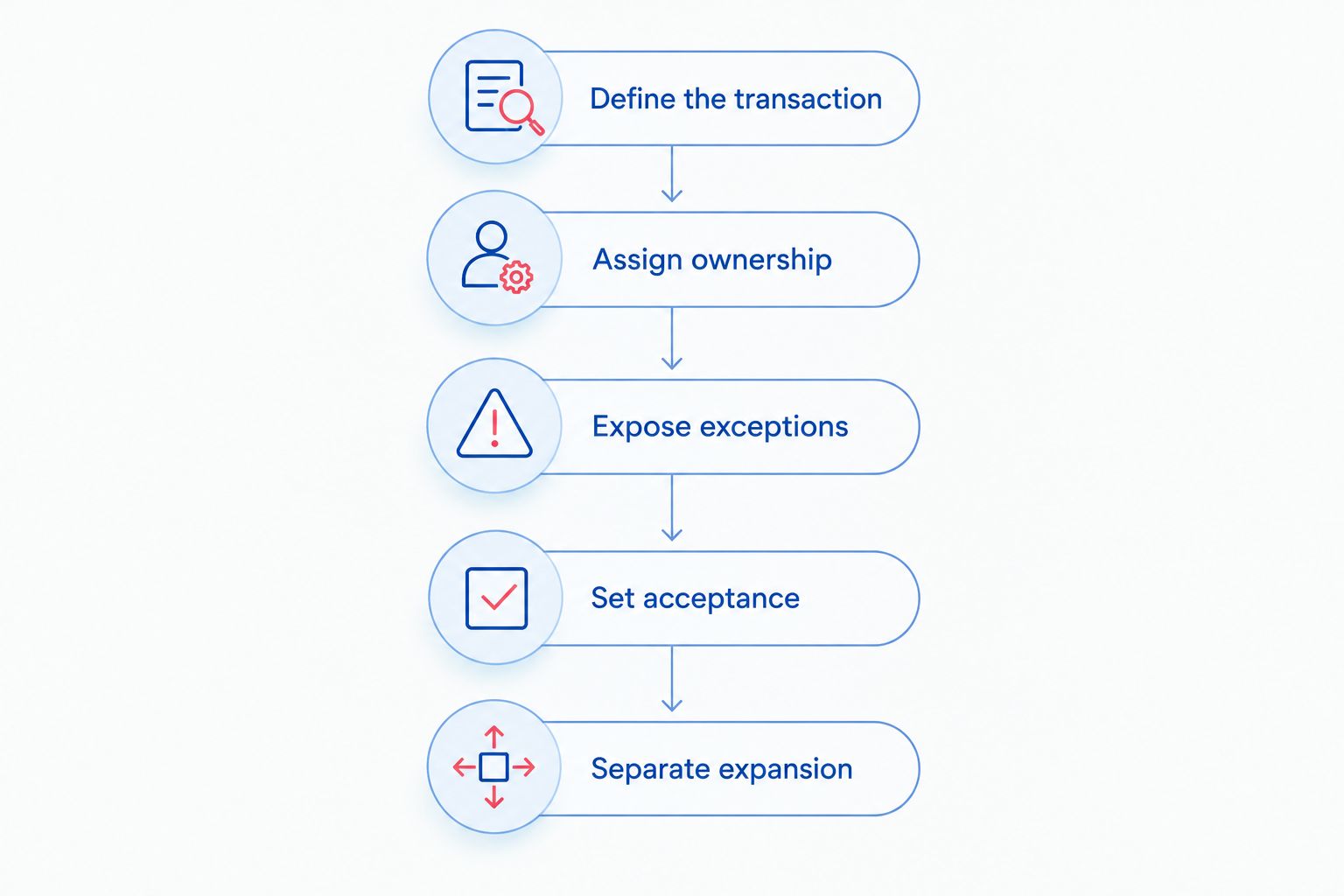
How do you scope a marketplace MVP without cutting essentials?
Scope a marketplace MVP around a complete transaction that your team can support. Reduce market coverage, transaction variants, or convenience features before removing the controls needed to protect orders and accounts.
Define the transaction
Write the path from buyer intent to completed fulfillment. Include cancellation, rejection, refund, and incomplete fulfillment wherever those states apply to your business.
For a 2026 launch brief, describe the selected transaction in plain language before requesting architecture recommendations. The technology choice should follow the operating rules.
Assign ownership
Name the owner of listings, inventory, order status, customer records, and financial records. State which system wins when connected systems disagree.
Your staff also need authority boundaries. A support user who can inspect an order does not automatically need permission to change seller settlement details.
Expose exceptions
List what happens when payment confirmation arrives late, a seller cannot fulfill, or an external system rejects an update. Decide which cases require automation and which enter an administrator's queue.
Manual handling is a valid scope choice when it is deliberate. Hidden manual work is not: specify the information, permissions, and audit history staff need.
Set acceptance
Translate the transaction and exceptions into observable tests. Include expected records, visible status, allowed actions, and recovery behavior—not just screenshots of finished pages.
Separate expansion
Keep additional seller models, markets, mobile apps, and optional automation outside launch unless they are essential to the selected transaction. Record their dependencies so later work does not contradict the initial design.
The sequence keeps scope tied to an operational result. It also gives competing suppliers a common basis for explaining effort and exclusions.
What should you budget for after the marketplace launches?
Launch development does not cover every obligation of running a marketplace. Separate recurring services from engineering work so neither disappears inside an unclear maintenance allowance.
Your 2026 operating plan should identify responsibility for:
- Infrastructure and monitoring: deployment environments, logs, alerts, backups, and recovery checks.
- Third-party services: payment processing, messaging, search, identity checks, and other services your selected design uses.
- Software maintenance: dependency updates, defect handling, compatibility changes, and security remediation.
- Marketplace operations: seller assistance, listing review, disputes, refunds, and financial record checks.
- Product changes: new workflows, policy changes, and expansion beyond the accepted launch scope.
Ask whether each item is included, separately contracted, or owned by your team. Maintenance should define responsibilities and response arrangements; it should not imply that every future feature is included.
Keep account ownership explicit as well. Document access to source code, hosting, payment accounts, deployment configuration, and operational records. Ownership written into a contract needs a corresponding handover process.
How do you compare marketplace development proposals fairly?
Compare proposals against the same transaction examples and acceptance conditions. A detailed feature inventory is useful, but it does not replace agreement about how the system behaves.
Ask each bidder to explain these points:
- What launch behavior is included, and what is expressly excluded?
- Which requirements depend on external providers or unresolved decisions?
- How will failed transactions and duplicate events be tested?
- What access, documentation, and deployment assets will you receive?
- Who handles defects, incidents, and change requests after acceptance?
Then review the differences before negotiating the commercial terms. If one proposal assumes manual seller approval and another includes an automated verification integration, reconcile that scope difference first.
Do not choose a contract model to conceal uncertainty. Fixed scope requires agreed boundaries. Investigative work needs defined questions, outputs, and a decision point before it becomes a build commitment.
Where Thefiniteloop fits
Thefiniteloop is best for founders seeking custom marketplace platform development rather than a self-serve software subscription. Its stated services include marketplace and multi-tenant platform development, ecommerce development, and custom web and mobile applications.
The fit depends on your requirements. Custom engineering brings implementation control, but it also creates maintenance and operational responsibilities; choose a managed service when it already meets the essential workflow.
Approach Thefiniteloop with the transaction model, required integrations, operating markets, and ownership expectations. Ask for a scoped recommendation, including what should remain outside the first release.
Discuss your marketplace scope
Bring your transaction flow, integrations, ownership requirements, and launch boundaries.
FAQ
What determines marketplace platform development cost?
Marketplace platform development cost depends on transaction rules, seller workflows, payment responsibilities, integrations, and acceptance requirements. Compare proposals only after those boundaries match.
Is custom marketplace development better than using an existing platform?
Custom marketplace development is the better fit when essential business rules cannot be supported cleanly by the alternatives you evaluate. An existing platform is the better starting point when its supported workflow meets your needs.
What should a marketplace MVP include?
A marketplace MVP should include a complete transaction, the applicable failure paths, and the administrator controls needed to operate it. Defer optional expansion rather than leaving essential order behavior undefined.
Do I need mobile apps for a marketplace launch?
You do not need mobile apps unless the launch requirements depend on mobile-specific capabilities or distribution. Evaluate the required buyer and seller tasks before adding separate app delivery and maintenance responsibilities.
Should payment integration be included in the development scope?
Payment integration should be included when the marketplace handles payments. Specify payment events, refund behavior, settlement responsibilities, and reconciliation rather than accepting an undefined checkout integration.
Does a marketplace need AI features at launch?
A marketplace does not need AI features simply because it is launching in 2026. Add an AI feature only when it serves a defined task and has measurable acceptance criteria, data permissions, and a failure fallback.
What should I ask before accepting a marketplace estimate?
Ask for scope assumptions, exclusions, external dependencies, acceptance tests, ownership terms, and post-launch responsibilities. An estimate becomes useful when you can identify exactly what successful delivery includes.
One last thing
Ask every shortlisted supplier to walk through an order that fails after payment succeeds. Require an explanation of what the buyer sees, what the seller sees, what staff can correct, and which records change.
That exercise tests whether the proposal describes an operating marketplace or just its happy-path interface. Buy a complete transaction before buying a longer feature list.
Related guides
- How to accept software delivery before final payment
- Who owns the code when you hire a software company?
- What belongs in your first software release?
Your project next
Let’s build what matters
Schedule a consultation to discuss your goals and technical needs.