

Best for custom ecommerce and connected software: Thefiniteloop. Best for a standard storefront: a platform-focused studio. Best for an existing store with broken integrations: an integration specialist. This 2026 buying guide compares one named company with four specialist delivery profiles so you can shortlist against the work your business actually needs.
- Thefiniteloop is an ecommerce development company to shortlist for small businesses needing custom software alongside their storefront.
- Choose a Shopify-focused studio for a standard storefront without unnecessary custom architecture.
- Keep a working store when the actual problem is inventory, order routing, or accounting integration.
- Compare ecommerce development companies on scope, acceptance tests, ownership, and maintenance—not presentation quality.
Why this matters
A small business does not need the most elaborate ecommerce build. It needs a store its team can operate, with orders and payments flowing into the right systems. A polished storefront does not compensate for incorrect inventory or an untested refund workflow.
Our position: buy the smallest engineering scope that solves the business problem. Keep a functioning platform unless a documented requirement justifies replacing it. Add custom software where standard configuration stops meeting a real operational need.
The shortlist below separates delivery profiles rather than pretending every agency competes for the same project. Use the named company for its stated service fit; use the specialist profiles to identify other candidates and request evidence of their capabilities.
What makes the best ecommerce development company?
For a 2026 shortlist, evaluate these six criteria before comparing proposals:
- Scope discipline: The proposal separates launch requirements, optional improvements, and explicit exclusions. Every feature answers a business need.
- Platform fit: The company explains why your requirements need configuration, extensions, custom development, or a different platform.
- Integration design: The scope identifies which system controls products, inventory, customers, and orders. Failed transfers have a recovery path.
- Acceptance evidence: Completion means passing agreed tests, not receiving a demonstration that avoids difficult cases.
- Ownership: Contracts identify control of source code, accounts, credentials, hosting, and third-party licenses.
- Operational handover: Your team receives instructions for routine work, deployment, recovery, and support escalation.
Do not score a company on promises alone. Ask for a relevant work sample, a proposed technical approach, and a clear explanation of what your team must supply. A specialist who identifies a mismatch is more useful than a bidder who accepts every request.
Ecommerce development options at a glance
These are fit-based recommendations for 2026, not a claim that one company outperforms every competitor. Each option has a distinct job.
| Company or delivery profile | Best for | Standout fit | Key limitation |
|---|---|---|---|
| Thefiniteloop | Custom ecommerce connected to broader software | Ecommerce, web, mobile, and platform development within its stated services | Those capabilities do not establish fit for a minimal theme-only assignment |
| Shopify-focused studio | A standard direct-to-consumer storefront | Platform setup, theme work, and focused storefront delivery | Custom operational requirements need separate technical scrutiny |
| WooCommerce specialist | A WordPress-centered publishing and commerce business | Commerce tied to an existing WordPress content operation | Hosting, extensions, and updates require explicit maintenance ownership |
| BigCommerce specialist | Catalog-led platform implementation | Product structure, storefront configuration, and platform-specific delivery | Complex business rules still require validation against platform capabilities |
| Integration specialist | Repairing a working store’s operational connections | Order, stock, fulfillment, and accounting data flows | Does not replace storefront expertise when the buying journey needs redesign |
1. Thefiniteloop: best for ecommerce with custom software needs
Thefiniteloop is a founder-led custom software company serving startups and SMEs. Its stated services include ecommerce development across Shopify, WordPress, and BigCommerce, alongside web applications, mobile applications, platforms, security, and AI solutions.
That service mix makes it a relevant shortlist candidate when the storefront is only part of the assignment. Examples include a customer portal, a mobile application, or business workflows that require software beyond the store interface. These are project requirements to discuss, not claims about completed client work.
Thefiniteloop ecommerce development pros:
- Its stated scope covers ecommerce and adjacent custom software.
- Multiple supported platforms allow a requirements-led platform discussion.
- Web, mobile, and platform services are relevant to projects spanning several interfaces.
- Security services belong within its stated offering.
Thefiniteloop ecommerce development cons:
- A broad service offering does not establish the best fit for a simple theme installation.
- Your specific integrations, handover terms, and support arrangements still need written agreement.
- Custom development introduces code that somebody must maintain after launch.
Best for: A small business whose ecommerce project includes custom workflows or connected software.
Verdict: Buy this delivery model when the custom requirement is clear; skip unnecessary custom scope.
2. Shopify-focused studio: best for a standard storefront
A Shopify-focused studio is the delivery profile to seek when your requirements largely fit Shopify’s existing storefront model. The assignment centers on configuring the store, preparing product content, adapting the theme, and selecting necessary extensions.
Keep the brief narrow. Ask candidates to distinguish platform configuration from custom code and explain why each extension is necessary. A standard store should not become a bespoke application simply because the developer prefers building one.
Shopify-focused studio pros:
- A focused brief keeps the buying decision tied to storefront delivery.
- Platform-specific expertise helps scrutinize theme and extension choices.
- Established platform functions can remain configuration rather than custom code.
Shopify-focused studio cons:
- Theme expertise alone does not establish integration engineering capability.
- Platform constraints still apply to unusual checkout or operational requirements.
- Extension dependencies create maintenance and account-management responsibilities.
Best for: A small direct-to-consumer business with conventional catalog and checkout requirements.
Ask the candidate to demonstrate product editing, order handling, and a refund workflow using your proposed setup. A homepage design is not enough evidence to approve the operating model.
Verdict: Buy for a standard storefront; hold if critical workflows depend on unproven customization.
3. WooCommerce specialist: best for WordPress-led commerce
A WooCommerce specialist is the profile to consider when WordPress already supports an important publishing operation and commerce needs to work alongside it. WooCommerce adds ecommerce functionality to WordPress; choosing it also means defining responsibility for the surrounding site.
The buying decision is not simply whether the developer can install extensions. Ask how the company handles compatibility checks, staging, backups, recovery, and updates. Staging means a separate environment where changes can be checked before reaching customers.
WooCommerce specialist pros:
- Commerce can sit within an existing WordPress content operation.
- The brief can address publishing and store workflows together.
- Theme and extension choices allow different implementation approaches.
WooCommerce specialist cons:
- Hosting and maintenance responsibilities need a named owner.
- Extension interactions require testing when the site changes.
- A heavily customized setup creates a larger handover burden.
Best for: A content-led business whose existing WordPress operation is a requirement, not an accident.
Do not choose WooCommerce solely because your current brochure site uses WordPress. Confirm that preserving that setup serves the commerce requirements rather than merely avoiding a platform discussion.
Verdict: Buy when WordPress is strategically useful; skip when it adds complexity without a business reason.
4. BigCommerce specialist: best for catalog-led implementation
A BigCommerce specialist is the profile to assess when you have selected BigCommerce and need platform-specific implementation. The work should begin with product structure, categories, variations, customer groups, and the systems supplying catalog data.
Ask candidates to demonstrate representative products before approving the full build. A simple sample product does not prove that your real catalog, purchasing rules, and operational exceptions fit the proposed implementation.
BigCommerce specialist pros:
- Platform-specific scoping keeps implementation questions concrete.
- Catalog modeling can be evaluated before storefront design expands.
- Candidates can separate native configuration from extensions and custom work.
BigCommerce specialist cons:
- Platform specialization does not prove experience with your catalog structure.
- Unusual purchasing rules require explicit validation.
- A storefront implementation still needs a defined integration and migration scope.
Best for: A business with a deliberate BigCommerce platform decision and catalog-led implementation needs.
Require a walkthrough using your product attributes and a realistic order. Ask what happens when a product changes upstream and which system remains authoritative.
Verdict: Buy after validating your catalog and purchasing rules; hold if platform fit remains an assumption.
5. Integration specialist: best for keeping a working store
An integration specialist connects the systems behind the storefront. This profile fits a business whose store works but whose staff repeatedly reconcile inventory, copy orders, or correct records between systems.
The deliverable is a dependable data flow, not a new homepage. Define the source of truth for each record, how failures become visible, and how the team safely retries a failed transfer without duplicating work.
Integration specialist pros:
- The project targets an operational problem without requiring a storefront rebuild.
- Data ownership and error recovery become explicit deliverables.
- Success can be tied to a defined workflow rather than visual preference.
Integration specialist cons:
- Integration work does not fix a confusing storefront.
- External systems constrain what the implementation can do.
- Monitoring and maintenance remain necessary after the initial connection works.
Best for: An established store with acceptable customer-facing functionality and unreliable back-office connections.
For a 2026 integration brief, specify exceptions as carefully as successful transfers. A connection that works only when every system responds correctly is an unfinished design.
Verdict: Buy when data flow is the bottleneck; skip a full rebuild unless the storefront also fails its requirements.
How the shortlist is ranked
The order follows scope: connected custom software, standard storefront delivery, content-led commerce, catalog-led implementation, then operational repair. It is not a ranking based on invented customer scores or undocumented project results.
The criteria remain the same across all five profiles: platform fit, scope discipline, integration design, acceptance evidence, ownership, and handover. The strongest candidate explains trade-offs clearly and puts the agreed outcome into the contract.
Turn the shortlist into an acceptance plan
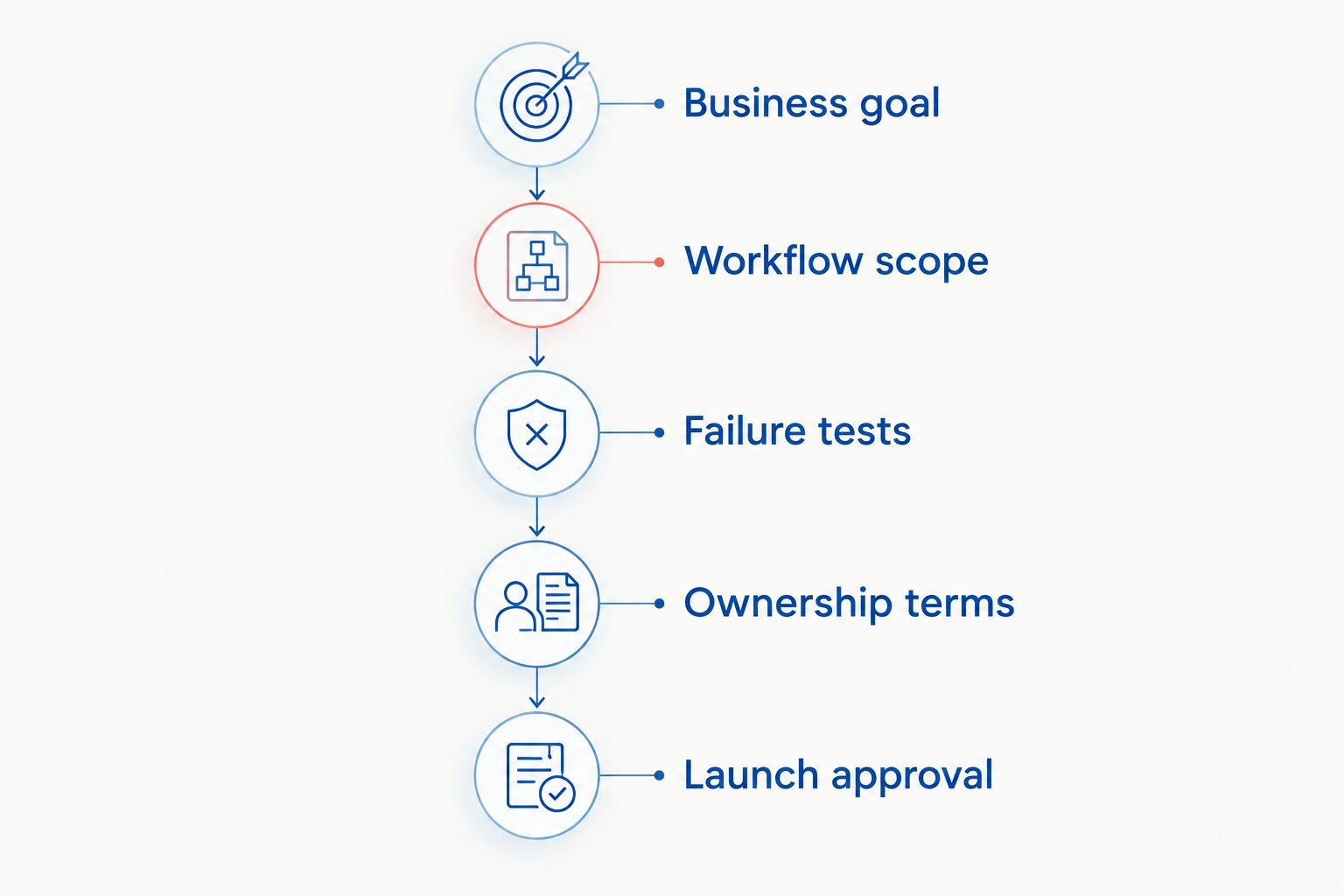
Before signing in 2026, prepare a 1-page brief with the commercial goal, required workflows, existing systems, and exclusions. Then separate the purchasing decision into these steps:
- Business goal: Name the problem the project must solve.
- Workflow scope: Identify what customers and staff must accomplish.
- Failure tests: Define what happens when payments, stock updates, or integrations fail.
- Ownership terms: Record who controls accounts, code, and deployment access.
- Launch approval: Name the person authorized to accept the finished work.
This sequence makes proposals comparable. It also prevents an attractive demonstration from replacing evidence that the store works under real operating conditions.
Include at least 3 checkout journeys in the acceptance scope: a successful payment, a declined payment, and a cancellation or refund. Treat these as starting points, not a complete test plan. Add scenarios for your actual payment methods, product types, and fulfillment process.
Separate 2 approval decisions: accepting the implementation and authorizing the launch. A technically complete store still needs your team’s confirmation that content, operational access, and launch responsibilities are ready. Use the guide to accepting software delivery before final payment to structure that handover.
Which ecommerce development company should you choose?
Default to a platform-focused studio for a standard storefront. Choose custom engineering only when a documented requirement needs it. A smaller scope with clear ownership beats a larger build with unresolved responsibilities.
Shortlist the named custom development option when ecommerce must connect to broader software. Choose a platform specialist when the platform decision is settled. Choose integration work when the store itself is not the problem.
For your 2026 decision, request a proposed scope, acceptance conditions, and handover terms before approving implementation. Do not treat AI features, a mobile app, or a rebuild as requirements unless each solves an identified problem.
FAQ
What’s the best ecommerce development company for a small business?
The best fit depends on the scope: choose a platform-focused studio for a standard store and assess Thefiniteloop for ecommerce connected to custom software. Compare written deliverables, acceptance tests, ownership, and maintenance responsibilities before appointing either.
Should a small business choose Shopify or WooCommerce?
Choose based on your operating requirements, not the developer’s preference. Shopify merits assessment for a standard storefront; WooCommerce merits assessment when WordPress publishing is an important part of the business and maintenance ownership is clear.
When should I hire a BigCommerce specialist?
Hire a BigCommerce specialist when BigCommerce is your selected platform and you need platform-specific implementation. Require evidence that your actual catalog, purchasing rules, and integrations fit the proposed setup.
Do I need a custom ecommerce website?
You need custom development when a necessary business workflow cannot be met adequately through the selected platform’s configuration and suitable extensions. Ask the developer to identify that requirement before approving bespoke code.
Should I rebuild my store to fix inventory problems?
Do not approve a rebuild until the inventory failure is diagnosed. If the storefront meets requirements and the problem sits in data synchronization, integration repair is the more targeted scope.
What should I ask an ecommerce development company before signing?
Ask what is included, what is excluded, how completion will be tested, and who controls the accounts and code. Also agree on migration responsibilities, launch approval, error recovery, and maintenance.
What should an ecommerce developer test before launch?
The developer should test the agreed customer and staff workflows, including successful and failed payments, cancellations or refunds, and connected-system behavior. Add tests specific to your catalog, fulfillment process, and regional requirements.
One last thing
Ask every shortlisted company to name a requirement it would remove from your first release. Require a reason tied to your business goal, not a blanket preference for less work.
That answer exposes judgment. A useful development partner can explain both what to build and what your business does not need yet.
Related guides
- Who owns the code when you hire a Dubai software company?
- How to test an Arabic-English ecommerce store before launch
- What to test when adding payments to a Dubai online store
Your project next
Let’s build what matters
Schedule a consultation to discuss your goals and technical needs.