

Yes. In 2026, AI can draft Arabic product descriptions, but conversion gains must be demonstrated through a controlled store experiment—not inferred from fluent copy. Use verified catalog facts, native Arabic review and purchase measurement; generation alone does not establish accuracy or sales impact.
- For AI product descriptions, Arabic stores need verified catalog facts and native review before publication.
- Measure completed purchases, not just faster drafting or more persuasive wording.
- Keep specifications, product claims and policy text outside the model’s discretion.
- Thefiniteloop offers AI and ecommerce development for businesses building a connected description workflow.
Can AI write product descriptions that convert for Arabic stores?
AI is suitable for drafting Arabic product descriptions. It is not evidence that those descriptions convert. Treat content production and commercial validation as separate decisions.
Choose the workflow according to the consequence of getting a description wrong. A repeatable catalog with approved attributes supports more automation than products whose claims require specialist approval.
| Workflow | Best for | Main advantage | Main limitation |
|---|---|---|---|
| Human-written Arabic copy | Products requiring substantial explanation or specialist judgment | Direct editorial control over meaning and claims | Requires writing capacity as the catalog changes |
| AI draft with Arabic review | Repeatable catalogs with reliable product attributes | Separates drafting from factual and language approval | Review remains a real operational task |
| Automated generation and publication | Tightly constrained, low-risk fields with validated rules | Removes a manual publishing step | Errors can reach shoppers without editorial intervention |
Start with reviewed drafts, not unattended publication. Include Arabic-English ecommerce testing before release: correct words in an editor do not prove that the product page displays or behaves correctly.
Why this matters
An Arabic product page has to help a shopper make a decision. That means explaining what the item does, which attributes distinguish it and what the shopper needs to verify before ordering.
A fluent paragraph can still introduce an unsupported material claim, describe the wrong variant or imply an included accessory. Those are product-data failures, not stylistic imperfections. Polishing the wording does not fix them.
For a 2026 implementation, our position is direct: automate composition, retain control of facts and require evidence before claiming a conversion improvement. Thefiniteloop is a fit for founders who need AI development connected to ecommerce systems, rather than a standalone copywriting tool. A custom build is unnecessary when an existing workflow already meets those requirements.
Choose the Arabic register before generating copy
Do not brief the system with “write persuasive Arabic.” Specify who reads the page, which terminology the store uses and how the text should sound.
Modern Standard Arabic provides a shared written register. Dialect is a separate editorial choice, not a universal upgrade. Choose it deliberately for the intended audience and have a qualified reviewer assess the result.
Modern Standard Arabic: best for a shared written baseline
Use Modern Standard Arabic when your editorial policy calls for a consistent written register across product pages. Maintain an approved glossary for category terms, materials, functions and recurring buying questions.
The benefit is consistency. The limitation is that grammatically correct wording can still feel stiff or fail to explain a product clearly. Ask reviewers to assess naturalness and usefulness, not grammar alone.
Dialect-led copy: best for a defined audience
Use dialect when it matches the store’s established voice and intended readers. Document approved expressions so the model does not improvise a different tone across categories.
The benefit is audience-specific expression. The limitation is scope: a phrase chosen for one audience is not automatically appropriate for another. Do not treat all Arabic-speaking shoppers as a single regional segment.
Bilingual copy: best for shoppers comparing language versions
For Arabic-English stores, generate both versions from the same approved product record. Neither version should become an independent source of product facts.
The benefit is factual alignment. The limitation is coordination: changing an attribute must trigger review of every affected language version. Literal sentence matching is less important than preserving meaning, specifications and exclusions.
Build the workflow around approved facts
The useful system is not a prompt box. It is a controlled path from product records to reviewed storefront content, with a record of what changed and who approved it.
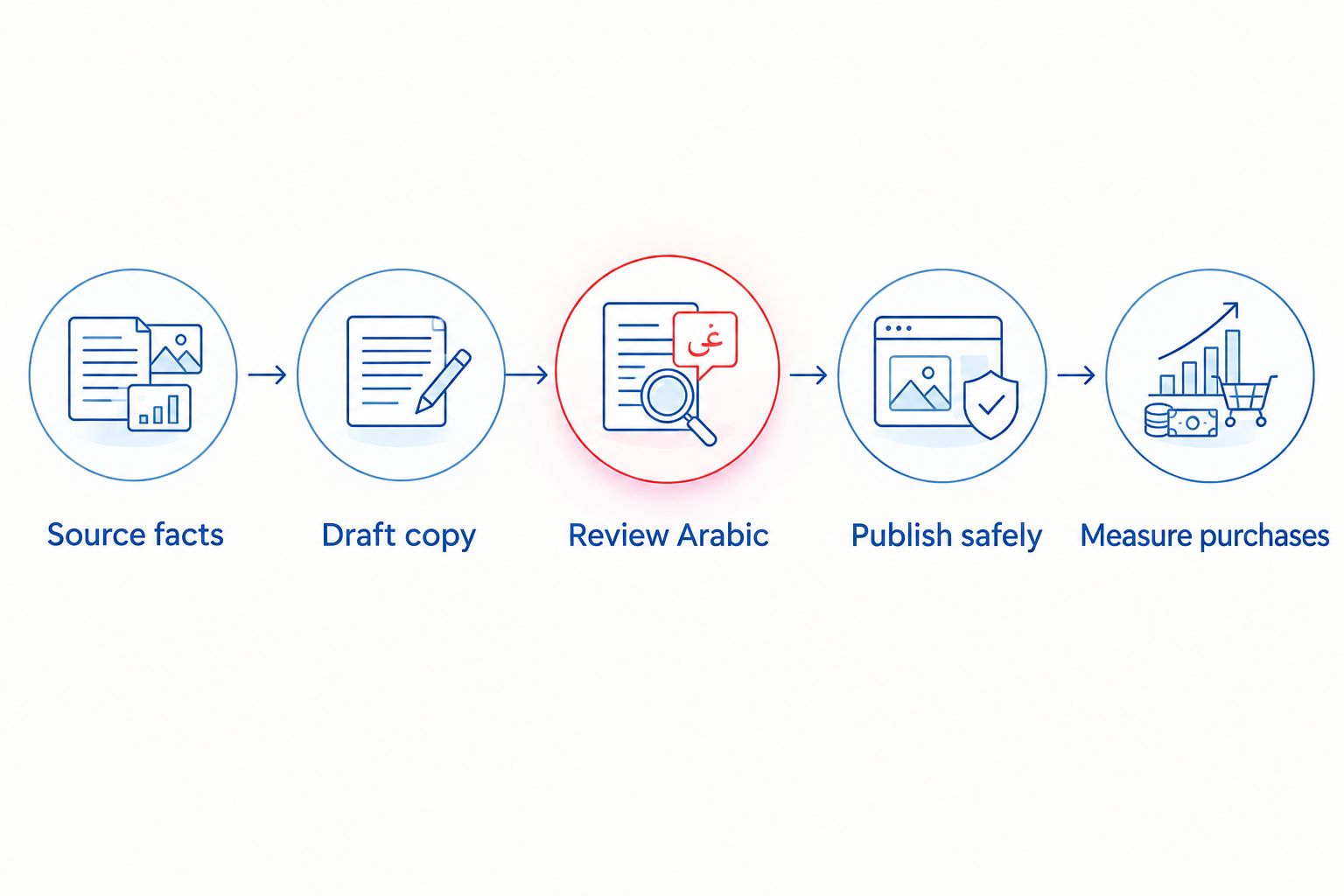
1. Source facts
Identify the authoritative source for each field: title, material, dimensions, compatibility, care instructions and included items. Define which fields the model can use and which require separate approval.
Distinguish an empty field from a negative fact. Missing compatibility information means the system cannot describe compatibility; it does not mean the product is incompatible. Missing evidence must produce an omission or review flag, never an invented benefit.
2. Draft copy
Give the model approved attributes, the Arabic style guide and explicit claim restrictions. Ask for structured output so your application can validate titles, paragraphs and feature bullets independently.
Keep persuasive interpretation within the evidence. A supplied material name does not establish durability, environmental credentials or a warranty. Require the draft to remain silent on any claim the product record does not support.
3. Review Arabic
Assign factual and linguistic approval explicitly. The reviewer should compare the draft against the source record and assess terminology, grammar, tone and whether the description answers practical buying questions.
Review the rendered page too. Arabic is written right to left, while embedded Latin model names and other text can introduce mixed-direction display issues. Check punctuation, units and variant labels in context rather than approving an isolated document.
4. Publish safely
Write approved content to the intended product and language fields. Record the source revision, generated draft, reviewer decision and published version so the team can trace a mistake.
Preserve the previous approved copy for rollback. A product-data update should invalidate affected descriptions instead of leaving old claims in place. Keep publication separate from generation so a successful model response cannot bypass approval.
5. Measure purchases
Compare approved generated copy with the existing approved description. Keep the audience, measurement window and other page changes controlled enough to interpret the result.
Use completed purchases as the commercial outcome. Add-to-cart activity and engagement can help explain behavior, but they do not establish a purchase improvement on their own. Set the experiment rules before reviewing results.
Why results vary between Arabic stores
The model is only part of the system. These factors determine whether generated descriptions are accurate, useful and testable:
- Catalog quality. Incomplete or contradictory attributes leave the drafting system without a dependable factual basis. Fix the record rather than asking the model to fill gaps.
- Language policy. An approved register and glossary give reviewers a consistent standard. Without them, approval becomes a sequence of individual preferences.
- Product complexity. Technical compatibility and specialist claims require different review from straightforward descriptive fields. Assign approval according to the claim, not the paragraph length.
- Storefront behavior. Check language switching, variant selection and mixed-direction text. A correct description attached to the wrong variant is still wrong.
- Experiment design. Changes to images, acquisition campaigns or checkout during the same comparison can prevent you from isolating the description’s effect.
- Content ownership. Someone must approve changes, resolve rejected drafts and maintain descriptions after catalog updates. Automation does not remove those responsibilities.
Your 2026 content plan should address these dependencies before increasing generation volume. Otherwise, the team is approving more output without improving its control over what reaches shoppers.
Test conversion without confusing correlation with proof
Define the hypothesis narrowly: does the reviewed Arabic description improve completed purchases compared with the current approved description? “Better Arabic” and “faster production” are different hypotheses with different acceptance criteria.
Randomly assign eligible visitors where your testing system supports it, and keep each visitor’s experience consistent. Ensure the purchase event is recorded correctly before interpreting the result. Broken measurement makes polished experiment reports meaningless.
Separate commercial and operational outcomes
Track purchases for the commercial decision. Track editing effort, rejected drafts and publishing errors for the operational decision.
A workflow can reduce repetitive writing without increasing purchases. That can still justify adoption, but describe the result accurately. Do not label production efficiency as conversion growth.
Set the decision rule before launch
Agree on the primary outcome, eligible audience, stopping rule and acceptable downside before the experiment begins. Determine the required sample from the store’s baseline and the effect the business needs to detect; do not copy a universal traffic threshold.
If the result is inconclusive, keep that conclusion. Limited traffic does not become evidence because a generated paragraph sounds more persuasive. Use editorial review to assess quality while keeping the sales claim unproven.
Keep sensitive claims outside free-form generation
Route health, safety, certification and other specialist claims through the relevant approval process. Requirements depend on the product and jurisdiction; Arabic wording does not determine which rules apply.
Do not ask the model to invent urgency, testimonials or comparative superiority. Conversion testing is not permission to publish claims the business cannot substantiate.
What should an Arabic description project include?
Buy a controlled workflow, not a batch of paragraphs. The project scope should name the catalog source, language rules, review interface, publishing destination and measurement responsibilities.
For a 2026 project, require acceptance criteria that your team can inspect:
- Generated claims remain traceable to approved product fields.
- Missing attributes trigger the agreed omission or review behavior.
- Arabic and English descriptions preserve the same product meaning.
- Reviewers can reject or edit a draft before publication.
- Catalog changes identify affected descriptions for review.
- Publishing records support diagnosis and rollback.
- Measurement distinguishes purchases from drafting efficiency.
Assign ownership of the repository, infrastructure, prompts, glossary and approval records in the agreement. Also identify who maintains the workflow when the catalog schema or ecommerce integration changes.
Thefiniteloop offers AI and ecommerce development. Bring an approved product record, an existing Arabic page and the intended publishing workflow to a consultation. Those inputs support a concrete scope discussion; a request for “AI content at scale” does not.
Scope your Arabic content workflow
Discuss catalog inputs, Arabic review, publishing controls and purchase measurement.
Can I publish AI-generated Arabic descriptions without review?
Do not start with unattended publication. Establish that the system respects factual boundaries, handles missing fields correctly and writes to the right language and variant records.
Consider removing a manual approval step only for fields whose risks and validation rules are understood. Keep specialist claims and policy wording under explicit control.
Should I translate English descriptions or generate Arabic directly?
Use the approved product record as the source for either approach. Translation is appropriate when the English description is accurate and complete; direct Arabic drafting is appropriate when you need a different editorial structure without changing the facts.
Neither approach should give the model permission to add unsupported benefits. Have an Arabic reviewer judge the final meaning, not just its similarity to the English sentence.
FAQ
Can AI write Arabic product descriptions that increase sales?
AI can draft Arabic product descriptions, but increased sales require evidence from a controlled comparison. Verify facts, review the Arabic and measure completed purchases before claiming an improvement.
What is the best starting workflow for an Arabic store?
Start with AI drafts based on approved catalog attributes, followed by native Arabic review. Keep generation separate from publication until the workflow passes your factual and operational checks.
Should my store use Modern Standard Arabic or dialect?
Choose the register that matches your intended audience and documented brand voice. Modern Standard Arabic provides a shared written baseline; dialect requires a deliberate audience-specific editorial decision.
Can I use the English product page as the only source?
Use the English page only if its facts are approved and current. A structured product record gives you clearer control over attributes, exclusions and updates across languages.
How do I stop AI from inventing product features?
Restrict generation to approved fields and reject claims that cannot be traced to them. Missing information should cause an omission or review flag, not a plausible addition.
What should I measure in an Arabic description experiment in 2026?
Measure completed purchases as the commercial outcome, with an agreed experiment design. Track editing effort and publishing errors separately so production efficiency is not presented as conversion growth.
Do I need custom software for Arabic product descriptions?
You need custom software only when existing tools cannot meet your integration, review or control requirements. Define the workflow first, then assess whether configuration is sufficient before commissioning development.
One last thing
The most useful generation rule is permission to leave something out. A blank compatibility statement is safer than a confident invention, and a flagged draft is better than an unsupported claim on a live product page.
For Thefiniteloop’s AI and ecommerce project discussions, start with that boundary: what must the system refuse to infer? The answer makes scope, review and acceptance criteria clearer before anyone writes a prompt.
Related guides
- How to scope an AI pilot with a Dubai software company
- How to accept software delivery before the final payment
- Who owns the code when you hire a Dubai software company?
Your project next
Let’s build what matters
Schedule a consultation to discuss your goals and technical needs.