

A SaaS MVP development timeline should follow the smallest usable customer workflow, not a standard number of weeks. For your 2026 launch plan, include discovery, implementation, testing, deployment and acceptance—not just coding—and commit to a release date only after the scope and external dependencies are clear.
- Your SaaS MVP development timeline needs a defined customer workflow, acceptance criteria and named dependency owners.
- Thefiniteloop provides custom SaaS platform development for startups and SMEs; scope the buying decision around engineering needs.
- A prototype demonstrates an idea; a usable MVP must support its intended customers safely.
- Reduce optional features before cutting access controls, deployment checks or recovery procedures.
How long does it take to build a SaaS MVP?
The build takes as long as the agreed release needs to reach usable, tested acceptance. A calendar estimate without a defined starting point and finish line does not tell you when customers can use the product.
Start with what belongs in your first software release. Separate the workflow that proves customer value from features that make the product broader or more polished.
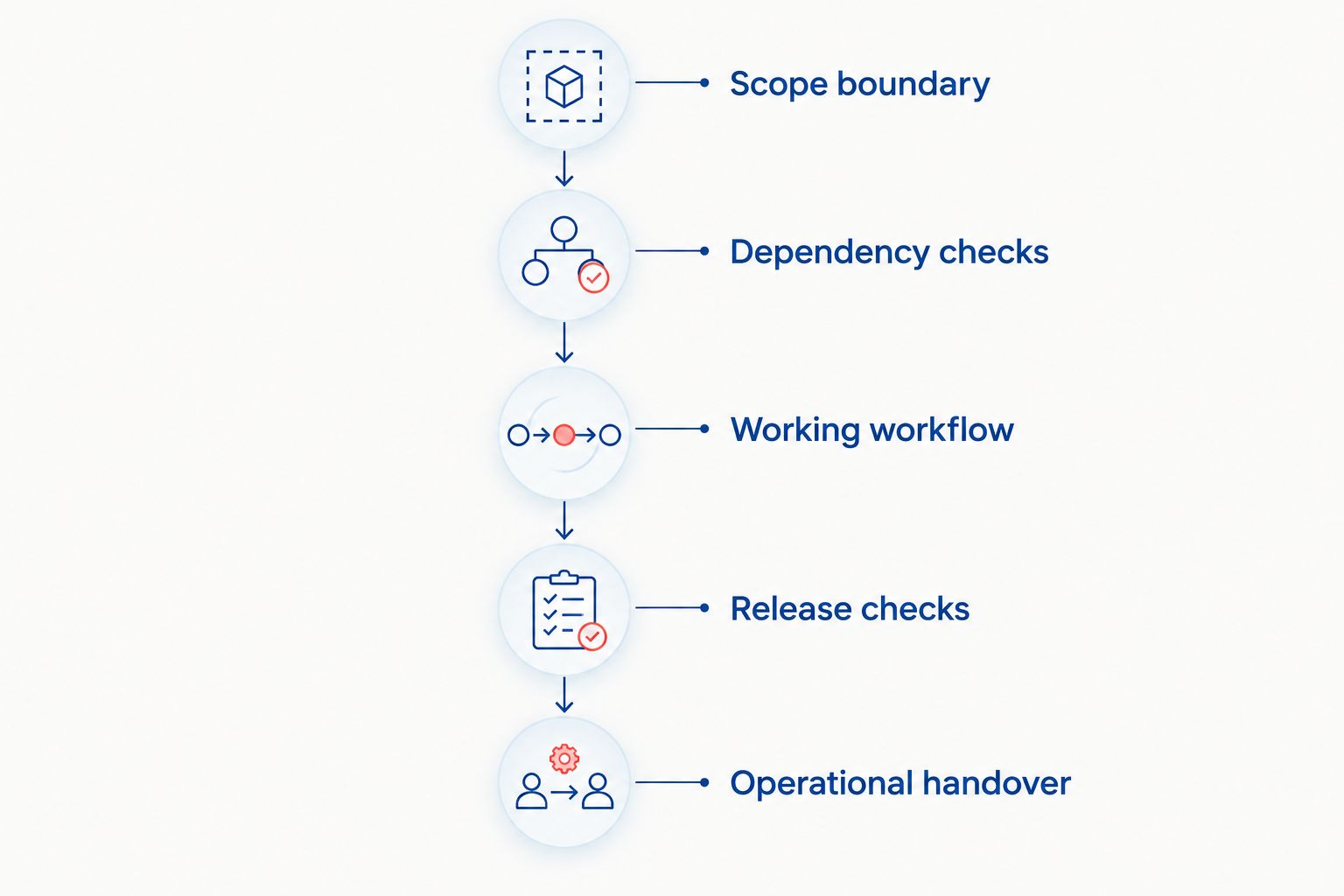
Use the following sequence to turn that boundary into a schedule. These are acceptance gates, not equal-length phases; some work overlaps once its dependencies are resolved.
- Define the outcome. Name the intended user, the task they need to complete and the evidence that the task succeeded.
- Resolve critical dependencies. Confirm access to required systems, representative data, integration documentation and decision-makers.
- Build the working path. Connect the interface, application rules and stored data so the customer can complete the intended task.
- Test failure paths. Check permissions, invalid inputs, interrupted operations and recovery—not just a successful demonstration.
- Accept and release. Verify the agreed behavior in the deployment environment, confirm operational ownership and approve customer access.
Ask a prospective development partner which gate supports each delivery milestone. If the answer describes activity rather than a demonstrable result, the schedule needs more work.
Why this matters
An MVP deadline is a business commitment. Sales conversations, customer onboarding and internal staffing can all depend on what the release actually supports.
For a 2026 buying decision, compare proposals against the same acceptance boundary. A proposal that ends at a demonstration is not equivalent to one that includes production deployment, permission testing and handover.
Our position at Thefiniteloop: define the release boundary before debating the delivery date. This does not mean designing the entire future platform. It means resolving the decisions that determine whether the first release is usable.
That recommendation does not require a full custom build. If an existing product already handles your essential workflow and the remaining differences are optional, assess configuration before commissioning replacement software.
Prototype, pilot or production MVP: choose the finish line
The word “MVP” does not settle what you are buying. A clickable prototype, a restricted pilot and a production MVP answer different questions, so their timelines should not be treated as interchangeable.
| Release option | Best for | Main advantage | Main limitation | Acceptance boundary |
|---|---|---|---|---|
| Clickable prototype | Checking a proposed interaction before implementation | Lets users review the intended journey | Does not prove backend behavior, security or integrations | Users can understand and attempt the proposed task |
| Restricted pilot | Testing a working workflow with controlled access | Exposes operational issues within a defined audience | Manual support and restrictions can conceal wider rollout needs | Selected users complete the workflow under agreed conditions |
| Production MVP | Serving the intended initial customers | Tests the product in its actual operating environment | Requires deployment, access controls and operational preparation | Customers complete the task and the team can support the release |
Choose the least extensive release that answers your immediate business question. Do not commission a production platform to test whether users understand a proposed screen. Equally, do not present a prototype as evidence that customer data and permissions work correctly.
A restricted pilot is useful when you can explicitly control access and support. It is the wrong shortcut when the proposed restrictions prevent you from testing the risk that matters.
Build the schedule around evidence, not activity
A useful 2026 delivery plan names the evidence needed to move forward. “Backend development complete” is weaker than “an authorized customer can submit a request and retrieve the saved result.”
Scope boundary
Write the primary workflow as a short sequence in the customer's language. Include where it starts, what the user supplies and what successful completion produces.
Then record exclusions. If reporting, bulk imports or advanced administration are outside the first release, say so before they become assumed commitments.
Dependency checks
Identify everything the delivery team cannot resolve independently. Examples include credentials, sample records, business-rule decisions and access to external systems.
Give each dependency an owner and a readiness condition. “Integration ready” should mean the team can perform the required operation, not merely that documentation exists.
Working workflow
Build a connected path through the interface, application rules and stored data. This exposes mismatches that separate screen demonstrations cannot reveal.
Review the result against acceptance examples. A screen looking finished does not establish that records save correctly or that another account cannot retrieve them.
Release checks
Run acceptance checks in an environment that represents the intended release. Confirm configuration, access, error handling and the process for responding to a failed deployment.
Resolve release-blocking defects before opening access. Record lower-priority issues separately rather than quietly changing the definition of completion.
Operational handover
Confirm who can deploy, inspect failures, restore service and manage customer access. Document unresolved limitations and who owns them.
Handover belongs in the release schedule. It is not an administrative task to squeeze in after the delivery team moves on.
Why a SaaS MVP development timeline varies
The relevant question is not how many screens you need. It is how much behavior, coordination and verification sits behind the customer journey.
- Workflow breadth. Each additional journey introduces business rules and acceptance cases. Separate the essential task from adjacent convenience features.
- Tenant and permission boundaries. Shared SaaS software needs explicit rules about which organization and user can access each record. Define these rules before building account-specific behavior.
- External integrations. Work depends on usable access, understood responses and defined failure handling. A connection that succeeds once is not a complete integration.
- Data preparation. Imported records need agreed mappings, validation and ownership of corrections. Treat data readiness as a delivery dependency.
- Acceptance decisions. Unresolved business rules leave implementation choices open. Name the person authorized to settle them and approve completed behavior.
- Release obligations. Deployment, monitoring, support and security checks change what “finished” means. Include the obligations that apply to your intended users and operating environment.
Do not apply one region's obligations to every customer. If jurisdiction-specific requirements affect your product, identify the jurisdiction and obtain the appropriate review before fixing the release boundary.
How can you shorten the timeline without weakening the product?
Remove optional behavior before removing essential safeguards. A narrower product can still be usable; a product with unclear permissions or no recovery process carries a different kind of risk.
Start by postponing features that do not change whether the customer completes the core task. Advanced dashboards, extensive configuration and secondary workflows belong outside the first release unless they are essential to that task.
Use manual operations deliberately. An internal team can handle an agreed administrative step during a restricted pilot, provided the owner, access rules and customer impact are clear. Manual work is not a substitute for protecting customer data.
Keep technical choices proportional to the release. Do not build an elaborate platform foundation solely for hypothetical future requirements, but do not defer a foundational decision when the first workflow already depends on it.
For an AI-enabled feature, define what acceptable output looks like and what happens when the system cannot produce it. If the customer outcome does not need that feature, leave it outside the MVP rather than adding uncertainty to the core release.
What should you ask before accepting a delivery estimate?
A useful estimate explains its assumptions. Ask for the scope, dependencies, exclusions, acceptance conditions and change process alongside the proposed dates.
What starts the delivery clock?
State whether delivery begins at contract approval, access readiness or scope approval. Otherwise, the same proposed duration can describe different commitments.
Ask which unresolved items prevent implementation from starting. Keep those items visible rather than treating waiting time as unexplained development delay.
What proves the milestone is complete?
Require demonstrable behavior and a named approver. Screenshots and status labels do not establish that the agreed workflow works.
Use a written process to accept a software delivery before the final payment. Acceptance should connect the commercial milestone to the agreed release, not to an impression of progress.
What happens when scope changes?
Require the team to explain what changes in the release boundary and schedule before accepting additional work. A new feature is not free of delivery consequences because it appears small on screen.
For a fixed launch event, separate essential release behavior from optional additions. Decide what leaves the release when something new enters it.
When custom development is the right next step
Thefiniteloop is a custom SaaS development option for startups and SMEs that need a purpose-built platform. The buying decision should turn on your workflow, integrations and ownership requirements—not a preference for custom software by itself.
Custom development gives you room to define behavior around your business. The trade-off is that implementation, verification and ongoing operation still need explicit ownership; commissioning the build does not remove those responsibilities.
For your 2026 project brief, bring the customer workflow, current constraints and required integrations. Ask for a scoped delivery discussion rather than a commitment based only on a feature list.
Discuss your SaaS release scope
Bring your core workflow, integrations and acceptance requirements to a custom development discussion.
FAQ
How long does it take to build a SaaS MVP in 2026?
A SaaS MVP timeline depends on the agreed workflow, dependencies and release criteria. Get a scope-based estimate that includes testing, deployment and acceptance rather than coding alone.
Can I launch a SaaS MVP faster by cutting features?
Yes, cutting optional workflows reduces the release scope. Preserve the access controls, data handling and recovery procedures required for the customers you intend to serve.
Does an MVP need subscription billing at launch?
An MVP needs subscription billing when billing is part of the customer workflow or business assumption being tested. If it is outside a controlled pilot, document the alternative process and its owner.
Is a clickable prototype the same as a SaaS MVP?
No, a clickable prototype demonstrates an interaction rather than a working production service. It does not establish that integrations, stored data or permission boundaries work.
Should I add AI to my first SaaS release?
Add AI only when it serves the core customer outcome and you can define acceptable behavior. Otherwise, keep it outside the first release and avoid making the essential workflow depend on it.
What should a SaaS MVP development estimate include?
A SaaS MVP development estimate should include scope, assumptions, dependencies, exclusions, acceptance conditions and release responsibilities. It should also explain how changes affect the delivery commitment.
Who should own the SaaS MVP after launch?
Your release plan should name the owners of deployment, incidents, customer support and ongoing changes. Confirm repository, infrastructure and credential access before handover.
One last thing
Define the first customer invitation as a release event, not a marketing event. Before sending it, confirm that someone can observe failures, respond to support requests and control further access.
Put that check into your 2026 acceptance plan. A working demonstration answers whether the workflow runs; an accepted release also answers who takes responsibility when it does not.
Related guides
- Software development for multi-tenant SaaS teams
- Who owns the code when you hire a software company?
- What security checks should a software build include?
Your project next
Let’s build what matters
Schedule a consultation to discuss your goals and technical needs.
One thought on “How long does it take to build a SaaS MVP?”