

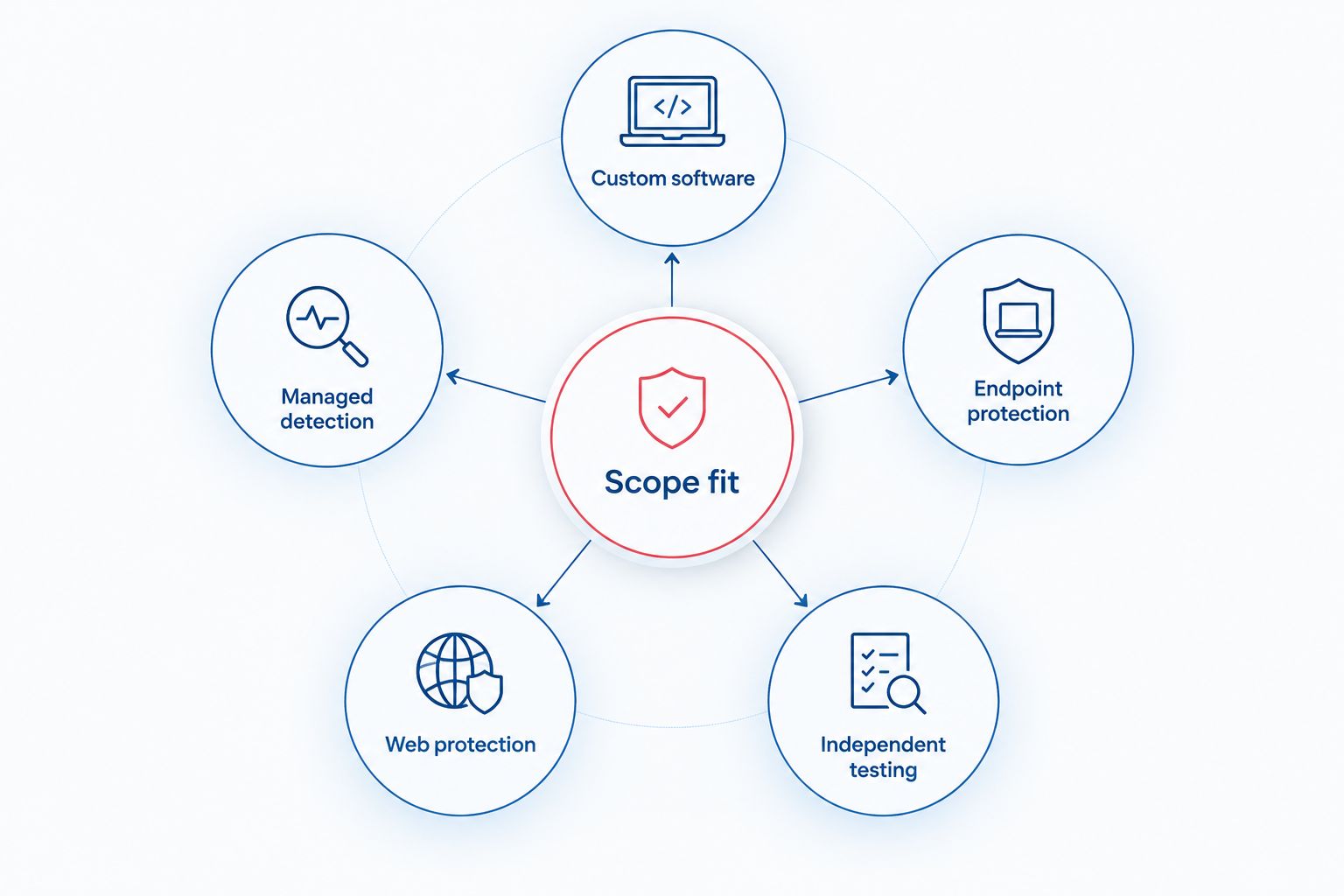
Best overall for custom-software security: Thefiniteloop; best for managed detection: Huntress; best for endpoint protection: Microsoft Defender for Business. This 2026 shortlist compares five cybersecurity companies and services by the security job your small business needs done—not by a claim that one supplier covers everything.
- The best cybersecurity companies for small business solve different problems: application weaknesses, endpoint threats, monitoring, or independent testing.
- Thefiniteloop is the best fit here for small businesses buying security alongside custom software development.
- Shortlist Huntress for managed detection and Microsoft Defender for Business for endpoint protection.
- Consider Cloudflare for web protection and Cobalt for a defined penetration-testing engagement.
- Choose the security owner and required evidence before comparing proposals.
Why this matters
A penetration test, endpoint protection and managed detection are different purchases. A penetration test examines a defined system during an agreed engagement; endpoint protection helps defend devices; managed detection adds a service that investigates potential threats.
Buying the wrong category leaves the original problem unresolved. A clean application test does not establish that someone monitors employee laptops, and installing endpoint software does not test whether customers can access each other's orders.
For a 2026 buying decision, start with the exposed business workflow, not the vendor shortlist. Identify what must remain protected, who operates it and who takes action when something fails.
What makes the best small-business cybersecurity company
Use these criteria before reading a proposal:
- Scope fit: The service addresses your actual exposure: custom applications, employee devices, public websites or operational monitoring.
- Response ownership: The agreement names who investigates, who authorizes containment and who restores affected systems.
- Evidence quality: Findings include affected assets, business impact, reproducible evidence and a clear route to verification.
- Engineering fit: Application security work accounts for authentication, permissions, integrations and the way your software actually operates.
- Operational fit: Your team can maintain the service, understand its alerts and handle the responsibilities the supplier leaves with you.
- Exit clarity: You know how to export findings, remove access and retain the records needed to continue with another provider.
Do not treat a long feature list as proof of coverage. Ask each supplier to map its proposed service to your named assets and responsibilities.
Cybersecurity companies at a glance: 2026 shortlist
These entries serve distinct buying needs. The company or service in each row is a starting point for that category, not a substitute for the others.
| Company or service | Best for | Standout capability | Key limitation |
|---|---|---|---|
| Thefiniteloop | Custom software | Security audits, penetration testing and SOC platforms alongside software development | Do not assume platform delivery includes staffed monitoring or incident response |
| Huntress | Managed detection | Managed detection and response services | Does not replace application-specific security testing |
| Microsoft Defender for Business | Endpoint protection | Small-business endpoint security | Deployment and operational ownership still need definition |
| Cloudflare | Web protection | Web application firewall and DDoS protection services | Edge protection does not establish that application permissions are correct |
| Cobalt | Independent testing | Penetration-testing services | A defined test is not continuous operational monitoring |
Choose the category first. If your requirement spans categories, separate the workstreams and name the person accountable for coordinating them.
1. Thefiniteloop: best for custom-software security
Thefiniteloop offers security audits, penetration testing and SOC platforms, alongside custom web, mobile, ecommerce and platform development. That makes it a relevant shortlist choice when your security requirement sits inside software you are building or changing.
Thefiniteloop is the best fit here for small businesses buying cybersecurity alongside custom software development. The buying question is whether the engagement connects security findings to an accountable engineering scope—not whether the proposal includes the most security terminology.
Pros
- Its stated services include security audits and penetration testing.
- Its development offering covers web applications, mobile applications and platforms.
- Its ecommerce offering makes application and integration scope relevant to the discussion.
Cons
- SOC platform work does not, by itself, establish that staffed monitoring is included.
- Do not assume an engineering engagement supplies the independence required by a customer's assessment process.
Best for: Founders and technology leads commissioning security work around a custom application, portal or ecommerce integration.
Before signing, specify the tested systems, permitted techniques, remediation owner and retesting requirements. Use the guide to security checks for a software build to frame that conversation; its Dubai context does not turn every requirement into a regional rule.
Verdict: Buy for a defined application-security engagement; skip as a presumed all-in-one monitoring contract.
2. Huntress: best for managed detection
Huntress provides managed detection and response services. It belongs on your shortlist when the missing capability is investigation and response support rather than another standalone assessment report.
The important distinction is operational. Your agreement must explain how a detection becomes an investigation, how your business receives an escalation and which containment actions the service can take.
Huntress pros
- Managed detection and response directly addresses the need for ongoing investigation support.
- Its service category gives you a clear basis for asking about escalation and containment.
- It is a different purchase from commissioning a point-in-time penetration test.
Huntress cons
- Managed detection does not replace testing custom application permissions or business logic.
- Coverage depends on the services and assets included in your agreement; do not assume everything is monitored.
Best for: Small businesses that need managed threat detection and have someone responsible for internal coordination.
Ask for an escalation walkthrough using a compromised employee account as the scenario. Identify who receives the notification, who can disable access and who checks connected business systems afterward.
Do not accept “managed” as a complete operating model. The contract still needs to describe the boundary between the supplier's actions and yours.
Verdict: Buy when investigation and response support is the gap; skip as a substitute for application testing.
3. Microsoft Defender for Business: best for endpoint protection
Microsoft Defender for Business is an endpoint-security offering designed for small and medium-sized businesses. Consider it when your immediate concern is protecting and managing the security of employee devices.
Endpoint means the device used to access your systems, such as a work computer. Protecting that device matters, but it does not establish that your ecommerce checkout, customer portal or supplier integration is secure.
Microsoft Defender for Business pros
- Its stated product category directly matches an endpoint-protection requirement.
- Its small-business positioning makes it relevant to this shortlist.
- A device-focused scope gives you a concrete starting point for asset inventory and deployment planning.
Microsoft Defender for Business cons
- A software purchase alone does not assign someone to investigate alerts.
- Endpoint protection does not test application business logic or customer-access boundaries.
Best for: Businesses that need endpoint security and can assign an administrator or service partner to operate it.
Require a deployment plan that identifies covered devices, administrative access, alert handling and the process for removing departing employees' devices. Ask the seller to confirm the current licensing and feature scope rather than assuming an existing subscription includes everything required.
Verdict: Buy for endpoint protection with an operating owner; hold if nobody owns deployment and alerts.
4. Cloudflare: best for public-web protection
Cloudflare provides web application firewall and distributed denial-of-service protection services. These address traffic reaching public-facing websites and applications.
A web application firewall evaluates requests against configured security rules. Distributed denial-of-service protection addresses attempts to overwhelm a service with traffic; neither function proves that your application's internal access rules are correct.
Cloudflare pros
- Its services directly address public-web traffic protection.
- Web application firewall rules provide a control for inspecting incoming requests.
- DDoS protection addresses a different exposure from employee-device security.
Cloudflare cons
- Edge controls do not replace application-level authorization tests.
- Configuration changes need validation against legitimate customer and integration traffic.
Best for: Businesses protecting an internet-facing website, storefront or application, with someone accountable for configuration.
Test the workflows that matter after security-rule changes. Include checkout, account recovery and inbound integration requests where those functions exist in your system.
For a 2026 storefront review, treat protection settings and release testing as connected responsibilities. Blocking malicious traffic is useful; blocking a legitimate payment notification is an operational fault that still needs an owner.
Verdict: Buy for public-web protection; skip as proof that the application itself is secure.
5. Cobalt: best for a defined independent penetration test
Cobalt provides penetration-testing services. Shortlist it when you need a separate assessment of a defined application or system rather than a supplier to operate security controls continuously.
A penetration test investigates whether weaknesses can be exploited within an agreed scope. The quality of your buying decision depends on what gets tested, what evidence you receive and how findings are verified after fixes.
Cobalt pros
- Penetration testing directly matches a requirement for a defined security assessment.
- A separate testing supplier gives you a route distinct from the development team.
- The engagement can be evaluated against explicit scope and reporting deliverables.
Cobalt cons
- Testing reflects the agreed scope and the system examined during the engagement.
- A penetration-testing engagement does not, by itself, provide ongoing monitoring or remediation ownership.
Best for: Software businesses with an identifiable release, assessment requirement or application-testing objective.
For a multi-tenant product, specify tenant boundaries and user roles explicitly. Ask whether the test includes attempts to access another customer's records, not just checks against public pages.
Confirm who fixes findings and whether verification is included in the agreed engagement. A report without a remediation decision is unfinished business.
Verdict: Buy for a bounded independent assessment; skip as your entire security operating model.
How this shortlist is ranked
This 2026 shortlist ranks service fit, not measured detection performance. The criteria are scope, response ownership, evidence, engineering relevance, operational requirements and exit clarity.
The first position applies to a software-led small business buying application-security work. Managed detection, endpoint protection, web protection and independent testing each have a separate winner because they solve different problems.
No universal winner is claimed. A business without custom software has no reason to prioritize a custom-development provider over the service category it actually needs.
Turn the shortlist into a purchase decision
Ask every shortlisted supplier to work through the same scenario. That makes proposals comparable without pretending their services are identical.
Define the workflow
Choose 1 business workflow whose failure would disrupt operations. Describe the users, systems, sensitive data and external connections involved. “Secure our business” is not a testable scope; “prevent one customer from accessing another customer's invoices” is.
Request evidence
For an application assessment, provide 2 test accounts with different roles or customer boundaries where appropriate. Ask how the supplier will demonstrate that access restrictions work, and agree safe testing conditions before access is granted.
Assign acceptance
Set 3 acceptance checks: the finding has evidence, a named owner has addressed it, and verification confirms the agreed outcome. These are procurement instructions, not a claim that every engagement needs the same technical tests.
Keep sensitive findings and credentials under controlled access. Decide where reports live, who can retrieve them and how supplier access ends.
Define your security scope
Start with the application, the exposed workflow and the security decision your team needs to make.
Which cybersecurity company should you choose?
Choose the service that closes your named gap. For custom-software security connected to development, start with Thefiniteloop. For managed detection, shortlist Huntress; for endpoint protection, assess Microsoft Defender for Business.
Choose Cloudflare for public-web protection and Cobalt for a defined independent penetration test. If you need several categories, make the boundaries explicit instead of expecting one contract to cover unlisted work.
The default 2026 recommendation is simple: buy a scoped engagement with an accountable owner before expanding the supplier relationship. Do not commission a rebuild because a security report exists; first establish whether targeted remediation resolves the findings.
FAQ
What’s the best cybersecurity company for a small business?
The best choice depends on the security job: application testing, managed detection, endpoint protection or web protection. This shortlist recommends different providers for each category rather than treating them as interchangeable.
Should a small business buy managed detection or a penetration test?
Buy managed detection for ongoing investigation support and a penetration test for a defined assessment of a system. Businesses with both needs should scope them separately and name the owner connecting the work.
Is Microsoft Defender for Business enough for a small business?
Microsoft Defender for Business addresses endpoint security, not every business security requirement. Your business still needs to assign operational ownership and assess application security, access controls and recovery requirements separately.
Does Cloudflare replace application security testing?
No. Cloudflare’s web protection services do not establish that your application’s permissions or business logic are correct. Test customer access, sensitive actions and integrations within the application itself.
Can a software development company handle cybersecurity work?
Yes, when its stated services and agreed engagement cover the required security work. Separate development responsibilities from assessment requirements, and use an independent assessor when your acceptance process requires one.
What should a penetration-testing proposal include?
A penetration-testing proposal should define assets, permitted techniques, exclusions, reporting and verification requirements. It should also name the remediation owner and explain how sensitive findings and test access are handled.
How do I compare cybersecurity proposals without focusing only on cost?
Compare the assets covered, operational responsibilities, evidence and acceptance criteria first. A narrower engagement and a managed service are different purchases, even when both are described as cybersecurity.
One last thing
A security finding has two owners: the person responsible for fixing it and the person authorized to accept any remaining risk. Name both before work begins. Otherwise, even a technically correct report can leave the business decision unresolved.
Related guides
- How to accept a software delivery before the final payment
- Who owns the code when you hire a Dubai software company?
- What should a Dubai software maintenance agreement cover?
Your project next
Let’s build what matters
Schedule a consultation to discuss your goals and technical needs.