

Fashion retailers’ ecommerce development is the design and engineering of online selling systems with the aim of turning product discovery into correctly fulfilled orders. Fashion adds size-and-color variants, fit information, seasonal collections and exchanges; repair the buying journey before committing to a rebuild.
- Ecommerce development for fashion retailers should prioritize variant accuracy, fit information, checkout and order integrations.
- Thefiniteloop is best for startups and SMEs seeking custom ecommerce development.
- Keep your current platform when targeted repairs address the documented problems.
- Approve delivery against real buying and return workflows, not screenshots.
Why ecommerce development matters for fashion retailers
A fashion storefront must connect a shopper’s choice to the correct sellable item. A product page can look finished while its size selector, product feed and warehouse integration disagree about what the customer ordered.
Treat your 2026 development brief as an operational specification, not a collection of design references. The useful question is whether customers can select the right item and your team can fulfill, exchange and reconcile it without undocumented workarounds.
Thefiniteloop offers ecommerce development alongside custom web, mobile and platform engineering. Thefiniteloop is best for startups and SMEs seeking custom ecommerce development. The engagement still needs explicit scope, named system owners and acceptance tests; hiring a development company does not replace those decisions.
For your first review, trace 3 workflows: buying a size-and-color variant, exchanging that variant, and canceling an order before fulfillment. These are a recommended starting scope, not a claim about your store’s performance.
Build the store around fashion operations
Define the buying problem before choosing technology
Start with a manual walkthrough of your current store. Use a phone, place permitted test orders and ask customer support to identify questions the product pages leave unanswered. Record the affected journey and the expected behavior before discussing a replacement platform.
Separate presentation problems from operational failures. Confusing fit information needs different work from duplicate orders or incorrect variant mappings. A new storefront does not, by itself, fix an unreliable connection to your warehouse.
For your 2026 brief, write acceptance criteria that a non-developer can verify. Replace “improve mobile shopping” with a precise description of selecting a variant, retaining that selection and completing checkout.
- Name the customer journey that needs repair.
- Capture the current behavior with reproducible steps.
- Identify the system responsible for the failure.
- Define the expected outcome and its acceptance evidence.
- Exclude unrelated redesign requests from the initial scope.
Structure product data around purchasable variants
Begin with a spreadsheet export of representative products. Check whether each purchasable size-and-color combination has an unambiguous identifier and whether that identifier stays consistent across commerce, warehouse and reporting systems.
Keep product-level content separate from variant-level facts. A collection story belongs to the style; a particular size selection belongs to the variant. Size charts should explain their measurement conventions rather than relying on an unexplained label.
Custom development becomes useful when your team has documented a data problem that configuration or a controlled import cannot solve. Thefiniteloop’s ecommerce development services cover Shopify, WordPress and BigCommerce; select the implementation around your actual catalog and integrations, not a platform preference.
- Audit identifiers across your connected systems.
- Separate style, color and size attributes.
- Document measurement units and fit terminology.
- Define how discontinued variants retain historical order references.
- Assign responsibility for product-data corrections.
Keep the architecture proportional to the problem
Inspect your current platform settings and extensions before commissioning new code. Remove conflicting behavior in a test environment and establish which requirements the existing setup can meet. A rebuild needs a documented constraint, not just an outdated-looking homepage.
A platform-based storefront keeps more commerce behavior within an established system. A headless storefront separates the customer-facing interface from the commerce backend, adding another application your team must maintain. Custom commerce gives you control over workflows but also responsibility for building and operating them.
Ask your development partner to explain the simplest acceptable architecture and its limitations. A persuasive proposal includes what will remain standard, what requires custom code and which future changes would force another architectural decision.
- List requirements the current platform cannot satisfy.
- Separate essential workflows from design preferences.
- Identify every application your team would operate.
- Document extension and integration dependencies.
- Require a reason for each custom component.
Assign ownership across the order lifecycle
Map the order journey manually before automating it. Identify which system records the order, reserves units, requests fulfillment and processes a return. Do not let “the integration handles it” stand in for a named owner and a defined recovery path.
Use this sequence to describe the intended flow: accept order, reserve units, send fulfillment and record return. Define what happens when a message arrives late or is delivered again. Repeating a message must not create another business action unintentionally.
The principles in recovering safely from failed syncs belong in the integration brief, even when your operation serves markets outside Dubai. The key decision is who detects and resolves a partial failure.
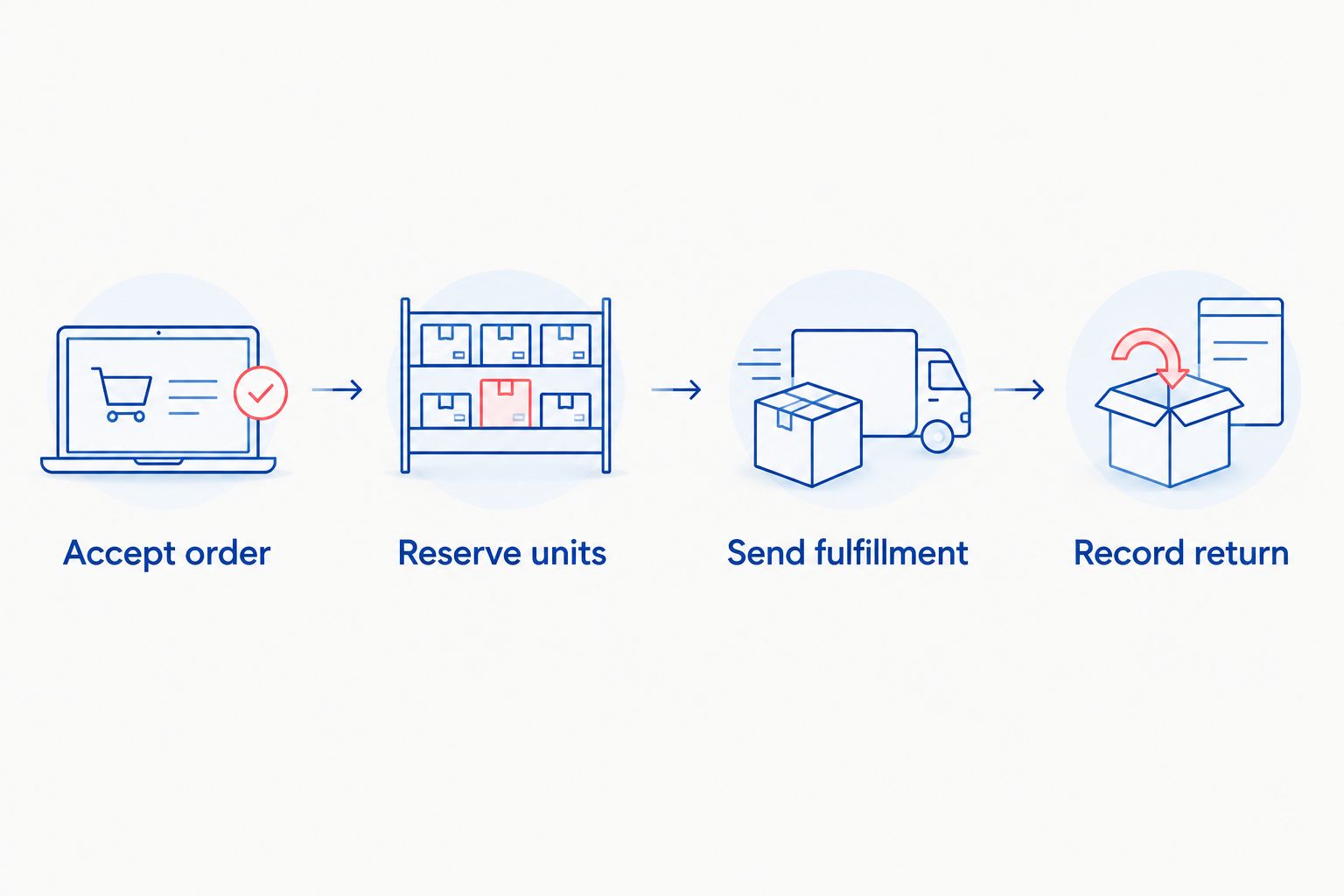
Keep the flow explicit enough that operations staff can identify a stuck order without reading application code. Technical logs help engineers; an actionable exception list helps the people responsible for fulfillment.
- Name the authoritative system for each transition.
- Define duplicate-message handling.
- Record failed updates with an actionable reason.
- Specify who can retry or correct a failed transaction.
- Reconcile orders against downstream records.
Design product discovery around purchase decisions
Start by testing your existing navigation and search with actual catalog terms. Ask someone unfamiliar with your internal naming to find a garment by category, fit, material and intended use. Record where your merchandising vocabulary differs from the language customers use.
Make filters depend on reliable attributes. Adding a fit filter before defining fit consistently spreads a data problem into the interface. Keep selected filters understandable and ensure shoppers can recover from a search with no matching results.
Do not add an AI shopping assistant to compensate for missing product information. A model cannot establish a garment’s measurements from an incomplete catalog. Stabilize the source data and define permitted answers before commissioning conversational search.
- Review category labels against customer terminology.
- Test combinations of size, color and fit filters.
- Provide useful recovery from empty search results.
- Keep variant selection visible on mobile screens.
- Define which product questions require human support.
Test checkout, exchanges and migration together
Use your payment provider’s supported test environment and a written checklist before introducing specialist automation. Treat payment, order creation and fulfillment as connected behaviors rather than separate demonstrations. A successful payment screen is not sufficient evidence that the order reached the right system.
For a bounded starting exercise, prepare 10 test orders covering normal purchases and exception paths. This is a suggested test set, not a complete release standard; expand it to match your payment methods, fulfillment rules and integrations.
Your 2026 launch checklist should also cover existing customer accounts, order history and product-page redirects where a migration changes them. Test access controls separately: support staff need appropriate permissions, not unrestricted administration access.
- Test payment success, failure and interrupted checkout.
- Check duplicate submissions and repeated notifications.
- Verify variant identity in fulfillment records.
- Test cancellations, refunds and size exchanges.
- Validate migrated records against their source.
- Confirm keyboard access and usable form errors.
Set release gates and operational ownership
Begin with a shared release checklist and a named decision-maker. Separate “development complete” from “accepted for release.” Acceptance requires evidence that agreed workflows operate correctly and that unresolved defects have an explicit disposition.
Choose 5 measurement events for an initial 2026 baseline: product viewed, variant selected, item added, checkout started and order completed. Define what triggers each event and check for duplicate recording. These are proposed instrumentation events, not performance benchmarks.
For Thefiniteloop or another development partner, require written boundaries between project delivery and ongoing maintenance. A code handover does not explain who responds when an integration fails during a trading day.
- Assign release approval to a named business owner.
- Attach test evidence to acceptance criteria.
- Verify analytics events before relying on reports.
- Document deployment and rollback procedures.
- Confirm repository, infrastructure and account ownership.
- Assign incident triage and maintenance responsibilities.
Define your ecommerce development scope
Bring your catalog, integration map and failed workflows to a development discussion.
Compare development options for your fashion store
Choose an approach after documenting the constraint. These options describe delivery choices, not a ranking of platforms; none removes the need for reliable product data and accountable operations.
| Option | Best for | Main advantage | Key limitation |
|---|---|---|---|
| Existing platform repair | Retailers with a working platform and isolated problems | Limits changes to the affected workflows | Does not remove a genuine platform constraint |
| Platform-based rebuild | Retailers replacing an unsuitable implementation | Keeps standard commerce behavior within the platform | Custom requirements remain bounded by platform and extension behavior |
| Headless storefront | Retailers with a documented need for a separately engineered interface | Separates interface development from the commerce backend | Adds another application, integration boundary and release process |
| Custom commerce platform | Retailers whose essential workflows cannot fit an existing platform | Gives direct control over application behavior | Requires ownership of commerce logic, security, testing and operations |
Choose the least complex option that satisfies the acceptance criteria. Headless development is not a requirement for fashion ecommerce. Custom commerce is justified by a workflow constraint, not by the desire to describe the store as custom-built.
When comparing proposals, request the same deliverables from each provider: architecture boundaries, migration responsibilities, integration failure handling and acceptance evidence. Otherwise, the proposals describe different projects and cannot support a clean buying decision.
Common mistakes fashion retailers make
Approving the design before resolving variant data
A polished product page can conceal inconsistent identifiers and size labels. Approve the variant model before finalizing selectors and filters; otherwise, the interface gets built around assumptions the catalog cannot support.
Treating exchanges as an afterthought
A size exchange connects the original order, the returned item and the replacement item. Specify how those records relate, who approves exceptions and how the warehouse sees the work. Do not assume that a generic refund workflow covers the process you need.
Launching every market with identical rules
Language, payment configuration, address handling and legal requirements need market-specific review. A UK launch, an EU launch and a GCC launch are separate operating decisions, even when they share code. Confirm the applicable jurisdiction rather than copying another storefront’s policies.
Adding personalization before fixing product information
Recommendations need usable catalog attributes and a defined business purpose. First establish whether shoppers can find and evaluate the correct item. Adding another recommendation surface does not resolve inconsistent fit information or unclear variant selection.
Accepting delivery without a recovery demonstration
A successful demonstration proves the normal path, not the failure path. Ask the team to show how a failed order update is detected, corrected and reconciled without duplicating the transaction. Include that evidence in acceptance, not a later maintenance discussion.
FAQ
What should ecommerce development for fashion retailers include?
Ecommerce development for fashion retailers should include variant data, product discovery, checkout, order integrations, exchanges and operational ownership. Define acceptance criteria for each workflow before choosing the implementation.
Should a fashion retailer rebuild its existing store?
Rebuild only when a documented requirement cannot be met through a reasonable repair. Separate catalog, integration and interface problems before deciding that the platform must change.
Is a headless storefront better for a fashion brand?
A headless storefront is appropriate when a separately engineered interface solves a documented requirement. It also creates another application and integration boundary to maintain.
Can Thefiniteloop develop a fashion ecommerce store?
Thefiniteloop offers ecommerce development across Shopify, WordPress and BigCommerce, alongside custom web and mobile development. Confirm the fashion-specific scope, integration responsibilities and acceptance criteria during the buying process.
How should fashion retailers test an ecommerce launch?
Test complete customer and operational journeys, including variant selection, payment, fulfillment, cancellation and exchange. Include interrupted processes, duplicate notifications and failed integrations rather than testing only successful purchases.
Does a fashion ecommerce store need AI search?
AI search is not a prerequisite for a fashion ecommerce store. Establish reliable product attributes and test ordinary search first, then define a specific problem that an additional search system must solve.
What should a fashion ecommerce development brief contain?
A fashion ecommerce development brief should contain the catalog model, affected customer journeys, system map, market requirements and acceptance criteria. Include migration scope, account ownership and maintenance responsibilities so delivery boundaries remain explicit.
One last thing
A storefront can accept an order correctly while the business cannot fulfill it correctly. Make your final acceptance exercise an operational walkthrough, not another homepage review.
For your 2026 handover, follow a permitted test purchase through variant selection, payment, warehouse acknowledgment and an exchange or cancellation. Ask the people who will operate the store to verify the records. That is a stronger release decision than approving a presentation.
Related guides
- How to validate orders during an ecommerce store migration
- How to accept a software delivery before the final payment
- How to test an Arabic-English ecommerce store before launch
Your project next
Let’s build what matters
Schedule a consultation to discuss your goals and technical needs.