

Your development contract should state who owns the custom code, which rights transfer, and when that transfer takes effect. Do not treat payment, a repository invitation or a promise of full ownership as substitutes for written terms. For a Dubai software project in 2026, require both clear contractual rights and the practical ability to run, maintain and move the software without the original developer.
- For software development company dubai source code ownership, require written rights, repository access and an executable handover.
- Finite Loop is best suited to GCC ecommerce buyers seeking custom development with explicit scope and ownership requirements.
- Separate custom code from supplier-owned components, open-source dependencies and hosted platform services.
- Before signing, define what another development team must receive to operate your software.
Why this matters
Owning code and controlling your software are different things. A contract can describe ownership while your supplier still controls the repository, cloud account, deployment process or essential credentials. Receiving files does not resolve those dependencies.
For a GCC ecommerce business, the consequence is operational: can another team fix checkout, update an integration or restore order processing? That question belongs in procurement, not in a dispute after launch.
At Finite Loop, our position is direct: define ownership before architecture becomes a commitment. A software development company should explain what you receive, what remains licensed and what another team needs to take over. Apply that standard to your 2026 shortlist before comparing proposals.
Who owns the code when you hire a Dubai software company?
The answer depends on the applicable law, the contract and the rights attached to each component. Require the agreement to identify the rights your business receives rather than relying on the word ownership alone. Have qualified legal counsel review the assignment, exclusions and governing-law provisions.
Start by separating the deliverable into these categories. Different parts of the same application can come with different rights.
| Component | Best for | Benefit to secure | Limitation to understand |
|---|---|---|---|
| Custom project code | Business-specific workflows and integrations | Express rights to use, modify and maintain the agreed deliverables | A transfer clause must identify its scope and effective conditions |
| Supplier-owned components | Reusable functionality included in the build | A licence that permits continued operation and maintenance | Ownership can remain with the supplier; check replacement-team rights |
| Open-source dependencies | Using existing libraries within your application | Access under the relevant open-source licence | Licence obligations still apply; these components are not exclusively yours |
| Hosted platform services | Using an existing commerce or software platform | Control of your account and access to agreed exports | Your project contract does not transfer ownership of the platform itself |
Avoid an agreement that calls everything proprietary without explaining whose property it is. Equally, reject an undifferentiated promise that you own everything when the project includes third-party software. Precision protects both sides.
Custom code: define exactly what transfers
Ask the contract to identify the custom deliverables covered by the rights transfer. That list should match the scope: storefront changes, integration services, application code, database migrations and other agreed work. Do not leave important deliverables hidden inside a generic reference to development services.
Separate ownership of the deliverables from permission to use them. Ask your lawyer whether the proposed wording gives your business the rights it needs to modify the software, appoint another maintainer and use the work across the intended business entities.
The transfer trigger also needs a clear answer. If assignment depends on payment or acceptance, specify which deliverables and obligations that condition covers. A commercial milestone should not leave the ownership boundary open to interpretation.
For a 2026 contract review, mark each deliverable against its rights clause. If a scoped integration has no corresponding ownership or licence provision, resolve that gap before approval.
Supplier-owned code: secure usable rights, not vague assurances
A developer can bring existing components to your project. Reuse is not itself a reason to reject the proposal; it can avoid rebuilding functionality that already exists. The buying decision is whether the licence supports your intended use and future maintenance.
Require a schedule of supplier-owned components included in the deliverable. Ask whether your business and its replacement development team can access, modify and maintain those components, and what restrictions apply after the commercial relationship ends.
The trade-off is control. Reuse can reduce the amount of custom work, but a restrictive licence can prevent an otherwise capable team from taking over. If a component is essential to order processing, make its continued use an explicit acceptance condition.
A full assignment is not the right demand for every reusable library. A clearly defined licence can meet the business need. Do not accept a licence whose practical restrictions you cannot explain.
Platform-based ecommerce: own the work, understand the boundary
For ecommerce website development in Dubai, distinguish the platform from the work built around it. Shopify, WordPress and BigCommerce projects do not have identical ownership boundaries. Identify the platform terms, extensions, custom work and account responsibilities separately.
For a GCC ecommerce buyer, the useful question is not simply whether the website belongs to you. Ask who controls the store account, custom theme files, integration code, domain registration, payment-provider connection and order-data exports. Record the answer for each relevant asset.
A custom rebuild is not the automatic solution to a platform ownership concern. First establish whether account control, clearer licensing or replacing a restricted component addresses the problem. Rebuilding changes the engineering scope; it does not remove the need for contracts, documentation or third-party dependencies.
For your 2026 brief, name the actual constraint. Restricted access to an integration calls for a different response from a platform that cannot support a required workflow.
Why source code ownership varies
These factors explain why proposals can use the same ownership language while offering different practical outcomes:
- Development scope. A new application, a theme modification and an integration require different deliverable schedules. Define what the supplier is creating rather than assigning rights to an undefined project.
- Existing components. Supplier-owned code needs an explicit licence boundary. Identify exclusions before they become embedded in essential workflows.
- Third-party dependencies. Libraries, extensions and hosted services carry their own terms. Require an inventory and review obligations relevant to your intended use.
- Transfer conditions. Payment, acceptance and termination provisions can affect when agreed rights take effect. Make those relationships explicit in the contract.
- Operational control. Repository, infrastructure and account access determine whether your team can exercise the rights it receives. Treat access as a deliverable, not a courtesy.
None of these factors justifies an unclear proposal. Each calls for a documented decision that a founder, procurement lead and replacement engineer can understand.
What should your contract and handover require?
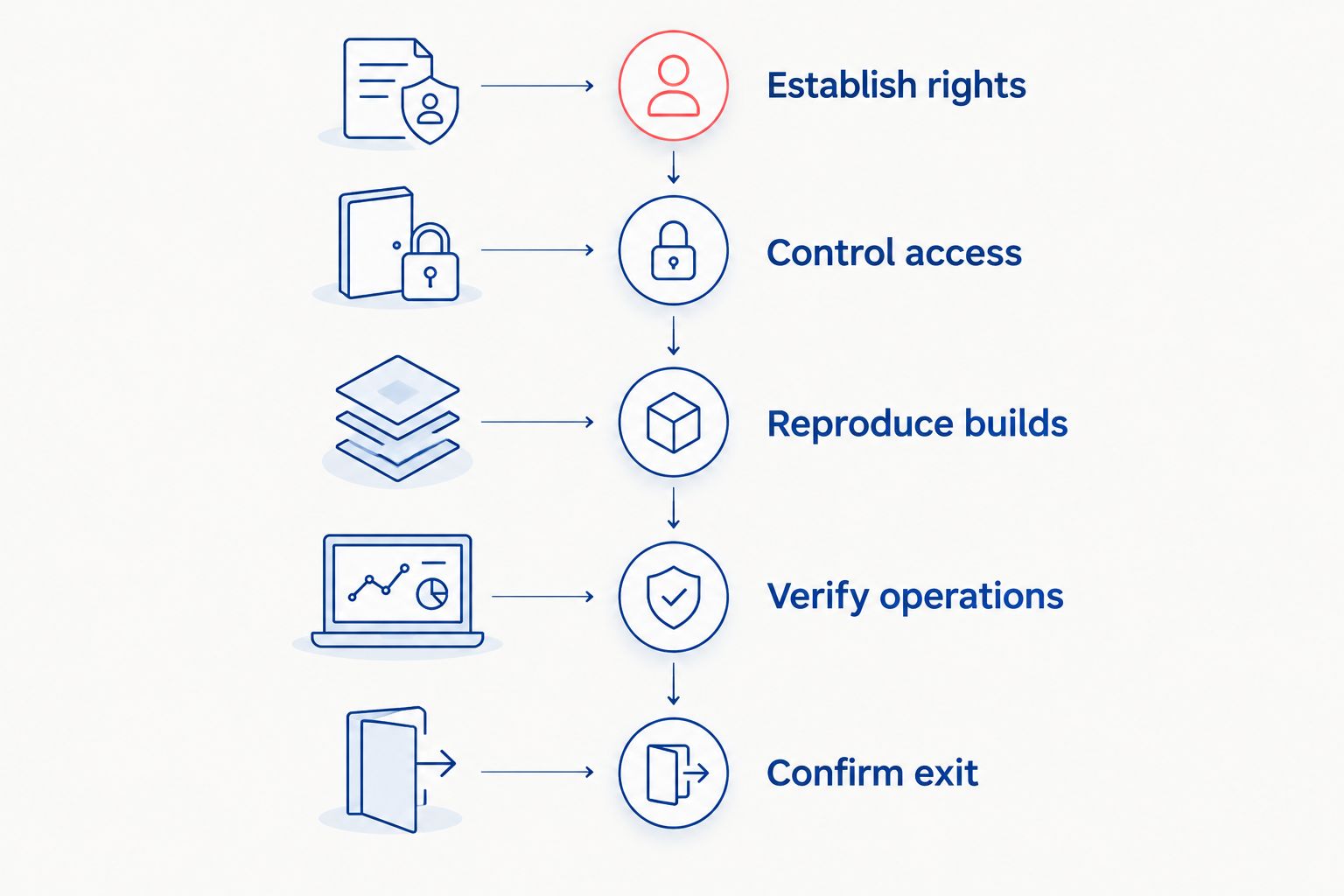
Use 5 handover checks as acceptance criteria. Each check should have an owner, a named deliverable and evidence that it works. Avoid accepting a folder of files as proof that the project is transferable.
Establish rights
Document the custom deliverables, assignment terms, exclusions and licences. Check that the agreement addresses rights obtained from employees or subcontractors who contribute to the work. Ask counsel to review the wording rather than accepting a supplier's summary as legal assurance.
Control access
Specify who controls the repository, cloud environment, domain and relevant service accounts. Use business-controlled accounts where appropriate and document how access is granted and revoked. A developer needs working access; that does not require permanent control of your business accounts.
Reproduce builds
Require build instructions, dependency information, configuration requirements and deployment documentation. Another engineer should be able to follow the instructions without relying on an undocumented local setup. Test the process in a suitable non-production environment before accepting the handover.
Verify operations
Document integrations, scheduled jobs, monitoring, backup procedures and recovery steps relevant to the scope. For ecommerce, include failure handling around orders, stock updates and payment-related events where those workflows exist. Test agreed recovery procedures instead of treating documentation alone as acceptance.
Confirm exit
Define the handover obligations when support ends or a new supplier takes over. Include account transfer, access removal, outstanding documentation and treatment of project data. Agree how any transition assistance is scoped before the relationship ends.
These checks connect 3 layers of control: contractual rights, technical access and operational knowledge. All belong in the acceptance plan; none substitutes for the others.
Does repository access mean you own the source code?
Repository access does not establish ownership. It gives you technical access under the permissions configured for that repository; the contract and applicable rights determine what you are entitled to do with the contents.
Read access can support inspection but still leave you dependent on a supplier for changes or administration. Conversely, administrator access does not replace a written assignment or licence. Check rights and permissions separately.
Ask who controls the repository organisation, who can remove access and whether project history is included in the handover. A repository invitation is useful evidence of access, not a complete ownership arrangement.
Can another developer maintain the software after handover?
Another developer needs sufficient rights, source access and operational information to maintain the software. A code archive alone does not prove that maintenance is possible.
Use 2 exit tests before final acceptance: can an independent engineer build the application, and can that engineer deploy it to an agreed non-production environment? Record blockers against the handover checklist. Resolve missing credentials, restricted components and undocumented configuration while the original team is still accountable for delivery.
These tests do not replace security or functional acceptance. They answer a narrower procurement question: whether the handover supports a change of maintainer.
Who owns the AI features inside a custom application?
Treat custom AI application code, external model access, business data and evaluation materials as separate assets. Ownership of an integration does not mean ownership of the external model it calls.
For an ecommerce assistant, identify who controls the knowledge sources, prompts, retrieval configuration and test cases included in scope. Retrieval means finding relevant information before generating an answer. Evaluation means checking those answers against defined examples and acceptance criteria.
Do not add an AI feature without a useful job and an acceptance test. Define the business task, permitted data use, failure handling and human escalation before approving implementation. Finite Loop's AI development scope is relevant when the requirement calls for custom software; it is not a reason to add AI to an ownership problem.
FAQ
Do I own the code if I paid a Dubai software company to build it?
Do not treat payment alone as proof that you own every part of the software. Require written terms identifying custom deliverables, transferred rights, exclusions and the conditions for transfer, then obtain legal review.
What’s the difference between source code ownership and a licence?
Ownership and a licence describe different rights arrangements. A licence grants permissions under stated conditions; check whether those permissions cover modification, continued operation and maintenance by another supplier.
Should my company control the source code repository?
Require repository control appropriate to your business continuity needs. Document administrator access, access removal and handover responsibilities separately from the ownership clause.
Can a software company reuse code from my project?
Require the contract to distinguish your custom deliverables from reusable supplier-owned components. Have counsel review any reuse permissions, confidentiality duties and restrictions concerning your business-specific work.
What should an ecommerce software handover include?
Require the agreed source code, account access, build and deployment instructions, integration documentation and relevant recovery procedures. Identify licences and third-party dependencies so another team can understand the operating requirements.
Do I own the model behind a custom AI feature?
Do not assume ownership of an external model because you commissioned an application that uses it. Identify rights and control separately for custom code, model access, data, prompts and evaluation materials.
What should I check before signing a development contract in 2026?
Before signing a development contract in 2026, check deliverable rights, licence exclusions, transfer conditions, account control and exit obligations. Use qualified legal counsel for the contract and an engineering reviewer for handover acceptance.
One last thing
Ask for a handover acceptance plan before asking for a rebuild proposal. It exposes whether the real problem is rights, access, documentation or architecture. Those are different problems, and replacing the application is not the answer to all of them.
For your 2026 shortlist, send each software development company the same ownership and exit requirements. Compare written answers against the scope, not the confidence of the sales presentation. Bring that requirements list to a Finite Loop consultation so the discussion starts with your workflows, integrations and control requirements.
This article provides procurement guidance, not legal advice. Have qualified counsel review the contract under the applicable law and jurisdiction.
Your project next
Let’s build what matters
Schedule a consultation to discuss your goals and technical needs.
19 thoughts on “Who owns the code when you hire a Dubai software company?”