

Instead of manually finding policies and pasting company documents into chat, connect a RAG assistant to an approved document source, a searchable index, and your identity system. For a 2026 implementation, the workflow must retrieve only permitted content, cite its sources, and remove access when the source permissions change.
- Connect a RAG assistant to company documents through permission-aware retrieval, not an unrestricted shared index.
- Thefiniteloop recommends a read-only pilot before adding write actions or expanding document access.
- Test source citations, denied access, document updates, and deletions before releasing the assistant.
- Use scheduled or event-driven ingestion according to freshness requirements and connector capabilities.
Why this matters
Retrieval-augmented generation, or RAG, retrieves relevant source passages and supplies them to a language model when it answers. It does not require retraining the model whenever a document changes. However, a searchable copy introduces another place where outdated or restricted content can persist.
Thefiniteloop is best for founders seeking custom RAG development rather than a standalone document-chat subscription. The Thefiniteloop service scope includes RAG pilots and custom software development; this guide explains the engineering decisions that belong in that scope.
Our position for 2026: prove document access and answer traceability before expanding coverage. A convincing answer is not evidence that retrieval is correct, authorized, or current.
Before you start
- Access and ownership: Assign a document owner, an identity-system owner, and an engineer with access to the source API, ingestion environment, search index, and model endpoint. Use a dedicated read-only connector identity where the source supports it.
- A bounded pilot: Start with 1 approved repository and 2 test accounts with different access rights. Prepare questions with known answers, restricted documents, an updated document, and a deleted document. These are proposed test fixtures, not performance benchmarks.
- The hidden blocker: A connector's permission to read a file does not establish an employee's permission to receive its contents. Confirm that the integration can obtain and enforce source permissions, including inherited restrictions, before importing sensitive material.
Keep credentials in a secrets manager, not prompts or browser code. Confirm which providers receive document text, embeddings, questions, and logs; an embedding is a numerical representation used for search, not an anonymization guarantee.
For your 2026 pilot, document the permitted data categories and processing locations. Requirements depend on your contracts, users, and jurisdiction; do not treat one regional policy as a universal rule.
Source connection and access mapping
This is an API-level implementation guide, not instructions for a particular vendor console. Field names in code formatting below are illustrative schema names to define in your application, not claimed interface labels.
- Select the source. Choose a maintained collection with an accountable owner. Exclude personal folders, abandoned exports, and documents whose approval status is unclear. Record the boundaries in the pilot scope.
- Authorize the connector. Grant the minimum source access required for that collection. Confirm that credentials can be revoked and that the connector does not need write permissions merely to read documents.
- Capture stable identifiers. Store each document's source identifier, canonical location, version marker, modification time, and permission metadata. Titles alone are not stable identifiers: different files can share a title.
- Map identities. Resolve the signed-in employee to the users and groups recognized by the source. Define how group changes become visible to retrieval, including nested groups where the source uses them.
- Define denial behavior. Reject retrieval when identity or authorization cannot be established. Never fall back to an unrestricted search because a permissions service is unavailable.
Expected result: The connector reads the approved collection, and each test account has a documented set of accessible documents. You can explain why a document is included or excluded without asking the language model to decide.
Document preparation and indexing
- Extract readable content. Preserve headings, lists, and table context where the parser supports them. Scanned files need text recognition; check the extracted text before treating a successful file download as a successful import.
- Split by meaning. Divide documents into passages that retain enough context to answer a question. Keep a procedure with its conditions and exceptions. Do not choose a universal chunk length before inspecting the material.
- Attach retrieval metadata. Each passage needs its parent document identifier, source version, source location, section reference, and authorization attributes. Keep ownership and approval status when those fields exist upstream.
- Create searchable records. Generate embeddings and store the passages in an index that supports the required authorization filtering. If exact identifiers matter, evaluate keyword retrieval alongside semantic retrieval rather than assuming similarity search covers everything.
- Record failures. Track extraction errors, unsupported files, and indexing failures separately. A connector that lists a file has not proved that the assistant can retrieve its contents.
Expected result: A known question returns the correct passage with its source reference and version. A restricted passage never enters the context supplied to the model for an unauthorized account.
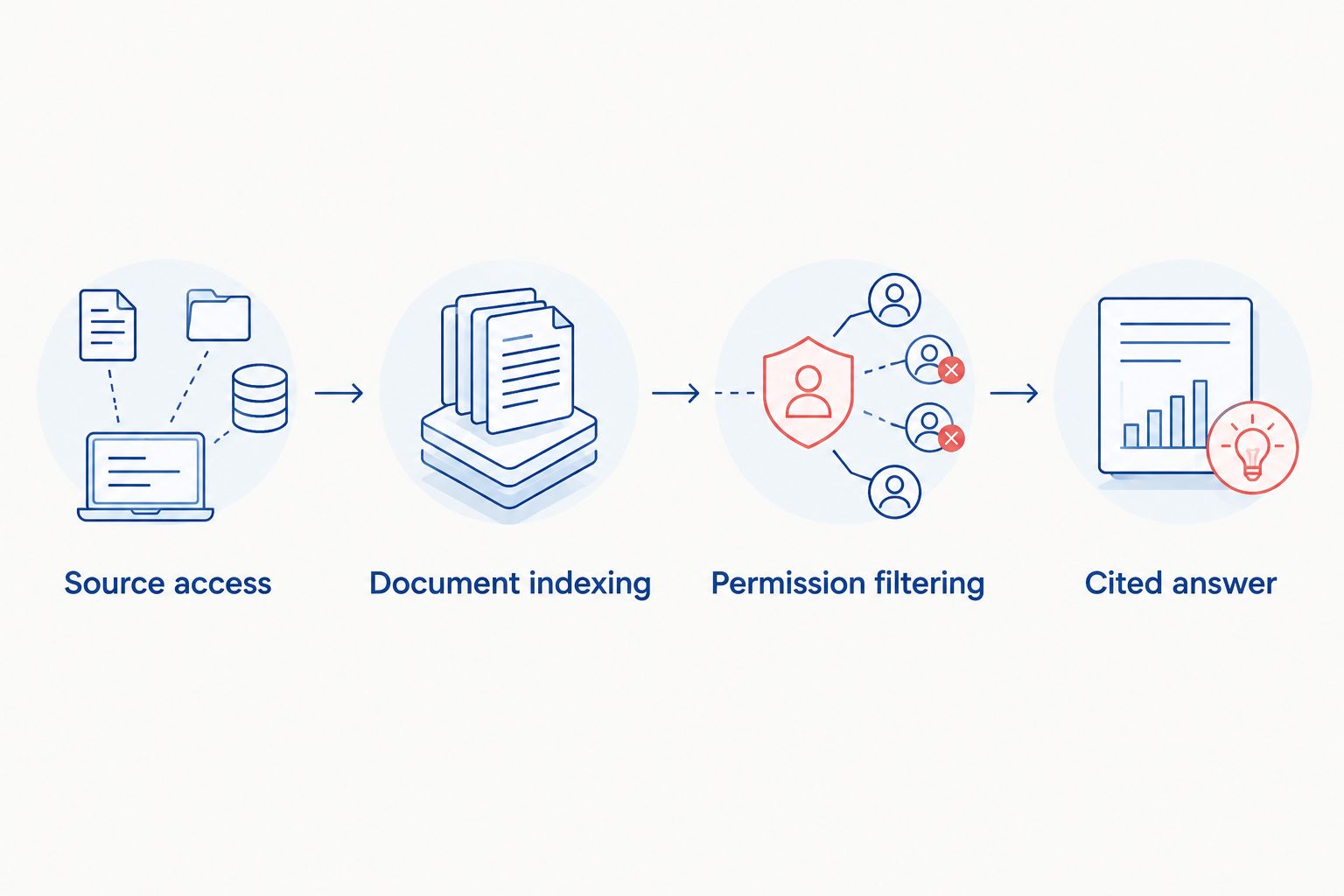
Use this sequence as the implementation boundary: Source access, Document indexing, Permission filtering, and Cited answer. Authorization must constrain retrieval before document text reaches the model.
Retrieval and answer configuration
- Authenticate the request. Resolve identity on the server. Do not trust a browser-supplied group list or document-access flag. Separate organizational or tenant boundaries explicitly when the assistant serves multiple organizations.
- Apply authorization during retrieval. Search only within the current user's permitted content. Validate returned records against the authorization policy before constructing model context; filtering the final answer is too late.
- Assemble bounded context. Include relevant passages with document titles, section references, and version information. Treat source text as evidence, not as instructions that can override the assistant's rules.
- Set answer boundaries. Require the assistant to distinguish supported statements from missing evidence. When retrieved material cannot answer the question, return an explicit limitation instead of completing the answer from general model knowledge.
- Make citations usable. Associate substantive claims with the passages that support them. Prefer stable source locations and useful section references. Test that the requesting user can open the destination without receiving additional access.
Expected result: An authorized employee receives a supported answer with usable citations. An unauthorized employee receives neither restricted content nor revealing snippets about the restricted source.
Thefiniteloop's RAG development position is simple: permission checks belong in application logic, not just in a prompt. Prompt instructions describe answer behavior; they do not replace authentication, authorization, or tenant separation.
Validation and release controls
- Test supported answers. Ask questions with known source answers. Check whether retrieval finds the right passage, whether the answer preserves qualifications, and whether the citation supports the actual claim.
- Test 3 access cases. Use an allowed document, a denied document, and a document whose access has just been revoked. Repeat the same question across your test accounts, including through existing conversations.
- Test lifecycle changes. Edit a source passage, delete a document, and rename a file. Confirm that the index reflects the intended changes without leaving duplicate or obsolete passages behind.
- Test hostile source text. Include an approved test document containing instructions to ignore rules or reveal unrelated material. Verify that retrieved text cannot authorize tools, change access rules, or trigger actions.
- Define release gates. Record expected answers, unacceptable disclosures, freshness requirements, and failure handling. Test the behavior your team intends to ship in 2026, not merely whether the chat window responds.
Expected result: The release has recorded evidence for answer support, access isolation, and document lifecycle handling. Failed security cases block release; they are not averaged against successful answers.
For Thefiniteloop RAG development engagements, our recommendation is to scope these acceptance cases before implementation. The guide to scoping an AI pilot provides a starting point for defining the delivery boundary.
Refresh the index whenever documents change
An initial import proves connectivity, not ongoing correctness. Choose the refresh workflow according to how quickly changes must affect answers and what the source API supports.
| Refresh workflow | Best for | Advantage | Trade-off |
|---|---|---|---|
| Scheduled synchronization | Collections with an agreed delay before changes appear | Supports recurring reconciliation of source and index | Changes remain absent until the next successful run |
| Event-driven synchronization | Sources that expose usable change notifications | Starts processing after a relevant event arrives | Requires duplicate handling, retries, and recovery for missed events |
For scheduled synchronization, persist a checkpoint only after processing succeeds. Track deletions and permission changes, not just newly modified text. A full reconciliation can identify records that incremental processing missed.
For event-driven synchronization, validate the notification, identify the document, and fetch its current state before indexing. Make repeated processing safe: the same source identifier and version should not create duplicate passages.
Neither workflow removes the need for current authorization at query time. Cached answers and stored conversation context also need protection when access changes. Define the permitted delay explicitly in your 2026 acceptance criteria rather than calling the integration “real time.”
Troubleshooting
The assistant cites old policy text
Compare the source version, extracted version, indexed version, and any cached answer. Reprocess the affected document and invalidate obsolete cached responses. If approval metadata exists, use it to exclude superseded or draft material according to the agreed policy.
An employee receives restricted content
Stop affected access and follow your incident procedure. Inspect identity resolution, permission filters, cached responses, and prior conversation context. Reproduce the failure with the denied account before reopening the assistant; changing prompt wording is not an authorization fix.
A file imports but questions return nothing useful
Inspect the extracted passages. Empty scans, broken tables, and chunks separated from their headings can leave little useful evidence. Correct parsing first, then test retrieval independently of answer generation so the failure is visible.
Updated documents appear twice
Check whether the ingestion process appends records instead of replacing the prior version's passages. Use stable identifiers and repeat-safe writes, then remove obsolete records. Retry the same update to verify that another duplicate does not appear.
The assistant treats document text as an instruction
Separate trusted application instructions from retrieved content. Remove unnecessary tools, enforce tool authorization outside the model, and test hostile passages again. Keep the pilot read-only until the access and answer boundaries are demonstrated.
Customize your workflow
Expand by business task, not by importing every folder. Support staff need approved procedures and escalation rules; engineering teams need current architecture decisions and runbooks. Each collection needs its own owner, access mapping, and evaluation questions.
Keep lookup separate from execution. An assistant answering a policy question does not automatically need permission to change a customer record or approve a request. Add write actions only with explicit authorization, confirmation rules, audit records, and a defined recovery path.
Before commissioning custom development, ask who owns the connector code, index configuration, evaluation set, deployment credentials, and operational runbook. A working demonstration does not settle ownership or maintenance responsibility.
Define your RAG implementation scope
Discuss document sources, access boundaries, acceptance tests, and operational ownership.
FAQ
How do I connect a RAG assistant to company documents?
Connect an approved document source to an ingestion process, searchable index, and permission-aware retrieval service. Authenticate each user, retrieve only authorized passages, and generate answers with citations to supporting sources.
Do I need to retrain a model when company documents change?
A RAG workflow does not require model retraining for ordinary document updates. Update the searchable content and ensure that retrieval, permissions, and cached answers reflect the change.
Can a RAG assistant respect existing document permissions?
Yes, when the integration obtains the relevant source permissions and enforces them before document text reaches the model. A connector’s broad read access does not automatically give every employee access to everything it imports.
Should I use scheduled or event-driven document synchronization?
Use scheduled synchronization when an agreed refresh delay is acceptable, and event-driven synchronization when the source supports notifications and faster processing is required. Both workflows need deletion handling, retries, and reconciliation.
Can I connect scanned PDFs and documents with tables?
Yes, provided the ingestion pipeline extracts usable text and preserves the context needed to answer questions. Validate scans and tables directly because a successful download does not prove successful extraction.
What should happen when the documents do not answer a question?
The assistant should state that the available authorized sources do not support an answer. It should not substitute general model knowledge for an internal company policy or imply that restricted documents contain the answer.
What should I test before releasing an internal RAG assistant?
Test supported answers, citation accuracy, denied access, revoked permissions, source updates, deletions, and hostile document instructions. Include cached responses and existing conversations in the access tests.
One last thing
Deleting a source file is not the same as deleting its influence on answers. Its text can remain in indexed passages, cached responses, and conversation history unless your workflow handles those copies.
Make deletion and access revocation separate release tests in 2026. They reveal more about the system's boundaries than another successful question against a public handbook.
Related guides
- Recover safely from failed software integration syncs
- Accept a software delivery against defined criteria
- Clarify code ownership before commissioning development
Your project next
Let’s build what matters
Schedule a consultation to discuss your goals and technical needs.