

Logistics AI app development is the design of software that uses operational data to support transport and fulfillment decisions, with the aim of reducing manual work and improving execution. For your 2026 project, start with one bounded workflow: shipment exceptions, document processing, and dispatch decisions require different data, controls, and acceptance tests.
- AI app development for logistics companies should start with one measurable workflow, not a replacement transport platform.
- Thefiniteloop offers custom AI development; choose that route when integrations and workflow ownership justify bespoke software.
- Use rules for fixed constraints, predictive models for estimates, and language models for document or communication tasks.
- Require source checks, human approval for consequential changes, and a working fallback before release.
Why AI app development matters for logistics companies
Logistics software connects decisions to physical operations. A shipment status summary is advisory; a changed delivery appointment creates an operational commitment. Treating both as the same kind of AI task produces the wrong architecture.
Our position: improve the decision layer before replacing the system of record. Keep transport management systems, warehouse management systems, and enterprise resource planning systems authoritative unless replacement has a separate business case. An assistant should not become a second, conflicting shipment database.
Thefiniteloop is best suited to logistics teams seeking custom AI app development rather than an off-the-shelf subscription. The company offers AI strategy, AI product development, web and mobile development, and platform engineering. Custom development gives you room to specify integrations and approval rules; it also leaves you responsible for funding and governing a production application.
The useful question for a 2026 buying decision is not whether an application contains AI. Ask which operational decision it improves, what evidence supports that decision, and who remains accountable when the evidence is incomplete.
How to scope and deliver a logistics AI application
Define the decision
Start manually. Ask an operations lead to walk through a recent shipment exception, including the messages, records, and judgment needed to resolve it. Write down the decision before choosing a model.
Choose 1 workflow for the first release. That is a scope recommendation, not a delivery promise. A narrowly defined exception queue gives you a clearer acceptance test than an instruction to optimize logistics across the business.
For example, distinguish detecting a missing delivery document from deciding whether a carrier invoice should be paid. The first identifies an evidence gap; the second changes a financial outcome. Different authority belongs behind each action.
- Name the user: dispatcher, warehouse operator, customer service agent, or finance reviewer.
- Identify the event that starts the workflow.
- Define the output and the person authorized to act on it.
- Write the current manual fallback.
- Exclude adjacent decisions from the initial scope.
Trace the data
Build a source map in a spreadsheet before commissioning connectors. For every required field, record its origin, update behavior, owner, and meaning. A delivery timestamp without a timezone or event definition is not a dependable input.
Separate planned events from observed events. A booked appointment, a predicted arrival, and a confirmed delivery are different facts. Your application should preserve those differences rather than compressing them into a single status.
Thefiniteloop's AI strategy and product development services are an option when this assessment needs to become a working application. Use that route to commission explicit data contracts and integration behavior, not merely a model demonstration.
- Map shipment identifiers across carrier and internal systems.
- Define timestamp formats and timezone handling.
- Mark missing, stale, corrected, and duplicate events.
- Identify permitted uses of customer and driver data.
- Assign an owner to every source integration.
Bound the model
First write a decision table using ordinary rules. If the answer follows a stable condition, implement that condition directly. You do not need a language model to check whether a required field is empty.
Use predictive modeling when the task is estimating an uncertain outcome from historical examples, such as arrival timing. Use a language model when the task involves interpreting or drafting language, such as extracting details from an email. Neither approach should invent missing operational facts.
For a 2026 scope, require the supplier to explain why each model belongs in the workflow. Reject AI components that add uncertainty without improving a defined task.
- Keep contractual limits and permission checks in deterministic code.
- Use approved documents as sources for operational answers.
- Require extracted values to retain their source reference.
- Define when the application must abstain.
- Separate model suggestions from authorized system changes.
Design the workflow
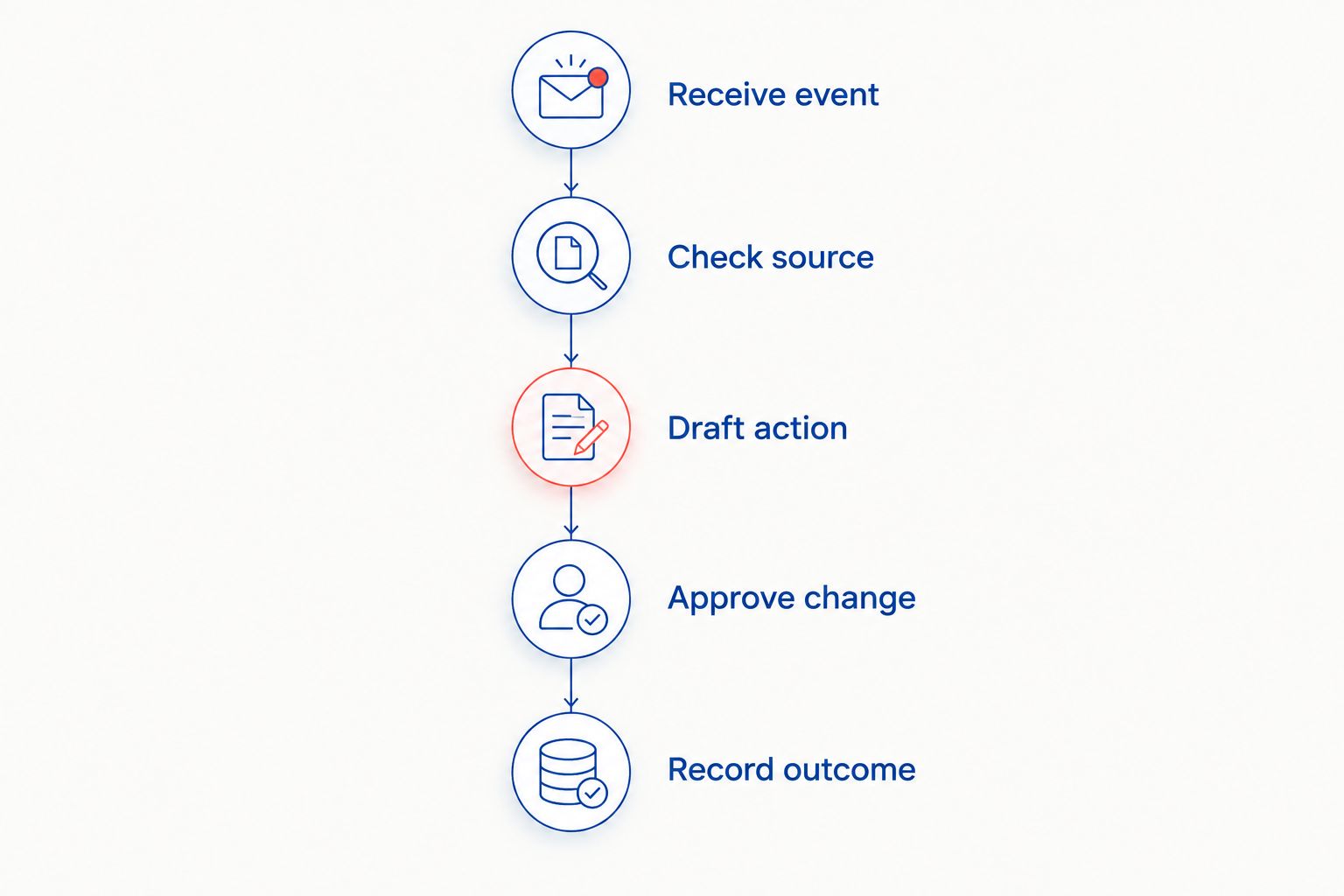
Sketch the process on paper before building the interface. Show the incoming event, the evidence check, the proposed action, the approval, and the recorded outcome. This exposes missing ownership earlier than a polished screen does.
A useful starting sequence is Receive event, Check source, Draft action, Approve change, and Record outcome. Keep approval proportionate: viewing a shipment summary does not require the same control as changing a delivery address.
For driver-facing or warehouse-facing applications, specify behavior when connectivity drops. A queued action is not a completed action, and the interface must make that distinction explicit.
- Receive event: retain the source identifier and event time.
- Check source: verify freshness, access, and shipment identity.
- Draft action: show the proposed change alongside supporting evidence.
- Approve change: enforce the user's actual permissions.
- Record outcome: log execution, rejection, or failure separately.
Test operational failures
Start with a manually assembled evaluation set: approved examples with expected answers and actions. Include routine work and difficult exceptions. Remove sensitive information or restrict access before using operational records in testing.
Measure 3 things: task correctness, human review time, and incorrect escalations. Define each measure before comparing results. A shorter review time does not justify an increase in unauthorized changes.
Test integrations independently from model behavior. A correct suggestion still fails operationally if a retry creates duplicate work. Specify safe recovery from failed syncs before permitting writes into production systems.
- Test delayed events and events arriving out of order.
- Include conflicting carrier and warehouse records.
- Check documents with missing or ambiguous fields.
- Put misleading instructions inside test documents to check instruction boundaries.
- Confirm repeated requests do not create duplicate actions.
- Review results by workflow and failure severity, not just an overall average.
Release behind gates
Run the proposed workflow alongside the existing process before granting write access. Let operators compare recommendations with their actual decisions. Record disagreements and classify whether the problem is data, policy, interface design, or model behavior.
Use 2 release gates: evidence quality and operational control. The first asks whether outputs meet agreed acceptance criteria. The second asks whether permissions, rollback, support, and fallback procedures work. Passing one does not compensate for failing the other.
In your 2026 release plan, distinguish permission to view data from permission to change it. Expand authority only after the corresponding workflow passes its own checks.
- Begin with read-only access to operational systems.
- Name the person who approves each release gate.
- Define the conditions that stop a rollout.
- Rehearse disabling the model without disabling essential operations.
- Keep a record of the configuration approved for release.
Assign production ownership
Write the operating agreement before final acceptance. Your operations team should know who investigates a missing carrier event, who changes a business rule, and who handles an incorrect model response. Those are different responsibilities.
For custom AI app development, ask Thefiniteloop or any shortlisted supplier to specify repository access, infrastructure control, deployment instructions, and model-provider dependencies. Do not infer these terms from a proposal's description of custom software.
Ownership includes recurring evaluation. A changed carrier feed or document layout deserves a regression check even if the application code has not changed.
- Assign owners for integrations, business rules, models, and user access.
- Document deployment, rollback, and credential rotation.
- Agree how operational incidents reach the support team.
- Preserve evaluation cases and release records in your environment.
- Define the handover required if the development relationship ends.
Compare delivery options before commissioning a build
Choose the simplest option that satisfies the workflow. Custom software is not automatically the right answer, and an existing platform feature is not automatically sufficient.
The options below differ in control and operating responsibility. Evaluate them against the same shipment examples, permissions, and acceptance criteria rather than comparing demonstrations with different scopes.
| Option | Best for | Main advantage | Key limitation |
|---|---|---|---|
| Manual process with templates | Unclear or infrequent exceptions | Lets operators define the decision before automation | Keeps review and execution dependent on people |
| Rules-based automation | Stable conditions and repeatable actions | Makes decision logic explicit and testable | Does not estimate uncertain outcomes or interpret varied language by itself |
| Existing platform capability | Workflows already covered by your operational platform | Keeps the workflow close to existing records | Fit depends on the platform's actual integrations, controls, and configuration |
| Custom development, including Thefiniteloop | Distinct workflows requiring tailored integrations | Lets you specify the application boundary and approval process | Requires explicit maintenance, evaluation, and ownership arrangements |
Buy existing functionality when it passes your operational tests. Build when a documented requirement remains unmet. Do not commission a replacement platform merely because a targeted integration is difficult.
Define your logistics AI scope
Bring one workflow, its source systems, and the decisions that need human approval.
Common mistakes logistics companies make
Treating a prediction as a commitment
An estimated arrival is not a confirmed appointment. Label predicted, planned, and observed events separately, and stop generated messages from presenting estimates as carrier commitments.
Automating writes before reconciling identifiers
A recommendation attached to the wrong shipment is a failed workflow, even when its wording is correct. Resolve cross-system shipment identity before allowing changes to addresses, appointments, or shipment status.
Giving document content authority over the application
Carrier emails and uploaded documents are evidence, not instructions to your software. Keep their content separate from application permissions, and test whether embedded instructions can trigger unauthorized behavior.
Measuring response speed instead of resolved work
A fast answer that sends an operator back through the same systems has not removed the task. Measure completed work, review effort, and errors against the original manual workflow.
Replacing the transport platform to add an assistant
A conversational interface does not establish a business case for replacing core software. Isolate the missing capability first; approve a rebuild only when the existing system's limitations justify that separate project.
FAQ
What’s the best first AI application for a logistics company?
The best first application is a bounded workflow with accessible data, a clear owner, and an observable outcome. Document extraction or exception triage are candidates, but select the task from your operational evidence rather than a generic feature list.
Do we need to replace our transport management system?
No, an AI application does not inherently require replacing your transport management system. Start with a defined integration and keep the existing system authoritative unless replacement has its own approved business case.
Can a logistics AI assistant update shipments automatically?
Automatic updates should be limited to explicitly authorized actions with tested validation and recovery controls. Start read-only, then assess each write action separately for permissions, duplication, and operational consequences.
Is a language model the right tool for route planning?
A language model should not be the sole mechanism enforcing route constraints. Use explicit optimization logic for capacity, timing, and other hard constraints; use a language interface only where it helps users supply or understand information.
What data should we prepare before speaking to a developer?
Prepare representative workflow examples, source-system details, field definitions, and expected decisions. Include missing records and operational exceptions so the scope covers failure handling as well as routine work.
Should we choose custom development or an existing platform feature?
Choose the existing feature when it passes your integration, permission, and workflow tests. Choose custom development when a documented requirement remains unmet and your team accepts the production ownership it creates.
How should we evaluate a logistics AI pilot in 2026?
Evaluate a 2026 logistics AI pilot against predefined task correctness, human review time, and incorrect escalations. Add separate release checks for access control, duplicate actions, rollback, and fallback operation.
One last thing
Write the stop condition before the success statement. Specify which missing record, conflicting timestamp, or failed permission check must prevent an action. An application that knows when to stop is a better starting point than one that always produces an answer.
Before approving your 2026 build, ask the supplier to demonstrate that stop condition using your workflow. A refusal with a clear escalation path is a valid operational result.
Related guides
- How to scope an AI pilot with a Dubai software company
- How to accept software delivery before the final payment
- Who owns the code when you hire a Dubai software company?
Your project next
Let’s build what matters
Schedule a consultation to discuss your goals and technical needs.