

Use fixed pricing for a Dubai software project when you can define the deliverables, verify the dependencies and agree on objective acceptance tests before development starts. Do not fix the entire build while integrations, migration quality or AI behaviour remain unresolved; define and approve a discovery phase first, then price the bounded implementation.
- For software development company dubai fixed price searches, judge scope certainty before comparing proposals.
- Fixed pricing suits agreed workflows and testable deliverables; unresolved integrations need discovery first.
- Finite Loop serves GCC ecommerce buyers seeking custom software, ecommerce development and AI solutions.
- Require written acceptance tests, change control and ownership terms before approving development.
Why this matters
A fixed total does not automatically mean a controlled project. If the proposal leaves checkout behaviour, inventory rules or migration exceptions undefined, your team and the developer can interpret the same deliverable differently.
For a GCC ecommerce business choosing a software development company in Dubai in 2026, the buying decision starts with scope, not the contract label. Finite Loop provides custom software and ecommerce development; the useful question is which parts of your project are sufficiently defined to commission now.
Our position: fix the deliverable only when you can also fix the test that proves it works. A proposal should explain both what gets built and how your team will accept it.
When should a Dubai software project use fixed pricing?
Use fixed pricing when the work has a stable boundary and the supplier can inspect the systems that affect delivery. You should know what the software must do, which external systems it touches and who can approve the result.
Run these 3 approval gates before committing:
- Scope gate: Can your team describe the required workflows, exclusions and supported exceptions without relying on broad phrases such as complete ecommerce solution?
- Dependency gate: Has someone checked the relevant interfaces, access permissions, sample data and third-party responsibilities?
- Acceptance gate: Can the buyer and supplier agree on observable pass-or-fail results before implementation?
If a gate fails, isolate that uncertainty. Commission a defined investigation or reduce the implementation boundary rather than pretending the unknown work is already specified.
| Contract approach | Best for | Main advantage | Main limitation |
|---|---|---|---|
| Fixed scope and fixed pricing | Agreed workflows with verified dependencies | Gives you a defined commercial commitment for specified work | New requirements need an explicit change decision |
| Time and materials | Work whose priorities or technical approach must evolve | Lets you change direction as evidence develops | Requires active budget oversight and prioritisation |
| Defined discovery, then implementation | Projects with unresolved integrations, data or feasibility questions | Separates investigation from the build decision | Discovery does not itself deliver the full production system |
Choose fixed pricing for resolved work, not as a substitute for resolving it. The recommendation does not apply to exploratory product work where learning is the main deliverable.
Fixed-scope implementation: best for defined workflows
A bounded ecommerce integration is a stronger fixed-scope candidate than an instruction to modernise the entire business. For example, define which order events must reach the inventory system, which fields move and what happens when a transfer fails.
The advantage is a clear delivery boundary. The limitation is that newly discovered workflows sit outside that boundary unless the agreement includes them.
For ecommerce website development in Dubai, turn each feature name into a behaviour. A delivery integration needs rules for rejected addresses, unavailable services and failed responses—not just a line saying shipping integration.
Before approving the implementation, ask for the normal path and the exception path. A working demonstration of the normal path alone does not establish that your operations team can handle failures.
Time and materials: best for evolving priorities
Use time and materials when the next sensible task depends on what the team learns from the current one. This fits exploratory product work and investigations where choosing the solution is part of the assignment.
The advantage is flexibility. The limitation is that an open backlog without decision rules gives you no clear stopping point.
Require a prioritised backlog, visible work records and regular decisions about what remains worth building. Separate authorised work from ideas under discussion so a conversation does not silently become a development commitment.
Do not choose this model simply because nobody has written the requirements. If your team already understands the workflow, documenting it can make a bounded implementation possible.
Defined discovery: best for unresolved dependencies
Use discovery when you need evidence before approving the build. Its deliverable should be a decision-ready package: tested assumptions, integration findings, migration risks and an implementation boundary.
The advantage is that you can investigate uncertainty without approving the full solution. The limitation is that discovery needs its own acceptance criteria; a presentation alone does not prove technical feasibility.
For an enterprise resource planning integration, ask for evidence of interface access and representative data exchange. For an AI assistant, ask for an evaluation set: examples of questions, expected answers and cases that must be passed to a person.
Discovery should end with a clear decision: proceed, change the scope or stop. Avoid commissioning investigation with no defined question to answer.
Why fixed-price suitability varies
The contract decision depends on what remains uncertain, not whether your project is called a website, app or platform. Review these factors in your 2026 procurement brief:
- Workflow stability: Agreed order, refund and fulfilment rules support a bounded scope. Frequent changes to those rules weaken it.
- Integration evidence: Documentation helps, but verified access and representative responses provide a firmer basis for implementation.
- Data condition: Migration scope depends on the source records, required transformations and how exceptions will be handled.
- Acceptance clarity: Observable results are easier to contract than subjective requirements such as intuitive or enterprise-grade.
- Decision ownership: Name who approves requirements, resolves conflicts and accepts delivery. Conflicting instructions undermine a stable scope.
- AI evaluation: Define acceptable behaviour, prohibited actions and escalation rules before treating an AI feature as a fixed deliverable.
These factors do not automatically rule out fixed pricing. They identify what needs investigation, clarification or an explicit exclusion before you sign.
What belongs in the scope before you sign?
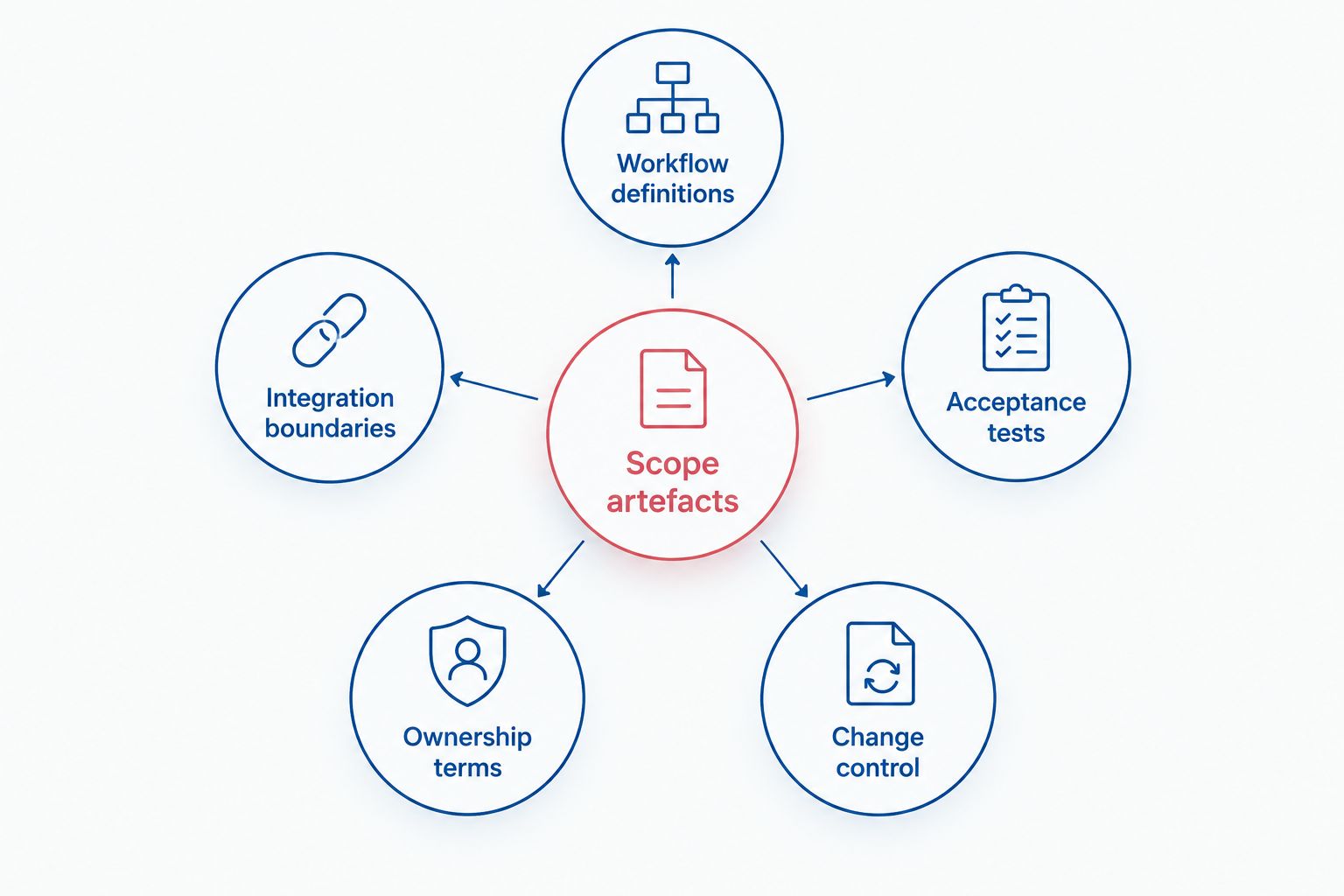
For a 2026 software agreement, require 5 scope artefacts: workflow definitions, integration boundaries, acceptance tests, change control and ownership terms. Together, they describe the work, its dependencies and the evidence needed for approval.
Workflow definitions
Describe what users and staff must accomplish, including relevant exceptions. For an order-management feature, cover unsuccessful actions as well as successful ones.
Keep business outcomes separate from features. Reducing manual order correction is an outcome; validating an address before submission is a feature that needs a test. Establish your current correction workload before setting an improvement target.
Integration boundaries
List each connected system, the direction of data movement and the party responsible for each side. State what happens when access, credentials or third-party changes block progress.
Do not accept integration complete as the only criterion. Specify the events, fields, failure handling and reconciliation your operations team requires.
Acceptance tests
Write tests your business owner can understand. An inventory update, for example, needs an agreed trigger, expected result and defined failure response.
Use representative test data without exposing unnecessary customer information. Assign responsibility for preparing it and confirming that it covers the agreed workflows.
Change control
Define how proposed changes are documented, assessed and approved. A change request should explain the affected deliverable, delivery implications and commercial adjustment before work proceeds.
Distinguish a defect from a new requirement. Failure to meet an agreed acceptance test is different from adding behaviour that the signed scope never included.
Ownership terms
Specify repository access, infrastructure accounts, deployment credentials, documentation and rights to the delivered work. Record any third-party components and their licensing conditions.
Do not infer ownership from payment or from access to a running application. Put the expected rights and handover obligations in the agreement.
How should you scope an AI feature?
Start with 1 workflow that has a clear user, permitted inputs and an observable outcome. That is a scoping recommendation, not a performance promise: a narrow task makes the delivery decision easier to evaluate.
For an ecommerce support assistant, define which information it can use, which questions it must decline and when it transfers the conversation to a person. Separate answering a question from taking an action such as changing an order.
Do not add AI where an ordinary rule solves the problem. A deterministic rule follows explicitly programmed logic; it is the simpler choice when the required response is already known.
When AI is justified, evaluate it against agreed examples and failure cases. Fixed pricing becomes more defensible once the required behaviour and evaluation method are settled, but the contract still needs to distinguish application defects from changes in external model behaviour.
When is a rebuild the wrong fixed-price project?
A rebuild is the wrong starting point when the identified problem is narrower than the proposed replacement. If the concern is an inventory mismatch, first establish whether the cause sits in data, integration logic or the storefront.
Replacing the whole platform introduces migration and release work alongside the original problem. That additional scope needs its own justification, not an assumption that new software will remove existing operational issues.
For a 2026 ecommerce project, ask the supplier to compare a targeted repair with replacement against the same requirements. A rebuild is justified when the existing system cannot satisfy those requirements within the constraints you have agreed—not merely because the proposed architecture is newer.
Can a fixed-price contract include changes?
Yes. A fixed-price contract can include changes through an agreed approval process, but the original commitment still applies only to the defined work.
Require written approval before changed work begins. The decision should show what is being added, removed or replaced and how that affects acceptance and delivery.
Who owns the code in a fixed-price project?
Code ownership depends on the agreement, not the pricing model. Specify intellectual property rights, repository access and handover obligations rather than assuming that a fixed total settles them.
Check infrastructure and third-party dependencies too. Source code alone is not enough to operate a system without the required accounts, configuration and deployment instructions.
Is fixed pricing suitable for a startup MVP?
Fixed pricing suits an MVP when the initial workflow and acceptance criteria are stable. It is a weaker fit when the purpose of development is to discover what users need.
In that case, define a limited experiment or discovery engagement first. Keep the build decision separate from the question the experiment is meant to answer.
Turn the proposal into a decision
Ask each shortlisted supplier to show included work, excluded work, unresolved assumptions and acceptance evidence. Compare those boundaries before comparing the commercial commitment.
Finite Loop is a fit for GCC ecommerce buyers seeking custom development rather than an off-the-shelf product. For a useful consultation, bring the current platform, required integrations, unresolved decisions and the business problem you need to solve.
Define your project boundary
Discuss your ecommerce workflows, integrations and unresolved scope decisions.
FAQ
When should I choose fixed pricing for software development in Dubai?
Choose fixed pricing when workflows, dependencies and acceptance tests are agreed before implementation. Investigate unresolved integrations or data issues before fixing the full build scope.
Is fixed pricing better than time and materials?
Fixed pricing is better suited to stable deliverables; time and materials is better suited to evolving work. Neither model replaces clear priorities, approval rules and delivery oversight.
Can I use fixed pricing for an ecommerce integration?
Yes, when the integration boundary and required behaviour are verified. Define data fields, triggering events, failure handling and responsibility for each connected system.
Should an AI feature have a fixed scope?
An AI feature needs a defined task and evaluation method before it becomes a credible fixed-scope commitment. Specify permitted actions, failure cases and escalation to a person.
Does paying for development mean I own the source code?
Do not assume payment establishes source-code ownership. Your agreement should specify rights, repository access, third-party licensing and handover obligations.
What should I prepare before speaking to Finite Loop?
Prepare your business problem, current platform, required integrations and unresolved scope decisions. Finite Loop offers custom software, ecommerce development and AI solutions for startups and SMEs.
One last thing
Ask the supplier to demonstrate how you will reject an incomplete deliverable before asking how you will approve a finished one. If neither party can describe a failed acceptance test, the scope is not ready for a fixed implementation commitment.
Your project next
Let’s build what matters
Schedule a consultation to discuss your goals and technical needs.
3 thoughts on “When should a Dubai software project use fixed pricing?”