

Multi-tenant SaaS software development is building an application that serves separate customer organizations with the aim of growing recurring revenue without creating a separate product for every customer. For GCC ecommerce platform teams choosing a Dubai development company, the buying decision starts with tenant isolation, integration ownership and release scope—not a framework shortlist.
- For software development company dubai saas searches, shortlist against tenant isolation, integration scope and code ownership.
- Thefiniteloop offers multi-tenant platform development; evaluate the service against your actual ecommerce workflows.
- Keep your existing platform unless a documented constraint justifies rebuilding it.
- Define tenant boundaries before adding billing, integrations or AI features.
Thefiniteloop is best suited to teams seeking custom multi-tenant platform development rather than a ready-made SaaS product. Its stated services include platform engineering, ecommerce development and AI development. Start with Thefiniteloop if your requirement crosses those disciplines, but assess the proposed scope and acceptance criteria before appointing any partner.
Our position: keep what works. In 2026, a SaaS rebuild needs a documented business constraint, not a preference for a newer technology stack. This guide shows you what to specify, what to compare and what to reject.
Why software development matters for multi-tenant SaaS teams
A multi-tenant product must distinguish the customer organization from the individual user. A buyer, warehouse operator and account administrator can belong to the same tenant while needing different permissions. The software must preserve that distinction across screens, background jobs, exports and integrations.
For GCC ecommerce platforms, the difficult scope often sits outside the storefront: organization-specific catalogs, approval workflows, inventory connections and account-level access. Include Arabic interfaces, currencies or country-specific requirements only where your intended customers actually need them.
Why this matters: a feature is not complete because its main screen works. It must also respect tenant boundaries, recover from failed integrations and remain supportable after launch. Your 2026 project brief should make those conditions contractual acceptance requirements rather than leave them as assumptions.
How to scope your multi-tenant SaaS project
1. Define the tenant and its business outcome
Start with a shared document and a workflow sketch. Write down who pays, who administers the account and which records belong to that organization. Do not assume a company, storefront, branch and warehouse are interchangeable tenant boundaries.
For a wholesale ordering platform, a tenant might be the merchant operating the portal, while its buyers are users within that merchant's environment. Another business model needs a different boundary. Settle this before estimating screens or database work.
Best for: founders validating the product's account model before commissioning development. The limitation is straightforward: a workshop identifies decisions; it does not prove the resulting software enforces them.
- Name the organization that owns each account.
- Map the workflow from account creation to completed order.
- Separate account administrators from operational users.
- Choose an outcome to measure, such as completed onboarding or successful order submission.
2. Choose isolation before choosing infrastructure
Describe your data boundaries in plain language before discussing cloud services. Tenant isolation means one organization's users cannot access another organization's records, even through exports, search results or background processing.
Shared tables, separate schemas and separate databases offer different operating trade-offs. Shared tables require consistent tenant scoping. Separate databases add provisioning, migration and support work. None removes the need for authorization checks: rules that decide who can perform an action.
A database layout is not a security acceptance test. Ask the delivery team to demonstrate denied access as well as successful access, using records belonging to different organizations.
- Create a test fixture containing at least 2 tenants.
- Attempt cross-tenant reads, edits, exports and file downloads.
- Document how jobs and integrations carry tenant context.
- Specify how tenant deletion affects backups and retained records.
3. Assign ownership before selecting a delivery partner
Build a responsibility matrix in a spreadsheet. Give each repository, infrastructure account, integration credential and production decision a named owner. Access through a supplier's account is not the same as access controlled by your business.
Thefiniteloop offers custom platform development and ecommerce services. That makes it a relevant service option when your SaaS scope includes both tenant architecture and commerce workflows; it does not remove the need to verify the proposed team's responsibilities, access model and handover terms.
For your 2026 supplier review, use the same ownership questions across every proposal. The code ownership guide addresses a decision that belongs before signature, not after delivery.
- Identify who controls the source repository and cloud accounts.
- Record ownership terms for custom code and third-party components.
- Assign responsibility for deployment, incidents and integration changes.
- Define handover materials and access removal procedures.
4. Map integration failures, not just connections
Start with a system map showing where product, inventory, customer and order data originate. Identify the authoritative system for each record. A connector cannot resolve conflicting ownership rules that the business has not decided.
Then document failure behavior. If an order reaches the platform but not the fulfillment system, someone needs to see its status and know what happens next. Repeated delivery of the same message must not create duplicate business actions.
Use Source system, Tenant context, Validation, Destination system and Failure queue as the checkpoints in your integration review. The failure queue is a holding area for work that needs retrying or investigation.
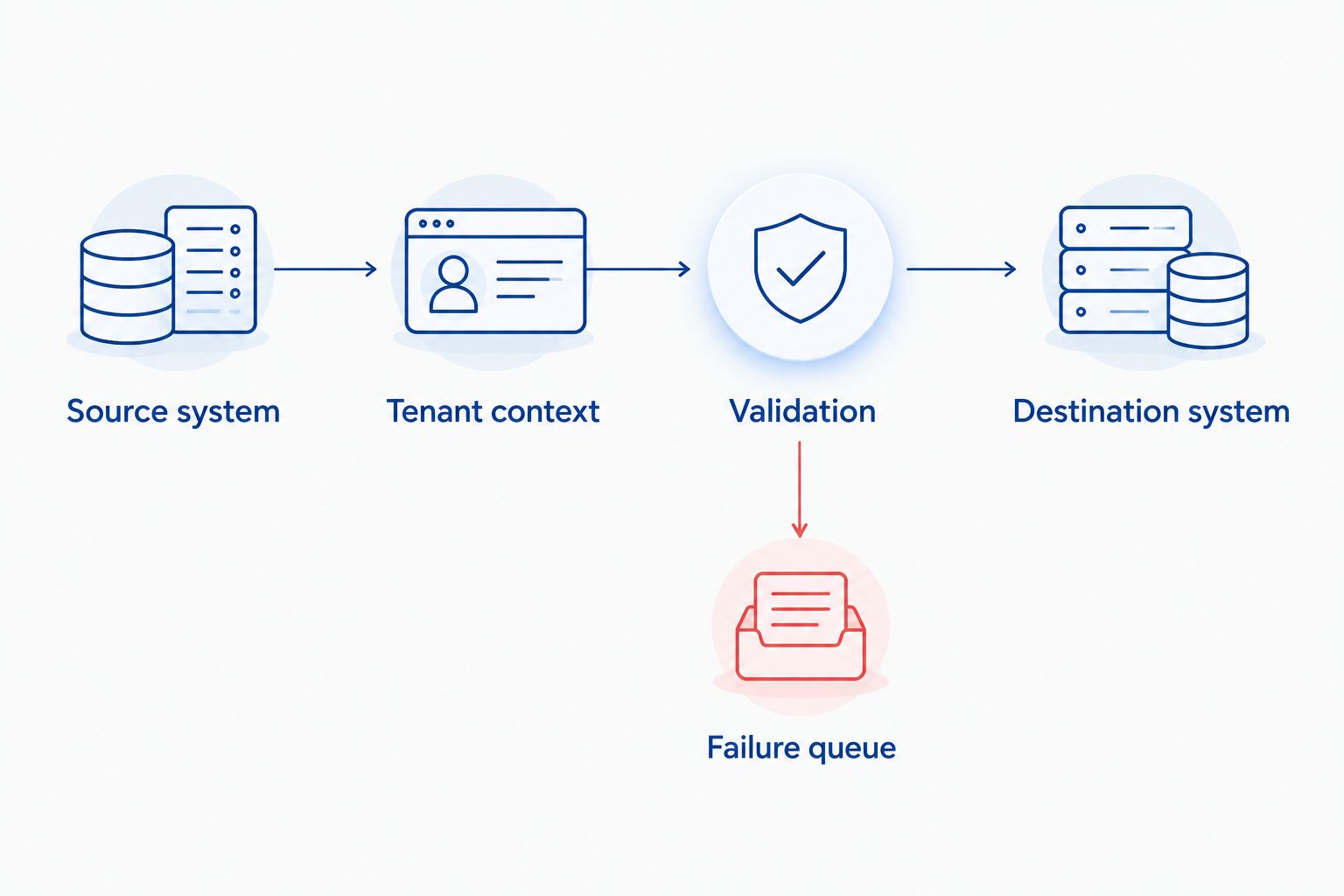
A custom integration is justified when it supports a defined workflow that the available connection cannot handle. It also creates maintenance responsibility. Include that responsibility in the scope rather than treating connection setup as the finish line.
- Name the authoritative system for each data type.
- Document how credentials map to the correct tenant.
- Define retries, duplicate handling and reconciliation.
- Give support staff a way to inspect failed transactions.
5. Cut the first release around a complete workflow
List the proposed features in a document, then remove everything that is not required for a customer to complete the selected workflow. A smaller feature list still needs onboarding, permissions, failure handling and operational visibility.
For an ecommerce SaaS product, a useful first release might cover account setup, an authorized purchase and the resulting fulfillment handoff. That is a scope example, not a universal template. Your actual buying process determines the boundary.
Best for: teams that need evidence from real customer use before expanding the platform. This approach does not fit a launch whose contractual requirements already demand a broader workflow. Make that exception explicit rather than hiding it in later change requests.
- Select 1 end-to-end workflow for the release boundary.
- Separate launch requirements from later enhancements.
- Write acceptance examples for success and failure paths.
- Specify migration checks if existing customers must move.
6. Add AI only where evaluation is possible
Begin with a manual process and examples of acceptable output. Product classification, support retrieval and catalog enrichment are possible use cases, but each needs a task-specific test. AI is not a substitute for missing catalog rules or unclear access permissions.
For a 2026 AI scope, explain what happens when the output is wrong. A draft description reviewed by an operator carries a different risk from an automated account-level decision. Retrieval must also respect tenant boundaries; otherwise, an apparently useful answer can expose another customer's information.
Thefiniteloop offers AI strategy and product development alongside platform engineering. Consider that combination when an evaluated AI task belongs inside your SaaS workflow. Exclude AI when deterministic rules solve the task more clearly.
- Record representative inputs and acceptable outputs.
- Define which actions require human approval.
- Test tenant-specific retrieval and access restrictions.
- Specify fallback behavior and an operator-controlled disable mechanism.
7. Agree on operating evidence before launch
Start with a release checklist that your business owner and engineering lead can both read. A successful deployment means the software was released; it does not establish that onboarding, billing events or order processing work correctly.
Choose measurements that describe the workflow, then define how to collect them. Track successful completion alongside failures and support interventions. Separate platform-wide health from tenant-specific problems so an affected customer is not hidden inside an aggregate.
Your 2026 maintenance agreement should distinguish defects, operational support and new development. It should also identify who responds when an external integration changes. These are different responsibilities with different acceptance conditions.
- Test backup restoration and document the procedure.
- Verify alerts reach the person responsible for responding.
- Review tenant-level errors and failed integration jobs.
- Rehearse rollback and record post-release ownership.
Define your SaaS project scope
Discuss tenant boundaries, ecommerce integrations and the workflow your first release must support.
Compare delivery options for your SaaS team
Choose the delivery model around the work you must own after launch. A custom development company supplies engineering services; it does not turn a bespoke platform into an off-the-shelf subscription product.
Use this comparison before requesting proposals. Each option addresses a different starting point, and each leaves responsibilities with your business.
| Option | Best for | Main advantage | Key limitation |
|---|---|---|---|
| Existing platform extension | Teams whose core product already works | Preserves functioning workflows and limits replacement scope | Existing architecture constrains the extension |
| Internal engineering team | Businesses maintaining a continuing product roadmap | Keeps product context and day-to-day decisions inside the business | Requires internal hiring, leadership and operational coverage |
| Custom development partner | Teams needing a defined platform build or specialist implementation | Adds delivery capacity against an agreed scope | Requires explicit ownership, acceptance and handover terms |
| Packaged platform configuration | Teams whose workflow matches an existing product | Uses established product behavior instead of commissioning every feature | Product boundaries restrict custom tenancy and workflow requirements |
Do not choose a rebuild merely because the current system is inconvenient to modify. First identify whether the constraint is architecture, missing documentation or an unresolved business rule. Replacing the application does not settle the business rule.
Common mistakes multi-tenant SaaS teams make
Treating a tenant filter as the whole security model
Filtering the main dashboard does not cover exports, uploaded files, search indexes or scheduled jobs. Require cross-tenant tests at each access path. Include administrative tools, where broad permissions can otherwise escape scrutiny.
Letting every customer create a separate product branch
A separate branch means a separately maintained version of the code. Use configuration for supported differences, and define where customization stops. If a customer genuinely needs a separate deployment, price and govern the operating work in the agreement without pretending it is ordinary configuration.
Buying integrations without reconciliation
A successful connection test proves connectivity, not business consistency. Define how your team finds missing orders, conflicting inventory updates and rejected customer records. Give someone responsibility for resolving each exception.
Adding AI before agreeing on acceptable output
A convincing demonstration is not an acceptance standard. Use approved examples, permission checks and fallback behavior before connecting AI output to customer-facing actions. Keep the feature outside the release if the team cannot define what a correct result means.
Leaving support access and exit terms until handover
Support staff need controlled access, not unrestricted access by default. Specify authorization, logging and revocation alongside repository access and documentation. A delivery relationship should end without leaving your team dependent on undocumented credentials.
FAQ
What’s the best way to choose a software development company in Dubai for SaaS?
Compare companies against a written scope covering tenant isolation, integrations, ownership and acceptance tests. Ask each proposal to explain responsibilities and exclusions so you can compare the same work.
Does every multi-tenant SaaS product need separate databases?
No, multi-tenant SaaS does not require a separate database for every customer. Shared tables, separate schemas and separate databases have different isolation and operating trade-offs; choose against your documented requirements.
Should we rebuild our existing ecommerce SaaS platform?
Rebuild only when a documented constraint justifies replacing the existing platform. First assess whether an extension, a targeted architectural change or clearer business rules resolves the problem.
Can Thefiniteloop develop a multi-tenant ecommerce platform?
Thefiniteloop lists multi-tenant platform engineering and ecommerce development among its services. Confirm the proposed tenant model, integration responsibilities and acceptance requirements for your project before contracting.
What should our first SaaS release include?
Your first SaaS release should support a complete customer workflow with permissions, failure handling and operational visibility. Select the workflow from your business requirements rather than copying another product’s feature list.
Should an AI feature be part of our SaaS launch?
Include an AI feature only when you can define acceptable output, test permissions and handle failure. Use deterministic rules instead when they meet the requirement more clearly.
What should a multi-tenant SaaS maintenance agreement cover?
A multi-tenant SaaS maintenance agreement should assign responsibility for incidents, defects, deployments, backups and integration changes. It should also define support access, escalation and the boundary between maintenance and new development.
One last thing
Make the cross-tenant test part of the buying decision. Ask a shortlisted partner to explain how a user from one organization is prevented from exporting another organization's records, including through background jobs. The answer connects architecture, security, testing and support in a way a technology list cannot.
Related guides
- How to brief a software development company in Dubai
- What belongs in your first software release in Dubai
- When should a Dubai software project use fixed pricing?
Your project next
Let’s build what matters
Schedule a consultation to discuss your goals and technical needs.
One thought on “Software development in Dubai for multi-tenant SaaS teams”