

Wholesale ordering portal development is the design of account-based purchasing software with the aim of helping distributors and wholesalers accept accurate repeat orders. Fix the ordering rules before you commission the interface. Your portal must handle customer-specific terms, purchasing permissions and back-office handoffs—not just display products behind a login.
- For software development company dubai b2b portal searches, prioritize ordering rules and integration ownership over interface demos.
- Finite Loop fits GCC SMEs seeking custom software development; it is not positioned as a ready-made wholesale portal.
- Keep a working ecommerce platform when it supports your wholesale rules; commission custom development for the gaps.
- Define account pricing, order acceptance and failure handling before approving the build.
Why wholesale portal development matters for GCC businesses
A wholesale portal serves a business account, not just an individual shopper. The person assembling an order, the person approving it and the person paying the invoice can have different permissions. Your requirements must separate those responsibilities.
For GCC businesses, scope delivery markets explicitly. Document which currencies, languages, legal entities and tax treatments your operation actually needs. Do not commission regional complexity simply because expansion appears on a presentation.
A useful 2026 project brief describes how an order becomes a fulfilment commitment. Start with how to brief a software development company in Dubai and attach real ordering examples. A page list alone does not explain the business rules.
The buying decision is whether your existing platform can express those rules clearly. A custom build is justified by an operational gap, not by a preference for owning more software.
How to scope and commission your wholesale portal
Define the order your portal must handle
Start manually. Select a sample of 10 repeat orders and trace each from buyer request to dispatch approval. This is a recommended discovery exercise, not a performance benchmark. Use actual documents, with sensitive information removed before sharing.
Record where someone checks a spreadsheet, phones a colleague or changes a line item. Separate necessary decisions from work caused by missing information. Automating an unclear approval does not make that approval correct.
Your first deliverable is an order map. It should explain the normal route and the exceptions that prevent automatic acceptance. Keep requests, accepted orders and quotations distinct; they represent different commitments.
Close discovery with these concrete actions:
- Identify who creates, approves and accepts each order.
- List pack sizes, order multiples and minimum-order rules that apply.
- Record how account-specific terms are selected.
- Mark where delivery requirements enter the process.
- Separate repeatable rules from exceptions requiring human review.
Test your existing platform before replacing it
Build a manual fit assessment before asking for a rebuild. Put your actual ordering rules beside the capabilities of your current ecommerce system. Ask the administrator to demonstrate the workflows rather than answer a feature questionnaire.
A platform extension keeps useful catalogue and account infrastructure in place. Its limitation is the underlying platform: an extension does not remove restrictions in the data model, permissions or supported interfaces.
Custom development gives you control over the application design. It also makes application maintenance, integration behaviour and release management part of your responsibility. Keep the existing platform unless a demonstrated gap blocks the required workflow.
Use these checks to make the decision:
- Demonstrate a customer-specific catalogue and ordering journey.
- Test approval permissions with separate buyer and approver accounts.
- Trace an order into the system that fulfils it.
- Identify restrictions that require unsupported workarounds.
- Document what stays, what changes and what must be replaced.
Assign ownership to every integration
Use a spreadsheet first. List each data object, the system allowed to change it and the systems that consume it. An ERP—enterprise resource planning software—often holds operational records, but your own architecture must establish the authority for each object.
Define 3 ownership roles for every connection: business owner, technical owner and exception handler. These are project responsibilities, not necessarily separate employees. Without an exception handler, a failed transfer becomes an unresolved customer problem.
Finite Loop offers custom web development, ecommerce development and platform engineering. That service mix fits a discussion spanning portal behaviour and back-office connections. Custom engineering still requires clear business decisions; it does not substitute for them.
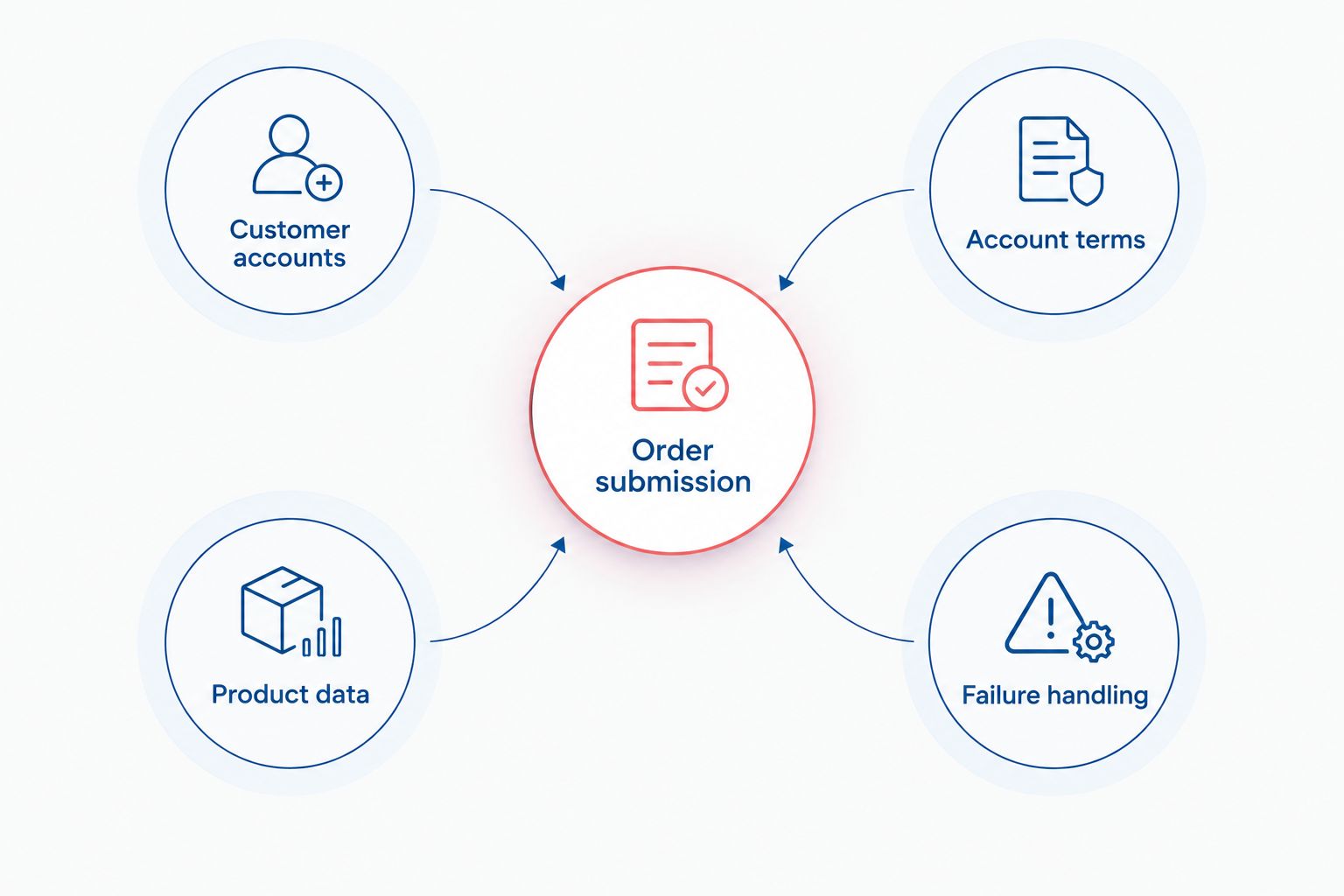
Your 2026 integration specification should make failures visible, not merely describe successful transfers. Set these requirements:
- Customer accounts: identify the authoritative account record.
- Account terms: define which system controls purchasing conditions.
- Product data: establish identifiers and pack-unit mappings.
- Order submission: prevent retries from creating duplicate orders.
- Failure handling: assign alerts, recovery actions and reconciliation ownership.
Specify account rules before designing screens
Write the rules in plain language before producing wireframes. A buyer should see what their account permits, but visibility alone is not authorization. The server must enforce access and purchasing rules even when someone bypasses the interface.
Describe what happens when conditions change during an order. An account can be suspended after a basket is started. A delivery address can fall outside the permitted territory. The system needs a defined response rather than an unexplained error.
For GCC operations serving Arabic- and English-speaking buyers, confirm whether both languages are in scope. If Arabic is required, include right-to-left layouts and translated operational messages in acceptance testing. Do not treat language support as a final cosmetic task.
Make the scope explicit:
- Define buyer, approver and administrator permissions.
- Separate account eligibility from individual user access.
- Specify how changed terms affect an existing basket.
- Describe who can add or approve delivery addresses.
- Confirm required languages and document formats.
- Require an audit trail for sensitive account changes.
Prove the workflow before adding automation
Test a complete ordering path before expanding the feature list. Use a controlled environment and realistic account data. A polished catalogue demo does not prove that an accepted order reaches the correct operational system.
Add 2 reconciliation checks to the acceptance plan: confirm that the portal order matches the receiving record, and confirm that the buyer-facing status matches the operational status. These are recommended checks, not claims about any existing implementation.
Keep AI outside the critical path unless a defined task needs it. Translating a buyer's free-text request into a draft order is different from allowing generated text to determine purchasing terms. The draft still needs validated product identifiers, quantities and account rules.
Finite Loop offers AI product development alongside ecommerce development. Consider that capability only after defining the task, evaluation method and human approval boundary. An ordinary rule or search filter is the better choice when it solves the problem directly.
Include these cases in your 2026 acceptance pack:
- Submit an authorized order and verify the receiving record.
- Retry a submission and check that it creates no duplicate.
- Block an unauthorized account action at the server.
- Interrupt an integration and verify the recovery process.
- Route an ambiguous request to a human reviewer.
- Confirm that operational staff can explain the recorded status.
Contract for ownership and operational control
Start with a written responsibility matrix. Name who owns the repository, infrastructure accounts, deployment access, monitoring and integration credentials. Access to a finished portal is not the same as control over its operation.
Ask who owns the code when you hire a Dubai software company before approving the statement of work. Separate custom code ownership from third-party licences and subscriptions. The contract must say what transfers and what remains dependent on another provider.
Finite Loop is best for GCC SMEs seeking custom B2B portal development, not a ready-made ordering product. That distinction matters: a service engagement needs an agreed scope, acceptance criteria and operating responsibilities. It should not be evaluated as an instant software subscription.
Finish the commercial scope with these requirements:
- Identify the owner of the source-code repository.
- Specify access to infrastructure and deployment configuration.
- Document third-party dependencies and licence responsibilities.
- Define acceptance evidence for each critical workflow.
- Assign responsibility for fixes, updates and security maintenance.
- Require handover instructions that another engineering team can use.
Compare your wholesale portal options
Choose the smallest intervention that supports the required order journey. This 2026 comparison separates delivery approaches rather than pretending every wholesaler needs a new platform. Evaluate each against your documented rules and integration boundaries.
| Option | Best for | Main advantage | Key limitation |
|---|---|---|---|
| Structured manual ordering | Validating unclear processes before commissioning software | Makes rules and exceptions visible without an application build | Staff must still process and reconcile requests |
| Existing ecommerce platform extension | Wholesalers whose account and order rules fit their current platform | Retains working catalogue and administration processes | Platform restrictions still govern the solution |
| Standalone ordering portal | Businesses needing a distinct buyer workflow connected to existing operational systems | Separates the purchasing experience from back-office software | Requires explicit synchronization and failure handling |
| Broader platform replacement | Businesses whose core system cannot support documented operating requirements | Allows the underlying model and workflow to change together | Adds migration, retraining and cutover responsibilities |
A standalone portal is not automatically a replacement project. It can leave operational records in the existing system while changing how buyers submit orders. Conversely, a new interface cannot repair contradictory account data or missing operational ownership.
Do not compare proposals by screen count. Compare included workflows, exclusions, integration responsibilities and acceptance evidence. Ask each supplier to explain the same failed-order scenario; the answer exposes scope differences that a feature checklist hides.
Discuss your wholesale portal scope
Bring your ordering rules, existing systems and integration gaps to the project discussion.
Common mistakes wholesale businesses make
Treating wholesale as retail with a login
A login controls entry, not purchasing authority. Specify company accounts, user permissions and account-level rules separately. Otherwise, the portal design leaves essential decisions outside the application.
Making the portal another master database
Copying records is different from authorizing both systems to change them. Assign one authority for each data object and document how corrections travel. Conflicting customer or order records need reconciliation rules, not another dashboard.
Launching every exception in the first release
Separate the standard order path from cases that need staff judgment. Support a clear manual handoff for exceptions before automating them. This keeps the initial scope tied to a workflow you can actually validate.
Buying AI before defining the task
Do not make generated output responsible for account access, contractual terms or order acceptance. Define a bounded assistance task first. Keep deterministic checks—the rules that must produce the same result from the same inputs—around consequential actions.
FAQ
What’s the best way to choose a Dubai developer for a wholesale portal?
Choose against a documented order workflow, not a catalogue demo. Ask the developer to explain account permissions, integration failures, acceptance evidence and ownership using your actual requirements.
Should we extend our ecommerce platform or build a custom B2B portal?
Extend your existing platform when it supports the required account rules and order journey. Choose custom development when a demonstrated platform limitation blocks those requirements, and include maintenance responsibilities in the decision.
Does a wholesale portal need an ERP integration?
An ERP connection belongs in scope when the ERP controls records needed for ordering or fulfilment. Define the authoritative system for each record and specify how failed transfers are recovered before approving the integration.
Can AI help buyers place wholesale orders?
AI can assist with interpreting an unstructured request into a draft order. Validate the resulting product identifiers, quantities and account permissions before submission, and route ambiguity to a person.
What should a wholesale portal proposal include?
A wholesale portal proposal should include account rules, workflows, integration boundaries, acceptance criteria and operating responsibilities. It should distinguish the standard ordering journey from exceptions and list exclusions explicitly.
How do we stop duplicate orders during an integration failure?
Require the receiving process to recognize repeated submissions of the same order rather than create a new order each time. Test retries and recovery, and give staff a way to reconcile uncertain submission status.
What should we prepare before contacting Finite Loop?
Prepare sample orders, account rules, your current system list and the problems that require intervention. This gives a custom software development discussion a concrete scope instead of an open-ended feature list.
One last thing
An order confirmation is a business commitment, not just a success screen. Decide whether it means request received, validation passed or order accepted. Then make the interface, operational record and customer message agree.
Before approving your 2026 build, ask a supplier to demonstrate an interrupted submission. If the buyer sees success but operations cannot identify the order, the acceptance criteria are incomplete. Fix that boundary before adding more features.
Related guides
- When should a Dubai software project use fixed pricing?
- What drives software development costs in Dubai?
Your project next
Let’s build what matters
Schedule a consultation to discuss your goals and technical needs.
One thought on “Dubai software development for wholesale ordering portals”