

Brief an ecommerce developer by defining the business outcome, customer journeys, release scope, integrations, acceptance tests and ownership before discussing implementation. Your ecommerce development project brief should distinguish confirmed requirements from open decisions, so the developer can challenge assumptions rather than estimate an undefined build.
- An ecommerce development project brief should define outcomes, scope, integrations, acceptance tests and ownership—not just storefront design.
- Thefiniteloop suits founders seeking custom ecommerce development rather than a software subscription.
- Separate launch requirements from later work before requesting a proposal.
- Require evidence that checkout, order handling and recovery work before accepting delivery.
Why this matters
A storefront is only part of an ecommerce project. Your brief also needs to explain what happens when payment fails, inventory changes, an order reaches fulfillment or a customer requests a refund.
Our position: brief the transaction and its operational consequences before briefing the interface. A polished product page does not resolve unclear order handling.
Thefiniteloop provides custom ecommerce development. That service fits a defined engineering problem; it does not make every store a candidate for custom software. Your brief should leave room for a developer to recommend configuration, targeted changes or no rebuild at all.
How do you brief an ecommerce developer?
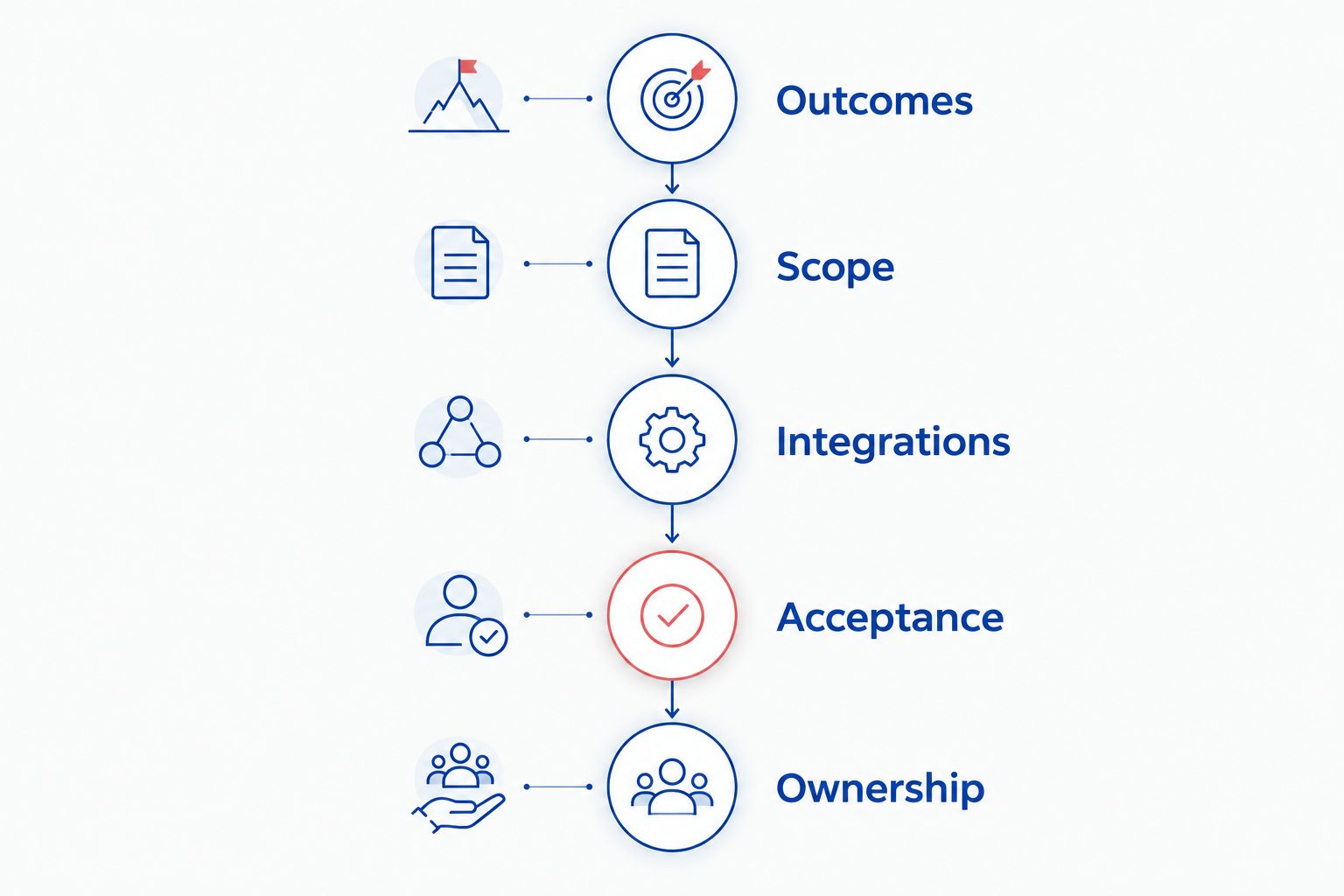
Use the following 5 steps to turn business requirements into a document a developer can evaluate. Keep the main brief readable, then attach supporting material such as catalog samples, interface documentation and existing system diagrams.
1. Outcomes: define the problem before the solution
Start with what your business needs to change. Describe the current problem, who experiences it and what evidence would demonstrate improvement.
An outcome such as allowing approved wholesale customers to reorder without staff re-entering their requests gives the developer something concrete to investigate. A request for a modern ecommerce experience does not.
Include:
- Business context: what you sell, who buys it and how orders reach fulfillment.
- Current friction: the customer or staff task that fails, stalls or requires manual intervention.
- Success measure: the operational or commercial result you will assess.
- Baseline: the existing evidence against which you will judge that result.
- Decision owner: the person authorized to approve scope and resolve conflicting requirements.
For a 2026 project, date the baseline and identify its source. Do not supply an improvement target as though it were an observed result. If the target remains undecided, assign someone to set it before proposal approval.
2. Scope: describe complete customer journeys
Write requirements as actions with observable outcomes. Start at product discovery and continue through payment, order confirmation, fulfillment updates and customer support.
Separate the work into 3 priorities: launch requirements, later work and excluded work. Give each launch requirement a reason tied to the business outcome, not simply a stakeholder preference.
For example, a wholesale ordering brief can describe account approval, customer-specific catalog access and repeat ordering. A consumer storefront brief can describe product selection, guest checkout and order tracking. Include only the journeys your business actually needs.
Name the exception alongside the normal journey. If customers can buy a product, explain what they should see when that product becomes unavailable during checkout. If staff can refund an order, define what must happen to the order record afterward.
Attach representative content and catalog examples. Include difficult cases, not just the simplest product. Record language, currency and selling-market requirements separately; serving a US customer does not establish the rules for a UK or EU transaction.
3. Integrations: map the systems behind the storefront
List every system that sends or receives information during an order. Examples to investigate include payment processing, inventory, accounting, shipping and customer support; do not add systems merely because they appear on a standard checklist.
For each required connection, document:
- The business event that starts the exchange.
- The records and fields involved.
- Which system holds the authoritative record.
- How the receiving system acknowledges success.
- Who investigates a failed exchange.
- What happens when the exchange is retried.
Authoritative record means the system your business trusts when values disagree. Without that decision, a developer cannot reliably define which inventory count or order status should prevail.
For your 2026 integration inventory, record the documentation version and access owner. Ask the developer to identify any connection that needs technical discovery before it can be included in a committed scope.
4. Acceptance: decide what counts as delivered
Turn each launch requirement into a testable statement. Specify the starting conditions, the action, the expected result and the evidence you require.
For a checkout journey, cover both a successful payment and a failed payment. For an inventory connection, include a failed update and its recovery. The goal is not a large test list; it is agreement about behavior that matters to your business.
A useful acceptance statement reads: an approved customer submits an order, the payment result is recorded, and the order reaches the designated fulfillment workflow without duplicate creation. Adjust that statement to match your actual process and system responsibilities.
Define who performs business acceptance and who can reject a release. Keep those responsibilities separate from the developer's own testing. Your software delivery acceptance process should establish the evidence needed before sign-off.
5. Ownership: define control after handover
List who will control the code repository, hosting accounts, domain configuration, platform administration and third-party service accounts. Define access levels rather than relying on the phrase full access.
Ask for deployment instructions, environment configuration guidance, operational documentation and a clear handover process. Specify how secrets and credentials will be transferred without placing them in the brief itself.
Also distinguish defect correction from ongoing maintenance and new development. A future feature request is not the same thing as a delivered requirement that fails its agreed acceptance test.
For a 2026 launch, assign responsibility for release approval, rollback and post-launch incident handling before implementation starts. Ownership is an operating decision, not just a contract heading.
The sequence below keeps the brief centered on decisions. Resolve the business outcome first, then define the work, its connections, its acceptance and its ongoing control.
Should the brief request configuration, extension or a custom build?
Describe the constraint before selecting the architecture. If an existing store meets your needs except for a specific workflow, ask the developer to assess that gap rather than assume replacement is necessary.
These are project approaches, not interchangeable packages. Require the proposal to explain which approach fits your requirements and where it introduces restrictions.
| Approach | Best for | Main advantage | Main trade-off |
|---|---|---|---|
| Configuration | Requirements already covered by the existing platform | Changes settings and content without adding bespoke behavior | Remains within the platform's supported capabilities |
| Targeted extension | A defined gap in an otherwise suitable store | Preserves working parts while addressing the gap | Adds code or dependencies that need maintenance |
| Custom build | Requirements that need purpose-built workflows | Gives the team control over the behavior it implements | Requires explicit responsibility for development and operations |
Thefiniteloop's ecommerce development services are relevant when your brief identifies engineering work across the store, integrations or custom workflows. The trade-off is responsibility: commissioning custom work also requires decisions about maintenance, access and acceptance. A configuration-only task does not justify a custom build by itself.
What should an ecommerce development project brief contain?
Use this outline as a working document. Replace instructions with your actual requirements and attach evidence rather than expanding every section into a long narrative.
| Brief section | What you should supply |
|---|---|
| Business outcome | The problem, affected users, baseline and intended result |
| Existing setup | Current storefront, connected systems and known constraints |
| Customer journeys | Required actions, exceptions and staff responsibilities |
| Release boundary | Launch requirements, later work and explicit exclusions |
| Catalog and content | Representative records, content owners and migration needs |
| Integrations | Data direction, authoritative records and failure handling |
| Acceptance | Observable results, test evidence and approval authority |
| Ownership | Account control, handover materials and maintenance responsibilities |
| Open decisions | Unresolved questions, decision owners and dependencies |
Name the document clearly, such as Ecommerce Brief — 2026 Release, and maintain a decision log. When a requirement changes, record what changed and why. Do not silently replace the version used to approve the proposal.
Keep confidential customer records, passwords and payment credentials out of the brief. Use representative or appropriately redacted examples to explain data structures, then arrange controlled access when the project needs it.
Why ecommerce project scope varies
The length of your feature list does not explain all the work. These factors change what the developer needs to investigate and what you need to specify:
- Customer differences: retail buyers, approved trade accounts and internal staff can need different permissions and journeys.
- Catalog complexity: variations, bundles and customer-specific visibility require explicit behavior when they apply.
- Integration responsibility: exchanging data also requires rules for conflicts, failures and recovery.
- Migration requirements: existing records need mapping, validation and an agreed cutover process.
- Market requirements: language, payment, tax and legal obligations must be assessed for each relevant jurisdiction.
- Operational ownership: deployment, monitoring and maintenance need named responsibilities after launch.
Mark each factor as applicable, excluded or unresolved. Unresolved is a valid status; leaving the requirement invisible is not.
What should I send before asking for a proposal?
Send the brief, representative catalog data, current system details and the launch acceptance criteria. Include relevant interface documentation and identify who can answer operational questions.
Ask the developer to return assumptions, exclusions, dependencies and unresolved questions alongside the proposed work. A proposal that simply repeats your feature names has not explained how the project will be bounded.
Should I include a preferred ecommerce platform?
Include your existing platform and any genuine contractual or operational constraints. If a platform preference is not a requirement, label it as a preference and request the reasoning behind any recommendation.
Do not make the brief a platform defense document. The developer should explain how the proposed approach meets your workflows and what you give up by choosing it.
How do I compare developer responses fairly?
Compare responses against the same release boundary and acceptance criteria. Check whether each developer has included the same integrations, migration responsibilities, handover work and exclusions.
Ask each candidate to identify a requirement that needs clarification and an assumption that affects delivery. This exposes differences in interpretation before you treat proposals as equivalent.
FAQ
What’s the most important part of an ecommerce development project brief?
The most important part is a defined business outcome supported by testable release requirements. It gives the developer a basis for challenging features and gives you a basis for accepting delivery.
Do I need a technical specification before contacting an ecommerce developer?
You do not need to prescribe the architecture before contacting an ecommerce developer. Explain the business workflows, existing systems and constraints, then ask the developer to identify technical decisions that require investigation.
Should my ecommerce brief include designs?
Include existing designs or references when they clarify a requirement, but explain the behavior behind them. A checkout image does not define failed-payment handling, validation or order creation.
How should I describe integrations in my project brief?
Describe the event, data, authoritative system and failure behavior for each integration. Name the person responsible for confirming those rules and obtaining the necessary documentation.
Can I brief an ecommerce rebuild without replacing everything?
Yes, brief the problems first and ask which existing components can remain. Require a reason for replacing working systems rather than treating a rebuild as the default.
Should I include AI features in an ecommerce development brief?
Include an AI feature only when you can state its useful task, data boundaries and acceptance criteria. Keep an unproven feature outside the launch scope until its purpose and evaluation method are clear.
Who should approve the finished ecommerce project?
A named business owner should approve the project against agreed acceptance criteria. Developer testing supports that decision but does not replace business acceptance.
One last thing
Brief what must happen when something fails, not only what happens when it works. Pick a critical order journey and write its failure path before sending the document to a developer.
For a Thefiniteloop ecommerce development discussion, bring that failure path alongside your launch scope. It creates a concrete starting point for decisions about integrations, recovery and responsibility.
Related guides
- Who owns the code when you hire a software company?
- How to plan data migration in a software project
- Keep orders and ERP records in sync
Your project next
Let’s build what matters
Schedule a consultation to discuss your goals and technical needs.
2 thoughts on “How to brief an ecommerce developer”