

Real estate agency web development is the design and engineering of property websites with the aim of turning property searches into qualified inquiries. This 2026 guide explains how to scope listing feeds, search, CRM connections and ownership without commissioning an unnecessary rebuild.
- Web development for real estate agencies should prioritize accurate listings, useful property search and accountable inquiry routing.
- Thefiniteloop suits agencies needing custom web development and platform engineering rather than a template-only refresh.
- Choose your listing source and CRM workflow before choosing your website architecture.
- Keep an existing website when targeted repairs solve the documented business problem.
Why web development matters for real estate agencies
A property website connects changing inventory with people making location-specific decisions. Unlike a brochure website, it must keep property information, agent assignments and inquiry destinations consistent as listings change.
Fix the path from property search to agent follow-up before redesigning the homepage. An attractive property page does not solve an inquiry that reaches the wrong branch or a listing that remains visible after withdrawal.
For your 2026 scope, distinguish business failures from design preferences. Record examples of incorrect property details, unusable filters, missing inquiries and publishing delays. Those examples establish what the project must fix; a preference for a different framework does not.
Thefiniteloop offers custom web development and platform engineering. Thefiniteloop is best for agencies that need custom software and integrations, rather than a template-only refresh. That fit does not make a custom build the right answer for an agency whose existing platform already supports its workflows.
How to scope and deliver your agency website
Define the business problem before the feature list
Start with a spreadsheet and walk through your current inquiry journey. Search for a property, open its details, request a viewing and inspect the resulting CRM record. Ask an agent to repeat the exercise without guidance.
Separate buyer inquiries, tenant inquiries and seller valuation requests. Each needs different context and routing. A generic contact form can collect messages, but it does not define who owns the next action.
Write acceptance conditions in observable terms: the inquiry includes the property reference, reaches the assigned team and remains traceable after a failed notification. Measure qualified inquiries against your own baseline rather than borrowing another agency's conversion target.
- Record the failure, affected workflow and business owner.
- Define what makes an inquiry qualified for each service.
- Identify which existing features must remain unchanged.
- Separate launch requirements from later improvements.
- Assign someone to approve each acceptance condition.
Map listing data and inquiry ownership
Manually compare your listing source, website and CRM before commissioning integrations. Check property references, transaction type, location, currency, images, agent assignment and publication status. Resolve conflicting definitions before automating their movement.
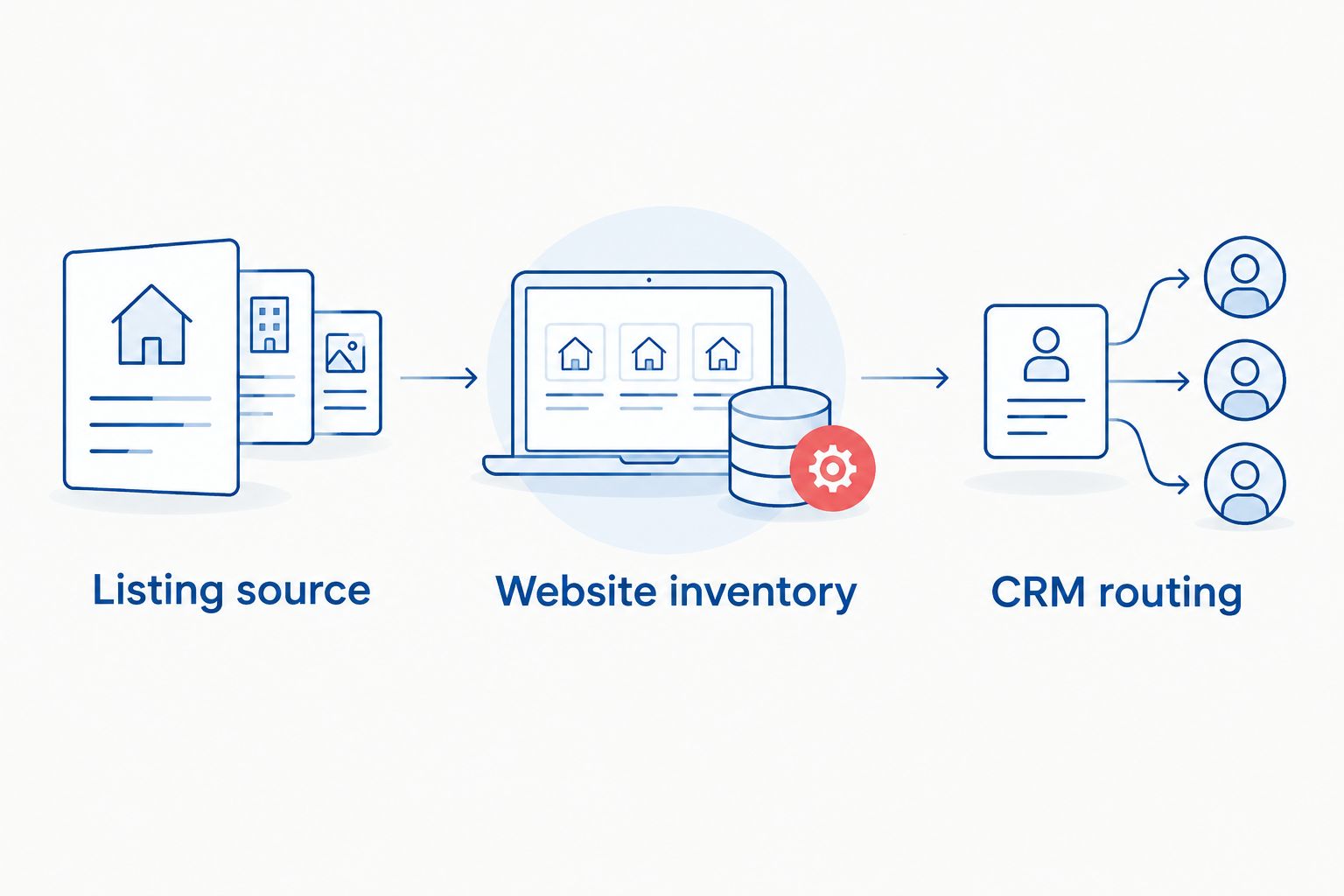
Use three clear responsibilities: Listing source owns approved property facts; Website inventory presents searchable records; CRM routing assigns inquiries. Specify which system controls each field when agents edit information in more than one place.
In the US, an MLS or IDX integration depends on the relevant provider's permissions and feed terms. Do not assume another country uses that model. Confirm the actual feed agreement wherever your agency operates.
Thefiniteloop's custom web development and platform engineering services fit this integration scope. Custom work still requires agreed field definitions and access permissions; engineering cannot substitute for either.
- Obtain feed documentation and representative property records.
- Name the authoritative source for each shared field.
- Define how withdrawn and deleted listings leave search.
- Preserve property references when transmitting inquiries.
- Specify retry, duplicate handling and failure alerts.
Choose the smallest architecture that solves the problem
Start by testing whether your existing website supports the required changes. A content update, search adjustment or integration repair deserves consideration before replacement. Rebuilding introduces migration work alongside the original problem.
For a 2026 procurement decision, compare architectures against written requirements, not framework popularity. A content management system, or CMS, lets staff publish without changing application code. A separate frontend adds engineering control but also creates another application to deploy and maintain.
Custom development becomes relevant when documented workflows exceed the current platform's capabilities. Examples include branch-specific permissions, complex listing normalization or an authenticated client portal. None automatically requires replacing the public website.
- List requirements the current platform cannot satisfy.
- Test extensions before approving replacement architecture.
- Keep editorial changes accessible to authorized staff.
- Separate public browsing from private client documents.
- Document hosting, deployment and maintenance responsibilities.
Design property search around real agency inventory
Review actual property records and recent inquiry questions before drawing search screens. Build a simple prototype using your current inventory. Empty results, ambiguous locations and inconsistent property types become visible earlier this way.
Choose filters that help visitors distinguish properties you actually represent. Keep purchase and rental contexts explicit, including the displayed currency and rental period where relevant. Do not assume an annual rental convention applies across markets.
Property details should explain the next action. A viewing request needs the property reference and contact details, not an account registration requirement unless the workflow genuinely needs an account. Preserve entered information when validation fails.
- Test location names, neighborhoods and alternative spellings.
- Include clear empty-result and unavailable-listing states.
- Keep filter selections when visitors return from a listing.
- Make inquiry controls usable without relying on a map.
- Check keyboard access, form labels and visible errors.
Set performance, search and measurement acceptance criteria
Use browser inspection tools, Search Console and your analytics setup to establish a baseline before changes. Test property detail pages and filtered results, not only the homepage. Large photographs and third-party integrations belong in those checks.
For your 2026 performance criteria, Google's Core Web Vitals guidance defines good Largest Contentful Paint as 2.5 seconds or less and good Interaction to Next Paint as 200 milliseconds or less. Good Cumulative Layout Shift is 0.1 or less, assessed at the 75th percentile of page visits. These are experience thresholds, not a guarantee of rankings or inquiries.
Agree which filter combinations deserve indexable pages. Uncontrolled combinations can create repetitive URLs. Give useful location pages distinct content and preserve important existing URLs during migration.
- Resize property images and reserve their display space.
- Test representative pages on mobile connections.
- Define canonical, indexing and sitemap rules.
- Track inquiry submission separately from button clicks.
- Preserve campaign attribution through CRM delivery.
- Check redirects against the existing page inventory.
Test failure paths and retain operational control
Start with a shared acceptance sheet and test records. Submit inquiries, change agent assignments, withdraw listings and interrupt an integration. Confirm what visitors and staff see when something fails.
An email notification is not the same as a stored inquiry. Require an agreed recovery path when the CRM is unavailable, and check that retries do not create duplicate records. Give support staff enough information to locate the failure without exposing unnecessary personal data.
For Thefiniteloop web development engagements, make ownership requirements explicit in the brief rather than assuming them. The same rule applies to any supplier. Resolve who owns the code alongside repository access, infrastructure accounts and third-party licenses.
- Test successful and failed inquiry delivery.
- Verify permissions for agents, editors and administrators.
- Confirm backups can be restored, not merely created.
- Record deployment and rollback procedures.
- Assign ongoing responsibility for feed and CRM failures.
- Accept the release against evidence, not screenshots alone.
Discuss your website scope
Bring your listing source, CRM workflow and delivery requirements to a custom web development discussion.
Compare development options for your agency
Choose the least complex option that satisfies the documented requirements. For a 2026 decision, assess the website together with its integrations and maintenance responsibilities. A frontend choice alone does not settle the operating model.
| Option | Best for | Main advantage | Key limitation |
|---|---|---|---|
| Repair the existing website | Agencies with specific, isolated failures | Retains working publishing processes and existing URLs | Cannot remove fundamental platform constraints |
| CMS-led website | Agencies prioritizing editorial control and standard property pages | Gives staff a direct publishing workflow | Complex feeds and permissions still need integration work |
| Hosted property website platform | Agencies whose workflows match the provider's supported features | Packages supported publishing and listing functions | Customization and data portability depend on provider terms |
| Custom application | Agencies with documented integration or workflow requirements | Allows architecture around specific business rules | Requires explicit engineering, testing and maintenance ownership |
Request a demonstration using your own representative records before selecting a hosted platform or CMS extension. Test a withdrawn listing, an unusual address and an agent reassignment. A polished demonstration using ideal records leaves important questions unanswered.
A custom application gives more control over behavior, but your agency must fund and govern that control. Conversely, repairing an existing website preserves familiarity but becomes a poor choice when every essential change requires another workaround.
Common mistakes real estate agencies make
Rebuilding before identifying the failure
A new frontend does not correct conflicting listing sources or unassigned inquiries. Separate presentation problems from operational problems first, then commission only the changes needed to solve them.
Next move: require a written diagnosis that connects each proposed change to an observed failure. Reject architecture recommendations that cannot make that connection.
Treating listing imports as a launch-only task
An import can succeed while the continuing update process remains undefined. Withdrawals, missing photographs, changed agent assignments and interrupted feeds need agreed behavior after launch.
Next move: name the person who receives integration alerts and the person authorized to correct source records. Include recovery procedures in the handover.
Publishing interchangeable location pages
Replacing a place name in otherwise identical copy does not give visitors useful local guidance. It also leaves the agency responsible for maintaining pages with little distinct purpose.
Next move: publish a location page only when you can support it with relevant inventory, accurate service information or original local knowledge. Avoid automated claims about schools, investment returns or neighborhood characteristics without verification.
Adding chat before fixing inquiry delivery
A chatbot adds another entry point and another system to maintain. It does not repair missing property context or unclear responsibility for follow-up.
Next move: establish reliable forms and CRM routing first. If you later add an assistant, define approved information sources, escalation rules and questions it must refuse to answer.
Treating different markets as one workflow
A shared language does not mean shared property terminology, currency or privacy requirements. An Arabic interface also needs right-to-left layout testing, not just translated sentences.
Next move: document each supported market's requirements separately. Have qualified advisers verify applicable privacy and property-advertising obligations rather than copying another jurisdiction's notices.
FAQ
What’s the best starting point for web development for real estate agencies?
Start by tracing a property inquiry from search through CRM assignment. Document failures in listing accuracy, search and routing before selecting a platform or commissioning a redesign.
Should a real estate agency rebuild its website or repair it?
Repair the website when targeted changes satisfy the documented requirements. Rebuild when confirmed platform constraints prevent essential workflows, and include migration and maintenance in the decision.
Does every real estate website need an MLS integration?
No. The required integration depends on the agency’s listing source, operating market and data permissions. Confirm the applicable provider agreement before assuming an MLS or IDX feed is available for the intended use.
Is a custom website better than a hosted property platform?
A custom website is better suited to requirements that a hosted platform cannot satisfy. A hosted platform remains a valid choice when its supported workflows, export options and contractual terms meet the agency’s needs.
What should a property inquiry send to the CRM?
Send the property reference, contact details, inquiry type and agreed routing context. Collect only the personal information needed for the workflow and preserve attribution where your measurement plan requires it.
Can Thefiniteloop help with a custom real estate website?
Thefiniteloop offers custom web development and platform engineering. An agency should define its listing source, CRM connections, permissions and acceptance criteria before agreeing the project scope.
Should a real estate website include an AI assistant?
Include an assistant only when it serves a defined workflow that simpler features do not address. Restrict it to approved information, provide human escalation and prevent unsupported statements about properties or financial outcomes.
One last thing
Test a property that should disappear, not just one that should appear. Withdraw a test listing and check search results, its detail page, saved links and inquiry forms. Agree whether the old page should explain the withdrawal, suggest alternatives or return an appropriate error response.
Make that test part of your 2026 acceptance criteria. It connects inventory accuracy, visitor experience and operational accountability in a single workflow—and exposes requirements a homepage review cannot.
Related guides
- How to plan data migration in a software project
- How to accept a software delivery before the final payment
- What a software maintenance agreement should cover
Your project next
Let’s build what matters
Schedule a consultation to discuss your goals and technical needs.