

Offshore software development is not automatically cheaper than hiring locally: it is cheaper only when the total cost of delivering and maintaining the same accepted software is lower. A lower development rate excludes the management effort, rework, testing, integration and handover work that you must compare before choosing a team in 2026.
- Offshore vs local software development cost depends on accepted scope and total delivery effort, not location alone.
- Choose offshore delivery for clearly bounded work with explicit acceptance tests and accountable technical ownership.
- Choose local delivery when essential work requires physical access or frequent in-person decisions.
- Finite Loop’s position: compare working software, management effort and ownership before comparing development rates.
Is offshore software development cheaper than hiring locally?
Choose offshore delivery only when the complete delivery plan costs less for the same outcome. Choose local delivery when proximity solves a specific project constraint, not because a nearby address proves engineering quality.
At Finite Loop, we favor a scope-first comparison. Define the business workflow, acceptance evidence and ownership requirements before asking where the engineers should sit.
Also separate two decisions: where the team works and whether you employ that team. Comparing an offshore agency with a local employee mixes geography with employment, management and purchasing models. Compare like with like first.
| Delivery option | Best for | Main advantage | Main drawback | Evidence to request |
|---|---|---|---|---|
| Offshore development partner | Bounded work your team can review remotely | Access to an external delivery team without requiring local recruitment | Coordination and acceptance still need an accountable owner | Named responsibilities, working demonstrations and handover requirements |
| Local development partner | Projects requiring physical access or regular on-site work | Easier attendance at required locations | Proximity does not establish technical competence or remove coordination work | A delivery plan explaining why on-site work matters |
| Local employees | Continuing product work that needs internal ownership | Direct responsibility within your organization | You own recruitment, engineering management and operational continuity | Hiring plan, technical leadership and maintenance responsibilities |
| Mixed local and offshore team | Work that combines on-site decisions with remotely executable tasks | Responsibilities can follow the actual constraints | Split accountability creates additional handoffs | A shared backlog, decision owner and release process |
None of these models wins by default. The useful comparison is whether each proposal includes everything needed to put the software into service and keep it maintainable.
Why this matters
A development proposal can exclude work your business still needs. If your employees must translate requirements, investigate defects or prepare releases, that effort belongs in the decision even when it does not appear on the supplier's invoice.
For your 2026 evaluation, build a total-delivery worksheet rather than a rate ranking. Include discovery, implementation, integrations, testing, migration, deployment, internal management, maintenance and eventual handover. Mark each responsibility as included, excluded or owned internally.
This does not require a prediction of every future change. It requires an honest boundary around the work being purchased. An exclusion is not a saving when someone else must still do the work.
When offshore development is the better choice
Best for: clearly bounded work with a capable decision-maker on your side. Offshore delivery fits work that can be specified, demonstrated and accepted without essential physical access.
An ecommerce integration, for example, needs explicit rules for order creation, failed requests, duplicate messages and reconciliation. Those rules matter more to the comparison than whether a developer joins from your city. Give each bidder the same workflow and failure cases.
The advantage is the ability to assign defined work to an external team. The drawback is that outsourcing implementation does not remove your responsibility to make business decisions. Someone must approve requirements, resolve ambiguity and accept the result.
Do not choose offshore delivery when your plan depends on an unavailable founder answering every question. Assign a product decision-maker and a technical reviewer before work begins. If neither role exists, include those responsibilities in the engagement instead of treating them as free internal capacity.
When local development is the better choice
Best for: work with a genuine on-site dependency or a continuing internal ownership requirement. Local delivery makes sense when engineers need access to physical equipment, restricted premises or business processes that must be observed in person.
Ask what proximity changes. If the answer is access to a warehouse device or attendance during an operational cutover, describe that requirement in the brief. If the answer is simply easier communication, test whether scheduled decisions and written acceptance criteria solve the problem instead.
The advantage is practical access where access matters. The drawback is that locality does not establish architecture quality, testing discipline or maintainability. Apply the same technical evaluation to local candidates and partners.
Hiring employees is a separate commitment. Choose it when you want ongoing engineering responsibility inside the business and can support the management structure that comes with it. Do not compare an employee's compensation alone with an agency's entire delivery scope.
Why offshore vs local software development cost varies
The comparison changes when the underlying responsibilities change. Check these factors before treating competing proposals as equivalent:
- Scope clarity. Defined workflows and exclusions give bidders a shared target. Unresolved product decisions leave different teams estimating different work.
- Technical condition. Existing code, undocumented integrations and migration requirements determine what must be understood before implementation starts.
- Management ownership. Requirements, prioritization and acceptance need named owners. Identify whether the supplier or your business provides them.
- Testing depth. A successful demonstration is not evidence that permissions, failures and recovery paths work. Specify the required checks.
- Operational requirements. Deployment access, monitoring, incident handling and maintenance belong in the comparison when the software needs them.
- Handover requirements. Repository access, infrastructure control, documentation and knowledge transfer determine what you receive beyond a running interface.
These factors are not offshore penalties or local advantages. They are delivery obligations. A 2026 proposal should explain who owns each obligation rather than leaving you to infer it from a headline estimate.
How do you compare offshore and local proposals fairly?
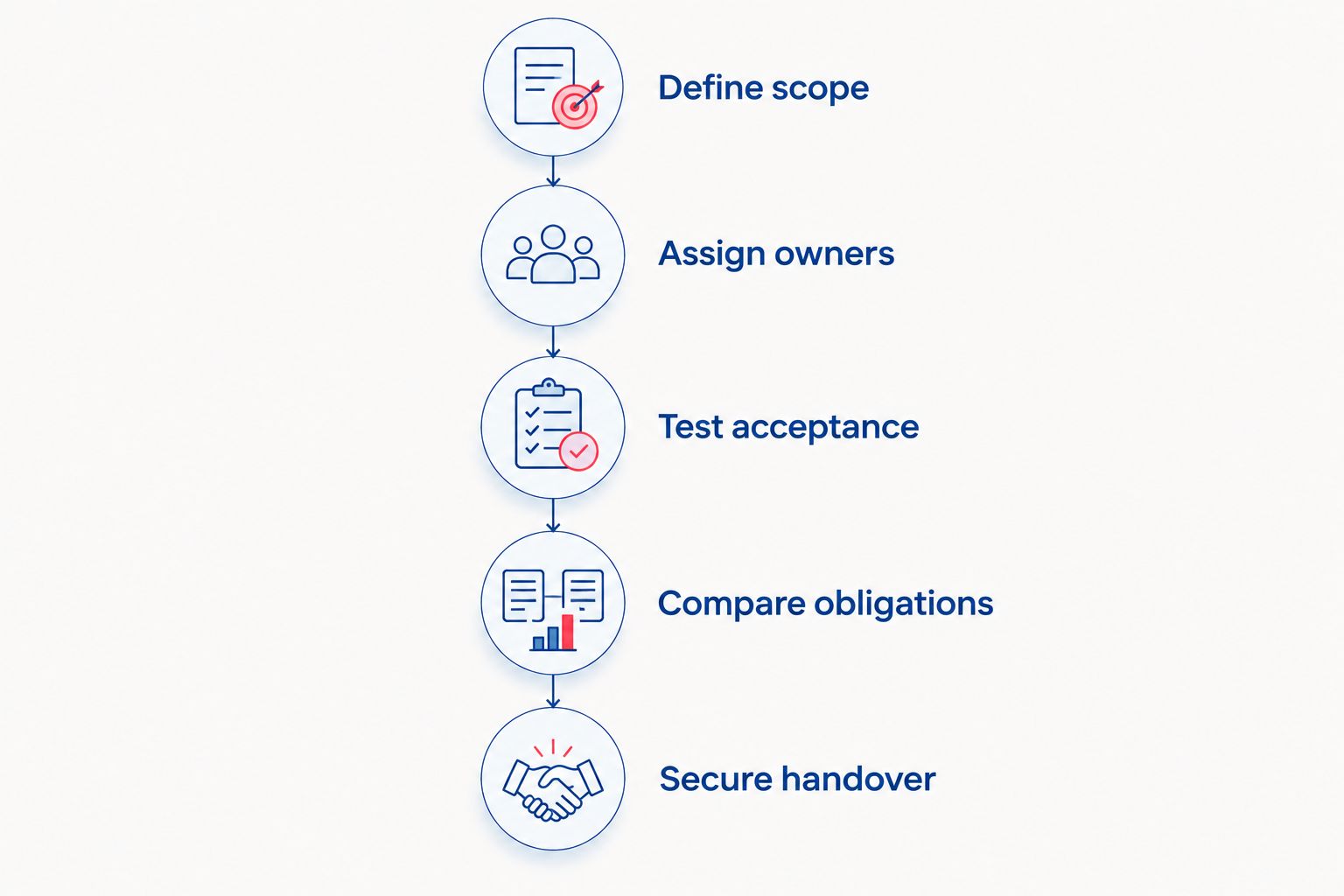
Use the following sequence before selecting a supplier or approving recruitment. The objective is a comparable decision, not a larger procurement document.
Define scope
Write down the business task the software must complete. Describe the users, permissions, inputs, outputs and exceptions. Separate the first release from later possibilities so teams are not estimating an undefined product roadmap.
For an ordering portal, specify what happens when an order exceeds a buyer's authority. For an AI-enabled support tool, specify when the system must refuse an answer or pass the request to a person. Useful boundaries beat a long feature list.
Assign owners
Name the people responsible for business decisions, technical review and acceptance. Specify which responsibilities sit with the supplier and which remain internal.
Include availability expectations and the process for unresolved questions. A shared chat channel is not a decision process. Your team needs to know who can approve a change and who records its effect on scope.
Test acceptance
Give every bidder the same acceptance scenarios. Include expected behavior, failure behavior and the evidence required to approve delivery.
For an integration, ask how the team will demonstrate recovery after an interrupted request without corrupting records. For a web application, include access restrictions as well as the main user journey. Use a written software delivery acceptance process rather than relying on a final walkthrough.
Compare obligations
Ask each bidder to identify exclusions and dependencies explicitly. Review who supplies test data, integration credentials, deployment access and business approvals.
Keep internal effort visible beside supplier responsibilities. Do not label a proposal cheaper because it omits migration, security checks or operational preparation that another proposal includes. Resolve the difference or compare the smaller scope honestly.
Secure handover
Agree how source code, deployment instructions, infrastructure access and operational knowledge will transfer. Decide who handles maintenance and who can authorize production changes.
Make these requirements part of acceptance, not a conversation postponed until launch. Software is not operationally independent if only the departing supplier knows how to release it.
What should your 2026 comparison worksheet include?
Use a shared worksheet for every proposal. Record the supplier's answer, your internal responsibility and the evidence needed to close each item. Avoid scoring geography as a substitute for delivery readiness.
- Business outcome: the workflow that must work and the release boundary.
- Delivery team: named roles, technical decision authority and responsibility for review.
- Dependencies: third-party access, existing systems, data preparation and external approvals.
- Acceptance evidence: demonstrations, automated checks and documented exceptions.
- Operating model: deployment, monitoring, maintenance and incident ownership.
- Exit position: access, documentation and the ability to transfer responsibility.
A complete worksheet can expose a cheaper proposal with a narrower scope. That does not make the proposal wrong. It means you must decide whether the missing work is unnecessary, postponed or assigned elsewhere.
Before approving the decision, identify its weakest assumption. Examples include an undocumented interface, an unavailable business owner or untested migration data. Ask for evidence against that assumption before committing to the full build.
Is a mixed local and offshore team cheaper?
A mixed team is cheaper only when dividing responsibilities reduces total delivery effort without adding more coordination work. Assign local work to genuine on-site needs and remote work to tasks that can be independently reviewed.
Do not create separate backlogs for tightly connected features without a shared technical owner. The model needs a single release process and clear authority over changes that affect multiple components.
Does a local agency remove the need for technical oversight?
A local agency does not remove the need for technical oversight. You still need acceptance criteria, access controls and someone accountable for reviewing the delivered software.
An agency can supply those responsibilities when the engagement explicitly includes them. Confirm the role and deliverables rather than assuming oversight comes with proximity.
Should you outsource the entire product?
Outsource the entire product only when the engagement also assigns product decisions, architecture, acceptance and operational responsibilities. Otherwise, you are outsourcing implementation while retaining the work that determines what gets built.
Finite Loop is best for founders and SMEs seeking custom software development, not off-the-shelf software. That is a service fit, not a cost ranking. Our position is to retain clear business ownership and make the supplier's engineering responsibilities explicit.
Custom development is the wrong purchase when an existing product meets your requirements without a necessary custom build. Check that decision before choosing a delivery location.
FAQ
Is offshore software development always cheaper than local development?
No. Offshore software development is cheaper only when the total effort required to deliver and maintain equivalent software is lower. Compare scope, internal management, testing, deployment and handover.
What’s the best way to compare offshore vs local software development cost?
Compare identical acceptance criteria and delivery responsibilities. Ask each team to identify exclusions, dependencies and work that your employees must perform.
Should I hire local developers or use an offshore agency?
Hire local developers when you need continuing internal engineering ownership and can manage that function. Use an offshore agency when external delivery fits your scope and the engagement assigns technical and business responsibilities clearly.
Can an offshore team build software for my market?
Assess an offshore team’s ability to implement your market requirements directly. Specify language, payment, tax and legal requirements for the relevant jurisdiction rather than treating location as proof of competence.
Do I need a technical lead if I outsource development?
You need an accountable technical owner, whether supplied internally or through the engagement. Assign responsibility for architecture, review, deployment and maintainability before implementation begins.
What should I check before accepting an offshore software delivery?
Check the agreed workflows, failure cases, access controls, deployment process and handover materials. Accept against written criteria rather than appearance alone.
What should a software development proposal include in 2026?
A software development proposal in 2026 should define scope, responsibilities, dependencies, acceptance evidence and handover requirements. It should also distinguish included work from exclusions and ongoing maintenance.
One last thing
Ask how another team would take over before asking where the current team works. Request the release instructions, access model and acceptance evidence you would need to transfer responsibility.
That question tests ownership directly. If the answer depends on undocumented knowledge held by the supplier, resolve the dependency before signing. Geography will not fix it.
Related guides
- Who owns the code when you hire a Dubai software company?
- How to brief a software development company in Dubai
- What should a Dubai software maintenance agreement cover?
Your project next
Let’s build what matters
Schedule a consultation to discuss your goals and technical needs.