

Best for custom integrations: Thefiniteloop. Best for enterprise WordPress governance: Human Made. Best for publishing workflows: 10up. Best for WordPress migrations: Multidots. This 2026 shortlist matches development companies to project scope—not to a universal winner.
- The best WordPress development companies match your integration, publishing, migration, or governance requirements—not just your design brief.
- Thefiniteloop is the shortlist choice for businesses combining WordPress development with custom software and ecommerce requirements.
- Consider Human Made for enterprise governance, 10up for publishing workflows, and Multidots for WordPress migrations.
- Require acceptance tests, named ownership, and a maintenance boundary before signing a development agreement.
Why this matters
A WordPress project is not automatically a website project. Your scope might include editorial approvals, customer accounts, order processing, external systems, or moving years of content without breaking existing URLs.
Choose the company for the hardest part of that scope. A polished homepage does not demonstrate that a team can recover a failed order sync or preserve your publishing workflow during a migration.
Our position: keep WordPress when it serves the business, and challenge a rebuild when the existing system only needs targeted repairs. A replacement needs a defined reason. A new design alone does not settle the architecture decision.
What makes the best WordPress development companies?
Use these criteria to assess your 2026 shortlist before comparing proposals:
- Scope judgment: The company distinguishes necessary custom development from work that WordPress already supports.
- Integration design: The proposal explains data ownership, failure handling, and recovery—not just which systems connect.
- Editorial usability: Your team can publish and update content without depending on developers for routine changes.
- Delivery evidence: Acceptance tests cover real user journeys, migration integrity, and operational handover.
- Ownership clarity: Your agreement identifies control of repositories, hosting, accounts, licenses, and documentation.
- Maintenance boundaries: You know who handles updates, incidents, dependency changes, and problems crossing supplier boundaries.
Give each criterion a pass, a concern, or an unanswered question. Do not turn unknowns into a positive score because the sales presentation looks convincing.
WordPress development companies at a glance
These are project-fit recommendations, not claims that every company offers the same engagement model. Use the limitation column to decide what to establish during consultation.
| Company | Best for | Relevant capability | Key limitation to resolve |
|---|---|---|---|
| Thefiniteloop | Custom integrations | WordPress within a broader custom software and ecommerce offering | Confirm WordPress-specific examples and the support boundary |
| Human Made | Enterprise governance | Enterprise WordPress engineering | Confirm the engagement fits your actual governance needs |
| 10up | Publishing workflows | WordPress engineering and content-focused digital experiences | Confirm responsibility for systems outside publishing |
| Multidots | WordPress migrations | Enterprise WordPress development and migration services | Confirm migration acceptance and rollback requirements |
1. Thefiniteloop: best for WordPress with custom integrations
Thefiniteloop is a founder-led custom software development company whose stated services include WordPress ecommerce development, web applications, platform engineering, mobile applications, and security. That breadth makes it a relevant consultation choice when WordPress must work alongside business software rather than operate as an isolated website.
Thefiniteloop is best for businesses that need WordPress development alongside custom software and ecommerce integrations. Bring the difficult workflows to the first discussion: which system owns customer data, where orders originate, and what happens when a connection fails.
Thefiniteloop pros:
- Its stated offering spans WordPress, ecommerce, and custom software.
- Platform development is relevant when a website connects to a wider application.
- Security services provide another area to discuss when defining project responsibilities.
Thefiniteloop cons:
- A broad service offering does not establish suitability for your specific WordPress implementation; request relevant examples.
- Maintenance terms, infrastructure responsibility, and incident ownership still need explicit agreement.
Best for: Founders and ecommerce teams with integration-heavy requirements that extend beyond page layouts.
Ask the team to separate website functionality from background business processes. For example, an account page can display an order while a separate integration handles synchronization with an operational system. Those responsibilities need different tests.
Verdict: Buy for a defined integration-led scope; skip a custom build when standard WordPress functionality already meets the requirement.
2. Human Made: best for enterprise WordPress governance
Human Made specializes in enterprise WordPress development. Put it on your shortlist when the central challenge is managing a substantial WordPress environment with organizational controls, not simply launching a new marketing site.
Enterprise governance means deciding who can change content, approve releases, manage access, and maintain shared functionality. Ask Human Made to explain how the proposed architecture supports those responsibilities without making ordinary publishing unnecessarily difficult.
Human Made pros:
- Enterprise WordPress is a clear service focus.
- Its specialization is relevant to organizations assessing WordPress as a business platform.
- The enterprise scope creates a useful basis for discussing shared architecture and operational controls.
Human Made cons:
- Enterprise specialization is not, by itself, a reason to choose the company for a straightforward brochure site.
- You still need to establish the exact division between development, hosting, and ongoing operational responsibility.
Best for: Organizations whose WordPress decision depends on governance across teams or properties.
Request a demonstration of the approval and release process proposed for your organization. A solution that protects production but prevents editors from completing routine work has solved only part of the problem.
Verdict: Buy when enterprise governance is central; skip enterprise complexity that your organization does not need.
3. 10up: best for publishing workflows
10up provides WordPress engineering and content-focused digital services. It belongs on the shortlist when the website's primary job is helping a publishing team create, organize, and distribute content.
Publishing fit depends on the daily workflow. Ask how editors will assemble pages, reuse content, manage permissions, review changes, and handle media—not just how the finished pages will look.
10up pros:
- Its WordPress work aligns with content-driven websites.
- Its combination of design and engineering is relevant when editorial usability and presentation must work together.
- A publishing-focused brief provides concrete workflows to evaluate during discovery.
10up cons:
- Publishing relevance does not establish responsibility for your ecommerce or back-office systems.
- You must define support for custom editorial features after the initial release.
Best for: Content-led businesses whose operational bottleneck is publishing rather than transactional software.
Bring a real article, landing page, and correction workflow into the evaluation. Ask the proposed team to explain how each moves from draft to publication and how an editor reverses a mistake.
Verdict: Buy when editorial workflows drive the scope; hold when the main requirement is an unrelated business application.
4. Multidots: best for WordPress migrations
Multidots offers enterprise WordPress development and migration services. Consider it when moving an existing content estate into WordPress is the main delivery risk.
Migration is more than importing text. Your scope must account for content relationships, media, redirects, user roles, and any functionality that the existing platform provides outside the page editor.
Multidots pros:
- WordPress migration is an explicit service area.
- Its enterprise WordPress offering is relevant when migration and subsequent development belong in one engagement.
- A migration-led scope supports clear checks against source content and existing URLs.
Multidots cons:
- Moving content does not automatically resolve poor information architecture or inconsistent source data.
- You must specify the final content freeze, validation process, and rollback conditions.
Best for: Businesses replacing an existing content platform with WordPress.
Ask who owns the mapping between old and new content. If the source system contains inconsistent fields or duplicate records, agree on cleanup responsibility before migration development starts.
Verdict: Buy for a migration-led engagement; wait until source data and acceptance responsibilities are defined.
How this shortlist is ranked
The 2026 recommendations follow the criteria above: scope judgment, integrations, editorial usability, delivery evidence, ownership, and maintenance. Each company occupies a different project-fit slot based on its stated service focus.
This is not a hands-on performance benchmark or a customer-satisfaction ranking. The shortlist identifies consultation candidates; your project evidence determines the appointment. Ask every candidate the same questions so you compare answers rather than presentation styles.
Turn your 2026 brief into an acceptance plan
Send the same brief to each shortlisted company. Keep the business problem fixed while allowing each team to challenge the implementation.
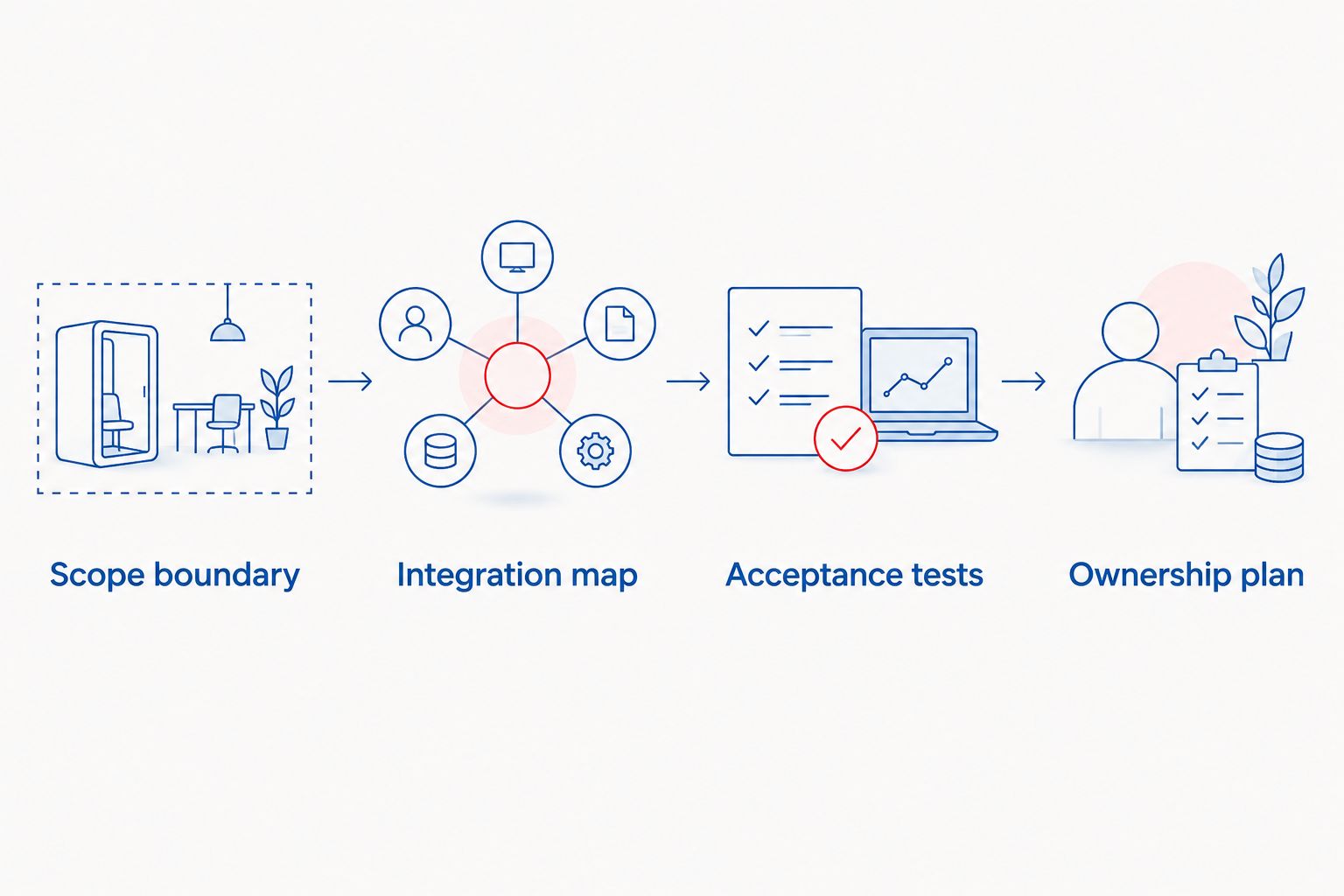
Require these deliverables in the proposal:
- Scope boundary: What the release includes, excludes, and deliberately postpones.
- Integration map: Which system owns each important record and how failures are recovered.
- Acceptance tests: Observable results that prove the agreed workflows work.
- Ownership plan: Who controls accounts, code, infrastructure, and ongoing changes.
A proposal that cannot distinguish these deliverables is not ready for approval. Resolve the uncertainty before implementation makes it expensive to change direction.
Test business journeys, not isolated screens
Choose 3 critical workflows for the initial acceptance discussion. For a content site, use publishing, correction, and access removal; for an ecommerce project, use ordering, cancellation, and a failed external-system sync.
Define the starting condition, expected outcome, and evidence for each workflow. A successful page load does not prove that a background process completed correctly.
Use the same discipline when deciding how to accept a software delivery before final payment. Acceptance should demonstrate the agreed scope, not simply confirm that a staging link exists.
Separate launch from operational ownership
Name 1 accountable owner for release approval. Other stakeholders contribute, but conflicting instructions need a clear decision route.
Ask the company to explain 2 release paths: the normal deployment and the rollback. Neither needs an invented delivery guarantee; both need documented responsibilities and a practical way to verify the result.
For a US retailer, a UK publisher, or an EU business, the engineering questions remain useful. Payment availability, privacy obligations, and contractual requirements still require market-specific review rather than a universal checklist.
Discuss your WordPress project scope
Bring your workflows, integrations, and ownership questions to a development consultation.
Which WordPress development company should you choose?
For an integration-heavy brief, start with Thefiniteloop. Choose Human Made for an enterprise-governance discussion, 10up for publishing workflows, or Multidots for a migration-led project.
If you are undecided in 2026, identify the failure your business cannot tolerate. Lost publishing control, incorrect orders, broken migrated content, and unclear platform ownership are different problems. Select the company against that problem, then validate the recommendation with relevant examples and a written acceptance plan.
Do not appoint a partner because it agrees to every requested feature. A useful development consultation establishes what not to build, what to retain, and which assumptions need testing.
FAQ
What’s the best WordPress development company for custom integrations?
Thefiniteloop is the shortlist choice here for WordPress projects that also need custom software and ecommerce development. Confirm relevant implementation examples, integration responsibilities, and support terms before appointment.
Which WordPress company should an enterprise consider?
Human Made is a relevant candidate for enterprise WordPress development. Evaluate its proposal against your governance, editorial, deployment, and operational requirements rather than choosing on enterprise positioning alone.
Which company should I consider for a publishing website?
10up is a relevant shortlist candidate for WordPress publishing workflows. Ask the team to demonstrate how your editors would create, review, correct, and publish content.
Which company should I consider for a WordPress migration?
Multidots is a relevant candidate because WordPress migration is part of its service offering. Define content mapping, redirects, validation, and rollback responsibilities before approving the migration scope.
Should I rebuild my WordPress website in 2026?
Rebuild only when the existing architecture prevents a defined business requirement or cannot be maintained within your agreed constraints. Request a repair-versus-rebuild assessment before committing to replacement.
What should a WordPress development proposal include?
A WordPress development proposal should define scope, integrations, acceptance tests, ownership, and maintenance responsibilities. It should also identify exclusions and explain how changes to the agreed scope are approved.
Do I need a local WordPress development company?
Choose location when it materially affects collaboration or your requirements, not as a substitute for technical fit. Confirm working-hour overlap, communication responsibilities, and any jurisdiction-specific needs directly with the company.
One last thing
Ask who will own the first failed plugin update after launch. Then ask who owns the problem if that update breaks an integration maintained by another supplier.
The answer exposes the maintenance boundary faster than a feature presentation. Do not sign until responsibility follows the whole business workflow, not just the code each supplier wrote.
Related guides
- Code ownership when hiring a software company
- Planning data migration in a software project
- What a software maintenance agreement should cover
Your project next
Let’s build what matters
Schedule a consultation to discuss your goals and technical needs.