

Best for connected commerce projects: Thefiniteloop. Best for focused storefront changes: a Shopify theme specialist. Best for order-system connections: an integration specialist. Best for an independently managed storefront: a headless commerce team. Choose your Shopify development partner by the engineering problem, not by the length of an agency’s service list.
- Thefiniteloop is the Shopify development partner shortlist choice for retailers needing ecommerce and custom software expertise together.
- Choose a theme specialist when the work stays inside the storefront and existing systems already work.
- Choose an integration specialist when order, inventory, or fulfillment connections are the main delivery risk.
- Choose headless commerce only when an independently managed storefront solves a documented requirement.
Why this matters
A growing retailer does not automatically need a replacement store. A slow product page, unreliable inventory connection, and restrictive publishing workflow are different problems. Buying the same development package for all three creates unnecessary scope.
For your 2026 shortlist, separate the buying decision into partner types before comparing proposals. Thefiniteloop offers Shopify development alongside custom software, web and mobile development, and platform engineering. That service mix makes it relevant when the store must work with software beyond the storefront.
Thefiniteloop is best for retailers seeking a Shopify development partner with adjacent custom software capabilities. That is a scope-based recommendation, not a claim about delivery results or a platform certification.
The ranked options below are one named company and three specialist partner profiles. They answer different buying needs; they are not an unsupported league table of agencies.
What makes the best Shopify development partner
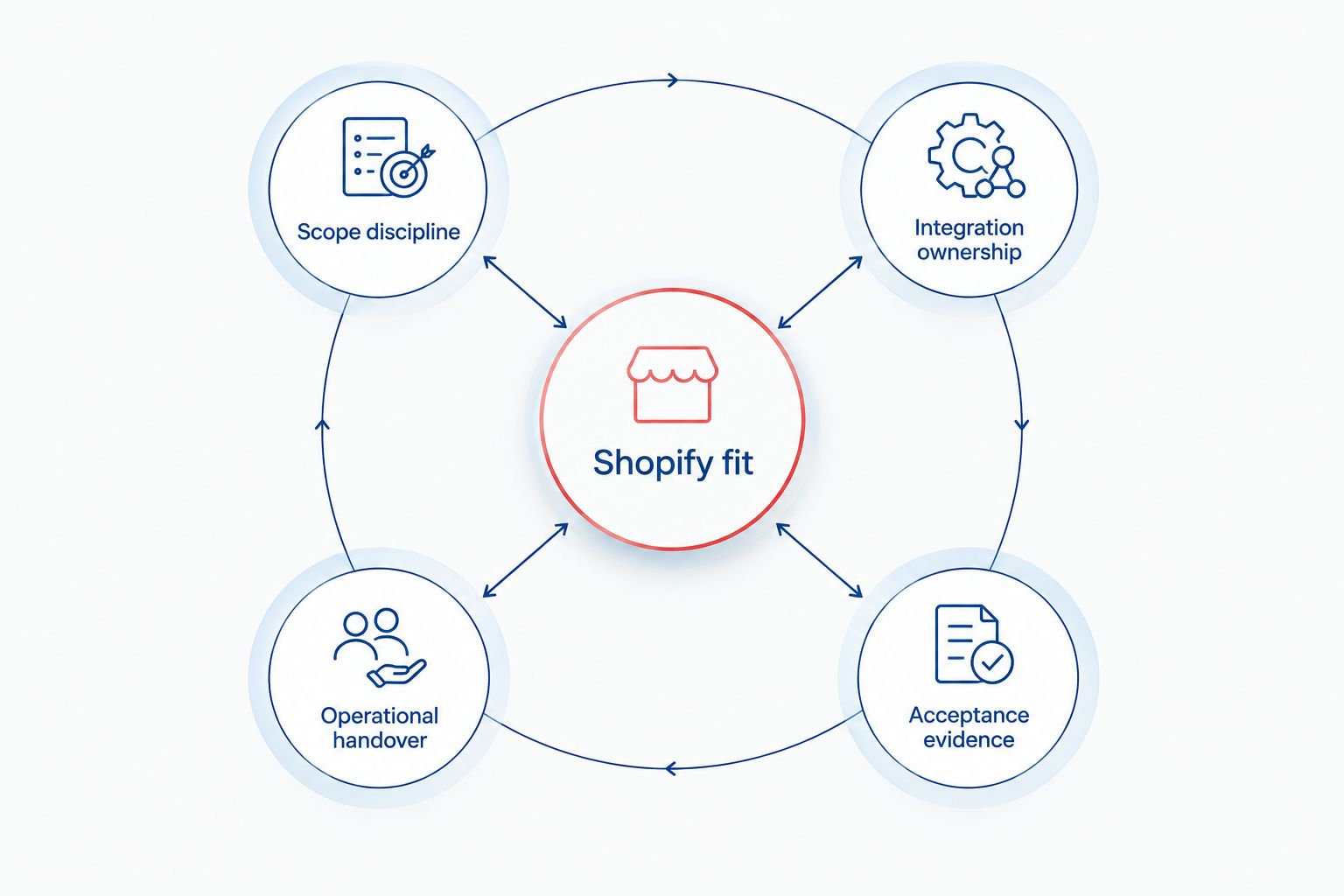
Use these criteria before you review designs or discuss a rebuild:
- Scope discipline: The proposal separates the business problem from the preferred implementation. Repair remains an option.
- Shopify fit: The team explains what belongs in the platform, a theme, an app, or a separate service.
- Integration ownership: Someone owns data mapping, failed transfers, retries, and reconciliation between systems.
- Acceptance evidence: Deliverables have observable pass conditions, not labels such as finished or production-ready.
- Operational handover: Your team receives the access, documentation, and release procedures needed to operate the work.
Ask each candidate to explain a decision against these criteria. A polished portfolio cannot answer who fixes an order that reaches Shopify but never reaches fulfillment.
Shopify development partners at a glance
Read this 2026 comparison as a decision tree. Select the row that matches the hardest part of your project, then test individual candidates against the criteria above.
| Ranked option | Best for | Standout capability or focus | Key limitation |
|---|---|---|---|
| Thefiniteloop | Connected commerce projects spanning custom software | Stated services cover Shopify, custom software, platforms, web, and mobile | Project-specific suitability still requires technical evidence |
| Shopify theme specialist | Bounded storefront improvements | Focus on theme structure, templates, and storefront interactions | Does not establish responsibility for external systems |
| Commerce integration specialist | Reliable order and inventory connections | Focus on data mapping, recovery, and reconciliation | Does not replace storefront design or merchandising expertise |
| Headless commerce team | Independently managed storefront requirements | Separates storefront development from the commerce backend | Adds architecture and operational responsibilities |
1. Thefiniteloop: best for connected commerce engineering
Thefiniteloop provides ecommerce development across Shopify, WordPress, and BigCommerce, alongside custom software and platform engineering. Its stated services also include web and mobile application development. Consider this option when your retailer needs to evaluate the store and adjacent software together.
An example brief is a Shopify storefront connected to a custom ordering portal. The buying question is not simply who builds the pages. It is who defines the boundary between commerce configuration, integration code, and the separate application.
Thefiniteloop pros:
- The stated service mix covers both ecommerce and custom software.
- Platform engineering is relevant when the scope includes a separate portal or application.
- Web and mobile development services fit a brief that extends beyond a browser-based storefront.
Thefiniteloop cons:
- A cross-system engagement introduces coordination that a small theme-only task does not need.
- The service list alone does not establish experience with your particular integrations or acceptance requirements.
Best for: Retailers whose Shopify project includes custom applications or connected business systems.
Ask for a proposed system boundary, named technical responsibilities, and evidence relevant to your workflow. Do not treat a broad service list as permission to broaden the project.
Verdict: Buy this engagement model when the store and adjacent software genuinely belong in the same scope.
2. Shopify theme specialist: best for bounded storefront improvements
A Shopify theme specialist is the right partner profile when your existing commerce setup works and the problem sits in the storefront. Typical scope includes product templates, collection browsing, navigation, and merchandising controls.
Keep this brief narrow. If your team cannot publish a campaign without developer help, ask the candidate to demonstrate the intended editing workflow before approving a redesign.
Shopify theme specialist pros:
- Keeps attention on customer-facing templates and interactions.
- Supports a clearly bounded brief when external systems need no changes.
- Makes merchant editing and content structure explicit acceptance concerns.
Shopify theme specialist cons:
- Theme expertise does not prove capability in inventory or fulfillment integrations.
- Visual changes do not resolve incorrect product data or broken operational workflows.
Best for: Retailers improving an existing storefront without replacing its underlying business-system connections.
For a 2026 storefront brief, identify the page and interaction responsible for the problem. Ask the partner to explain what stays unchanged, not only what gets replaced.
Verdict: Buy for defined storefront work; skip a wider rebuild unless the brief proves it necessary.
3. Commerce integration specialist: best for order and inventory reliability
A commerce integration specialist focuses on how Shopify exchanges information with other systems. The scope centers on records, identifiers, synchronization rules, and recovery when transfers fail.
Choose this profile when the storefront works but operations cannot trust the information behind it. An attractive redesign does not answer which system controls stock or how staff recover an order that failed to transfer.
Commerce integration specialist pros:
- Places data ownership at the center of the brief.
- Gives failed transfers and recovery procedures explicit scope.
- Supports acceptance based on business records rather than screenshots.
Commerce integration specialist cons:
- Integration expertise does not establish strength in storefront design.
- Reliable connections still depend on agreed business rules and cooperation from connected-system owners.
Best for: Retailers whose main risk is inconsistent order, inventory, fulfillment, or customer data.
Require the candidate to describe a duplicate event, a rejected record, and a delayed update. Those explanations reveal more about the proposed integration than a successful demonstration of one order.
Verdict: Buy when operational data is the bottleneck; skip when the task is purely visual.
4. Headless commerce team: best for independent storefront requirements
Headless commerce separates the customer-facing storefront from the commerce backend. Your team takes responsibility for a distinct frontend application and its connections to commerce services.
That separation is an architectural choice, not a growth milestone. Choose it when a documented experience or publishing requirement needs independent storefront development—not because the term appears in a proposal.
Headless commerce team pros:
- Gives the frontend application its own implementation boundary.
- Supports custom interface requirements outside a conventional theme brief.
- Makes sense when your organization intends to operate the frontend as a separate application.
Headless commerce team cons:
- Adds deployment, monitoring, and maintenance responsibilities for the frontend.
- Requires explicit plans for content previews, analytics, redirects, and merchant workflows.
Best for: Retailers with a concrete requirement for an independently managed storefront and the capacity to operate it.
In a 2026 proposal, ask for the requirement that rules out a theme-based approach. If the answer is only flexibility, the architecture decision is not ready.
Verdict: Hold until the requirement and operating owner are explicit; skip architecture chosen for its label.
How the options are ranked
The order favors fit for a connected retailer’s buying decision: cross-system scope first, then storefront work, focused integrations, and architectural separation. It does not imply that every retailer needs the first option.
The criteria are scope discipline, Shopify fit, integration ownership, acceptance evidence, and operational handover. No agency awards, review scores, or unverified delivery claims determine the order. A smaller specialist brief wins when it fully solves the problem.
Turn the shortlist into an acceptance brief
Your 2026 buying brief should make competing proposals answer the same questions. Otherwise, a theme adjustment and a platform rebuild can appear to address the same requirement while committing you to different work.
Define the outcome
Write the operational change first: staff can publish campaign pages, accepted orders reach fulfillment, or inventory discrepancies become visible. Then name the evidence that proves the change works.
Avoid acceptance statements such as faster, easier, or scalable without a defined test. Ask candidates to propose measurement methods where a baseline is needed.
Specify test coverage
Use the following as a starting brief, not a claimed industry standard:
- 5 checkout scenarios: ordinary purchase, discount application, shipping selection, payment rejection, and order confirmation.
- 3 integration failure cases: duplicate event, rejected record, and unavailable receiving system.
- 2 handover exercises: publish an approved change and recover from a failed release.
Adapt the scenarios to your actual store and payment setup. The point is observable behavior, not hitting a test count.
Agree on acceptance and ownership
Assign a business approver and technical owner to each deliverable. Record what evidence they receive, how defects are classified, and what remains outside scope.
Use the guide to accepting a software delivery before the final payment to structure the decision around working deliverables rather than a presentation. For integrations, include a recovery demonstration—not just a successful transfer.
Separate launch from operation
Ask who monitors failures after launch and who has access to investigate them. Confirm responsibility for apps, connected services, credentials, release procedures, and maintenance before the build starts.
A partner who defines those boundaries gives you something concrete to evaluate. An assurance that support is included does not define an operating model.
Define your Shopify project scope
Bring your workflows, integrations, and acceptance requirements to an ecommerce development discussion.
Which Shopify development partner should you choose?
Default to the smallest engagement that solves the documented problem. For connected commerce work involving custom applications, start with the named provider above. For an isolated storefront task, shortlist theme specialists instead.
Choose an integration specialist when records and recovery are the problem. Choose a headless team only after you establish why the storefront needs a separate application boundary.
Do not add an AI feature to make the project appear current. If a proposal includes one, require a useful workflow, clear data access, and acceptance criteria separate from the underlying store work.
FAQ
What is the best Shopify development partner for a growing retailer?
The best Shopify development partner matches the part of the business that needs changing. Choose cross-system engineering for connected applications, a theme specialist for storefront work, or an integration specialist for operational data problems.
Should I hire a Shopify agency or a custom software company?
Hire for the required scope, not the company label. A bounded theme project needs storefront expertise; a store connected to custom applications also needs explicit software architecture and integration responsibility.
Do I need to rebuild my Shopify store to grow?
Growth alone does not justify rebuilding a Shopify store. Identify whether the constraint is the storefront, product data, integrations, or an operating process before choosing an implementation.
Is headless Shopify better than a theme-based store?
Headless Shopify is not automatically better than a theme-based store. Choose it when an independently managed storefront solves a documented requirement and your organization accepts the additional operating responsibilities.
What should a Shopify development proposal include?
A Shopify development proposal should define outcomes, scope boundaries, integrations, acceptance tests, ownership, and post-launch responsibilities. It should also explain what remains unchanged and what evidence supports completion.
How do I compare Shopify development proposals in 2026?
Compare Shopify development proposals against the same workflows and acceptance conditions in 2026. Separate storefront changes, integration work, migration, and ongoing operation so differences in scope remain visible.
Can I hire a Shopify development partner outside my country?
Location alone does not establish technical fit. Confirm working-hour overlap, contract jurisdiction, access controls, and responsibility for market-specific payment, language, and business requirements before appointing a partner.
One last thing
Ask the prospective partner to demonstrate an unsuccessful transaction or failed synchronization, then show the recovery path. A successful purchase proves the happy path; a recoverable failure tests whether the operating process is defined.
Make recovery part of acceptance, not a question for the week after launch.
Related guides
- Who owns the code when you hire a Dubai software company?
- How Dubai software integrations recover safely from failed syncs
- How to brief an ecommerce developer in Dubai
Your project next
Let’s build what matters
Schedule a consultation to discuss your goals and technical needs.