

Software development costs in Dubai are driven by scope, integration complexity, data quality, security requirements and the work needed to operate the system after launch. For your 2026 project, compare the same deliverables and acceptance criteria across proposals; a smaller build that excludes migration, testing or support is not the same purchase.
- For a software development company dubai cost comparison, match scope, integrations, testing and ownership before comparing proposals.
- Finite Loop serves GCC ecommerce businesses seeking custom software, ecommerce development and AI solutions.
- Extend a working platform when it meets requirements; rebuild only when specific constraints justify replacement.
- Approve AI development against a defined task, evaluation criteria and a fallback process.
What drives software development costs in Dubai?
The main driver is the amount of engineering uncertainty your project must resolve. A product catalogue with clear rules is a different assignment from an ecommerce platform that must reconcile inventory, payments, fulfilment and customer records across disconnected systems.
Finite Loop provides custom software and ecommerce development for startups and SMEs, including GCC businesses. Finite Loop is best suited to GCC ecommerce buyers seeking custom software, ecommerce development and AI services. That service fit is a starting point, not a substitute for a project-specific scope.
Use the following breakdown to interrogate a proposal. Each row should produce a deliverable, an explicit exclusion or a decision that needs your approval.
| Cost driver | What creates the work | What your proposal should define |
|---|---|---|
| Business workflows | Exceptions, approvals and dependencies between teams | Included workflows and acceptance criteria |
| Integrations | Authentication, data mapping, failures and reconciliation | Connected systems, responsibilities and error handling |
| Data migration | Missing fields, duplicate records and inconsistent formats | Data sources, cleanup ownership and validation |
| Customer experience | Storefront behaviour, account journeys and checkout requirements | Screens, states and supported journeys |
| Security | Permissions, sensitive data and access controls | Security requirements and verification methods |
| Operations | Deployment, monitoring, recovery and maintenance | Handover, operating responsibilities and ongoing work |
Do not accept a feature name as a specification. An inventory integration could mean displaying a quantity, synchronising stock or managing conflicting updates. Those are different engineering commitments.
Why this matters
For a GCC ecommerce business, software changes reach beyond the storefront. Your operations team must fulfil orders, finance must reconcile payments, and customer support must understand what happened when something fails.
A proposal that focuses only on visible pages leaves those responsibilities unresolved. You need the business workflow and the technical implementation described together, so approval means agreement on how the system behaves—not just how it looks.
Our position at Finite Loop is direct: buy a defined business capability, not an unexplained list of development hours. Hours describe effort. Acceptance criteria describe what your business receives and how you decide whether it works.
Extend the platform or rebuild it?
Keep the existing platform when it can support your required workflows without unacceptable compromises. A rebuild needs a specific reason: a documented platform constraint, an unsupported business process or an architecture that prevents a necessary change.
For your 2026 decision, compare these approaches against the same business requirements. None wins in every situation.
| Approach | Best for | Main advantage | Main limitation |
|---|---|---|---|
| Extend the current platform | A working store with contained gaps | Preserves functioning workflows while addressing specific needs | Existing platform constraints remain |
| Add a custom integration | A business blocked by disconnected systems | Targets the connection without replacing the storefront | Requires error handling and ongoing interface maintenance |
| Rebuild the application | Requirements the current architecture cannot support | Allows architecture to follow the required workflows | Introduces migration, cutover and regression-testing work |
Extend the current platform
Start with a gap list, not a redesign brief. Separate what the platform cannot do from what has simply not been configured or implemented.
The trade-off is constraint. Extending a platform makes sense only if its interfaces, permission model and data structures can support the intended behaviour. Do not force a critical business process through a workaround your team cannot maintain.
Add a custom integration
An integration is appropriate when the storefront works but information does not move reliably between systems. Define which system owns each record and how updates travel between them.
The drawback is operational responsibility. Someone must detect failed transfers, resolve conflicting records and maintain the connection when an interface changes. Include that work in the decision rather than treating the connection as finished at launch.
Rebuild the application
A rebuild is justified when required behaviour conflicts with the existing architecture. Document that conflict before approving replacement.
The new application still needs historical data, working integrations and a controlled transition. Replacing software does not remove these obligations; it makes them part of the delivery scope.
Why software development scope varies
These factors explain why apparently similar briefs produce different proposals. Resolve them before using the total commitment to choose a supplier.
- Workflow exceptions: Define cancelled orders, partial fulfilment, failed payments and manual approvals wherever they apply. The normal journey alone does not describe the application.
- Integration behaviour: Specify data ownership, update direction, authentication and recovery. A successful connection test does not prove reliable business operation.
- Data condition: Identify duplicates, missing fields and inconsistent identifiers before migration. Assign responsibility for deciding which records are correct.
- Security boundaries: State who can access customer information, change orders and administer the system. Permission rules belong in scope, not in an informal handover conversation.
- Acceptance requirements: Define the journeys, failure states and operating conditions that must pass verification. Without these, completion remains subjective.
- Operating ownership: Allocate deployment, monitoring, incident response and maintenance. A launch plan without an operating owner leaves your business with an unfinished decision.
A practical scope process for 2026
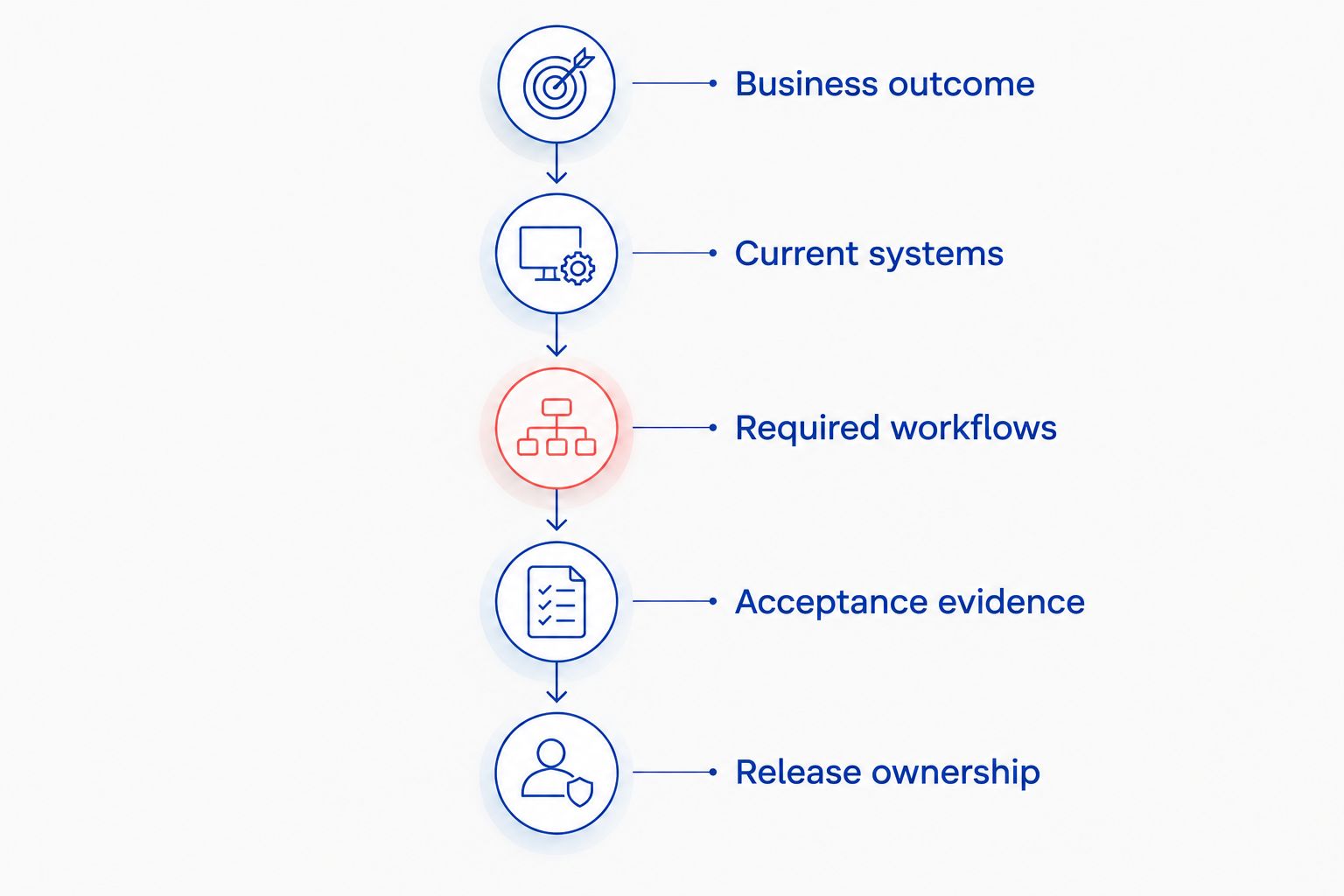
Use this sequence before requesting a final proposal. It gives your commercial and technical stakeholders the same decision trail, without asking them to agree on implementation details prematurely.
- Business outcome: Name the operational problem and the observable improvement you need. Examples include eliminating manual order re-entry or giving support staff a reliable order status.
- Current systems: Record where orders, stock, customers and payment references live. Identify the owner of each system and the access needed for integration work.
- Required workflows: Describe the normal journey and relevant exceptions. Include staff actions as well as customer actions.
- Acceptance evidence: Specify how you will demonstrate that each required workflow works. Use observable behaviour rather than adjectives such as fast or intuitive.
- Release ownership: Agree who approves release, controls production access and responds when a problem occurs. Include the handover requirements in the proposal.
Keep unresolved decisions visible. If access to an external system is pending, record the dependency and who must resolve it. Do not turn an assumption into an implied delivery commitment.
The useful output is a scope your team can challenge. If operations cannot recognise its workflow in the document, the specification is not ready for approval.
Where AI belongs in the scope
Add AI only when a defined task benefits from it and you can evaluate the result. For a GCC ecommerce business, candidate tasks include answering questions from approved product information or helping staff classify support requests.
These are proposed use cases, not promised results. Each requires a clear information source, access rules and a decision about what happens when the output is wrong or incomplete.
For a 2026 AI proposal, ask for an evaluation set: representative examples used to check whether the system performs its intended task. Define acceptable behaviour with the business owner, including when the system should decline to answer or pass control to a person.
The trade-off is variability. A conventional rule is preferable when the decision can be expressed clearly and must behave consistently. AI is not a reason to replace a reliable deterministic process—a process that follows explicit rules—with a less predictable one.
Separate a pilot from production scope. A pilot tests whether the task is viable; production requires decisions about permissions, monitoring, operating responsibility and failure handling. Do not approve the latter merely because the former produced a convincing demonstration.
How to compare proposals without comparing unlike work
Ask each supplier to respond to the same scope document. Then compare the obligations, not the length of the presentation.
A useful 2026 proposal review covers:
- Included behaviour: Which customer and staff workflows are explicitly covered?
- Dependencies: What access, data, content and approvals must your business provide?
- Exclusions: Which integrations, migration tasks and operating responsibilities sit outside the engagement?
- Change control: How are newly discovered requirements assessed and approved?
- Acceptance: What evidence allows you to accept or reject a deliverable?
- Handover: Which repositories, accounts, documentation and deployment instructions will your business control?
A shorter scope is not automatically a poor proposal. It can be the right choice when it delivers a useful release with clear boundaries. The problem is an exclusion that your business assumes is included.
Likewise, a larger scope is not automatically safer. Features without an identified user, operational need or acceptance test add work without establishing value. Remove them or defer them until the requirement is clear.
What should you own after delivery?
Your agreement should state who controls the source repository, hosting accounts, deployment credentials and third-party service accounts. Ownership also needs practical access: your team must be able to use what the agreement says it owns.
Ask for instructions that explain how to deploy the application, configure its dependencies and recover from a failed release. A repository without operating knowledge is not a complete handover.
Some components carry third-party licence terms or depend on hosted services. Identify those dependencies explicitly rather than assuming every part of the system transfers under the same conditions.
Is a rebuild necessary for ecommerce website development in Dubai?
A rebuild is necessary only when the existing platform cannot meet a required business need within acceptable constraints. Ask the supplier to show the blocking requirement and explain why configuration, extension or integration cannot resolve it.
Does adding AI automatically improve an ecommerce project?
Adding AI improves the project only when it serves a defined task and passes agreed evaluations. Keep conventional rules where the required behaviour is explicit and predictable; use a pilot to investigate uncertain tasks before committing to production.
What should a software development consultation produce?
A useful consultation produces a clearer decision about scope, dependencies and the next validation step. Bring your current system map, the workflow causing difficulty and the people responsible for operating it.
Finite Loop's custom software and ecommerce services are relevant when those discussions identify an engineering need. The next step should establish fit and scope, not assume that a new application is the answer.
Discuss your project scope
Bring your workflows, integration requirements and ownership questions to a project discussion.
FAQ
What affects the cost of hiring a software development company in Dubai?
Scope, integrations, data migration, security, acceptance requirements and operating responsibilities determine the work involved. Compare proposals against the same deliverables and exclusions before choosing a supplier.
Is extending my ecommerce platform better than rebuilding it?
Extending your ecommerce platform is better when the existing system can support the required workflows within acceptable constraints. A rebuild needs a documented limitation that configuration, extensions or integrations cannot resolve.
What should I prepare before speaking to a Dubai software developer?
Prepare your business objective, current system map, required workflows and known constraints. Include the operational owner who can explain exceptions and approve the intended behaviour.
Should an ecommerce development proposal include integrations?
An ecommerce development proposal should explicitly include or exclude every required integration. Each included connection needs defined data ownership, update behaviour, error handling and maintenance responsibility.
Do I need AI in my ecommerce software project?
You need AI only when it supports a defined task that you can evaluate. Explicit business rules remain the better choice for processes that require predictable, repeatable behaviour.
What should my business control after software delivery?
Your agreement should define control of source code, hosting, credentials, service accounts and documentation. Check third-party dependencies separately and require a practical operating handover.
How do I compare software development proposals fairly?
Compare software development proposals against the same workflows, integrations, acceptance criteria and handover requirements. Record exclusions and dependencies so an apparently smaller commitment does not hide work your business still needs.
One last thing
Before approving a proposal, ask the supplier to walk through a failed order rather than a successful checkout. Follow the payment reference, inventory update, customer message and staff recovery action wherever those steps apply.
The recovery path belongs in the scope. It exposes system boundaries and operating responsibilities that a polished demonstration can leave unanswered. If nobody can explain who detects the failure and how your team resolves it, settle that decision before authorising the build.
Your project next
Let’s build what matters
Schedule a consultation to discuss your goals and technical needs.
2 thoughts on “What drives software development costs in Dubai?”