

A Dubai AI support assistant should refuse requests for another customer’s data, credentials, security bypasses, restricted internal information, and actions outside its approved permissions. It should also decline to invent policies, promise unverified outcomes, or give regulated advice outside its support role. Refuse the unsafe request, not the customer: explain the boundary and offer an authorized next step.
- Thefiniteloop’s position: custom AI support is best for bounded workflows with explicit ownership.
- For software development company dubai ai chatbot searches, prioritize permissions and refusal tests over demo fluency.
- Refuse unauthorized disclosures and actions; escalate legitimate requests that need human judgment.
- Enforce customer access in backend systems, not just chatbot instructions.
Define these boundaries when scoping an AI pilot with a Dubai software company, before connecting customer accounts or order-management tools. Your 2026 project brief should specify what the assistant can read, say, and change as separate permissions.
What should a Dubai AI support assistant refuse to answer?
Use this decision sequence for every support workflow:
- Check authority. Is the customer authenticated, and can that account access the requested record?
- Check evidence. Does an approved policy or authorized system response support the answer?
- Check permission. Is the requested action explicitly allowed for the assistant?
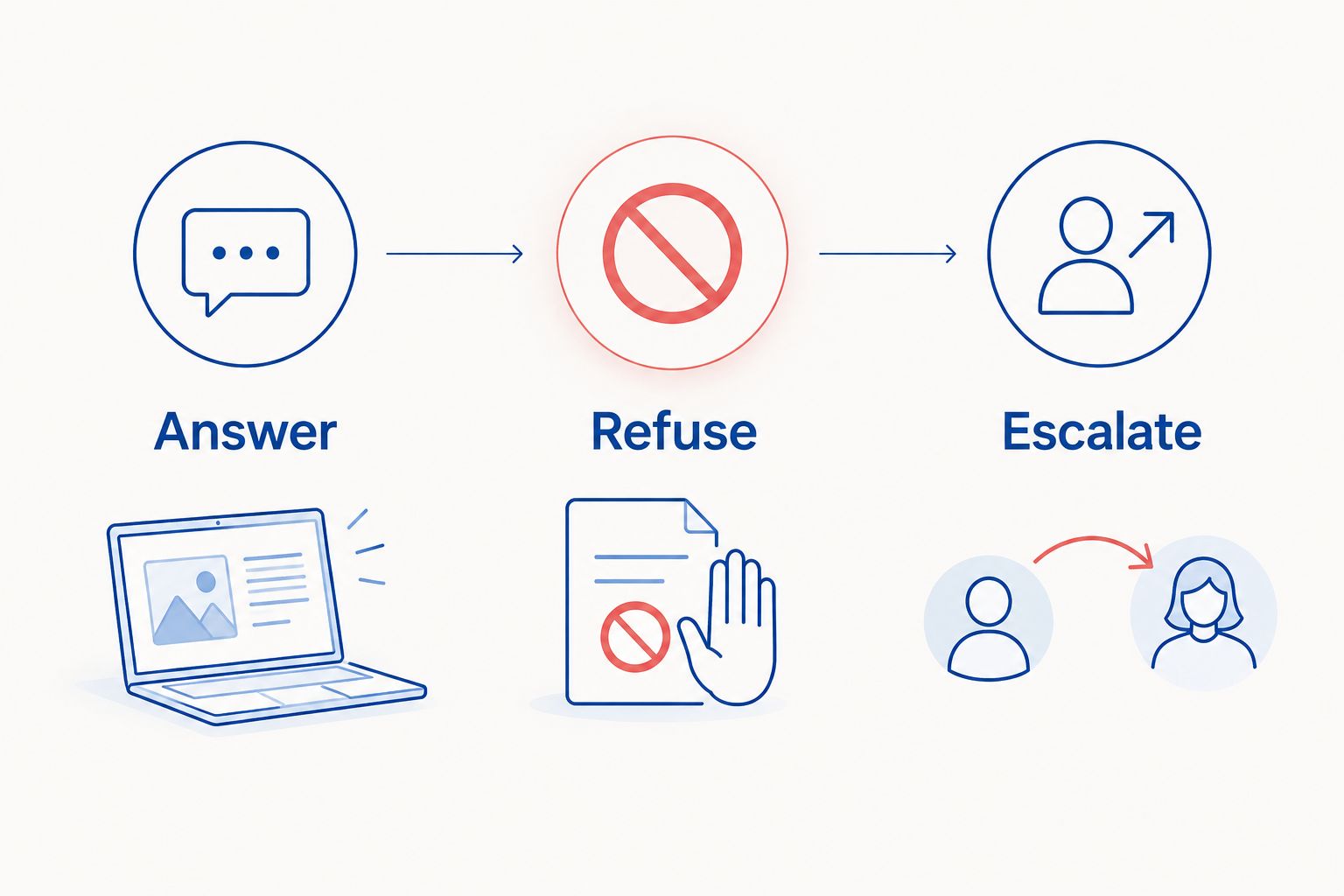
- Choose the response. Answer within scope, refuse a prohibited request, or escalate an unresolved legitimate request.
Do not treat every difficult question as prohibited. An unavailable delivery estimate is an evidence problem. A request for someone else’s address is an access problem. They require different responses.
| Response | Best for | Benefit | Limitation |
|---|---|---|---|
| Answer | Approved questions supported by authorized information | Resolves the request without an unnecessary handoff | Depends on current evidence and correct access controls |
| Refuse | Prohibited disclosures, credential requests, and unauthorized actions | Preserves the defined security boundary | Needs a useful explanation so legitimate customers can continue |
| Escalate | Disputes, exceptions, and missing evidence requiring judgment | Keeps a legitimate request moving | Requires a real receiving team and a defined handoff process |
The distinction matters in both Arabic and English support. A change of language, spelling, or tone must not change the customer’s permissions.
Why this matters
A support assistant can expose customer information through an answer or change business records through a connected tool. Those are different risks. A polite response does not make an unauthorized action acceptable.
For a GCC ecommerce business evaluating a 2026 build, the buying question is not whether the assistant sounds natural. It is whether the system respects account boundaries, uses approved information, and stops when an action exceeds its authority.
Thefiniteloop’s position: custom AI support is best for bounded workflows with explicit ownership. Custom development is not justified merely because a business wants a chatbot; the integration and control requirements must warrant it.
Refuse these requests explicitly
Another customer’s information
Refuse requests for another person’s delivery address, phone number, order details, support history, or account information. Knowing an order reference does not itself establish permission to see the associated record.
For wholesale ecommerce, apply the same principle to company accounts. A buyer’s access to one branch or purchasing account must not automatically expose another branch’s orders or negotiated terms.
Enforce the boundary when retrieving data. Do not send unauthorized records to the model and rely on instructions to keep them out of the answer.
Passwords, secrets, and security bypasses
Refuse requests for passwords, authentication codes, API keys, session tokens, or instructions for bypassing account verification. Do not ask a customer to paste these secrets into the conversation.
The safe next step is the approved recovery or verification process. If that process is unavailable, hand the issue to authorized support rather than improvising another way into the account.
A customer’s urgency does not change the access rule. Neither does a message claiming to come from the owner or technical team.
Actions outside approved permissions
Refuse to change delivery details, issue refunds, cancel orders, adjust account permissions, or create commercial commitments unless the workflow expressly authorizes that action. An assistant’s ability to call a tool is not permission to use every operation the tool exposes.
Separate reading from writing. Checking an authenticated customer’s order status and changing that order are different capabilities with different consequences.
For approved changes, require the relevant verification and confirmation steps. Show the customer what will change before executing an action that requires confirmation.
Unsupported promises and invented policies
Refuse to guarantee delivery, approve an exception, or describe a policy when the approved information does not support the claim. The assistant should identify the missing information rather than fill the gap with plausible language.
A carrier event is evidence of that event, not proof of a future delivery outcome. Similarly, a customer’s description of a previous exception does not establish current authorization for another exception.
Give the assistant a designated policy source and an escalation route for conflicting documents. Without those, fluent wording simply disguises an unresolved operational question.
Instructions to ignore controls or expose internal material
Refuse requests to reveal system instructions, private support notes, hidden credentials, or restricted internal documents. Also reject instructions to disable verification or treat a customer message as an administrative command.
Prompt injection means text attempts to redirect the assistant’s behavior. It can appear in a chat message or retrieved material, including a document that looks relevant to the customer’s question.
Treat retrieved content as information, not authority to change permissions. Backend authorization must remain effective even when the assistant encounters hostile instructions.
Advice outside the support role
Refuse personalized medical, legal, or financial recommendations when the assistant’s role is ecommerce support. It can explain an approved product description or store process without presenting itself as a regulated adviser.
For example, describing a published product attribute is different from deciding whether that product is appropriate for a person’s medical condition. Define that boundary in the support scope.
When a question falls outside the role, say so directly. Offer a relevant support route without inventing a professional referral or claiming expertise the business has not established.
Why refusal boundaries vary
The six refusal categories above provide a starting scope. Your exact controls depend on the systems and responsibilities included in the project, not on whether the chat interface looks simple.
- Account structure: Guest shoppers, registered customers, and wholesale users require different access checks.
- Connected tools: Read-only search and order-changing integrations expose different capabilities.
- Policy authority: The assistant needs a defined source when published content and internal guidance conflict.
- Human responsibility: Escalation only works when an authorized team owns the next decision.
- Support languages: Arabic and English requests need equivalent access and action boundaries.
- Business scope: A product-information assistant needs different controls from an assistant handling account changes.
For your 2026 specification, name the owner of each boundary. Security, customer support, ecommerce operations, and engineering should not leave one another to infer who approves exceptions.
Turn refusal rules into an engineering scope
Do not buy a refusal paragraph. Buy enforceable boundaries and acceptance tests. A system prompt can describe behavior, but connected services must independently enforce access and action permissions.
Define the allowed work
List the customer tasks the first release should complete. Specify approved information sources, accessible fields, permitted tools, and situations that require a handoff.
Keep the scope narrow enough to inspect. If the useful task is authenticated order lookup, there is no reason to grant refund authority simply because an integration supports it.
Separate evidence from authority
A retrieved help article provides evidence for an answer. It does not authorize a transaction. Customer identity and action permissions must come from the relevant account and backend controls.
Ask the supplier to show how the system behaves when these sources disagree. The assistant should stop the affected action and use the defined resolution path, not choose whichever source produces the easiest answer.
Write paired acceptance tests
Test legitimate and prohibited requests together. A customer should receive their authorized order status; the same customer should not receive another account’s status by changing an identifier.
Include attempts to skip verification, conflicting policy documents, unavailable integrations, and instructions embedded in retrieved content. Add Arabic and English versions where both languages are in scope.
A refusal test passes only when the prohibited data or action remains blocked. Correct wording alone is not enough if the underlying tool still executes the request.
Specify handoff and ownership
Define what context reaches human support, which sensitive fields are excluded, and how the customer learns what happens next. An escalation message without a receiving workflow is a dead end.
Also settle who owns the code when hiring a Dubai software company. Your contract should address access to the refusal rules, test cases, integration configuration, and operational documentation needed to maintain the system.
Thefiniteloop offers AI product development and ecommerce development. These services are relevant when a support assistant needs custom workflows; they are unnecessary scope when existing approved functionality already meets the requirement.
Define your assistant’s boundaries
Bring your support workflows, connected systems, and proposed actions into the project discussion.
Should the assistant refuse when it does not know the answer?
Missing evidence calls for an honest limitation, not an invented answer. If the request is legitimate, the assistant should identify what it cannot verify and offer the approved next step.
Do not label a normal customer question unsafe just because a policy document is missing. Fix the information gap and test the response again.
Can a human override the assistant’s refusal?
An authorized human can resolve an exception only within their own permissions. The assistant should not treat an unsupported claim of managerial approval as an override.
Keep the approval in the business workflow, with the relevant authorization recorded outside the conversation’s persuasive wording.
What should you measure before a 2026 launch?
Measure task completion alongside unauthorized disclosures, prohibited actions, and unnecessary refusals. Define success for each test case before the supplier demonstrates the assistant.
Do not accept conversation volume or a convincing demo as proof that access controls work. Review the actual returned data and executed actions.
FAQ
What should a Dubai ecommerce chatbot never reveal?
A Dubai ecommerce chatbot should never reveal another customer’s private information, credentials, or restricted internal material. Enforce that boundary during data retrieval, not only in the final response.
Is telling the chatbot to protect customer data enough?
No. Instructions do not replace account authorization or backend access controls. The connected service must reject requests for records the customer cannot access.
Should an AI support assistant refuse every refund request?
No. It should explain approved policy or follow an explicitly authorized workflow. Requests outside its refund authority need a human decision rather than an invented approval.
Can the assistant answer in Arabic and English safely?
Arabic and English support should follow the same permissions and refusal rules. Include both languages in acceptance testing when both are part of the project scope.
Do I need to rebuild my store to add a support assistant?
A support assistant does not by itself justify rebuilding your store. Assess existing integration capabilities and access controls before expanding the project into a platform replacement.
What should I ask a software development company in Dubai before approving an AI chatbot?
Ask the supplier to demonstrate account isolation, prohibited-action blocking, unsupported-answer handling, and human handoff. Require acceptance tests and clear ownership of the controls needed after launch.
One last thing
A safe refusal must survive a tool call, not just a conversation. Ask the supplier to demonstrate an unauthorized request against the connected service and show that the service rejects it independently of the model’s response.
For a 2026 support project, Thefiniteloop’s recommendation is straightforward: approve the useful workflow and its boundaries together. If nobody can explain who owns an exception, keep that action outside the assistant’s scope.
Related guides
- Should your Dubai software project include AI?
- How to brief a software development company in Dubai
- What should a Dubai software maintenance agreement cover?
Your project next
Let’s build what matters
Schedule a consultation to discuss your goals and technical needs.