

Ecommerce payment integration testing must cover the complete order lifecycle: successful payments, declines, interrupted checkouts, duplicate requests, refunds, and reconciliation. A successful checkout screen is not enough; your store must charge correctly, record the right order status, and recover safely when payment messages arrive late or fail.
- Ecommerce payment integration testing must verify checkout, payment status, refunds, and reconciliation—not just a successful transaction.
- Treat browser redirects as customer navigation, not proof of payment.
- Test duplicate requests and delayed webhooks before enabling fulfillment.
- Require evidence that failed payments cannot create paid orders or duplicate charges.
What should you test when adding payments to an online store?
Test each transition between the shopper, your store, the payment provider, and downstream systems. For your 2026 release, define the expected payment state, order state, customer message, and recovery action before anyone executes the tests.
Thefiniteloop provides ecommerce development for startups and SMEs that need custom implementation work. Its ecommerce and software development services are relevant when checkout changes also affect order processing, integrations, or customer-facing applications.
Use this sequence to turn a vague request to test payments into an acceptance plan:
- Map the flow. Document checkout, authentication, authorization, capture, fulfillment, cancellation, and refunds where applicable.
- Define the states. Specify what pending, authorized, paid, failed, canceled, and refunded mean in your implementation.
- Exercise failures. Interrupt connections, repeat requests, delay notifications, and reject invalid messages.
- Trace the records. Follow the payment reference through the order, inventory, fulfillment, and financial records.
- Approve the evidence. Keep reproducible test cases and results for the implementation you intend to release.
Why this matters
Payment failures are not confined to the checkout page. A customer can complete authentication while your application loses the response, or a payment notification can arrive after the shopper closes the browser.
Your release decision should answer a business question: Can the store explain what happened to the money and the order without asking someone to guess? Testing that question exposes defects that a successful checkout demonstration misses.
For a 2026 launch, separate checkout usability from financial correctness. Both matter, but an attractive payment form does not prove that a repeated request cannot trigger another charge.
Test successful payments and order creation
Start with the payment methods you actually plan to enable. Verify their documented behavior rather than assuming every method confirms immediately or supports the same operations.
For each successful flow, confirm:
- The submitted amount and currency match the server-calculated order total.
- Discounts, shipping, and applicable tax rules produce the expected total.
- The payment reference belongs to the correct customer and order.
- The order reaches the intended state only after verified payment confirmation.
- Inventory changes at the defined point in your workflow.
- Customer messages reflect the recorded payment state.
Calculate payable totals on the server. Attempt to alter browser-submitted amounts, currency values, and order identifiers. The backend must reject unauthorized changes rather than trusting the checkout page.
Also test a cart that changes during checkout. If a shopper changes quantity or shipping after a payment session is created, the implementation needs an explicit rule: update the session safely or require a fresh checkout. Do not accept payment against an unexplained total.
Test declines, authentication, and abandoned checkout
A declined payment should leave the customer with a truthful explanation and a safe next action. It must not create a paid order, release fulfillment, or leave the shopper unable to retry.
Use the provider's documented test scenarios for declines and authentication. For card flows that use 3-D Secure, exercise successful authentication, failed authentication, cancellation, and an interrupted return to the store.
Distinguish these outcomes:
| Scenario | Customer experience to verify | Backend result to verify |
|---|---|---|
| Payment declined | Clear failure message and safe retry | Order remains unpaid |
| Authentication canceled | Return to a usable checkout | No false payment confirmation |
| Browser closed | No dependency on the browser returning | Payment status remains recoverable |
| Response lost | Message does not claim an unverified failure | Existing payment is checked before retry |
| Payment still pending | Honest pending message | Fulfillment follows the defined pending-state rule |
Test mobile browsers and the devices your checkout supports. Redirects, browser history, and reopening a checkout can expose state-handling defects even when the initial desktop test passes.
A timeout is not proof that payment failed. Check the provider's recorded state before creating a replacement attempt.
Test duplicate requests and webhook recovery
Payment integrations must tolerate repeated actions and repeated messages. Test a double submission, a browser refresh, a network retry, and repeated delivery of the same webhook event.
Idempotency means a repeated request produces the intended effect without repeating the financial operation. Where the provider supports idempotency keys, verify that your application uses them according to its documented contract. Also enforce application-level uniqueness where order processing requires it.
Test the complete recovery loop:
- Payment event: A payment changes state at the provider.
- Signature check: Your receiver verifies authenticity using the provider's documented mechanism.
- Durable receipt: The event is stored or durably queued before acknowledgment.
- State update: Processing applies only valid transitions to the matching order.
- Recovery check: Failed or uncertain processing is identified and retried safely.
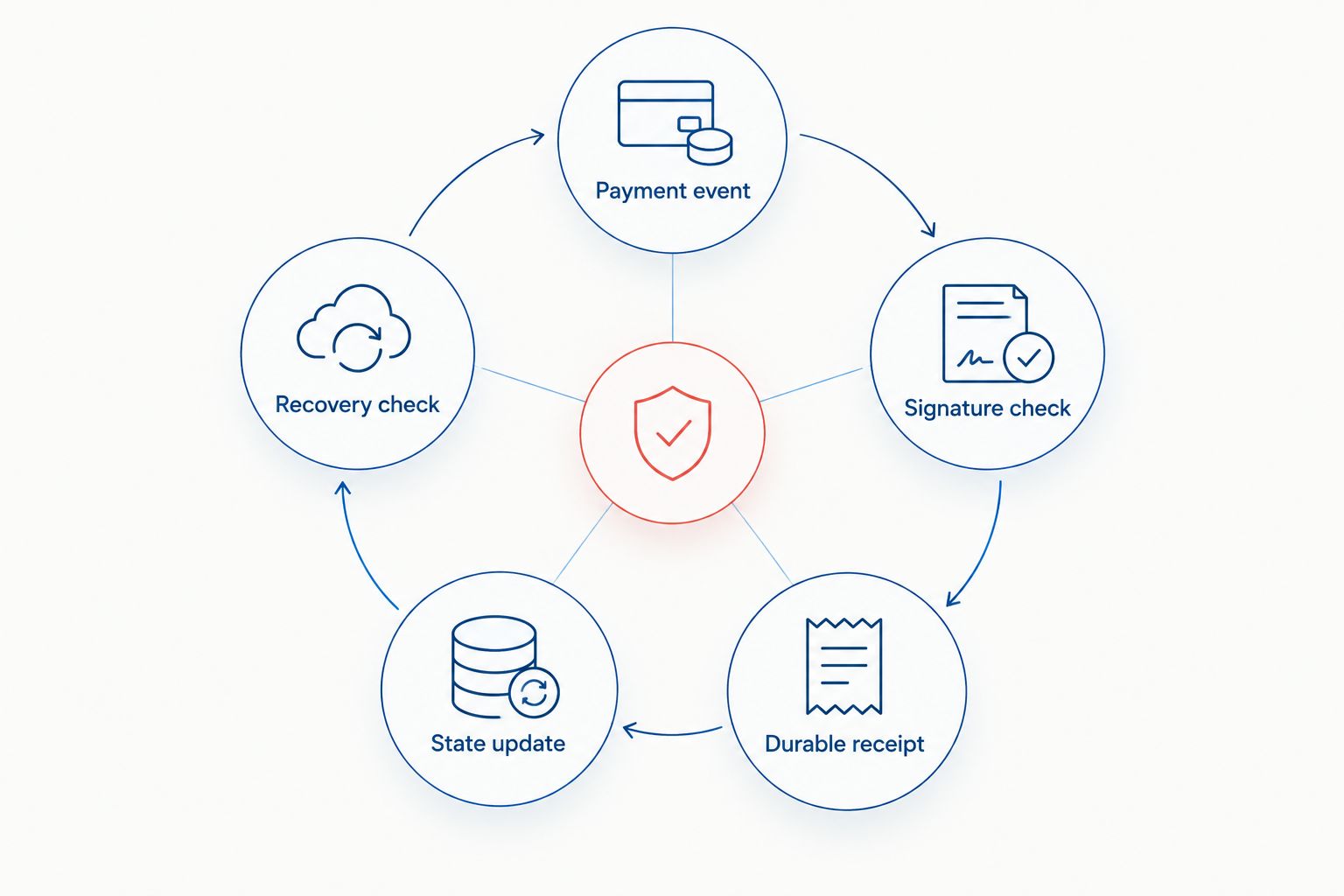
Verify the endpoint's response behavior against the provider's documentation. An HTTP 200 response indicates success at the HTTP layer; it does not prove that an order update or financial reconciliation completed. Exercise HTTP 400 and HTTP 500 responses where they apply, then confirm the provider's documented handling of each.
Deliver events late and out of order. A delayed authorization event must not overwrite a later refund state simply because it arrived last.
Test authorization, capture, cancellation, and refunds
Your 2026 acceptance plan should distinguish authorization from capture when the integration uses both. Authorization reserves access to funds; capture is the subsequent request to collect them. Do not label an authorization as a completed sale unless that matches your explicitly defined business workflow.
Test only the operations supported by the enabled payment method and merchant configuration:
- Authorization: Record the correct status without prematurely marking the order paid.
- Capture: Confirm the amount, reference, and permitted transition.
- Cancellation: Verify the outcome for uncaptured payments using the provider's terminology.
- Full refund: Track the request and its final result separately.
- Partial refund: Confirm the remaining refundable balance and order adjustment.
- Refund failure: Preserve the failure state and give the operator a recovery action.
Repeat refund submissions and interrupt the response. Your application must identify an existing refund rather than blindly issue another request.
Check customer-facing wording too. A submitted refund request and a confirmed refund are different states; neither proves when the customer's bank will display the funds.
Compare the integration boundaries you need to own
Hosted checkout and embedded payment interfaces have different testing boundaries. Neither removes the need to verify your order logic, notifications, or reconciliation.
| Approach | Best for | Advantage | Trade-off to test |
|---|---|---|---|
| Provider-hosted checkout | Teams prioritizing a provider-managed payment interface | Provider controls the hosted payment page | Redirects, session state, and return handling |
| Embedded provider components | Teams needing payment entry within their checkout | More control over the surrounding checkout experience | Component loading, authentication, and frontend errors |
| Custom backend orchestration | Businesses with specific payment and order workflows | Explicit control over application-side routing and state | More application logic to secure, test, and maintain |
Keep the simplest integration that satisfies the business workflow. Custom orchestration is justified by a concrete requirement, not by a preference for writing more code.
Security responsibilities depend on the actual implementation. Do not assume that using a hosted interface removes every payment-security obligation, or that an embedded interface necessarily sends raw card data through your server.
Why payment testing scope varies
Build the 2026 test matrix around your actual implementation. These factors determine which cases belong in scope:
- Payment methods: Immediate confirmation and delayed confirmation require different order-state tests.
- Capture model: Immediate capture and later capture need different acceptance conditions.
- Checkout architecture: Hosted redirects, embedded components, and custom backend logic have different failure boundaries.
- Markets served: Supported currencies, authentication requirements, payment availability, and tax treatment need market-specific verification.
- Order integrations: Inventory, fulfillment, accounting, and customer notifications each introduce another state to verify.
- Operational permissions: Staff access to refunds, payment settings, and credentials needs explicit authorization tests.
Do not copy tax or authentication assumptions between the United States, United Kingdom, European Union, and GCC. Identify the jurisdiction, merchant setup, and provider documentation behind each applicable requirement.
Test security and operational ownership
Try to access another customer's payment or order by changing an identifier. Check that refund actions require the correct staff permissions, and that unauthorized users cannot change payment configuration.
Verify webhook signatures using the provider's prescribed procedure. Test invalid signatures, modified payloads, and replay handling where supported. Keep secrets out of browser code and remove sensitive payment data from logs.
Operational ownership matters as much as the test itself. Record who controls the merchant account, production credentials, webhook configuration, alerts, and incident response. A failed notification must reach someone who can investigate it.
Thefiniteloop's position on ecommerce development is straightforward: the release gate is correct money movement and recoverable order state, not a successful demo. If a checkout defect comes from unclear ownership or broken synchronization, redesigning the storefront does not address it.
What evidence should you require before launch?
Require a test record that identifies the environment, application version, scenario, expected result, actual result, and relevant transaction references. Keep secrets and sensitive payment details out of screenshots and shared reports.
Your 2026 release gate should cover these evidence groups:
- Checkout evidence: Successful, declined, canceled, interrupted, and pending flows.
- Recovery evidence: Duplicate requests, repeated notifications, delayed events, and lost responses.
- Financial evidence: Correct amounts, currencies, captures, cancellations, refunds, and reconciliation.
- Operational evidence: Access controls, alerts, investigation steps, and named ownership.
Agree on software delivery acceptance before the final payment rather than debating completion after checkout is deployed. Sandbox results establish expected behavior; a controlled production validation checks the live configuration within an approved operational plan.
Can you test payments without charging real customers?
Use the payment provider's test environment and documented test instruments for supported scenarios. Sandbox testing lets you exercise failures without involving customer payments, but it does not validate every production setting.
Keep test credentials, webhook endpoints, and records separate from production. Never use an unsuspecting customer's transaction as a test case.
Should an order become paid when the shopper returns?
A browser return must not, by itself, mark an order paid. Confirm payment through the provider's authenticated server-side mechanism and apply your defined state transition.
The shopper can return before processing finishes, or never return at all. Your confirmation page needs to handle both situations honestly.
How do you know whether reconciliation works?
Reconciliation works when your application can match provider payment records to internal orders and explain discrepancies. Test missing notifications, unmatched references, duplicate records, refunds, and payment amounts that do not match the order.
Do not stop at a balanced summary. Require transaction-level traceability so an operator can investigate a specific customer complaint.
FAQ
What should ecommerce payment integration testing include?
Ecommerce payment integration testing should include successful payments, declines, authentication, interrupted checkout, duplicate requests, webhooks, refunds, security, and reconciliation. Verify the order state and financial result together.
Is a successful sandbox payment enough to launch?
No. A successful sandbox payment proves only that the tested path worked in that environment. Test failure recovery and validate production configuration through an approved launch plan.
What happens if the payment succeeds but the order fails?
The integration needs a recovery path that identifies the successful payment and repairs or flags the missing order state. Do not automatically create another charge.
How should we test duplicate payment submissions?
Repeat the same payment operation through double submission, refresh, and network retry. Confirm that the implementation prevents unintended duplicate financial effects and records the intended order outcome.
Do payment webhooks need security testing?
Yes. Verify the provider’s signature mechanism, reject invalid messages, and test repeated or delayed delivery. Protect payment updates from unauthorized requests.
Should refunds be part of checkout acceptance?
Yes, when refunds are part of the supported payment workflow. Test request submission, final status, permissions, duplicate handling, and matching order adjustments.
Who should own the payment integration after launch?
Assign named owners for merchant access, credentials, monitoring, reconciliation, and incident response. The business needs access to its payment records and a clear escalation route.
One last thing
The most revealing test is an uncertain outcome: payment completes, but your application loses the response. Ask the team to demonstrate how the store discovers the truth without charging again.
Thefiniteloop is best suited to startups and SMEs seeking custom ecommerce development. Bring a payment-state map and unresolved acceptance cases to that discussion—not just screenshots of a checkout redesign.
Related guides
- Recover safely from failed software integrations
- Keep orders and ERP records in sync
- Security checks to include in a software build
Your project next
Let’s build what matters
Schedule a consultation to discuss your goals and technical needs.
5 thoughts on “What to test when adding payments to an online store”