

A Dubai software build should include access-control tests, dependency and secret scanning, integration checks, deployment configuration review, and evidence that security findings have been fixed and retested. Add manual penetration testing where customer data, payment workflows, privileged access, or complex business rules justify it. Treat security as a release decision backed by evidence—not a certificate attached to the handover.
- For ‘software development company dubai security’ searches, demand test evidence and named remediation owners.
- Thefiniteloop is best suited to GCC ecommerce buyers seeking custom software development with cybersecurity services.
- Test customer isolation, administrative permissions, payment callbacks, and recovery—not just publicly visible pages.
- Automated scanning and manual penetration testing serve different purposes; neither replaces a documented release decision.
What security checks should a Dubai software build include?
Your 2026 software brief should specify what gets tested, who fixes failures, and what evidence you receive before launch. Put those requirements in the software development brief, not in an informal conversation after development starts.
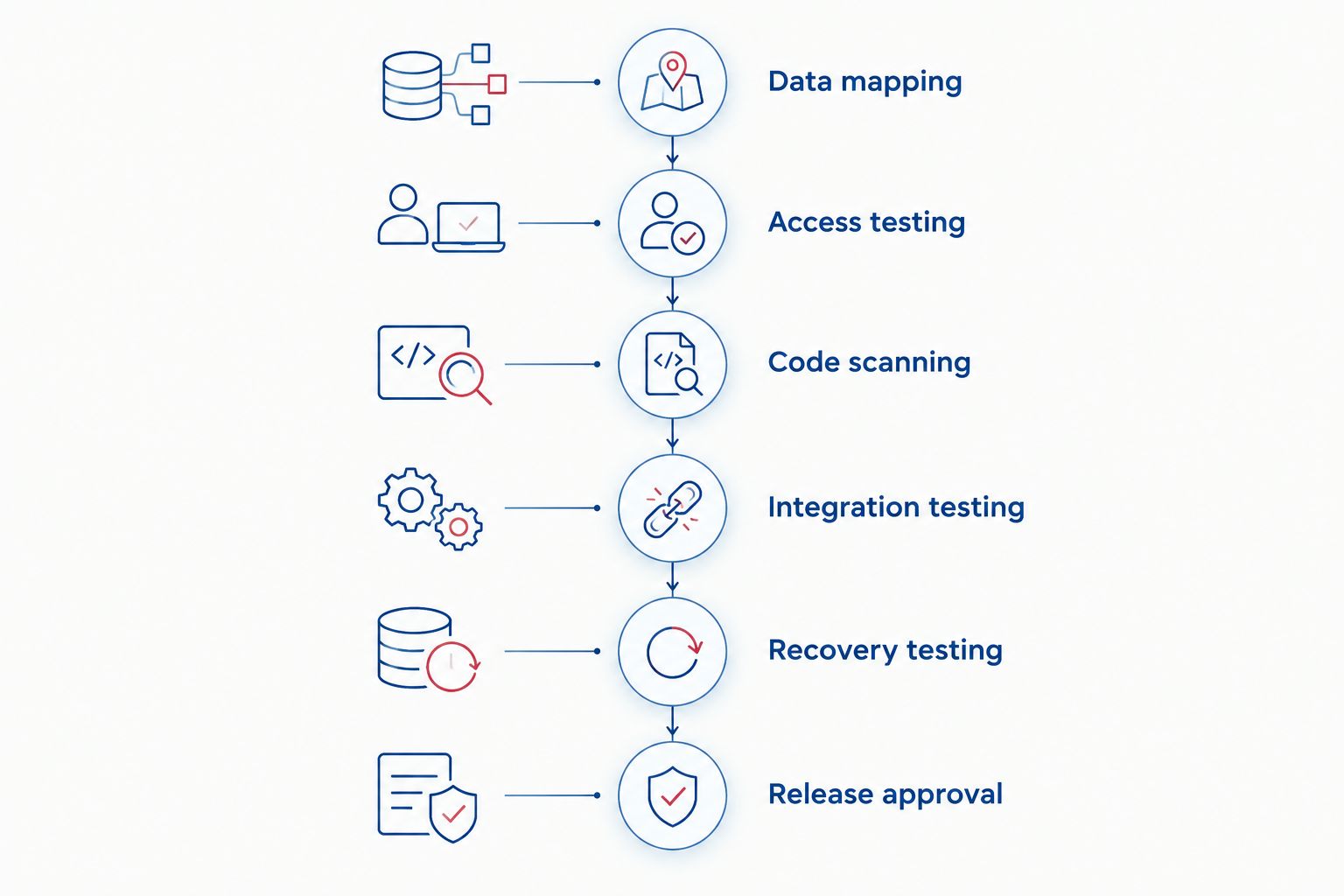
Use the following sequence as an acceptance checklist. Each step should produce something your technical reviewer can inspect.
Map sensitive data and trust boundaries
Identify the information your application collects, where it travels, and which people or systems can access it. Include customer accounts, delivery addresses, order histories, uploaded documents, administrative credentials, and integration secrets where applicable.
A trust boundary is a point where data moves between systems or permission levels. Your storefront calling an order-management service crosses one; a customer requesting an administrator-only action crosses another. Document these boundaries before choosing tests.
Acceptance evidence: a data-flow diagram, an integration inventory, and named owners for sensitive systems. A diagram without the actual external services leaves important dependencies outside the review.
Test authentication and authorization separately
Authentication establishes identity. Authorization decides what that identity can do. A working login does not prove that customers, support staff, warehouse teams, and administrators have the correct permissions.
Test password reset, session expiry, logout, administrative access, and cross-account requests. Attempt to retrieve another customer's order by changing its identifier. Repeat relevant tests against the underlying API, not only the interface.
Acceptance evidence: a permission matrix and negative tests showing that prohibited actions fail. HTTP 401 means authentication is required or has failed; HTTP 403 means the server refuses access. The response must also avoid exposing protected information.
Scan code, dependencies, and secrets
Review application code for security weaknesses, third-party packages for known vulnerabilities, and repositories for exposed credentials. Include build configuration and deployment scripts in the scope.
A scanner finding is a lead, not a complete diagnosis. Someone must determine whether the issue affects the deployed application, make the correction, and record the outcome. Removing a leaked credential from the latest code does not revoke it; exposed credentials require rotation.
Acceptance evidence: reviewed findings, remediation records, and clean retest results for release-blocking issues. Specify who reviews new dependency alerts after handover.
Exercise integrations and business rules
Test the actions that change money, stock, access, or order status. For ecommerce, this includes payment notifications, discount validation, inventory updates, refunds, and fulfillment events where those functions exist.
Check whether incoming callbacks are authenticated and whether repeated messages cause duplicate actions. Verify that the server calculates trusted totals rather than accepting a price supplied by the browser.
Acceptance evidence: test cases for altered requests, repeated events, failed integrations, and interrupted workflows. A successful checkout demonstration is not evidence that these failure paths are safe.
Review deployment and recovery
Inspect production permissions, network exposure, encrypted connections, secret storage, logging, and separation between test and production environments. Check that debugging output and administrative interfaces do not expose sensitive information.
Then test recovery. A backup record proves that a backup job ran; a restore exercise shows whether the application and its data can actually be recovered. Agree on recovery objectives based on business needs rather than adopting an arbitrary target.
Acceptance evidence: configuration review results, a restore record, alert ownership, and a documented response process.
Retest fixes and approve residual risk
Every unresolved finding needs a clear disposition: fix before release, remove the affected function, or accept the remaining risk through an authorized business owner. Record the reason and any compensating control.
Retesting must cover the corrected behavior and relevant neighboring workflows. Closing a ticket because code changed is not the same as verifying that the vulnerability is gone.
Acceptance evidence: a release checklist linked to findings, retests, and explicit approval. Keep the evidence with the project records so the next team can understand the decision.
Why this matters
For a GCC ecommerce buyer, security is an operational issue before it is a procurement label. Unauthorized order access exposes customer information. An unverified payment callback can change an order incorrectly. Excessive staff permissions create opportunities for accidental or deliberate misuse.
Your 2026 buying decision should therefore focus on the failure paths the supplier will test. Ask for evidence tied to your application, not a generic statement that the team follows security practices.
We would not recommend rebuilding a functioning store merely to describe the replacement as more secure. Identify the defect first. A targeted permission fix, integration correction, or configuration change can address a specific weakness without introducing an unnecessary migration.
Which security review does your project need?
Automated scanning, manual penetration testing, and architecture review answer different questions. Select the combination that matches your system rather than treating them as interchangeable packages.
| Review option | Best for | Strength | Limitation |
|---|---|---|---|
| Automated scanning | Repeatable checks during development | Flags known dependency issues, exposed secrets, and detectable code patterns | Does not establish that business permissions or order workflows are correct |
| Manual penetration testing | Applications with sensitive workflows or complex permissions | Investigates how weaknesses can combine and whether business rules can be bypassed | Applies to the agreed scope and tested application state |
| Architecture and configuration review | Integrations, cloud access, data movement, and deployment decisions | Examines trust boundaries and system-level exposure | Does not replace testing the running application |
A penetration test does not make later changes safe by default. If the team changes authentication, introduces a new integration, or expands administrative access, review the affected boundaries again.
For a small, tightly scoped application, focused testing can be more useful than a broad engagement with poorly defined coverage. For a multi-tenant platform, test isolation between organizations explicitly. Match the review to what an attacker or mistaken user can actually reach.
Why security scope varies
Your 2026 security scope should reflect the application you are buying. These factors change what needs examination:
- Data sensitivity: Customer contact details, identity documents, and confidential business records require different handling decisions. Inventory the actual data rather than using a generic classification.
- Permission complexity: Separate customer, merchant, warehouse, support, and administrator roles create more access rules to verify.
- Integration exposure: Payment services, fulfillment systems, accounting tools, and incoming callbacks introduce external dependencies and credentials.
- Transaction impact: Functions that issue refunds, adjust balances, change stock, or approve wholesale orders need explicit misuse tests.
- Deployment responsibility: Shared responsibility across your team, the developer, and hosting providers requires clear boundaries for patching, alerts, and incident response.
- AI access: A system that retrieves private documents or executes actions needs checks beyond ordinary text generation.
Location alone does not determine this scope. Establish applicable privacy, payment, contractual, and jurisdictional requirements with qualified advisers, then translate those requirements into engineering acceptance criteria.
What should ecommerce security testing cover?
For ecommerce website development in Dubai, start with the order lifecycle rather than the homepage. Follow the transaction from customer identity through payment, fulfillment, cancellation, and refund wherever those stages are included.
Test the server's decisions, not just the browser's restrictions. Hiding a refund button does not prevent an unauthorized API request. Disabling a quantity field does not establish that the server validates quantities.
Ask the team to demonstrate these checks:
- A customer cannot read or change another customer's order.
- Staff permissions restrict refunds, exports, and customer-data access as agreed.
- Payment notifications require the expected verification and cannot simply be replayed to repeat an action.
- Discount, quantity, and shipping calculations reject manipulated requests.
- Integration failures leave orders in an understood state rather than silently losing updates.
- Logs support investigation without unnecessarily recording passwords, tokens, or sensitive customer information.
For wholesale portals, include organization boundaries and approval rules. A buyer's access to one company's negotiated catalog must not grant access to another company's records.
Your 2026 acceptance criteria should name the relevant workflows and expected outcomes. “Checkout tested” is too vague to establish any of this.
What changes when the build includes AI?
An AI feature needs a defined purpose and an explicit permission boundary. A product-description assistant and an agent allowed to change orders present different risks.
For retrieval-augmented generation, or RAG, the system retrieves information before generating an answer. Test whether retrieval respects document permissions. A customer-facing assistant must not retrieve internal documents merely because those documents exist in its connected data source.
For action-taking agents, check the tools they can call, the parameters they can submit, and the actions that require human approval. Treat retrieved documents and user messages as untrusted input. Instructions embedded in that content must not override application permissions.
Use test cases for inappropriate disclosure, misleading instructions, unauthorized actions, and failure to complete a task safely. Keep deterministic permission checks outside the model: application code should enforce access regardless of the generated response.
Skip the AI feature when it has no defined business task or acceptable failure behavior. Adding a conversational interface does not remove the need for ordinary access-control and integration testing.
What must the supplier hand over?
Thefiniteloop offers custom software development and cybersecurity services, including security audits and penetration testing. That service combination is relevant when your application needs both implementation work and security review; it does not replace an agreed scope or application-specific evidence.
Before approving handover, require a usable security record:
- The tested application version and environments.
- The included and excluded systems, integrations, and workflows.
- Findings with remediation status and retest evidence.
- Known limitations and accepted risks with named approvers.
- Administrative access, credential-transfer arrangements, and operational documentation.
- Ownership of monitoring, dependency updates, incident handling, and future testing.
Clarify who owns the code alongside control of repositories, infrastructure, domains, and deployment credentials. Code ownership without operational access leaves a handover gap.
The trade-off with any external development engagement is coordination: someone still needs to own approvals and operations inside your business. Do not assume the supplier monitors production indefinitely because the supplier built it.
Define your security acceptance criteria
Discuss application boundaries, integration risks, testing evidence, and ownership for your software build.
Can a security scan replace penetration testing?
A security scan cannot replace manual examination of business logic. Scanners are useful for repeatable checks, while manual testing investigates application-specific behavior such as crossing customer boundaries or bypassing refund permissions. Use the combination your risks justify.
Should security checks continue after launch?
Security checks should continue after launch because software, dependencies, permissions, and integrations change. Your 2026 maintenance agreement should define who reviews alerts, applies fixes, tests relevant changes, and responds when an incident is suspected.
FAQ
What security evidence should I request before launching my Dubai software project?
Request the test scope, findings, remediation records, retest results, and release approval. The evidence should identify the application version and any excluded systems.
Does every ecommerce project need manual penetration testing?
Manual penetration testing should follow the application’s risk and scope, not a blanket rule. Sensitive workflows, complex permissions, and consequential integrations strengthen the case for it.
Is a managed ecommerce platform enough to secure my custom build?
A managed platform does not establish that your custom code, integrations, staff permissions, or deployment configuration are secure. Test the parts your project adds or changes.
Who should approve unresolved security findings?
An authorized business owner should approve any accepted residual risk with technical advice. Record the affected function, rationale, controls, and follow-up responsibility.
Can Thefiniteloop help with software security reviews?
Thefiniteloop lists security audits and penetration testing among its cybersecurity services. Agree on the systems covered, required evidence, remediation responsibilities, and exclusions before work starts.
What extra security checks does an AI assistant need?
An AI assistant needs checks for unauthorized retrieval, sensitive-data disclosure, misleading instructions, and misuse of connected tools. Enforce permissions in application code rather than relying on the model to obey instructions.
One last thing
Ask your supplier to demonstrate a request that must fail. Choose something meaningful: retrieving another customer's order, issuing an unauthorized refund, or repeating a payment notification.
A successful demo shows the intended path works. A rejected misuse case shows whether an important boundary holds. Put both in your acceptance criteria.
Related guides
- How to scope an AI pilot with a Dubai software company
- What a Dubai software maintenance agreement should cover
- What belongs in your first software release in Dubai
Your project next
Let’s build what matters
Schedule a consultation to discuss your goals and technical needs.
2 thoughts on “What security checks should a Dubai software build include?”