

Yes—AI can help reduce cart abandonment in ecommerce when it resolves a specific buying obstacle, such as an unanswered product question, and a controlled test confirms more completed orders. It does not fix broken payments, unexpected charges, or inaccurate inventory; repair checkout faults before adding automated persuasion.
- AI can reduce cart abandonment in ecommerce when targeted assistance helps shoppers complete purchases; verify the effect experimentally.
- Thefiniteloop provides AI and ecommerce development; commission a bounded pilot, not an open-ended checkout rebuild.
- Compare completed orders and contribution margin against a control group, not chatbot engagement.
- Keep payment decisions, policy exceptions, and unsupported product promises outside the assistant’s authority.
Can AI reduce cart abandonment for ecommerce stores?
AI is useful when a shopper needs help interpreting information, finding a suitable product, or understanding an existing policy. It is the wrong first intervention when the underlying transaction cannot complete reliably.
Start with investigating checkout failures before commissioning a model integration. Your diagnosis should distinguish a customer choosing not to buy from a customer trying unsuccessfully to pay.
| Approach | Best for | Advantage | Limitation |
|---|---|---|---|
| Checkout repair | Broken forms, payment errors, or inconsistent order state | Addresses the transaction failure directly | Does not answer product-selection questions |
| Rules-based assistance | Clear, repeatable questions with fixed answers | Predictable responses and straightforward testing | Handles unfamiliar wording and complex questions poorly |
| AI shopping assistance | Varied questions requiring approved product or policy information | Interprets natural-language questions | Needs grounding, evaluation, monitoring, and safe fallback |
| AI recovery targeting | Choosing relevant follow-up for eligible abandoned carts | Supports more selective recovery experiments | Requires permitted data use and evidence of incremental orders |
Choose the intervention that matches the failure—not the newest technology. For a 2026 buying decision, require a supplier to explain what AI adds beyond a clearer product page or an existing automation rule.
Why this matters
Cart abandonment is an outcome, not a diagnosis. The same unfinished cart can represent product uncertainty, a payment failure, an unexpected delivery condition, or a shopper who is not ready to purchase.
Adding an assistant without separating those causes creates another system to maintain. You still own the original checkout problem, plus the assistant’s answers, permissions, integrations, and failure behavior.
Your business case should identify an observable obstacle and a measurable change. “Answer delivery questions using approved policy information” is a testable scope; “make checkout intelligent” is not.
Where AI assistance fits—and where it does not
Product questions: best for documented uncertainty
AI assistance fits questions that require interpreting existing product information. A shopper can describe a need in ordinary language, and the assistant can retrieve relevant catalog details rather than forcing the shopper through filters.
The trade-off is answer reliability. If compatibility, dimensions, or suitability are not documented, the assistant must not fill the gap with a confident guess.
Use AI product assistance when the source information supports the answer. Improve the catalog first when important buying details are absent or contradictory.
Policy questions: best for explaining approved terms
An assistant can explain an existing delivery, returns, or order policy in language the shopper understands. The answer must come from the applicable policy, including any destination or product restrictions.
Do not let the assistant create exceptions. Explaining a policy and authorizing a refund are different permissions, with different business consequences.
A policy assistant also needs a visible route to human help. If the shopper’s circumstances fall outside the documented rules, escalation is the correct result—not a plausible answer.
Recovery targeting: best for an existing, permitted workflow
AI can support decisions about which eligible abandoned carts receive a particular follow-up. Start with an established recovery process and test whether the new decision rule improves outcomes.
The limitation is attribution. An order placed after a reminder does not prove the reminder caused it; the shopper might have returned without contact.
Compare recovery targeting against a control group. Do not count every subsequent purchase as recovered revenue, and do not treat contact details as permission to send any message.
Checkout repair: best when the transaction itself fails
A rejected address, broken payment handoff, or lost cart requires engineering work. A conversational explanation does not repair the state of the transaction.
Keep the checkout usable without the assistant. If an external model service is unavailable, shoppers should still be able to review their cart and attempt payment through the normal interface.
Why AI’s effect on cart abandonment varies
The effect depends on the obstacle, the underlying information, and how the intervention reaches the shopper. Assess these factors before approving a build:
- Failure location: A product-selection question needs a different response from a payment authorization failure.
- Catalog quality: Missing or conflicting product information limits what an assistant can answer safely.
- Policy clarity: An assistant cannot reliably explain rules that your business has not settled.
- Integration access: Reading a cart is different from changing it; each permission needs an explicit boundary.
- Traffic and measurement: Your experiment needs enough eligible observations to distinguish an effect from ordinary variation.
- Customer context: Language, destination, device, and applicable business rules affect which answer is relevant.
For multilingual stores, evaluate meaning rather than translation alone. An Arabic answer and an English answer should preserve the same exclusions and escalation rules, while the interface should support each language correctly.
Do not apply one market’s payment options, consent assumptions, or delivery rules everywhere. Confirm the relevant jurisdiction and storefront before approving an answer or recovery workflow.
How should you test AI cart assistance in 2026?
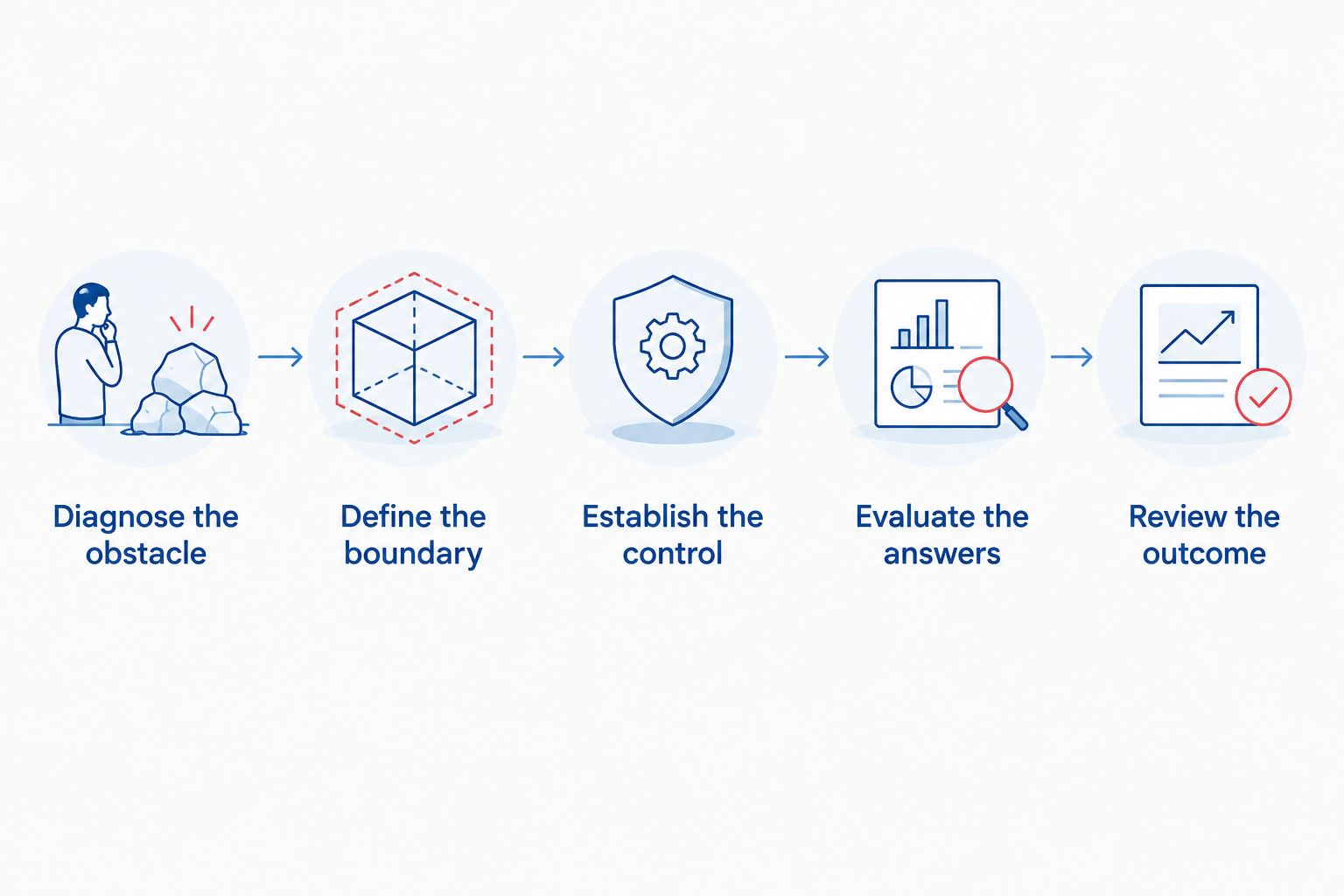
Use a bounded experiment with 5 steps. Decide how success will be measured before the assistant reaches customers, then preserve a comparison that can show whether it helped.
1. Diagnose the obstacle
Review the path from adding an item to receiving an order confirmation. Separate deliberate exits from technical failures, and inspect the support questions associated with the relevant journey.
Record the reason for choosing the pilot. If the evidence points to payment errors, the next release should address payments—not introduce a sales assistant.
2. Define the boundary
Write down the eligible shoppers, permitted questions, approved information sources, and actions the assistant can take. State what happens when the answer is unknown.
A useful first boundary is read-only assistance. Changing an order, applying an exception, or writing to a customer record should require a separate decision rather than arriving as an unnoticed extension of chat.
3. Establish the control
Compare the intervention with the existing experience for an appropriately assigned group of eligible shoppers. Keep other checkout changes separate where possible so the result remains interpretable.
Agree the analysis approach before launch. Include how you will handle returning visitors, delayed purchases, refunds, and overlapping campaigns rather than choosing favorable rules after seeing results.
4. Evaluate the answers
Test realistic questions against approved expected behavior. Include ambiguous requests, conflicting records, unavailable information, and attempts to obtain unauthorized actions.
Evaluate refusals as well as useful answers. A system that answers confidently when it should escalate has failed even if its conversation looks polished.
5. Review the outcome
Judge the pilot against completed orders and the commercial outcome you defined. Inspect wrong answers, complaints, escalations, and technical failures alongside conversion measures.
Keep, revise, or remove the intervention based on the evidence. A failed pilot is a reason to change the decision—not a reason to redefine engagement as success.
Put these decisions in the project brief. The guide to scoping an AI pilot provides a relevant starting point for defining a bounded engagement.
What should your development brief require?
Thefiniteloop is best suited to buyers seeking custom AI and ecommerce development, rather than a standalone recovery tool. Its stated services include AI product development and ecommerce solutions; that makes the integration brief more relevant than a list of generic chatbot features.
Custom development also brings an ownership burden. You need to assign responsibility for catalog connections, answer evaluation, monitoring, incident handling, and changes to policy sources.
For a 2026 procurement brief, define 4 acceptance gates:
- Answer correctness: Approved test questions produce supported answers or the required refusal.
- Permission safety: The assistant cannot access another shopper’s data or perform an unauthorized action.
- Checkout continuity: Model errors and timeouts do not prevent the normal purchase journey.
- Operational ownership: Named owners can inspect failures, update sources, and disable the feature.
Specify repository access, infrastructure access, integration credentials, and documentation in the agreement. Do not assume ownership from a presentation or a verbal promise.
Ask Thefiniteloop to separate essential checkout work from the experimental AI scope. That gives you an approval decision for each, instead of making a transaction repair dependent on an unproven feature.
Scope the checkout intervention
Discuss the failure point, integration boundaries, acceptance tests, and ownership requirements.
How do you measure whether cart abandonment actually fell?
Measure the same eligible journey in the treatment and control groups. Define what counts as a cart, a completed purchase, and a returning shopper before comparing results.
For a defined cart cohort, calculate abandonment as carts without a completed purchase divided by eligible carts, expressed as a percentage. Keep the observation window consistent; otherwise, a recent cart and an older cart receive different opportunities to convert.
Completed orders alone are not the whole business case. Review contribution margin after the relevant operating expenses, returns, and incentives, using definitions agreed with your finance team.
Track assistant errors separately from commercial outcomes. An experiment can improve an aggregate measure while still producing unacceptable privacy failures or unsupported promises.
For your 2026 reporting, avoid presenting a before-and-after change as proof of causation. Promotions, traffic changes, payment changes, and seasonality can alter the result independently of the assistant.
Should you fix checkout before adding AI?
Fix checkout first when customers cannot reliably complete a purchase. An assistant belongs beside a functioning transaction flow, not between the shopper and a broken payment process.
AI work can proceed separately when the identified problem is unanswered buying questions and the checkout itself works. Keep those workstreams distinct so each has clear acceptance criteria.
Can abandoned-cart reminders prove AI increased sales?
Abandoned-cart reminders do not prove incremental sales merely because recipients later purchase. Compare eligible recipients with a control group to assess purchases that would not otherwise have happened.
Also review whether the intervention changes margin or creates unwanted contact. More attributed revenue is not enough if the measurement assigns ordinary repeat purchases to the campaign.
Does every ecommerce store need an AI assistant in 2026?
No—an ecommerce store needs AI assistance only when it addresses a defined problem better than a simpler intervention. Clearer product information, working payments, and straightforward rules remain valid engineering choices.
At Thefiniteloop, our position is to scope the business obstacle before the feature. If a rules-based answer solves the problem, do not add a model merely to change the interface.
FAQ
Can AI reduce cart abandonment without changing checkout?
Yes, AI can address product or policy uncertainty outside checkout, but the effect needs a controlled test. It cannot repair a failed payment transaction through conversation.
What is the best first AI use case for an ecommerce store?
The best first use case is a documented buying obstacle with approved source information and a measurable outcome. Avoid starting with autonomous cart changes or broad promises to improve conversion.
Is an AI chatbot better than rules-based assistance?
An AI chatbot fits varied natural-language questions; rules-based assistance fits fixed, predictable answers. Choose based on the questions and failure risks, not the interface label.
How much does an AI cart-abandonment project cost?
The scope determines the project budget. Define the integrations, permitted actions, evaluation work, monitoring, and ongoing ownership before requesting a proposal.
Can an AI assistant offer discounts to recover a cart?
Discount authority should remain an explicit business rule, not a decision invented by the model. Any permitted incentive needs approved eligibility and margin controls.
What customer data should an AI shopping assistant access?
An AI shopping assistant should access only the information required for its approved task. Separate public catalog retrieval from authenticated customer data and transaction permissions.
What should happen when the AI assistant does not know an answer?
The assistant should state the limitation and provide the approved escalation route. It must not invent product specifications, delivery commitments, or policy exceptions.
One last thing
An accurate refusal can be more valuable than a persuasive answer. If an assistant cannot verify compatibility or a delivery condition, stopping the claim protects the customer’s decision and prevents an unsupported promise from becoming an operational problem.
Make that behavior part of acceptance—not a footnote. Before approving the pilot, ask to see the cases where the assistant deliberately does not answer.
Related guides
- What an AI support assistant should refuse to answer
- What to test when adding ecommerce payments
- How to accept software delivery before final payment
Your project next
Let’s build what matters
Schedule a consultation to discuss your goals and technical needs.