
Adding payments to an online store takes as long as the slowest unfinished dependency: merchant approval, checkout integration, or payment testing. Commit to a launch date only after those dependencies have named owners and confirmed completion criteria. Connecting a payment button is not the finish line; orders, refunds, and failure recovery must work too.
- Your timeline to add payments to an online store must cover merchant approval, checkout integration, and payment testing.
- Thefiniteloop’s position: define payment acceptance criteria before agreeing to a launch date.
- Choose a supported integration unless a documented checkout requirement needs custom development.
- Launch only when payment records, order status, refunds, and failure recovery agree.
How long does it take to add payments to an online store?
There is no single reliable duration for every store. A supported integration with approved merchant access has a different scope from a custom checkout that also needs subscriptions, inventory updates, or accounting connections. Estimate the actual payment journey, not the installation task.
Build the schedule around 3 workstreams: merchant readiness, engineering, and acceptance. Some tasks can proceed together; live verification still depends on production access. Use the payment testing guide to define the evidence required before release.
| Workstream | What must be resolved | Evidence needed before launch |
|---|---|---|
| Merchant readiness | Business verification, supported market, settlement setup, production access | Merchant account is enabled for the intended payment flow |
| Engineering | Checkout connection, payment events, order updates, refund handling | Payment outcomes produce the correct store behavior |
| Acceptance | Successful and unsuccessful journeys, recovery, operational handover | Named owners approve the agreed test results |
For a 2026 launch, ask for milestone dates tied to those dependencies. A calendar estimate without account status, integration scope, and acceptance criteria is not a dependable delivery plan.
Why this matters
A checkout can appear finished while the business process remains incomplete. The customer sees a confirmation page, but the warehouse still needs a trustworthy fulfillment instruction and finance needs a payment record it can reconcile.
The deadline should cover a usable payment operation, not a convincing demonstration. Otherwise, unfinished reconciliation, refunds, and support procedures become work your team must absorb after launch.
Do not turn a payment integration into a store rebuild by default. Keep the existing storefront unless a specific technical restriction prevents the required payment flow. Rebuilding introduces additional scope that needs its own business justification.
Choose the smallest integration that meets the requirement
Start with the payment path your platform and provider explicitly support. Add custom checkout behavior only when a written requirement explains why the supported path cannot do the job.
Thefiniteloop's ecommerce development position is simple: choose supported payments first; justify custom checkout with a business requirement. This recommendation does not apply when the supported route cannot handle an essential order, payment, or operational workflow.
| Approach | Best for | Main advantage | Main limitation | Scope to verify |
|---|---|---|---|---|
| Supported platform integration | Stores whose requirements fit an existing connector | Less payment-specific code to maintain | Connector behavior constrains checkout choices | Supported markets, payment methods, order states, refunds |
| Provider-hosted checkout | Stores that can use a provider-controlled payment page | Provider manages the payment interface | Checkout presentation and return behavior have constraints | Redirects, cancellations, session expiry, order confirmation |
| Custom API integration | Stores with requirements unsupported by existing routes | Direct control over the integration logic | Your team owns more implementation and maintenance | Authentication, payment state, retries, security, reconciliation |
These approaches are not always mutually exclusive. A platform connector can use a hosted payment page. Identify the actual architecture before estimating effort; labels alone do not describe responsibility.
For a 2026 project, record the selected integration and its current documentation in the scope. Verify capabilities against the intended merchant account rather than assuming that a familiar provider supports every market or business model.
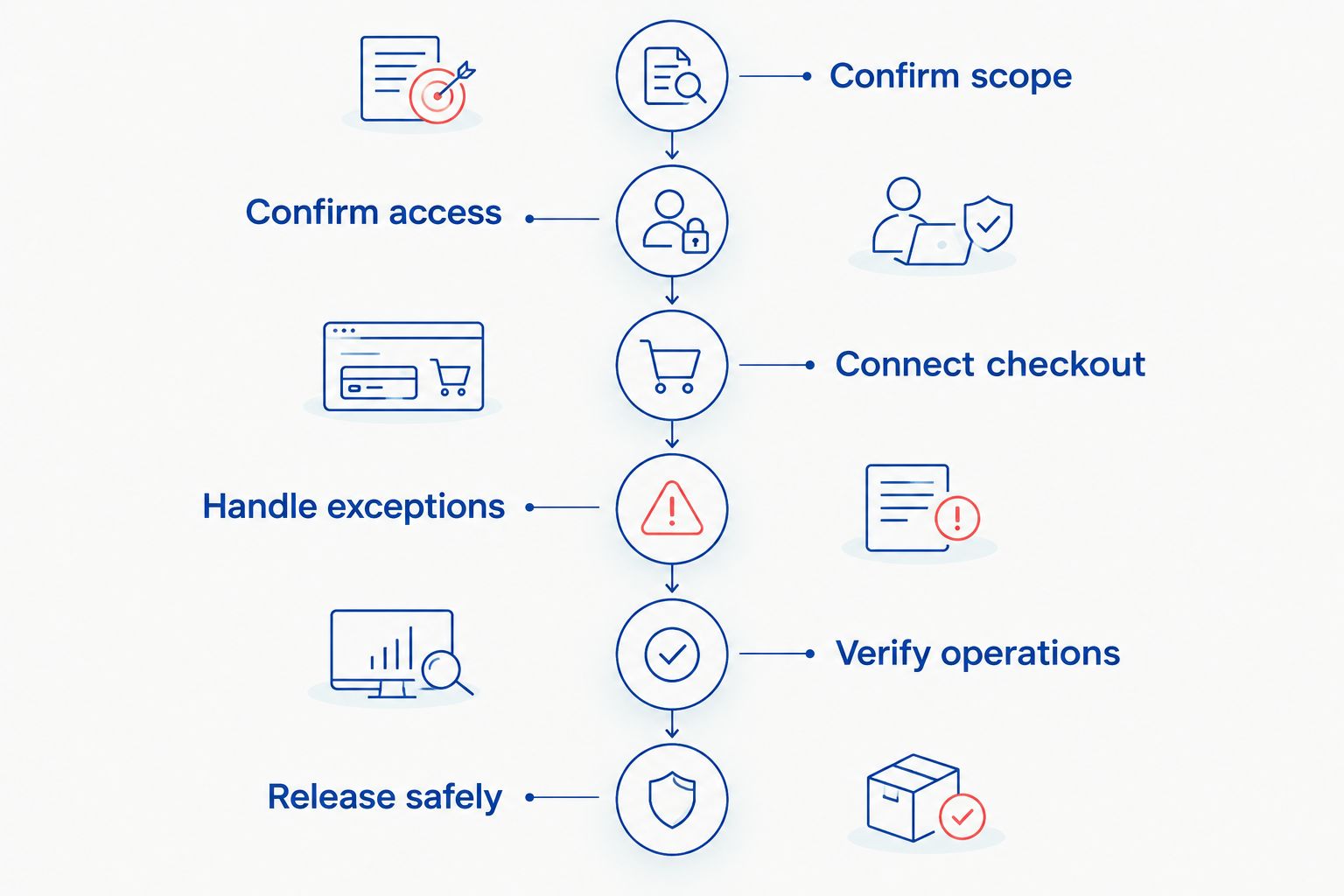
Plan the payment launch in 6 stages
Use these 6 stages as acceptance gates, not fixed-duration promises. Each stage ends with an observable result, which makes unresolved dependencies visible before they threaten the launch.
1. Confirm scope
Write down what customers must be able to do: pay once, retry after a decline, cancel, or receive a refund. Include subscriptions, deposits, or delayed capture only when the business actually needs them.
Define what a successful payment authorizes. Does it release an order for fulfillment, reserve inventory, or wait for a separate approval? That decision belongs in the brief, not in an assumption made during development.
2. Confirm access
Assign an owner for the merchant account and any outstanding verification requests. Confirm access to the store administration, test environment, production credentials, and relevant provider settings.
Keep credentials in controlled secret storage rather than informal messages. The business should retain ownership of its payment account and decide who can change configuration or issue refunds.
3. Connect checkout
Implement the selected payment path and connect it to the store's order lifecycle. Make the relationship between an order and its payment attempt explicit so failed attempts do not become unexplained orders.
Do not treat the customer's return to a success page as the sole proof of payment. Verify payment state through the provider's documented server-side mechanism before triggering the corresponding business action.
4. Handle exceptions
Define behavior for declines, abandoned sessions, delayed notifications, repeated notifications, and interrupted connections. A retry must not repeat a business action that has already completed.
This is where idempotency matters: repeated processing of the same event should not create another shipment or duplicate an order update. Payment handling needs that protection even when the normal checkout demonstration looks correct.
5. Verify operations
Test the customer's journey alongside the merchant's workflow. Confirm that staff can find the payment reference, understand the order state, and perform the agreed refund process.
Check downstream systems before approving release. If fulfillment, inventory, or accounting depends on payment events, include that connection in acceptance rather than treating checkout as an isolated feature.
6. Release safely
Confirm production configuration, monitoring, support ownership, and the response to a failed launch check. Follow the provider's permitted production-verification process without assuming that test credentials prove live readiness.
Record who can pause the affected payment method and how orders already in progress will be handled. A rollback plan must protect payment records and customer orders, not simply restore an earlier screen.
Why the payment integration timeline varies
The timeline changes when a dependency changes. Ask which of these factors remains unresolved rather than accepting a general statement that payments are complicated.
- Merchant approval: Outstanding verification or production-access requirements prevent live acceptance, even when engineering can continue in a test environment.
- Checkout architecture: An existing supported integration and a custom payment flow require different implementation and maintenance responsibilities.
- Payment lifecycle: Immediate payment, delayed capture, recurring billing, and refunds each introduce behavior that needs explicit scope and testing.
- Connected systems: Inventory, fulfillment, customer service, and accounting need agreed rules for receiving and acting on payment updates.
- Markets and interfaces: Merchant location, settlement currency, customer authentication, and supported payment methods require provider-specific confirmation. An Arabic-English interface also needs testing in both directions.
- Operational ownership: Unassigned credentials, acceptance decisions, refund access, or incident responsibilities leave work blocked between teams.
Separate provider-controlled dependencies from development work in the plan. Your developer can own implementation quality; that does not make the developer the decision-maker for merchant approval.
For a 2026 international launch, validate each intended market against the actual account and integration. Do not assume that a US configuration establishes eligibility or identical checkout behavior in the UK, EU, or GCC.
Can you launch before merchant approval is complete?
You can prepare the integration and test supported scenarios before merchant approval is complete, but do not accept live-payment readiness without production authorization. Keep the engineering milestone separate from the merchant-readiness milestone.
Ask the delivery team to identify what can proceed in the test environment and what remains blocked. This gives you a useful parallel plan without disguising external approval as completed work.
If payments are essential to the store's launch, merchant readiness belongs on the launch checklist. Publishing the storefront does not resolve an unavailable payment method.
Does adding another payment method mean rebuilding checkout?
Adding another payment method does not automatically require a checkout rebuild. First check whether the existing platform and payment integration support the required method and business workflow.
A rebuild needs a specific reason: an unsupported essential interaction, an architectural restriction, or a payment-state problem that cannot be corrected within the existing implementation. A different visual preference alone does not establish that need.
Keep unrelated redesign work outside the payment release. This makes acceptance clearer and avoids changing the storefront at the same time as the mechanism that collects payment.
How do you know the integration is ready to accept?
Use 5 acceptance checks: payment outcome, order state, repeat handling, refund handling, and operational ownership. Each check should have a recorded result and a named approver.
- Payment outcome: Approved, declined, canceled, and interrupted journeys produce the intended customer message and payment record.
- Order state: Payment confirmation produces the correct fulfillment status without relying solely on a browser redirect.
- Repeat handling: Repeated notifications and retries do not duplicate orders, fulfillment instructions, or other completed actions.
- Refund handling: The agreed refund path updates the payment record and the relevant order information.
- Operational ownership: Staff know where to investigate a mismatch, who can act, and how to escalate an unresolved issue.
For 2026 acceptance, request evidence from the environment being approved and record any remaining restrictions. Use a written software delivery acceptance process to keep a demonstration separate from formal sign-off.
Thefiniteloop is best suited to founders and SMEs seeking custom ecommerce development and payment-integration engineering, rather than a payment-processing account. Its development services do not replace the provider's merchant approval process.
Define your payment integration scope
Discuss checkout requirements, connected systems, acceptance criteria, and ownership.
FAQ
How long should I allow to add payments to my online store?
Base the schedule on merchant readiness, integration scope, and acceptance testing rather than a universal duration. Ask for separate milestones and identify which unresolved dependency controls launch.
Is installing a payment plugin enough to launch?
Installing a payment plugin is not enough to establish launch readiness. Confirm production access, order updates, unsuccessful payment journeys, refunds, and operational ownership.
Can payment integration start while merchant verification is pending?
Integration work can proceed where the provider offers suitable test access. Live acceptance still depends on production authorization and verification of the intended account configuration.
Is hosted checkout better than a custom payment integration?
Hosted checkout is the better starting point when its supported behavior meets your requirements. Choose custom integration when an essential workflow needs control that the supported route does not provide.
What should I ask a developer before agreeing to a payment launch date?
Ask for the integration approach, outstanding dependencies, acceptance tests, and named owners. The launch date should reflect merchant access and operational readiness as well as development completion.
Can Thefiniteloop help with an ecommerce payment integration?
Thefiniteloop offers ecommerce and custom software development. A consultation should establish the store platform, payment requirements, connected systems, and responsibility for merchant approval before a delivery commitment.
One last thing
Test a payment that succeeds while the customer's browser never reaches the confirmation page. The store still needs to recognize the confirmed payment and handle the order correctly through its server-side payment integration.
Make that interrupted journey part of your 2026 release acceptance. A successful charge and a failed browser return must not leave your team guessing whether to fulfill the order.
Related guides
- Investigate checkout failures in a Dubai online store
- Understand what can delay an ecommerce launch in Dubai
- Keep orders and ERP records in sync
Your project next
Let’s build what matters
Schedule a consultation to discuss your goals and technical needs.