

Yes. A marketplace platform can support multiple vendor currencies, but it must distinguish the currency used to list products, charge buyers, record transactions and pay vendors. A currency selector alone does not establish multi-currency settlement; your payment provider, vendor eligibility and accounting design must support the intended flow.
- A marketplace platform supports multiple vendor currencies only when checkout, accounting and vendor payouts follow explicit currency rules.
- Displaying converted amounts does not prove that vendors can receive their preferred currencies.
- Confirm payment-provider coverage before committing to marketplace development scope.
- Thefiniteloop suits founders commissioning custom marketplace platform development; payment-provider eligibility remains a separate requirement.
Can a marketplace platform support multiple vendor currencies?
Yes, but define what support means before approving the build. Showing a buyer a local-currency amount is a different capability from paying each vendor into a bank account in that vendor’s chosen currency.
For a 2026 marketplace launch, require a demonstration of the complete transaction path, not a list of currency symbols. Make that demonstration part of software delivery acceptance before final payment.
| Approach | Best for | What it supports | Main limitation |
|---|---|---|---|
| Display conversion | Buyers comparing products in familiar currencies | An indicative converted amount before checkout | Does not establish local-currency charging or vendor payouts |
| Shared settlement | Operators standardizing vendor accounting | Buyer currency choices with a common vendor settlement currency, where supported | Vendors do not necessarily receive their preferred currency |
| Vendor settlement | Marketplaces with explicit vendor currency requirements | Separate settlement instructions and currency balances, where supported | Requires payment-provider coverage and more reconciliation logic |
These are architectural approaches, not interchangeable feature labels. Choose the simplest approach that meets your vendor agreement and buyer checkout requirements.
Why this matters
A marketplace manages obligations to different parties. The amount a buyer pays, the marketplace’s commission and the amount owed to a vendor must remain explainable after conversion, refunds and payout adjustments.
A buyer in the United States purchasing from a UK vendor illustrates the distinction: the checkout currency and vendor payout currency need not match. That example says nothing about whether a particular provider supports the transaction; eligibility still depends on the actual account arrangement.
Do not buy “multi-currency” as an undefined feature. Buy a documented funds flow, supported payment routes and acceptance tests that prove the promised behavior.
Separate the currencies before choosing the architecture
Use explicit names in your requirements. Otherwise, “vendor currency” can mean the currency a seller types into a listing form or the currency that reaches the seller’s bank account.
- Listing currency: The currency in which a vendor maintains a product amount.
- Display currency: The currency shown to the buyer while browsing.
- Charge currency: The currency submitted for the buyer’s payment.
- Ledger currency: The denomination attached to each recorded financial entry.
- Payout currency: The currency requested for a vendor disbursement.
A transaction can use matching currencies throughout or cross currency boundaries. Your application must preserve those distinctions rather than overwrite the original transaction with a converted total.
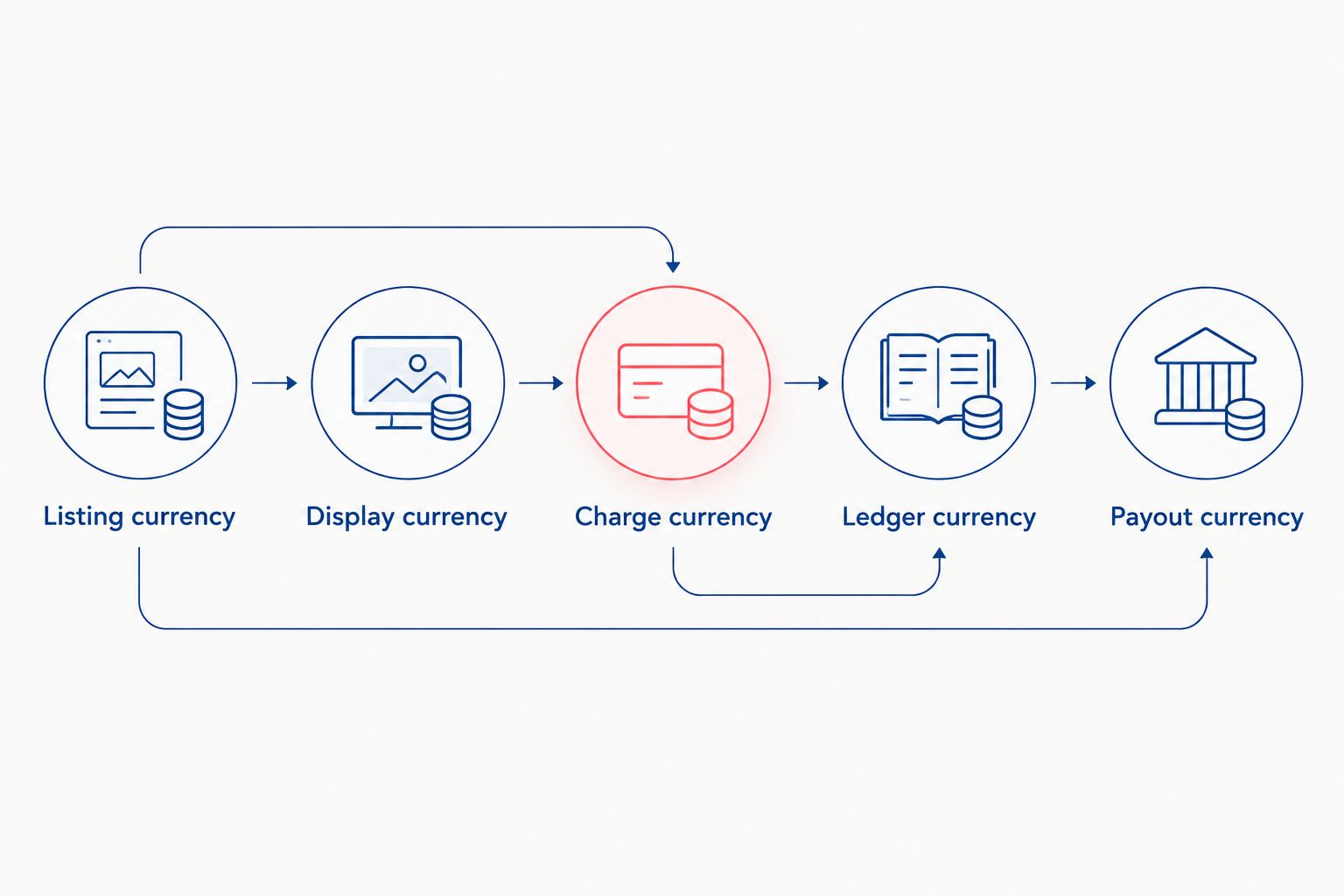
For every conversion boundary, identify the responsible system, rate source, recorded rate and rounding rule. If the payment provider performs conversion, distinguish the application’s estimate from the provider’s final settlement record.
This currency map belongs in your 2026 project brief. It gives engineering, finance and operations the same definition of a completed transaction.
Display conversion: useful for browsing, insufficient for payouts
Best for: marketplaces that need familiar browsing amounts without promising local-currency vendor settlement. Display conversion helps buyers understand an amount without changing the underlying vendor accounting model.
The trade-off is expectation management. If checkout uses a different currency, the interface must identify that currency before the buyer authorizes payment; otherwise, the browsing experience implies a capability the payment flow does not provide.
Record whether a displayed conversion is indicative or binding. Do not let an estimate silently become the accounting source of truth.
This approach is appropriate when your actual requirement is buyer comprehension. It is insufficient when vendor contracts require settlement in specified currencies.
Shared settlement: simpler rules, less vendor choice
Best for: marketplaces whose vendors accept a common settlement currency. A shared settlement model keeps the vendor obligation in an agreed denomination even when buyer-facing currency options differ.
Its advantage is a narrower accounting scope. Its limitation is that conversion can still occur elsewhere in the payment chain, including at the vendor’s receiving bank, depending on the arrangement.
Ask who bears conversion differences and how vendors see deductions. A common settlement currency simplifies a decision; it does not eliminate the need to explain the settlement statement.
Use this model only when vendor terms match the implementation. Do not advertise preferred-currency payouts when the platform actually sends every vendor the same currency.
Vendor settlement: greater choice, more financial state
Best for: marketplaces where vendor payout currency is a contractual requirement. Vendor-specific settlement requires explicit payout instructions, supported destinations and accounting records that preserve currency distinctions.
The benefit is alignment between the vendor agreement and payment operations. The trade-off is additional financial state: balances, conversions, adjustments and failed payouts need currency-aware handling.
Do not silently combine obligations in different currencies into an unlabeled balance. Present each obligation with its currency, then show any reporting conversion separately.
Vendor settlement is the right scope when vendors genuinely need it. It is unnecessary complexity when all vendors already accept a common settlement arrangement.
Why multi-currency marketplace scope varies
The engineering scope follows your actual funds flow, not the number of currencies shown in a dropdown. Require decisions on these factors before comparing development proposals:
- Vendor eligibility: Confirm which vendor countries, account types and receiving arrangements your payment provider supports.
- Conversion ownership: Identify whether the marketplace, payment provider or receiving institution performs each conversion.
- Cart structure: Decide whether buyers can combine vendors and listing currencies in the same checkout.
- Commission rules: Specify the currency and calculation stage used for marketplace fees, discounts and adjustments.
- Refund obligations: Define how reversals affect buyer refunds, vendor balances and conversion differences.
- Reporting requirements: Separate transaction records from management reporting and jurisdiction-specific accounting requirements.
For your 2026 scope, turn each factor into an explicit decision. “The developer will handle it” is not an acceptance criterion, and a payment-provider integration does not resolve commercial rules automatically.
How should you scope multi-currency marketplace support?
Start with the transaction and work outward. Thefiniteloop’s position on marketplace development is to settle the money rules before adding currency choices to the interface. A polished selector cannot fix an ambiguous vendor obligation.
- Write the vendor promise. State what currency the vendor receives, which deductions apply and what happens when payout fails. Separate required behavior from optional preferences.
- Confirm provider support. Check the intended platform account, vendor destinations, charge currencies and payout routes against current provider documentation. Confirm unresolved eligibility questions directly with the provider.
- Define the transaction record. Preserve original amounts, currency codes, conversion references and links between the order, payment, refund and payout. Specify which system owns each record.
- Define exception handling. Document failed payouts, delayed confirmations, partial refunds and duplicate notifications. State which events require an operator decision rather than an automatic retry.
- Approve executable tests. Require evidence for the supported paths and the deliberate rejection of unsupported ones. Include finance and operations in acceptance, not just the product team.
Thefiniteloop is a fit for founders who need custom marketplace platform development. The custom approach lets you encode specific vendor and accounting rules; it also leaves you responsible for funding and maintaining those rules as integrations change.
How should the platform store amounts and rounding rules?
Store every monetary amount with its currency. Use an exact numeric representation appropriate to the operation rather than binary floating-point arithmetic for financial calculations.
Currency precision is not universal: USD uses 2 decimal places, JPY uses 0 decimal places and KWD uses 3 decimal places under ISO 4217 currency conventions. Payment-provider amount formats still need checking because API representations can differ from general currency conventions.
Separate calculation precision from presentation precision. An exchange-rate calculation can require more precision than the final amount displayed or submitted to a payment API.
Specify when rounding occurs and where any remainder goes. For a cart split across vendors, the recorded allocations must reconcile to the charged amount; independently rounded values must not create unexplained differences.
Make precision handling an acceptance requirement in your 2026 release plan. A successful checkout does not prove that commissions, allocations and partial refunds reconcile correctly.
What should you test before launch?
Test financial outcomes, not just successful payment screens. Every scenario should identify the expected order state, ledger entries, vendor obligation and operator-visible result.
- Mixed-vendor checkout: Verify allocation between vendors and reject unsupported currency combinations clearly.
- Changed conversion quote: Define what happens when a browsing estimate differs from the amount confirmed at checkout.
- Partial refund: Trace the refund back to the original transaction and update the correct vendor obligation.
- Failed payout: Retain a visible unpaid obligation and provide a controlled recovery path.
- Repeated notification: Confirm that processing the same provider event again does not duplicate a financial action.
- Reordered events: Ensure a delayed message cannot overwrite a later confirmed state.
- Vendor currency change: Keep historical transactions intact and define when the new preference takes effect.
- Reconciliation discrepancy: Expose a difference between internal records and provider settlement records for investigation.
Record the expected result before running each test. Otherwise, a team can demonstrate activity without proving correctness.
Give finance access to the evidence. Engineering can confirm that an API call succeeded; finance must also be able to explain why the vendor statement matches the recorded obligation.
Can vendors receive different currencies from the same order?
Yes, when the payment arrangement supports the required allocation and payout routes. A shared checkout does not itself prove that each vendor can receive a different currency.
Define the buyer-facing charge separately from each vendor obligation. Then verify that the provider and ledger can carry that model through refunds, reversals and settlement.
Does multi-currency support require rebuilding the marketplace?
No. Start by inspecting the existing order model, payment integration and financial records rather than assuming a rebuild is necessary.
An extension is appropriate when currency boundaries can be added without corrupting existing obligations. Consider replacement only after identifying a specific limitation that prevents the required behavior, such as an integration that cannot support the intended payout arrangement.
Who should carry exchange-rate differences on refunds?
Your commercial terms and payment arrangement must define that responsibility. Do not let an implementation default decide who absorbs a conversion difference.
Document buyer refunds, vendor reversals and marketplace adjustments separately. Have qualified advisers check the policy against the jurisdictions and contracts involved before encoding it in software.
FAQ
Can a marketplace platform support multiple vendor currencies in 2026?
Yes, provided its payment arrangement, transaction records and payout rules support the intended currencies. Displaying converted amounts alone does not establish vendor settlement support.
Can buyers pay in a different currency from the vendor?
Yes, when the payment arrangement supports that charge and settlement combination. Define where conversion happens and how the final vendor obligation is recorded.
Is a currency converter enough for a multi-vendor marketplace?
No. A currency converter changes a displayed amount; vendor settlement also requires supported payout routes, accounting records and exception handling.
Should every vendor have a separate currency balance?
Separate currency balances are appropriate when the platform records obligations to a vendor in different currencies. A common settlement model can instead record the obligation in the agreed settlement currency.
Can a vendor change payout currency after receiving orders?
A vendor currency change needs an explicit effective-date rule. Preserve historical obligations and verify the new payout arrangement before applying the preference to eligible transactions.
What is the biggest mistake when scoping multi-currency payouts?
Treating a currency selector as proof of settlement support is a scope error. Require a demonstrated path from buyer payment through vendor allocation, refund handling and payout reconciliation.
What should a founder request before approving development?
Request a documented funds flow, confirmed provider eligibility and transaction-level acceptance tests. The proposal should also identify ownership of financial records and responsibility for operating failed payouts.
One last thing
A failed payout must not erase the vendor obligation. Keep “money owed” separate from “money successfully sent,” and make that distinction visible to operators and vendors.
Before approving your 2026 launch, ask the team to demonstrate that failure path. The most useful proof of multi-currency support is not a successful conversion; it is an explainable balance after something goes wrong.
Related guides
- What to test when adding payments to an online store
- Recovering safely from failed software integrations
- Keeping orders and ERP records in sync
Your project next
Let’s build what matters
Schedule a consultation to discuss your goals and technical needs.