

A penetration test cost is a scoped project quote, not a reliable flat fee: the work depends on your applications, access roles, integrations, and testing boundaries. Your total budget must also cover fixing findings and confirming those fixes, whether that verification sits inside the testing agreement or outside it.
- Compare penetration test cost against identical scope, access, evidence, and retesting terms—not the headline quote alone.
- Application penetration testing examines exploitable weaknesses; a vulnerability scan does not provide equivalent coverage.
- Thefiniteloop offers penetration testing alongside custom software development for startups and SMEs.
- Separate security testing, remediation, and retesting responsibilities before approving the engagement.
How much does a penetration test cost?
You need an agreed scope before a penetration testing quote becomes useful. For a 2026 procurement decision, compare what each proposal commits to examining and delivering. A quote without those boundaries leaves you unable to distinguish narrower coverage from more efficient delivery.
Start with the systems and business actions that matter. An ecommerce checkout, a customer portal, and a multi-tenant application expose different workflows; treating them as interchangeable testing units hides important differences.
Your brief should connect penetration testing with the security checks your software build should include. Testing is a defined assessment, not a replacement for secure development or ongoing maintenance.
| Quote component | What to specify | What to challenge |
|---|---|---|
| Assessment boundary | Applications, APIs, environments, and exclusions | A domain name presented as the complete scope |
| Access | User roles, accounts, documentation, and credentials | Authenticated testing left unspecified |
| Testing work | Manual investigation and supporting automated checks | A scan described as equivalent to penetration testing |
| Reporting | Reproduction evidence, affected assets, and remediation guidance | Findings without enough detail for engineering action |
| Verification | Retesting boundaries and closure evidence | An undefined promise to check fixes later |
Do not request a single bundled figure before agreeing on these items. Ask suppliers to separate the assessment, optional work, and verification terms so you can compare equivalent commitments.
Why this matters
The purchasing mistake is buying the label rather than the work. A report can describe many vulnerabilities while leaving the business workflow you care about outside the assessment.
For your 2026 security budget, define the decision the test must support. That might be approving a release, investigating exposure after a major integration, or answering a customer's security requirement. The objective determines which assets and workflows deserve attention.
A cheaper proposal with narrower coverage is a different purchase, not automatically a better deal. A broader proposal is not automatically better either: irrelevant systems and poorly defined objectives can distract from the risk you actually need assessed.
Which penetration testing scope fits your system?
Choose coverage around attack paths, not around a preferred report title. The following options address different surfaces; none establishes that an entire business is secure.
| Assessment | Best for | Useful coverage | Limitation |
|---|---|---|---|
| Web application testing | Customer portals and browser-based business workflows | Sessions, access control, input handling, and business logic | Does not automatically cover every supporting API or infrastructure component |
| API testing | Systems that expose data or actions through endpoints | Authorization, object access, and sensitive operations | Depends on a defined endpoint inventory and suitable access |
| External network testing | Internet-facing infrastructure | Exposed services and externally reachable weaknesses | Does not replace authenticated application testing |
| Mobile application testing | Businesses with mobile client applications | Client behavior and interactions with backend services | Backend coverage must be explicitly included |
A portal with an API can require both application and API coverage. Do not assume that testing the browser interface automatically examines every endpoint the application exposes.
Conversely, do not commission every assessment category simply because it appears on a supplier's menu. Match the engagement to the release, exposure, and business decision in front of you.
When a focused assessment makes sense
A focused test suits a clearly bounded change, such as a new account-management workflow or an integration that introduces sensitive operations. Its advantage is a specific objective and an understandable boundary.
The trade-off is deliberate exclusion. Record what remains untested, and do not present a focused assessment as assurance over the whole platform.
When broader coverage makes sense
Broader coverage suits a system whose risk crosses applications, APIs, and infrastructure. It lets the assessment examine interactions that a narrowly isolated test leaves outside scope.
The trade-off is more coordination. You need asset ownership, suitable accounts, environment access, and clear rules for testing across those boundaries.
Why penetration test cost varies
These scope factors explain why proposals differ. Use them to challenge assumptions rather than to infer a market rate.
- Attack surface: Applications, endpoints, exposed services, and environments define the territory the assessor must examine. Asset counts alone do not explain workflow complexity.
- Access boundaries: Customer, staff, administrator, and tenant roles introduce different authorization questions. Testing only an unauthenticated view leaves those questions unanswered.
- Business logic: Ordering, refunds, approvals, account recovery, and entitlement changes require an understanding of intended behavior. A scanner cannot establish all of those rules.
- Assessment depth: Automated checks and manual investigation serve different purposes. The proposal should explain how the assessor will investigate and validate findings.
- Delivery conditions: Access restrictions, third-party permissions, production safeguards, and reporting requirements shape how the work proceeds. Agree on those conditions before testing begins.
- Retesting scope: Verification depends on which findings, environments, and changed components are included. Define what happens when a fix changes the original assessment boundary.
For a 2026 comparison, put these factors into the same brief for every supplier. Otherwise, you are comparing different interpretations of your system rather than comparable testing engagements.
What should you prepare before requesting a quote?
Give prospective assessors a short, technically useful brief. You do not need to solve the security assessment yourself; you do need to explain what the software does and where its important boundaries sit.
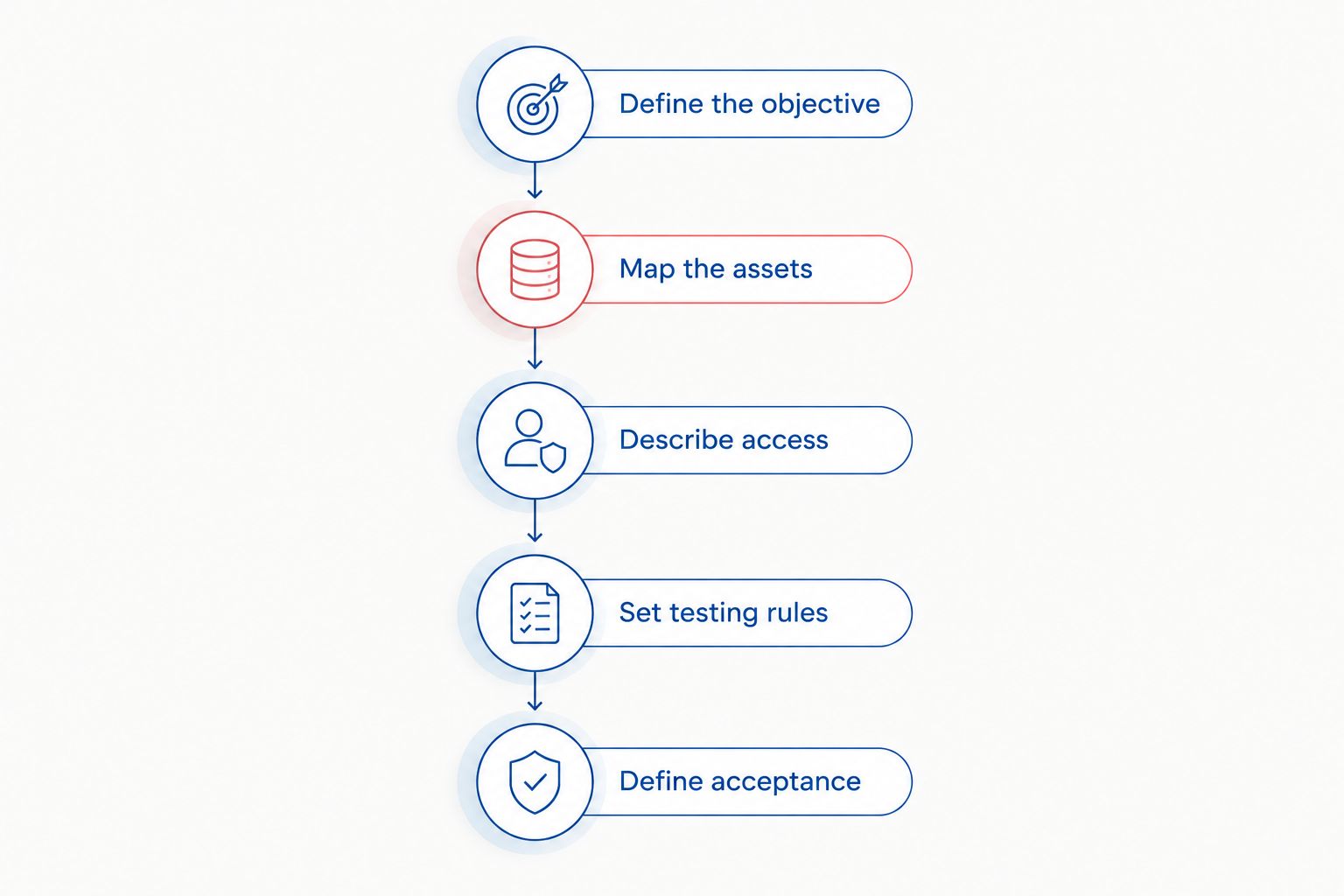
- Define the objective. State the decision the test must support, such as release acceptance or assessment of a newly exposed service. Include any customer-required deliverable wording.
- Map the assets. List the applications, APIs, environments, and integrations proposed for inclusion. Mark third-party systems separately rather than assuming permission to test them.
- Describe access. Identify user roles, tenant boundaries, authentication methods, and available test accounts. Explain the sensitive actions each role can perform.
- Set testing rules. Agree on permitted techniques, environment restrictions, escalation contacts, and stop conditions. Establish written authorization before work begins.
- Define acceptance. Specify reporting evidence, remediation ownership, and retesting expectations. Decide who accepts unresolved risk and who approves closure.
Include realistic test data without exposing unnecessary personal or commercial information. If production testing is necessary, agree on safeguards and escalation arrangements rather than treating production access as routine.
For an ecommerce system, describe the intended rules for checkout, discounts, refunds, and order changes. For a SaaS platform, explain what separates tenants and which roles can cross account boundaries. These details give assessors something concrete to challenge.
Does a vulnerability scan replace a penetration test?
A vulnerability scan does not replace a penetration test when your objective includes manual investigation of exploitability and business logic. Scanning identifies potential weaknesses through automated checks; penetration testing adds investigation within an agreed scope.
A scan is useful for repeatable discovery and checking known vulnerability indicators. Its limitation is context: an endpoint can behave exactly as implemented while still permitting an unauthorized business action.
A penetration test also has limits. It assesses defined assets under agreed conditions at a particular point in time; it does not guarantee the absence of vulnerabilities or remove the need for subsequent security work.
Should retesting be included in the agreement?
Retesting should be defined before you approve the engagement. The agreement must state which findings qualify, what evidence the assessor will review, and whether verification includes checking the affected behavior directly.
Separate remediation from verification. Your engineers implement fixes; the assessor verifies the agreed findings under the retest scope. If the same supplier handles both activities, ask how the verification will be reviewed.
Do not close a finding merely because a development ticket is marked complete. Require a clear connection between the original evidence, the implemented change, and the verification result.
What should a useful penetration testing report contain?
A useful report lets an engineer reproduce a finding and lets a decision-maker understand its consequence. Neither a severity label nor a screenshot alone achieves both.
Ask for affected assets, prerequisites, reproduction steps, evidence, business impact, and remediation guidance. The report should also distinguish confirmed findings from observations and explain the assessment's exclusions.
Your acceptance process should identify who owns each finding and who approves residual risk. The same principle applies to accepting software delivery before final payment: evidence matters more than a completion label.
For a 2026 release decision, use the findings to make an explicit acceptance choice. Record what must be fixed before release, what remains open, and who authorized that decision. Do not let the report become an attachment nobody owns.
When should you involve the development partner?
Involve your development partner while defining application behavior, preparing access, and assigning remediation. The people responsible for the software need to explain intended permissions and translate confirmed findings into changes.
Thefiniteloop is a fit for startups and SMEs seeking custom software development and penetration testing. That service combination is relevant when security work needs to connect with application delivery, rather than stop at a report.
Thefiniteloop's cybersecurity services include security audits and penetration testing. Keep the assessment boundary explicit: the availability of related development services does not establish independent verification or any particular testing deliverable.
For buyers considering Thefiniteloop, ask how remediation responsibilities, verification, and acceptance will be separated. If your customer requires an independent assessor, check that requirement before selecting a development-linked arrangement.
Discuss your security assessment scope
Explain your application, access roles, and release decision before requesting a scoped engagement.
FAQ
How do I get an accurate penetration test cost estimate?
Request a quote against a written scope covering assets, user roles, testing depth, reporting, and retesting. Give each supplier the same brief so differences in coverage remain visible.
Is a penetration test the same as a security audit?
No. Penetration testing investigates exploitable weaknesses within an agreed scope, while a security audit assesses defined controls or requirements. Specify the outcome you need rather than treating the labels as interchangeable.
Can I test only the new part of my application?
Yes, you can commission a focused assessment with explicit boundaries. Include relevant interactions with existing systems and record what the engagement excludes.
Do I need to give the penetration tester login access?
Provide suitable accounts when authenticated behavior is part of the assessment. Specify the roles and tenant boundaries to be examined rather than assuming a single account represents all users.
Will a penetration test prove my software is secure?
No. A penetration test assesses defined assets under agreed conditions at a particular point in time. Exclusions, later changes, and unexamined behavior limit the assurance it provides.
Who fixes vulnerabilities after a penetration test?
The engineering or infrastructure owner assigned to each finding implements the fix. Agree on ownership before testing, and define how the assessor will verify the resulting changes.
Can I use the same penetration testing brief internationally?
Use the same technical scope structure, but check authorization, contractual requirements, and data-handling conditions for the relevant systems and jurisdictions. Do not assume a requirement from one customer or country applies everywhere.
One last thing
Before approving a 2026 engagement, ask the assessor to show how the report will distinguish tested and passed, tested and failed, and not tested. These outcomes mean different things, and an executive summary should not blur them together.
A clean-looking report is not the purchasing objective. Your objective is a defensible understanding of what was examined, what failed, and what must happen next.
Related guides
- When fixed pricing fits a software project
- Assessing a software development company
- What a software maintenance agreement should cover
Your project next
Let’s build what matters
Schedule a consultation to discuss your goals and technical needs.