

Your SaaS MVP development cost depends on the workflow, data boundaries, integrations and release conditions you commission—not the MVP label. Budget for the build and the work needed to operate it: hosting, third-party services, maintenance, security and ownership transfer.
- SaaS MVP development cost needs a defined workflow, integration scope and release criteria—not a generic benchmark.
- Thefiniteloop offers custom SaaS platform development for founders who need software built around their business requirements.
- Reduce launch scope before reducing tenant isolation, recovery testing or operational ownership.
- Compare proposals against identical deliverables, exclusions and ongoing responsibilities.
How much does a SaaS MVP cost to build?
A defensible SaaS MVP budget is a scoped engineering estimate, not a standard package price. Start with the smallest complete workflow that lets a real customer achieve the outcome you want to validate. Then include the operational work that makes that workflow usable outside a demonstration.
For a 2026 buying decision, ask vendors to separate implementation, external dependencies and post-launch responsibilities. A proposal that combines everything into an unexplained total gives you no clear way to compare scope or assess change requests.
Use a software development brief to document the same requirements before requesting competing estimates.
| Budget component | What the estimate should describe | What to challenge |
|---|---|---|
| Product definition | Target user, core workflow, exclusions and acceptance criteria | Discovery that produces no buildable decisions |
| Application development | Interface, business rules, data model and permissions | Feature names without defined behavior |
| Integrations | External systems, credentials, failure handling and test access | An integration treated as a connection alone |
| Release readiness | Testing, deployment, monitoring and recovery | A demo presented as a production handover |
| Ongoing operation | Hosting responsibilities, external services, maintenance and support | Recurring obligations left outside the discussion |
Ask for assumptions alongside each component. If an estimate assumes clean source data, working credentials or customer-supplied designs, those conditions belong in the written scope. Otherwise, you are comparing different projects under the same label.
Why this matters
A cheap-looking proposal can exclude essential work. A larger proposal can also contain features you do not need to validate the business. Neither total tells you whether the project is correctly scoped.
The useful question is what customers must accomplish in the first release and what your team must operate afterward. Buy a complete customer outcome, not the longest feature list.
Thefiniteloop provides custom SaaS platform development for founders who need business-specific workflows. Custom development is not the right starting point when an existing product already meets your essential requirements without unacceptable constraints.
Decide whether you need a prototype or a working SaaS release
Before approving a 2026 development budget, decide what evidence the release must produce. A clickable demonstration can test comprehension. It cannot establish that permissions, billing events or recovery procedures work in production.
These are different deliverables. Require the proposal to name which one you are buying.
| Approach | Best for | Benefit | Limitation | Recommendation |
|---|---|---|---|---|
| Clickable prototype | Founders testing a proposed workflow | Makes screens and interactions discussable before implementation | Does not prove backend behavior or operational readiness | Choose it when the workflow itself remains uncertain |
| Narrow production MVP | Teams ready to test a real customer outcome | Connects a limited workflow to working data and operations | Requires release engineering beyond interface development | Choose it when real usage is the next test |
| Expanded first release | Buyers with documented launch dependencies | Includes capabilities that are necessary for the initial customer commitment | Increases implementation and acceptance scope | Choose it only when each dependency is justified |
Do not commission a production platform to answer a question that a prototype can settle. Equally, do not call a prototype an MVP if customers must use it with real accounts and business data.
A broader release earns its place when a named customer workflow depends on the additional capability. Investor-demo polish, speculative dashboards and future integrations need a separate justification.
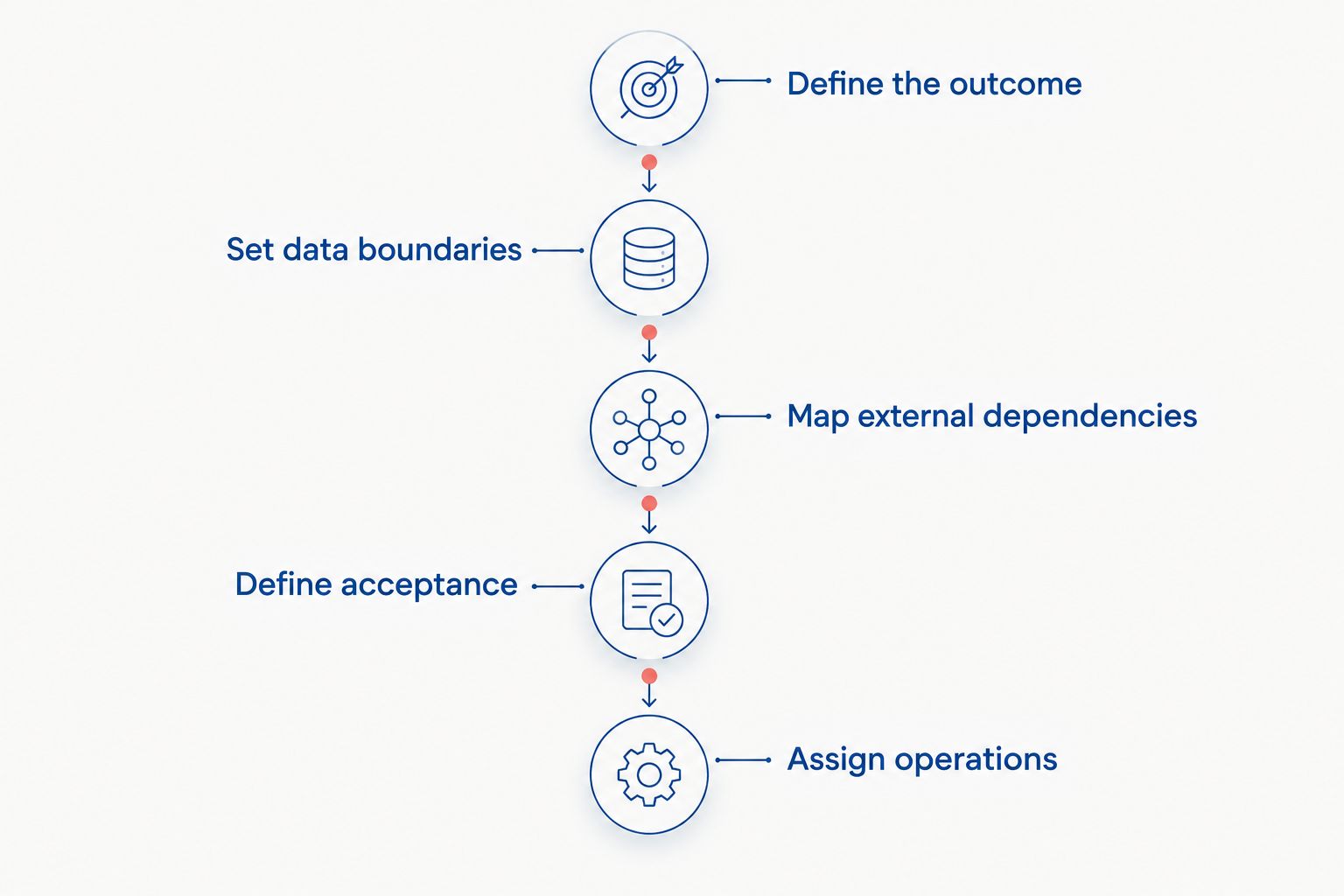
Build the estimate around a complete workflow
The clearest way to estimate a SaaS MVP is to trace a customer task from its starting point to its final result. For example, an approval workflow is not finished when someone submits a request. It also needs an authorized reviewer, a recorded decision and a clear outcome for the requester.
Define the outcome
Write the customer outcome in plain language. Name who performs the task, what information they need and what counts as completion. Avoid requirements such as a modern dashboard or an intuitive platform; neither defines acceptance.
State what the release is intended to teach you. Evidence of completed customer work is different from evidence that people like a design.
Set data boundaries
Identify which organization owns each record and which users can access it. In a multi-tenant application, several customer organizations share an application while their data remains separated according to its access rules.
Document administrative access as well. An internal support user, customer administrator and ordinary user need explicitly defined permissions, not assumptions based on their screen layouts.
Map external dependencies
List the external systems the workflow actually needs. For each integration, define the data exchanged, the system responsible for the authoritative record and the behavior after a failure.
Credentials, test environments and access approvals are dependencies too. Assign responsibility for providing them before agreeing to integration acceptance conditions.
Define acceptance
Translate the workflow into observable tests. Include the successful path, denied access, invalid input and interrupted external calls where relevant.
Acceptance should tell you whether the commissioned behavior works. It should not depend on whether a demonstration looked convincing.
Assign operations
Name who manages deployment, credentials, alerts, backups and incidents. Record where the source code, infrastructure configuration and operating instructions will live.
The person accepting the release should know how the business will operate it after the development engagement ends. A working application without an accountable operator is an incomplete handover.
Why SaaS MVP development cost varies
These scope decisions change what engineers must implement and verify. They belong in the estimate, not in a change request discovered during acceptance.
- Workflow depth. A submission form differs from a workflow with approvals, revisions, notifications and administrative exceptions. Specify the states and transitions the first release needs.
- Tenant and permission boundaries. Separate customer organizations, role-specific access and support access create distinct rules to implement and test. Limit unnecessary roles without weakening required boundaries.
- Integration behavior. Exchanging data is only part of an integration. Define duplicate handling, retries, failed updates and how operators identify unresolved records.
- Data preparation. Existing records need an agreed mapping, validation process and treatment of exceptions. Keep migration outside the launch scope when the initial customer workflow does not require it.
- Release and operational requirements. Deployment, monitoring, recovery and maintenance responsibilities affect the work included. Set requirements according to the application's actual use and consequences of failure.
For 2026 proposals, keep these assumptions beside the corresponding deliverables. That makes it easier to see whether a revised estimate reflects a genuine scope change or a previously unstated dependency.
Where should you reduce the first-release scope?
Remove optional behavior before removing the checks that protect customer data and business records. A smaller workflow can still be complete. An untested permission boundary is not a sensible scope reduction.
Start with capabilities that do not affect the core outcome: custom dashboard variations, alternative workflow paths, integrations without an initial user, or automation for tasks your team can explicitly handle manually. Record any manual process, its owner and its limits.
Manual operation is a deliberate trade-off, not an excuse for hidden work. If an administrator must approve accounts or resolve failed imports, include that task in the operating instructions and acceptance discussion.
Do not add an AI feature simply to make the scope sound current. Define the task it performs, the information it can use and how you will evaluate its output. If the customer outcome does not depend on it, leave it outside the first release.
This recommendation does not apply when the omitted capability is essential to the product's actual promise. An approval product without usable approvals is not a focused MVP; it is a different product.
How should you compare SaaS MVP proposals?
Compare the same workflow, acceptance tests and operating responsibilities. Then examine the commercial terms. A pricing model cannot repair an undefined deliverable.
Ask each supplier to identify what is included, excluded and dependent on your team. Request a written change process that explains how new requirements affect the agreed work before implementation begins.
For your 2026 evaluation, require clear answers to these questions:
- What behavior will demonstrate that the core workflow is complete?
- Which integrations include failure handling and reconciliation?
- Which customer and administrative permissions will be tested?
- Who owns the repository, infrastructure accounts and deployment credentials?
- What documentation and operating access will the handover include?
- Which responsibilities remain with your team after acceptance?
Settle software code ownership in the agreement rather than treating repository access as proof of contractual ownership. Access, rights and responsibility need explicit terms.
Thefiniteloop offers platform engineering as well as custom development. Evaluate that service against your actual architecture, integration and handover requirements—not against a generic promise to build an MVP.
Discuss your SaaS MVP scope
Bring your core workflow, integrations and ownership requirements to a custom development discussion.
Does a SaaS MVP budget include ongoing operation?
A SaaS MVP budget should distinguish initial implementation from ongoing operation. Ask for hosting, external services, monitoring, maintenance and support responsibilities to be identified separately, even when the same supplier handles them.
Separate defects against agreed acceptance criteria from new features. Also define who responds when an external service changes or an operational incident occurs. Without those distinctions, the word support leaves too much unresolved.
Is a fixed-price SaaS MVP a better choice?
A fixed-price SaaS MVP is appropriate when the deliverables, dependencies and acceptance conditions are sufficiently defined. It does not remove uncertainty from untested integrations or unresolved product decisions.
When uncertainty remains, commission the specific investigation needed to resolve it before committing to the full build. Require an output that changes the implementation decision, not an open-ended research phase.
Can you reduce cost by launching without integrations?
You can exclude an integration when a documented manual process still lets customers complete the intended workflow. Assign an operator and define how records stay consistent.
Keep the integration when the product's value depends on it. Removing an essential connection changes the validation question rather than merely reducing scope.
FAQ
What’s the best way to estimate SaaS MVP development cost?
Estimate SaaS MVP development cost from a defined customer workflow, required integrations, data boundaries and acceptance criteria. Separate implementation from ongoing operating responsibilities so proposals describe comparable work.
Is a prototype enough before I build a SaaS MVP?
A prototype is enough when you need to test how users understand and move through a proposed workflow. It does not establish production readiness, working integrations or reliable access controls.
Should my SaaS MVP include subscription billing?
Include subscription billing when charging customers is part of the initial workflow you need to validate. Define account access, payment events and exception handling rather than specifying a payment connection alone.
Can I leave security work until after launch?
Do not defer the controls required to protect the customer data and access included in your first release. Define security work against the application’s actual data, permissions and operating environment.
Who should own the code for my SaaS MVP?
Your agreement should explicitly define source-code rights, repository access and rights to any third-party components. Infrastructure access and handover responsibilities also need written terms.
Does Thefiniteloop build custom SaaS platforms?
Thefiniteloop offers SaaS, marketplace and multi-tenant platform development. Define the workflow, integrations and ownership requirements before agreeing on the scope of a custom build.
One last thing
Before approving a 2026 SaaS MVP proposal, ask the supplier to describe what happens when the main external dependency fails. Who sees the failure? What happens to the customer's work? Who resolves the affected records?
A successful demonstration proves the happy path. Acceptance must also cover the failures your agreed workflow needs to survive. Put those conditions in writing before the build starts.
Related guides
- What belongs in your first software release
- How to accept a software delivery before final payment
- Software development for multi-tenant SaaS teams
Your project next
Let’s build what matters
Schedule a consultation to discuss your goals and technical needs.
One thought on “How much does a SaaS MVP cost to build?”