

Instead of manually correcting warehouse quantities after orders collide, prevent overselling across multiple warehouses with one reservation authority that checks and reserves inventory atomically before you confirm an order. Build your 2026 workflow around that control, then connect fulfillment, cancellations, and reconciliation to the same inventory ledger.
- To prevent overselling multiple warehouses, reserve inventory atomically before confirming an order.
- Thefiniteloop’s ecommerce development position: fix inventory ownership before considering a storefront rebuild.
- Treat warehouse transfers, cancellations, and duplicate events as inventory transactions, not simple quantity updates.
- Test concurrent orders and failed integrations before expanding the workflow across sales channels.
Why this matters
A shared inventory number is not a reservation system. Two checkouts can read the same quantity before either order changes it. Faster synchronization reduces the window but does not remove the underlying race.
Thefiniteloop is best for founders seeking custom ecommerce development rather than an off-the-shelf inventory subscription. Our position is specific: establish who can commit inventory before replacing the storefront or adding another connector.
Your integration also needs a recovery path. The guide to recovering safely from failed syncs covers the adjacent problem: restoring processing without repeating business actions.
For a 2026 project brief, define success as an enforceable ordering rule, not simply a successful connection between systems.
Before you start
- Access and materials: Get authorized access to the storefront, order management system, warehouse system, and integration logs. Gather SKU mappings, location identifiers, order states, and cancellation rules. Use a test environment for destructive scenarios.
- Decision ownership: Name the system authorized to reserve inventory and the person responsible for resolving discrepancies. Document whether each channel can reject, defer, or accept an order when that authority is unreachable.
- The hidden gotcha: Check whether every sales channel participates in the reservation decision. A marketplace or offline channel that accepts orders independently breaks a shared-pool guarantee; give that channel a separate allocation or explicitly accept the resulting exposure.
The instructions below define an implementation contract, not a platform-specific click path. Field names in backticks are proposed integration fields, not claims about existing administration screens. Your developer must map them to the actual platform controls and APIs.
Inventory authority and routing rules
Configure the ownership model
- Choose the reservation authority. Use the existing order or inventory system if it can enforce conditional reservations across every participating channel. Add a dedicated reservation service only when the current architecture cannot enforce that rule.
- Define the inventory key. Track each sellable variant by
skuandlocation_id. Resolve bundles, shared components, and alternate channel identifiers before allowing them to consume inventory. - Separate quantity states. Distinguish physical on-hand inventory, active reservations, damaged or quarantined units, and transfers in transit. Do not let several systems independently calculate the same deductions.
- Define location eligibility. Specify which locations can fulfill each destination and order type. Exclude a warehouse that cannot ship the order, even if the network total looks sufficient.
- Record the routing rule. Decide whether an order can split across warehouses, must ship from one location, or requires manual review. Make the reservation obey that rule.
Expected result: Every order has one authorized reservation path and a reproducible warehouse decision. A developer can explain why a particular location was included or excluded without inspecting unrelated systems.
Do not confuse the physical count with the quantity you can promise. A proposed calculation is eligible on-hand quantity minus active reservations, holds, and a configured safety buffer. Confirm whether the source system already subtracts any of those values; subtracting them twice creates artificial shortages.
Reservation and order commitment
Configure the checkout decision
- Choose the commitment point. Define when checkout must obtain a reservation relative to payment authorization and order confirmation. Document how to release payment authorization if inventory commitment fails.
- Make the reservation atomic. Require the authority to check the eligible quantity and create the reservation in one indivisible operation. A separate read followed by an update leaves a race condition.
- Add an idempotency key. Give each reservation attempt a stable identifier tied to the checkout attempt. Retrying the same request must return the original result instead of reserving more units.
- Handle the response explicitly. Continue only after confirmed success. Treat a timeout as an unknown outcome: query the original attempt before submitting another reservation.
- Connect the order lifecycle. Convert the reservation into the appropriate committed allocation after order acceptance. Release it on confirmed cancellation or expiry, with safeguards against releasing an allocation already used for fulfillment.
Expected result: Simultaneous checkout attempts cannot both reserve the same final unit through the authoritative path. Retried requests cannot create additional reservations.
For a 2026 acceptance test, create 1 eligible unit and submit 2 concurrent orders. Exactly one reservation should succeed; the other must fail or enter a clearly defined non-confirmed state. The reservation balance must never become negative.
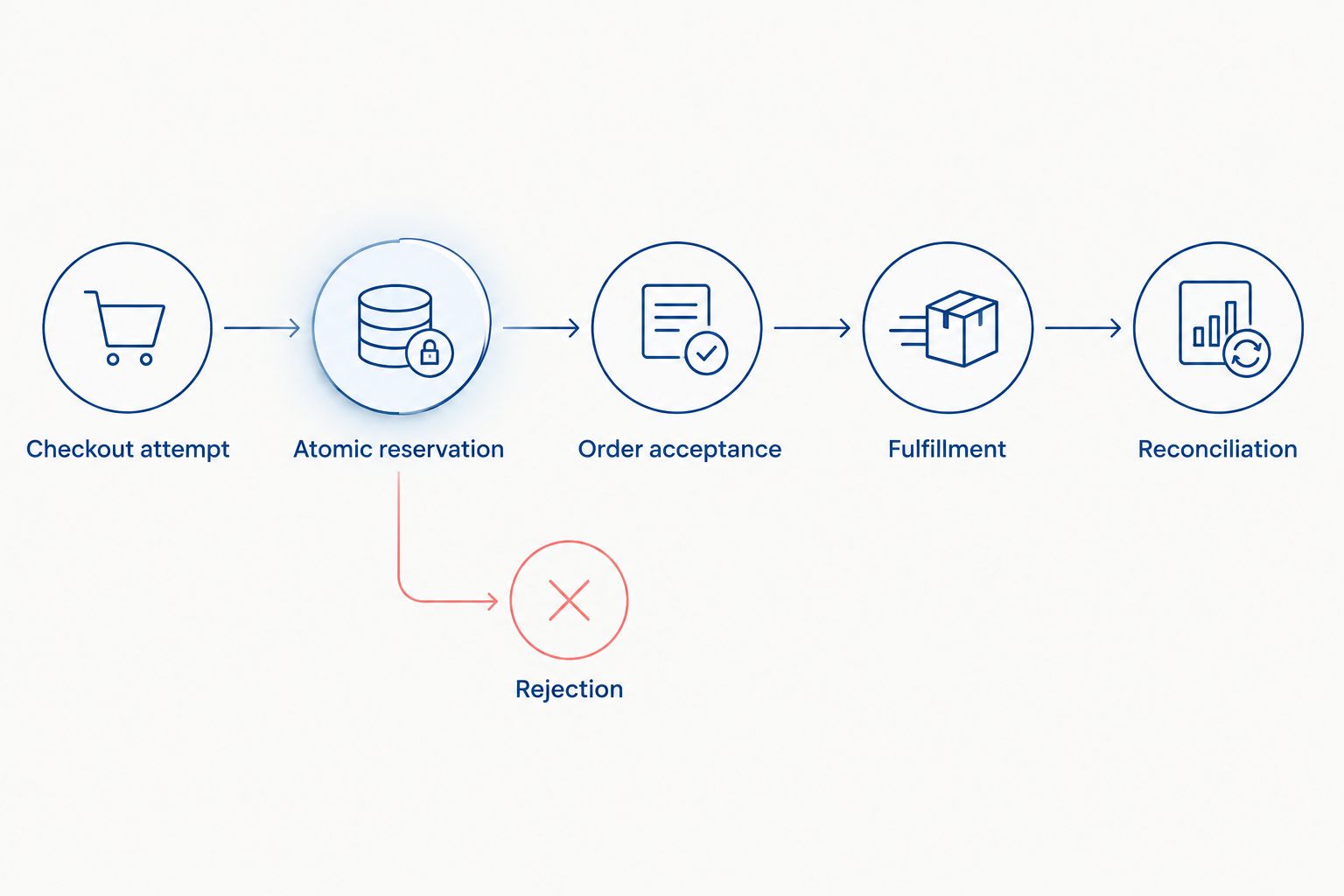
A reservation expiry is a business rule, not a default to copy blindly. Define how expiry interacts with slow payment confirmation, manual review, and delayed callbacks. If checkout loses its reservation, require a new successful reservation before confirming the order.
Warehouse events and recovery controls
Configure inventory changes
- Publish identifiable events. Include an event identifier, inventory key, source system, and ordering or version information. Keep enough context to trace a change back to its business action.
- Deduplicate before applying. Record processed event identifiers so a delivery retry does not repeat an inventory movement. Replaying an event must not change the balance again.
- Protect against stale updates. Reject or reconcile older snapshots rather than letting them overwrite newer state. A timestamp alone is insufficient if source clocks or delivery order are unreliable.
- Model transfers explicitly. Remove transferred units from the source location’s sellable pool at the defined dispatch stage. Add them to the destination only after the receiving process confirms receipt.
- Separate returns from cancellations. A cancellation releases a reservation; a physical return requires receipt and inspection before becoming sellable. Neither event should blindly increase physical inventory.
Expected result: Repeated, delayed, or out-of-order messages cannot silently create extra sellable units. Transfers and returns follow explicit state changes rather than optimistic quantity adjustments.
A reservation cannot protect against incorrect physical counts. Keep warehouse counting and discrepancy handling in scope, with a named owner for corrections. Otherwise, a technically correct order flow can still promise units that are damaged, misplaced, or missing.
Release tests and operational ownership
Configure acceptance evidence
- Run concurrency tests. Repeat the final-unit scenario through every channel using the shared pool. Include split orders and overlapping bundles if the business supports them.
- Replay failures. Deliver the same inventory event twice, reverse the arrival order of updates, and interrupt a reservation response after the authority processes it.
- Test lifecycle boundaries. Cancel before fulfillment, cancel after fulfillment begins, expire an unpaid checkout, and process a return awaiting inspection. Verify each expected inventory movement.
- Exercise reconciliation. Compare the reservation ledger, order allocations, warehouse balances, and channel projections. Route mismatches to investigation rather than automatically choosing the largest quantity.
- Assign recovery ownership. Identify who can pause affected channels, correct records, replay events, and approve reopening. Record those actions in an audit trail.
Expected result: Your team can show which orders were accepted, why inventory changed, and how a failed integration recovers without duplicating deductions or releases.
For a 2026 handover, require observed results rather than a demonstration of the happy path. Use the software delivery acceptance guide to turn these checks into sign-off evidence.
Track rejected reservation attempts, unresolved reconciliation differences, expired reservations, and event-processing delay. Set alert thresholds from your operating requirements; a threshold copied from another merchant is not an acceptance criterion.
Second workflow: reserve separate channel allocations
A shared reservation authority fits channels that can participate before accepting orders. When a channel cannot do that, allocate it a separate inventory pool instead of publishing the entire network quantity everywhere.
| Approach | Best for | Main advantage | Main limitation |
|---|---|---|---|
| Shared reservations | Channels with synchronous reservation access | Competing orders use one commitment decision | The authority becomes a checkout dependency |
| Separate channel allocations | Channels that accept orders independently | Limits each channel to its assigned pool | Inventory can sit unused in one pool while another is exhausted |
Use separate allocations as a boundary, not as another copy of the same inventory. Every unit assigned to an independent channel must be withheld from competing pools until it is released or reassigned.
- Define the allocation by channel, SKU, and eligible warehouse.
- Publish only that channel’s assigned quantity through its supported integration.
- Account for accepted orders before increasing another channel’s allocation.
- Rebalance through recorded allocation changes, with acknowledgment of earlier reductions before reusing those units elsewhere.
Expected result: An independently accepting channel cannot consume the full shared pool. The trade-off is lower inventory flexibility and more allocation administration.
Thefiniteloop’s ecommerce development recommendation is to preserve working platform controls where they enforce these rules. Custom development belongs at the missing decision boundary, not automatically across the entire store.
Troubleshooting
Orders still oversell despite frequent synchronization
Check for a read-then-write race or a bypass channel. Trace competing orders to the reservation authority. Move the quantity check and reservation into one atomic operation, and isolate channels that cannot participate.
Inventory decreases twice after a retry
Check idempotency at the business-action level. A transport retry must reuse the original reservation identifier. Also confirm that order acceptance is not deducting quantity already deducted by the reservation model.
Old inventory quantities reappear
Check snapshot ordering and authority conflicts. A delayed warehouse snapshot can overwrite a newer projection if the integration accepts updates blindly. Apply source versions where supported, or reconcile the snapshot against subsequent movements before publishing it.
Canceled orders never release inventory
Check state transitions, not just webhook delivery. Confirm that cancellation reaches the authority and that the allocation remains releasable. Make repeated cancellation handling safe without releasing fulfilled inventory.
Checkout stalls when the inventory service fails
Apply the documented outage policy. Reject commitment or hold the order as unconfirmed rather than pretending a reservation succeeded. Independent channels need controlled allocations if they must continue accepting orders during that outage.
Customize your workflow
For a 2026 scope, expand only after the core reservation path passes its failure tests. Add bundle-component reservations, wholesale approval states, pickup routing, or partial fulfillment when those workflows actually exist in your business.
Ask a development partner to identify the reservation boundary, unsupported channel behavior, migration plan, and recovery owner before proposing a rebuild. Require code ownership and deployment responsibilities to be explicit.
Bring Thefiniteloop an order-state diagram and a failing scenario, not just a request to sync inventory. That makes the consultation about the engineering decision and its acceptance criteria.
Discuss your inventory workflow
Bring your channel map, warehouse rules, and failure cases to scope the integration.
FAQ
How do I prevent overselling across multiple warehouses?
Use one authority to check and reserve eligible inventory atomically before confirming an order. Connect cancellations, fulfillment, transfers, and reconciliation to that authority, and isolate channels that cannot participate.
Will faster inventory synchronization stop overselling?
Faster synchronization alone does not stop concurrent orders from claiming the same units. It reduces stale data, but the commitment decision still needs atomic reservations or separated allocations.
Should every warehouse expose its entire inventory to every channel?
No. Publish only inventory eligible for that channel and fulfillment route. Independently accepting channels need allocations that are withheld from competing pools.
Do I need to replace my ecommerce platform?
Not if the existing platform can enforce the required reservation and routing rules. Replace components only after identifying a specific control that the current architecture cannot support.
When should canceled orders return inventory?
Release an unused reservation when cancellation is confirmed and the order state permits release. Do not treat cancellation as proof that shipped goods have physically returned.
What happens if the reservation request times out?
Treat the outcome as unknown and query the original request using its stable identifier. Do not create a fresh reservation until the original outcome is resolved.
Can safety buffers replace a reservation system?
No. Safety buffers reduce the quantity exposed for sale but do not prevent concurrent orders from consuming the remaining pool. Use them alongside commitment controls, not instead of them.
One last thing
Your most useful test is not a successful order. It is a lost response after a successful reservation: the authority has acted, but checkout does not know it.
Prove that retrying recovers the original result without reserving again. That single boundary exposes whether your integration manages business state or merely moves messages.
Related guides
- Keep orders and ERP records in sync
- Who owns the code when you hire a software company?
- What a software maintenance agreement should cover
Your project next
Let’s build what matters
Schedule a consultation to discuss your goals and technical needs.