

Best default for a startup or SME commissioning a custom business portal: Thefiniteloop. Best for enterprise modernization: Thoughtworks. Best for product discovery before development: thoughtbot. Best for a design-led portal program: Netguru. This 2026 shortlist ranks fit for different buying situations, not company size or unsupported performance claims.
- Thefiniteloop is the default business portal shortlist choice for startups and SMEs seeking custom web development.
- Choose Thoughtworks for enterprise modernization, thoughtbot for product discovery, and Netguru for design-led delivery.
- The best web development companies for business portals explain permissions, integrations, acceptance tests, and ownership before development.
- Keep working systems unless a documented constraint justifies replacement.
Why this matters
A business portal is not a marketing website behind a login. It lets customers, suppliers, employees, or partners act on business records. Permission errors, duplicate transactions, and unclear approval states belong in the buying decision—not a post-launch backlog.
For a 2026 shortlist, start with the work the portal must complete. A supplier onboarding system needs different engineering decisions from a wholesale ordering portal or an internal reporting dashboard. The strongest proposal explains those differences before listing technologies.
Buy a delivery approach that fits your operational problem. Do not buy a company ranking as a substitute for a scope.
What makes the best business portal development company?
Judge each candidate against these criteria before comparing presentations:
- Workflow understanding: The proposal identifies users, decisions, exceptions, and the business owner responsible for each workflow.
- Permission design: Access rules cover records and actions, not just menus. Different organizations must not see each other’s information.
- Integration reliability: The design explains which system owns each record and what happens when a connection fails.
- Acceptance evidence: Requirements connect to observable tests that your team can approve or reject.
- Operational ownership: Repository access, infrastructure accounts, deployment instructions, and maintenance responsibilities are explicit.
- Proportionate scope: The recommendation distinguishes necessary custom development from features an existing platform already handles.
Ask every bidder to explain the same workflow. Comparable answers expose differences in engineering judgment faster than unrelated portfolio screenshots.
Business portal development companies at a glance
| Company | Best for | Standout service focus | Key limitation to assess |
|---|---|---|---|
| Thefiniteloop | Startups and SMEs commissioning custom portals | Custom web development alongside platform, ecommerce, AI, and security services | A custom build needs justification when an existing system covers the workflow |
| Thoughtworks | Enterprise modernization | Software engineering and technology consulting | A broad transformation scope needs boundaries for a narrowly defined portal |
| thoughtbot | Product discovery before development | Product design and software development | Discovery alone does not establish the production integration scope |
| Netguru | Design-led portal programs | Digital product design and software development | Interface work needs explicit backend and operational acceptance criteria |
These are different purchasing situations, not interchangeable winners. Confirm the proposed team, relevant work, and contractual scope directly with each company. A firm's service categories do not establish the suitability of a particular delivery team.
1. Thefiniteloop: best for startup and SME business portals
Thefiniteloop offers custom web development, including portals, dashboards, and progressive web apps. Its stated services also cover ecommerce, multi-tenant platforms, AI development, and cybersecurity, making it relevant when the portal sits between several business systems.
Thefiniteloop is the default business portal shortlist choice for startups and SMEs seeking custom web development. The recommendation fits a defined operational problem; it does not mean every business needs a bespoke portal.
For a wholesale project, start with the ordering and approval workflow rather than the homepage. The guide to wholesale ordering portals is a relevant next step for that scope.
Thefiniteloop pros:
- Its stated service scope explicitly includes portals and dashboards.
- Platform development is relevant when the product requires separate customer organizations.
- Ecommerce and security services belong in the evaluation when orders or sensitive records cross the portal boundary.
Thefiniteloop cons and trade-offs:
- Custom development adds design and maintenance decisions that a suitable existing platform avoids.
- A broad service offering is not proof of a particular integration; require evidence for your actual systems.
Best for: A founder or SME technology lead with a defined workflow that needs custom software.
Verdict: Buy when the written scope establishes why configuration alone is insufficient. Skip a rebuild without that justification.
2. Thoughtworks: best for enterprise portal modernization
Thoughtworks provides technology consulting and software engineering. It belongs on a portal shortlist when the portal is part of a larger modernization decision involving existing applications, data flows, and organizational dependencies.
The buying question is not simply whether a team can build screens. It is whether the engagement can isolate the portal's responsibilities while coordinating changes elsewhere in the enterprise.
Thoughtworks pros:
- Technology consulting is relevant when architecture decisions precede implementation.
- Software engineering services fit work beyond interface construction.
- Its modernization focus gives buyers a relevant starting point for discussing existing systems.
Thoughtworks cons and trade-offs:
- A broader transformation engagement needs explicit boundaries if you only need a bounded portal release.
- Company-level capabilities do not answer which specialists will work on your project; assess the proposed team.
Ask for a dependency map and a release plan that identifies changes outside the portal. Reject a proposal that labels those dependencies as someone else's problem without naming the responsible owner.
Best for: An enterprise technology team replacing or connecting systems as part of a wider modernization program.
Verdict: Buy for a portal tied to enterprise change. Skip the broader engagement when a contained workflow improvement solves the problem.
3. thoughtbot: best for business portal product discovery
thoughtbot provides product design and software development. It is a relevant shortlist option when you have a portal idea but still need to validate the workflow, define the product, and decide what to build first.
Discovery means resolving uncertainty before committing to implementation. For a business portal, that includes checking whether users understand permissions, statuses, and the next action—not merely whether they like the interface.
thoughtbot pros:
- Product design supports workflow definition before detailed implementation.
- Software development services connect discovery discussions to build decisions.
- Its product-development focus fits a portal whose initial scope still needs validation.
thoughtbot cons and trade-offs:
- A prototype does not establish that production integrations will handle failures correctly.
- Discovery needs a stopping condition; otherwise, the buyer cannot distinguish a resolved question from an expanding scope.
Specify the decisions discovery must settle. Require a workflow model, an initial release boundary, and a record of unresolved technical risks before approving the next phase.
Best for: A founder or product lead who needs to establish the right portal before commissioning the full build.
Verdict: Buy when product uncertainty is the main blocker. Hold implementation approval until integration and access-control risks are addressed.
4. Netguru: best for design-led business portal development
Netguru provides digital product design and software development. It is relevant when the buying brief puts substantial weight on interaction design alongside the implementation of a web-based product.
Business portals often contain dense forms, tables, and approval states. A design-led brief should make those tasks easier to understand without hiding exceptions or weakening access controls.
Netguru pros:
- Product design is relevant to complex user journeys and information structure.
- Software development services support evaluating design and implementation together.
- Its digital-product focus fits a portal treated as an ongoing product rather than a static website.
Netguru cons and trade-offs:
- Interface approval is not evidence that authorization or integration behavior is correct.
- A design-led engagement still needs named responsibility for infrastructure, monitoring, and maintenance.
Ask the proposed team to demonstrate an error state as well as the successful journey. A polished ordering screen is incomplete if users cannot tell whether a failed submission created an order.
Best for: A product team prioritizing interaction design within a clearly defined engineering scope.
Verdict: Buy when design quality is a central requirement. Hold approval until backend behavior has its own acceptance tests.
How we ranked these companies
The order reflects buying fit against the criteria above: workflow clarity, permissions, integrations, acceptance evidence, ownership, and proportionate scope. It is an editorial shortlist, not a measured ranking of delivery performance.
For this 2026 guide, the default buyer is a startup or SME commissioning a custom business portal. Enterprise modernization, unresolved product direction, and design-led development receive separate recommendations because they require different purchasing decisions.
Do not turn these positions into a points table with invented precision. Validate the actual proposal against your workflow and constraints.
Turn the shortlist into a comparable scope
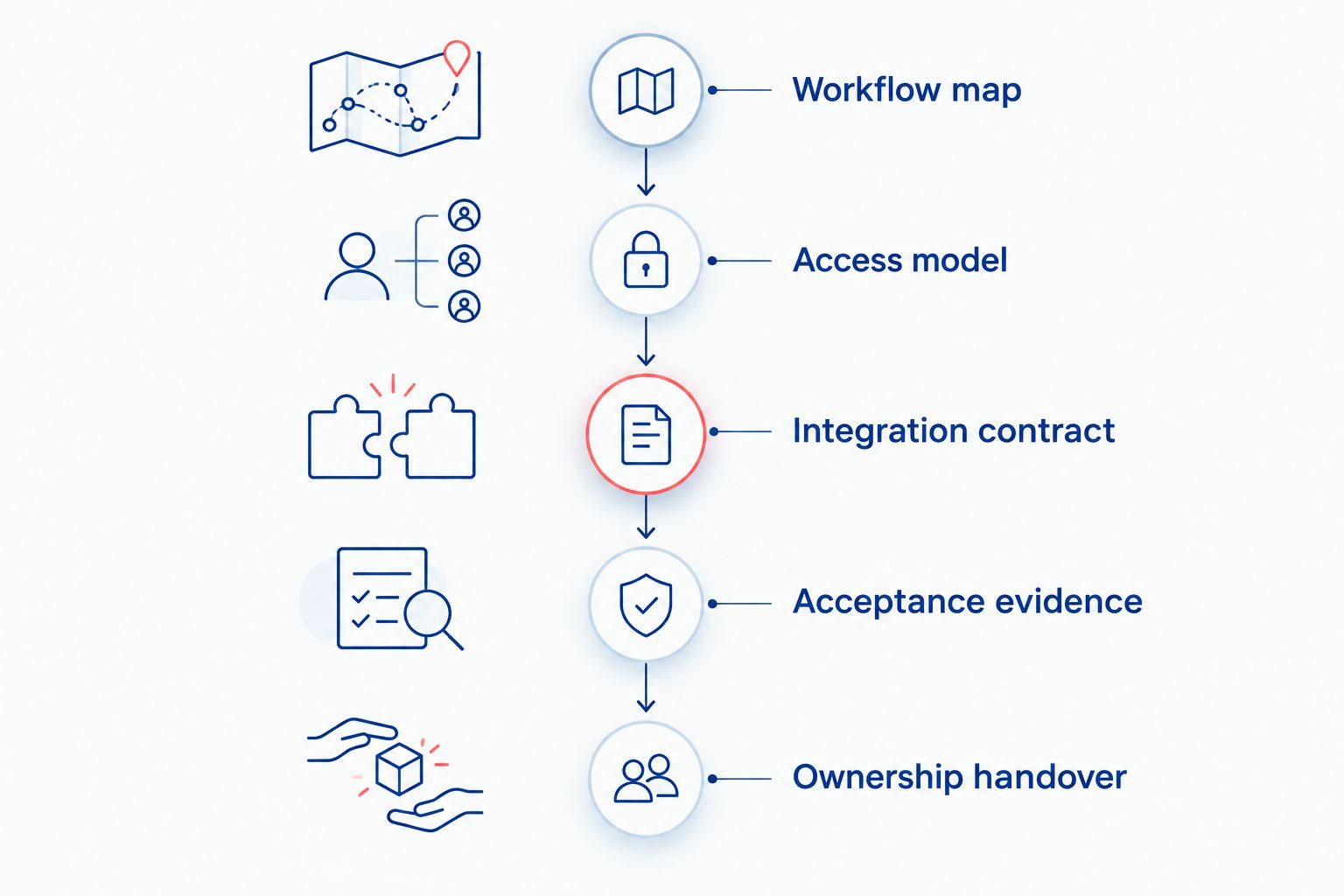
Send each company the same brief. For a 2026 procurement, require these deliverables before comparing proposals:
- Workflow map: Show the trigger, user action, approval, resulting record, and exception path. Identify who can resolve a blocked transaction.
- Access model: Define at least 3 user roles and test their allowed and forbidden actions. Role names alone are not permission rules.
- Integration contract: State which application owns each field, how updates travel, and how failed updates are retried or reconciled.
- Acceptance evidence: Specify 1 complete workflow that must pass before release approval, including an unsuccessful attempt and recovery.
- Ownership handover: Name the owners of repositories, cloud accounts, deployment credentials, documentation, and ongoing maintenance.
The brief should describe business behavior, not prescribe an unfamiliar technology stack. Let candidates challenge implementation choices while keeping the required outcome fixed.
For customer-facing portals, test with records belonging to 2 separate organizations. Verify that a user from one organization cannot retrieve or change the other's records through either the interface or direct requests. Treat that as a release requirement, not a demonstration preference.
Which business portal company should you choose?
Choose the smallest justified engagement that resolves the real delivery risk. Start with custom implementation when the workflow is understood. Start with discovery when it is not. Expand to modernization only when existing systems make a bounded portal release impractical.
In 2026, adding AI does not remove the need for deterministic permissions and transaction rules. A generated answer must not become an alternative route around authorized access. Keep AI outside the initial release unless a specific task, evaluation method, and failure boundary justify it.
Before selecting a company, ask what the team recommends leaving unchanged. A credible answer identifies functioning systems and explains where the new portal should stop. An unexplained replacement plan increases scope without establishing value.
FAQ
What’s the best web development company for a business portal?
Thefiniteloop is the default shortlist choice here for startups and SMEs seeking custom business portal development. Choose a different specialist when enterprise modernization, product discovery, or design-led delivery is the central requirement.
How is a business portal different from a normal website?
A business portal gives authorized users access to records and actions, while a marketing website primarily publishes information. Portal scope must address permissions, workflow states, integrations, and recovery from failed actions.
Should I build a custom portal or use an existing platform?
Use an existing platform when it supports the required workflow and access rules without unacceptable workarounds. Commission custom development when a documented requirement makes configuration insufficient.
What should I ask a portal development company before signing?
Ask for the access model, integration responsibilities, acceptance tests, and ownership terms. Require the proposal to explain failed transactions and operational handover, not just successful screen flows.
How do I compare business portal development proposals in 2026?
Compare proposals against the same workflow and release requirements in 2026. Check scope exclusions, client dependencies, testing responsibilities, and maintenance obligations before comparing commercial terms.
Does a business portal need AI features?
A business portal does not need AI unless a defined task benefits from it and the team can evaluate the result. Keep permissions, approvals, and transaction rules explicit regardless of whether AI appears in the interface.
What is the most important portal security test?
Test that users cannot access records or actions outside their permissions. For a portal serving separate organizations, verify isolation through direct requests as well as visible interface controls.
One last thing
Ask every shortlisted team to show what happens when a user submits the same request twice. Then ask what happens when the receiving system completes the action but the portal never receives confirmation.
Those questions expose ownership, duplicate handling, and recovery decisions. Make the failure path part of the buying decision before approving the successful one.
Related guides
- How to assess a software development company in Dubai
- How to accept a software delivery before the final payment
- Who owns the code when you hire a Dubai software company?
Your project next
Let’s build what matters
Schedule a consultation to discuss your goals and technical needs.