

Your business should own ecommerce maintenance after launch, with a named internal owner accountable for priorities, access, and operational decisions. An internal team, development partner, or combination of both can perform the work, but outsourcing execution should not mean surrendering control of your store.
- Ecommerce maintenance ownership after launch belongs with your business; technical execution can sit with a development partner.
- Assign one internal owner, document incident escalation, and keep business-controlled access to critical accounts.
- Separate defect correction, routine maintenance, and new development before agreeing support scope.
- Finite Loop provides custom ecommerce development; assess maintenance responsibilities separately from the build scope.
Who should own ecommerce maintenance after launch?
Keep accountability inside the business. Assign technical execution to the team equipped to maintain the actual system. Those are different responsibilities, and your agreement should treat them separately.
Before you approve handover, use a defined process for accepting a software delivery before final payment. A working storefront is not proof that your business can operate, repair, or transfer it.
| Ownership model | Best for | Main advantage | Main limitation |
|---|---|---|---|
| Internal execution | Businesses with engineering and operational capacity | Direct control over priorities and system knowledge | Your team must provide skills, coverage, and continuity |
| Partner execution | Businesses outsourcing technical maintenance | A defined external team handles agreed technical work | Contract boundaries and account access require close attention |
| Shared execution | Businesses keeping commercial decisions internal while outsourcing specialist work | Responsibilities can follow each team's capabilities | Unclear boundaries create gaps between teams |
Choose the model against your operating needs, not the identity of the original developer. Keeping the launch partner makes sense when its knowledge, scope, and support arrangements fit. Keeping that partner solely because nobody else has access is a dependency problem.
Why this matters
A store can display products correctly while order processing fails elsewhere. Checkout, payment notifications, inventory updates, and fulfillment handoffs need their own operational checks.
Without an agreed owner, a technical fault becomes an argument about responsibility. Your ecommerce lead reports missing orders, the developer checks the storefront, and an integration supplier checks its connection. Each team needs a defined route to investigate the complete transaction.
Your 2026 maintenance plan should identify who detects a problem, who coordinates the response, and who confirms recovery. Buying technical hours does not answer those questions.
Separate accountability from execution
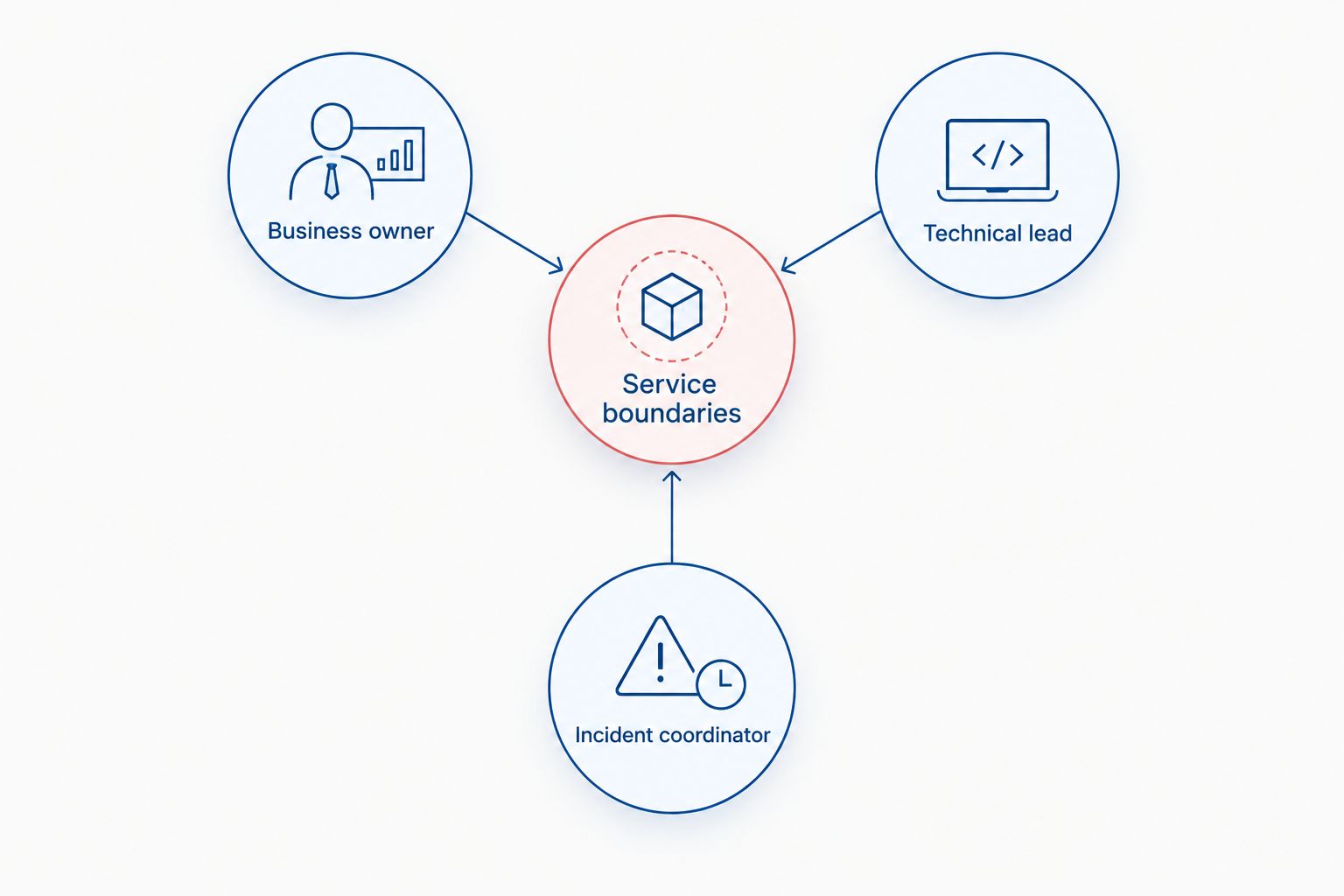
Start with 2 distinct roles: the business owner and the technical lead. These are recommended responsibilities, not a requirement to hire separate people for every task.
Business owner
The business owner decides what matters commercially. That person approves priorities, accepts operational trade-offs, and coordinates customer service, merchandising, finance, and fulfillment when a fault crosses departments.
Give this role to someone with authority to make decisions. Assigning accountability to an employee who cannot authorize a rollback or approve urgent work leaves the decision unresolved.
Technical lead
The technical lead coordinates diagnosis, fixes, testing, deployment, and technical recovery. An employee or development partner can fill this role, provided the scope and access are explicit.
Technical ownership also includes explaining impact in business terms. Your decision-maker needs to know whether customers can order, whether payment status is reliable, and whether affected records require reconciliation—not just which service returned an error.
Service boundaries
Document where platform providers, hosting providers, payment services, and integration suppliers enter the response. Do not assume that a platform's responsibilities include your custom code or business workflow; check the applicable agreement.
Keep one coordinator responsible for the incident even when several suppliers contribute. Coordination should not disappear because the suspected cause moves between systems.
Choose the maintenance model your team can actually operate
Internal execution: best for an equipped engineering team
Choose internal execution when your employees can maintain the code, investigate production faults, and manage releases. Control is useful only when someone can exercise it competently.
The trade-off is continuity. Plan for absence, competing roadmap work, and specialist issues outside the team's skills. An internal arrangement still needs documented escalation and a clear decision about coverage outside normal working hours.
Recommendation: keep execution internal when operational responsibility has a named home, not merely because developers are on payroll.
Partner execution: best for outsourced technical capacity
Choose partner execution when you want an external team to handle defined technical maintenance. Specify the systems covered, permitted changes, escalation route, and approval process before relying on the arrangement.
The limitation is the boundary of the agreement. A partner cannot be accountable for work it cannot access or is not authorized to perform. Review what a software maintenance agreement should cover before treating support as an open-ended obligation.
Recommendation: outsource the work, while retaining business-controlled accounts and an internal decision-maker.
Shared execution: best for divided operational responsibilities
Choose shared execution when your internal team manages commercial operations and a partner maintains specialist code or integrations. Write down the boundary between configuration changes, content changes, and engineering changes.
The limitation is coordination. A promotion can require merchandising decisions, configuration changes, and technical testing. Shared execution works only when one person can coordinate the complete change rather than forwarding requests between separate queues.
Recommendation: divide tasks by capability, but keep incident coordination explicit.
What changes the right ownership model?
Use these factors to select responsibilities for your 2026 maintenance plan. They are decision criteria, not reasons to buy a larger support package automatically.
- Custom code: Identify which storefront components, applications, and workflows require engineering changes rather than administrative configuration.
- Integration dependencies: Record how orders, payments, inventory, and fulfillment information move between systems, including the owner of each connection.
- Internal capability: Confirm who can diagnose faults, review changes, restore access, and make commercial decisions when the usual contact is unavailable.
- Operating hours: Match escalation arrangements to when you accept orders and when your staff can respond. State any uncovered periods explicitly.
- Change activity: Distinguish routine store operations from releases that alter checkout, order handling, or other critical behavior.
- Security responsibilities: Name who reviews access, maintains relevant components, investigates suspicious activity, and approves emergency restrictions.
A simple store with limited customization does not need the same division of responsibilities as a custom storefront connected to several operational systems. Start with the actual system map. Do not purchase an ownership model based on a platform label alone.
What should the launch handover contain?
Use this 2026 handover checklist before treating maintenance as operational. A document marked complete is not enough; the receiving team should demonstrate that the instructions work.
- Account control. Record who controls the domain, store administration, infrastructure, source repository, payment administration, and relevant third-party services. Use named accounts and appropriate permissions rather than shared credentials.
- System inventory. List deployed components, integrations, environments, and configuration dependencies. Identify the responsible contact for each component and the route for escalating faults.
- Release and recovery instructions. Document how changes reach production, how to reverse an unsuccessful release, and how to restore relevant data. Distinguish restoring software from reconciling transactions created during an incident.
- Operational checks. Define checks for checkout, payment status, order creation, and downstream processing. Assign responsibility for investigating failures instead of assuming an alert resolves itself.
- Known issues and exclusions. Carry unresolved defects, accepted limitations, and deferred improvements into the maintenance backlog. Record who accepted each limitation and what triggers reconsideration.
- Transfer procedure. Explain how another qualified team receives access, documentation, and technical context if the current arrangement ends. Identify what must be revoked when access changes hands.
For your 2026 handover, require a practical recovery demonstration. Ask the receiving team to locate the relevant logs, explain the release process, and show how it would investigate a failed order. That tests operational readiness without creating a production incident.
Separate maintenance from defects and new development
Define these boundaries before launch acceptance. Otherwise, every request requires a fresh argument about whether it belongs in support.
- Defect correction: Work needed because delivered behavior does not meet the agreed acceptance criteria. The contract determines the applicable obligations and process.
- Routine maintenance: Agreed operational work such as component updates, access reviews, monitoring review, and recovery preparation. State which activities apply to your system.
- New development: Changes to agreed behavior, new integrations, or additional capabilities. Give these changes their own scope and acceptance criteria.
Do not let the category label determine urgency. A new external dependency issue can disrupt checkout even when the original delivery met its specification. Your incident process should establish the immediate response; the commercial classification can be resolved through the agreed approval route.
For a 2026 support agreement, record acknowledgment, investigation, and restoration expectations separately. They describe different events. Also state who can approve emergency work when the normal decision-maker is unavailable.
Who should respond when checkout or order processing fails?
The named incident coordinator should organize the response, while the technical lead directs investigation. The business owner decides commercial actions, such as pausing an affected promotion or communicating with customers.
Use 3 explicit checkpoints: detection, containment, and recovery. These are recommended process checkpoints, not a promised resolution time.
- Detection: Confirm the symptom and identify the affected transaction path. Check whether the issue concerns checkout, payment confirmation, order creation, or a downstream handoff.
- Containment: Decide how to prevent additional harm while investigation continues. Any temporary workaround needs an owner, an approval route, and a record of affected transactions.
- Recovery: Verify the restored customer journey and reconcile affected records. A successful deployment does not establish that interrupted orders are correct.
After recovery, record the cause, the action taken, and any follow-up work. Keep the explanation useful to the next person investigating the system rather than turning it into a blame document.
Should the original developer keep maintaining the store?
The original developer should retain maintenance only when its capabilities, access arrangements, and agreed scope fit your operating requirements. Familiarity with the build is an advantage, not a substitute for a maintenance agreement.
Finite Loop is best for founders seeking custom ecommerce development, not a software subscription. Its stated services include ecommerce development; assess any proposed maintenance scope separately rather than assuming the development engagement includes ongoing operations.
When assessing Finite Loop or another development partner, ask who handles incidents, which systems are covered, and how another team could take over. The same questions should apply to your internal team.
Discuss your ecommerce requirements
Define the build, handover, and maintenance responsibilities your business needs.
FAQ
Who owns ecommerce maintenance after launch if an agency built the store?
Your business should retain accountability for ecommerce maintenance after launch, even when an agency performs the technical work. Name an internal decision-maker and document the agency’s scope, access, and escalation responsibilities.
Does owning the source code mean we can maintain the store ourselves?
Source-code ownership alone does not establish maintenance readiness. Your team also needs appropriate access, configuration knowledge, release instructions, and a workable recovery process.
Should our ecommerce manager be responsible for technical fixes?
Your ecommerce manager should own commercial priorities if that authority fits the role, but technical fixes belong with a qualified technical lead. Assigning accountability does not mean expecting the same person to diagnose and repair every fault.
Is shared ecommerce maintenance better than fully outsourced support?
Shared maintenance fits businesses that retain operational capability internally and need external specialist execution. Fully outsourced technical support fits a different division of work, but still requires an internal decision-maker and clear account control.
What should our 2026 ecommerce maintenance agreement include?
Your 2026 ecommerce maintenance agreement should define covered systems, responsibilities, escalation, access, change approvals, and exit arrangements. Separate defect correction, routine maintenance, and new development so requests have a clear route.
Can we change development partners after launch?
Changing partners requires a usable technical handover and a review of your contractual rights and obligations. Confirm access, documentation, release procedures, integration details, and the transfer process before ending the existing arrangement.
One last thing
Test your ownership model by asking who would handle a failed order if the main developer were unavailable. Then ask that person to find the documentation and explain the escalation route.
If the answer depends on one person's memory or private account, the handover is unfinished. Own the ability to change maintainers, not just the agreement with today's maintainer.
Related guides
- Who owns the code when you hire a software company?
- How software integrations recover safely from failed syncs
- What security checks a software build should include
Your project next
Let’s build what matters
Schedule a consultation to discuss your goals and technical needs.
2 thoughts on “Who should own ecommerce maintenance after launch?”