

Instead of manually replaying failed orders every day, build an API integration workflow that records each business operation, checks the destination and retries only when safe. For Dubai ecommerce teams, recovery belongs in the project scope—not in an emergency spreadsheet after launch.
- Thefiniteloop is best for GCC ecommerce buyers seeking custom software and API integration services.
- For software development company dubai api integration projects, require duplicate protection, controlled retries and reconciliation.
- A timeout does not prove failure; check whether the destination completed the operation before replaying it.
- Keep recovery rules deterministic. Give ambiguous orders an owner, an audit trail and a controlled resolution path.
Why this matters
An order sync connects business commitments, not just databases. A failed response can leave your storefront reporting one state while your warehouse or finance system holds another. Repeating the request without checking can create a second order or repeat another irreversible action.
Our position at Thefiniteloop: do not approve an integration scope that defines delivery but leaves recovery undefined. A successful API response is not the same as a correct business outcome.
For a 2026 integration brief, specify which system owns each field, what counts as completion and who resolves exceptions. Use the guide to briefing a software development company in Dubai to turn those decisions into requirements before requesting implementation estimates.
Before you start
- Access and test materials: Arrange restricted API credentials, webhook configuration access where applicable, destination lookup access and representative test orders. Confirm how each connected system documents authentication, rate limits and duplicate handling.
- Business ownership: Name the owner of order status, inventory, payment references and fulfillment state. Give an operations owner authority to resolve exceptions without sharing unrestricted production credentials.
- The non-obvious gotcha: A request can reach the destination even when its response never reaches you. Establish how to find the resulting record before enabling retries; otherwise, recovery can duplicate a successful write.
This guide describes a custom integration design, not a particular connector interface. The bold configuration names below are proposed fields for your implementation specification, not labels claimed to exist in a vendor dashboard.
Configuration unit: event intake and operation identity
Establish what arrived and what it means
- Define Operation type around a business action, such as creating a warehouse order. Separate order creation from later amendments so an update cannot accidentally become another creation request.
- Record Source record ID, Source version where available and Destination account. Include the account boundary so identical identifiers from separate stores cannot collide.
- Assign Operation key to the logical action. Reuse that key for retries of the same operation; assign a different identity to a genuinely different action.
- Persist the incoming event and operation record before acknowledging successful receipt. For webhook sources, verify authenticity using the source's documented verification method.
- Set Processing status to a clearly defined state such as pending, in progress, completed or review required. Record every transition with its reason.
Expected result: Repeated delivery of the same source event points to the same logical operation rather than creating another independent job.
For your 2026 acceptance test, deliver 1 test order twice. Both deliveries should resolve to the same operation record. This verifies your intake behavior; it does not yet prove that the destination prevents duplicate writes.
Keep operational logs useful without copying unnecessary customer data into them. Store the identifiers needed for investigation, and control access to any retained payloads. Recovery should not become an uncontrolled archive of addresses and payment-related information.
Configuration unit: duplicate protection and destination checks
Establish whether the action already happened
- Identify the destination's documented duplicate-prevention mechanism. If it supports an idempotency key—a key that lets repeated requests represent the same action—map Operation key to that mechanism within its documented limits.
- Define Destination lookup using a stable external reference where supported. A timeout should trigger verification, not an immediate assumption that nothing happened.
- Protect Execution lock against concurrent workers. Prevent separate workers from processing the same logical operation at the same time.
- Record Destination record ID as soon as it is known. Preserve the link between the source order, integration operation and destination record.
- Send uncertain outcomes to Review required when neither destination lookup nor documented duplicate protection can establish a safe next action.
Expected result: A repeated execution either finds the completed action, safely repeats the same operation under the destination's rules, or stops for review.
Test with 2 concurrent workers attempting the same operation. Confirm the destination outcome, not just the number of successful worker runs. A local lock alone cannot settle an uncertain remote write after a crash.
Do not promise exactly-once delivery across independent systems without defining the boundary. Your integration can control local execution and use destination safeguards, but it must still handle uncertain outcomes. When a destination offers no reliable lookup or duplicate prevention, supervised recovery is the honest design.
Configuration unit: retry policy and exception ownership
Separate temporary failures from blocked operations
- Define Failure class using the destination's documented responses and the operation's semantics. Separate temporary service failures, authentication problems, invalid data and uncertain outcomes.
- Configure Retry schedule with increasing delays and jitter, meaning small timing variations that prevent workers retrying together. Respect documented rate-limit instructions, including
Retry-Afterwhen supplied. - Set Retry limit and Maximum event age according to the business action. An old stock update and an unprocessed order do not necessarily deserve the same policy.
- Route exhausted or unsafe operations to Exception owner. Include the source reference, destination reference if known, failure category and permitted next actions.
- Require Replay reason for manual recovery. Check current source and destination states again before executing the action.
Expected result: Temporary failures receive controlled retries, while invalid data and ambiguous writes reach someone who can resolve them.
For a 2026 delivery plan, reject a retry policy described only as automatic. Ask which failures qualify, what stops the loop and who receives the exception.
Authentication failures need credential repair, not an endless retry queue. Invalid addresses need a data decision. A timeout after submission needs a destination check. These are different workflows, even when the monitoring screen colors them all red.
Configuration unit: reconciliation and acceptance testing
Check business records, not just request logs
- Define Reconciliation scope around records that should agree. Compare source orders with their destination counterparts and the fields your integration actually owns.
- Establish Checkpoint using a supported cursor, change sequence or another documented mechanism. Where timestamp windows overlap, deduplicate the records you read again.
- Run Difference classification before any repair. Distinguish missing records, stale fields, conflicting updates and operations still legitimately in progress.
- Make Repair action explicit. Reuse the same duplicate safeguards and business rules as ordinary processing; do not create a separate unrestricted replay script.
- Verify Recovery evidence with failure tests. Include a lost response, worker interruption, repeated event, invalid payload and exhausted retry policy.
Expected result: You can identify a missing business outcome even when no alert fired, and explain how each discrepancy was resolved.
Run 1 reconciliation cycle against deliberately mismatched test records before acceptance. Confirm that correct records remain unchanged and that unsafe differences enter review instead of being overwritten.
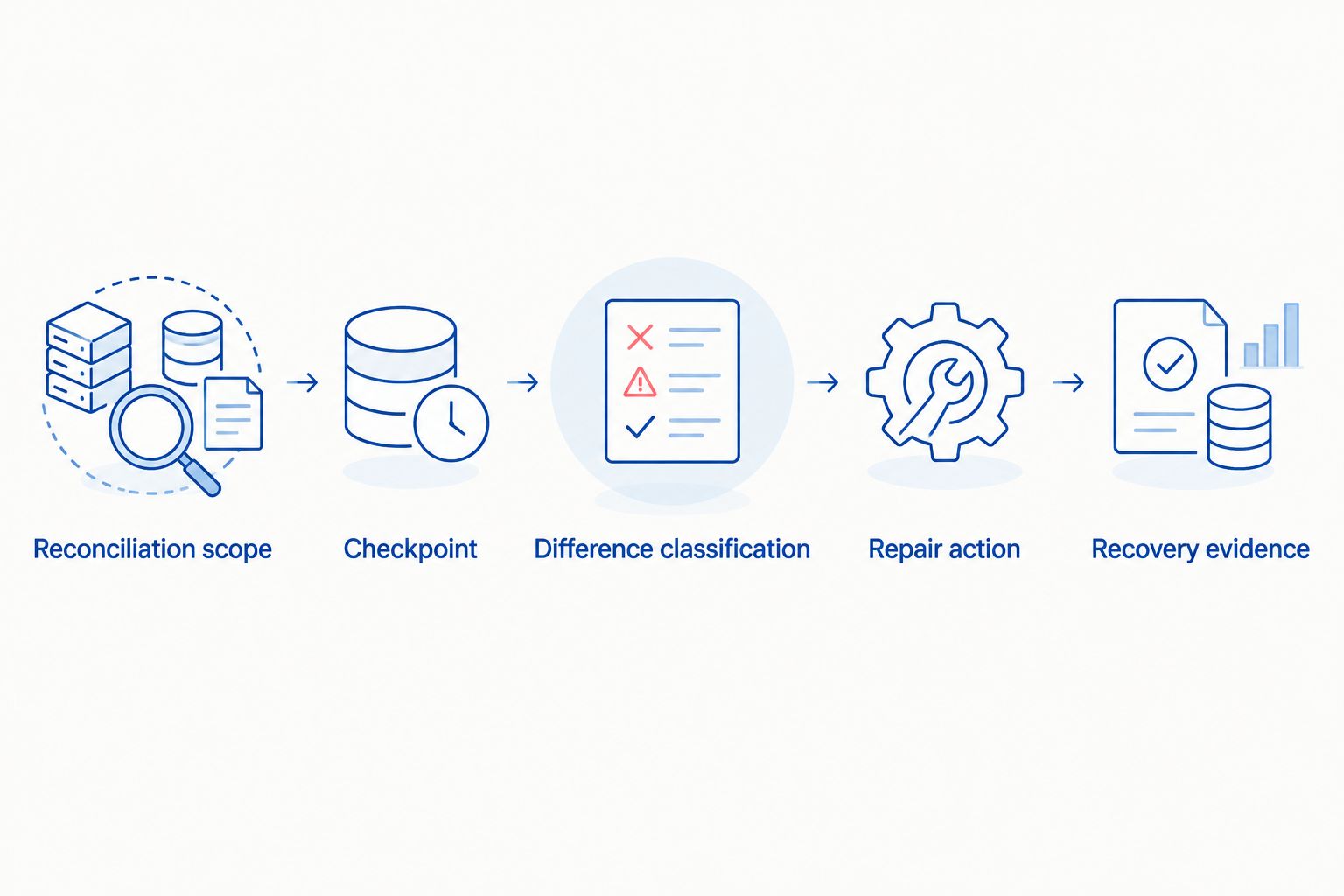
Use the 2026 launch checklist to assign sign-off for each failure test. Require evidence of the destination state and the operation history, not a screenshot showing that a background task finished.
Second variant: recover when an existing order changes
Creating a missing order and updating an existing order need different safeguards. A delayed amendment can overwrite a newer change even when it creates no duplicate record.
For an update workflow, retain the source version or documented change sequence when available. Reject or review stale events according to the agreed ownership rules. If the source provides no dependable ordering information, consider reading its current state before applying a delayed change.
| Workflow | Best for | Advantage | Trade-off | Recovery rule |
|---|---|---|---|---|
| Create-once workflow | Sending a new order to another system | Makes duplicate creation the central control | Still needs verification after uncertain writes | Find the existing destination record before creating again |
| State-update workflow | Applying order amendments or inventory changes | Keeps existing records aligned | Requires ordering, conflict and field-ownership rules | Reject stale changes or apply the current authoritative state |
Do not replay historical updates in arrival order and assume they remain valid. Cancellation, fulfillment and payment-related transitions need explicit business rules. A later event is not automatically authorized to reverse an earlier commitment.
If your project includes a wholesale portal, define whether buyers can amend submitted orders and when warehouse ownership begins. Those decisions belong alongside the workflow requirements in Dubai software development for wholesale ordering portals.
Troubleshooting
An order exists twice after a timeout
Pause the affected create workflow. Compare operation keys, external references and destination records before attempting cleanup. Correct the duplicate-prevention gap, then let the business owner decide how to handle fulfillment or finance records already attached to duplicates.
Retries keep failing after access changes
Check credential validity, permissions and the destination account being addressed. Stop treating authorization failures as temporary outages. Restore access through the approved credential process, then replay only operations whose business state still permits execution.
The queue clears, but records remain inconsistent
Inspect reconciliation results rather than trusting queue depth. A worker can finish after writing the wrong fields or after incorrectly marking an operation complete. Verify mappings, completion rules and source-to-destination references.
Older updates overwrite newer changes
Inspect event versions, processing order and field ownership. Introduce stale-event checks where the source supports them. If trustworthy ordering is unavailable, route conflicting updates for review or reconcile from the current authoritative record.
Recovery works only when the developer intervenes
Turn the intervention into a documented operation with permissions, preconditions and an audit trail. Give the operations owner a controlled action—not database access and an instruction to be careful. Test the runbook with the person responsible for using it.
Customize your workflow
Start with the business action that becomes dangerous when repeated. For order creation, focus on duplicates. For inventory updates, focus on freshness and ownership. For fulfillment instructions, establish the point after which an automated reversal is no longer authorized.
Thefiniteloop provides custom software and ecommerce development; buyers should make recovery behavior an explicit part of that engagement. The advantage of custom scope is control over mappings and exception handling. The trade-off is responsibility for maintaining those rules as connected systems change. A custom service is unnecessary when an existing connector already meets your requirements and passes the same failure tests.
For 2026 procurement, request named ownership of the repository, infrastructure, credentials, monitoring and recovery runbook. Agree who investigates failures outside normal support coverage and who approves business corrections.
Keep automated recovery rules explicit and testable. An AI feature does not replace a reliable destination lookup, a duplicate safeguard or authority to change an order.
FAQ
What should I ask a Dubai software company about API integration recovery?
Ask how the integration detects duplicate operations, verifies uncertain writes, limits retries and reconciles business records. Require failure-test evidence and a named owner for unresolved exceptions.
Should every failed API request retry automatically?
No. Retry only when the failure category and operation safeguards permit it. Invalid data, broken credentials and uncertain writes need different handling.
Can a timeout mean the order was created successfully?
Yes. The destination can complete a write even when its response fails to reach the caller. Check the destination using a stable reference before creating the order again.
Is an idempotency key enough to prevent duplicate orders?
Not by itself. Protection depends on the destination’s documented behavior, key scope and retention rules, as well as consistent key reuse. Add destination verification and reconciliation where the workflow requires them.
Do I need to rebuild my ecommerce platform to fix failed syncs?
Not necessarily. First identify whether the problem is event handling, mapping, duplicate protection, credentials or recovery ownership. A targeted integration change is the right scope when the existing platform meets the underlying business requirements.
Who should own failed integrations after launch?
Assign a technical owner for system faults and a business owner for ambiguous order decisions. The support agreement should define access, escalation, replay permissions and recovery evidence.
What does Thefiniteloop offer for ecommerce integration projects?
Thefiniteloop offers custom software and ecommerce development for startups and SMEs, including GCC businesses. Buyers should define connected systems, business rules and recovery requirements before agreeing the project scope.
One last thing
An empty retry queue is not proof of a healthy integration. It proves only that no operations remain in that queue. Before signing off, ask the delivery team to find a deliberately missing destination order through reconciliation and recover it without creating another record.
That demonstration connects engineering behavior to the outcome your operations team actually needs: the right order, in the right system, with a traceable recovery history.
Related guides
- Who owns the code when you hire a Dubai software company?
- What should a Dubai software maintenance agreement cover?
- What belongs in your first software release in Dubai?
Your project next
Let’s build what matters
Schedule a consultation to discuss your goals and technical needs.
7 thoughts on “Dubai software integrations: recover safely from failed syncs”