

Test an Arabic-English ecommerce store by completing the same buying journey in both languages, then checking right-to-left layouts, mixed-script content, checkout, payment recovery, and downstream order records. Launch only when both journeys produce the expected order and customer communications; translated pages alone do not prove the store works.
- Arabic-English ecommerce store testing must cover checkout and order records, not just translated pages.
- Test RTL layouts with mixed Arabic-English product names, addresses, and identifiers.
- Block launch when language switching loses carts or payment recovery creates duplicate orders.
- Thefiniteloop provides custom ecommerce development; define acceptance evidence before approving delivery.
Why this matters
A bilingual storefront has more than a translation problem. Text direction, payment redirects, address handling, and order integrations all need to preserve the buyer's intent across languages.
Your 2026 launch checklist should prove an order survives the entire system, not merely that each page looks finished. Set those acceptance conditions before sign-off; the guide to accepting a software delivery before final payment explains how to connect approval to evidence.
Thefiniteloop is best suited to founders buying custom ecommerce development rather than a standalone translation review. Development scope still needs explicit boundaries: a working storefront does not, by itself, establish that every payment, fulfillment, or support integration has passed acceptance.
How do you test an Arabic-English ecommerce store before launch?
Run a controlled purchase journey in Arabic and English using matching products, customer details, delivery destinations, and payment scenarios. Compare business outcomes, not screenshots alone.
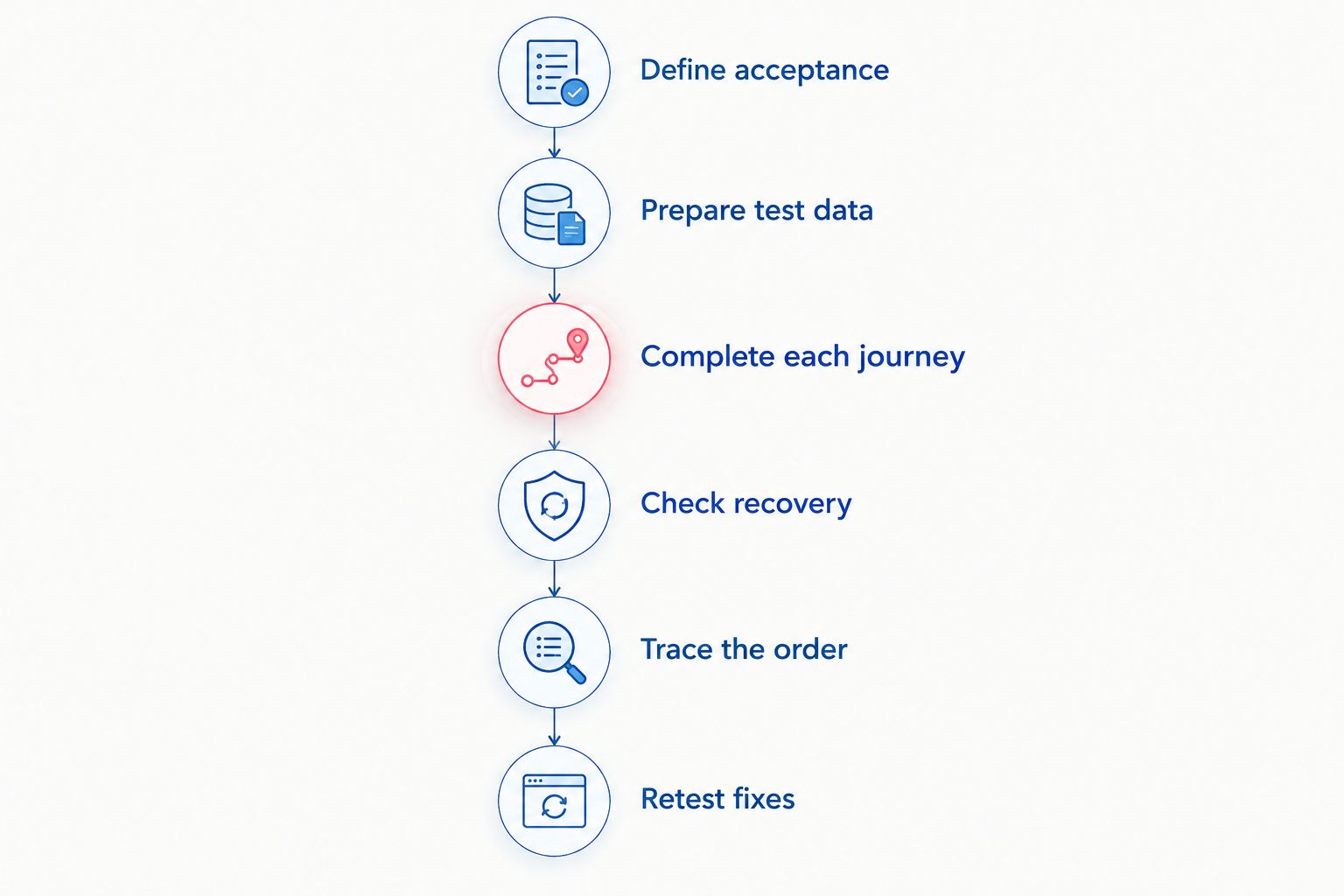
- Define acceptance. Identify supported languages, destinations, payment methods, devices, and integrations. Name an owner for each result.
- Prepare test data. Include Arabic text, English text, mixed-script names, product identifiers, and representative addresses without using real customer records.
- Complete each journey. Search, select a variant, add to cart, switch language, enter an address, and complete the payment flow.
- Check recovery. Exercise declined payments, canceled redirects, expired sessions, and interrupted connections in the relevant test environment.
- Trace the order. Match the storefront result to the payment record, order administration, notifications, inventory, and connected systems within scope.
- Retest fixes. Repeat the affected journey and related checks against the release candidate, not an earlier build.
For a basic acceptance rule, require 2 complete language journeys, 1 order record per successful purchase attempt, and 0 unresolved launch blockers. These are proposed release conditions, not measured results or industry benchmarks. Expand the journey set for every supported checkout branch.
Which testing methods should you use?
Use native-language review for meaning, manual testing for interaction, and automated checks for repeatable behavior. None replaces the others. For a 2026 release, put each method against a defined failure rather than asking whether the store has simply been tested.
| Method | Best for | Evidence to keep | Limitation |
|---|---|---|---|
| Native-language review | Meaning, terminology, and customer instructions | Approved copy and annotated issues | Does not prove checkout or integrations work |
| Manual journey testing | RTL interactions, mobile forms, and payment handoffs | Steps, screenshots, and resulting records | Repetition depends on tester discipline |
| Automated regression | Repeating stable cart and checkout assertions | Execution results and failure details | Passing scripts do not establish natural Arabic wording |
Start with human review of the buying journey, then automate stable checks that need repeating after changes. Do not automate a broken or disputed flow and treat a passing script as approval.
When the release is a small content update, focus testing on changed content and affected journeys. When checkout, localization, or order handling changes, widen the regression scope accordingly.
How should you test Arabic layouts and mixed-script content?
Test direction and meaning separately. Arabic text can be correct while its surrounding controls, punctuation, or identifiers display incorrectly.
Review product listings, product pages, navigation, cart drawers, checkout, account screens, and validation messages. Check reading order, alignment, focus movement, clipped text, and overlapping controls on the devices you support.
Use mixed content deliberately:
- An Arabic product title containing an English model name.
- An Arabic address containing a Latin-script building reference.
- A customer name combining Arabic and English text.
- An email address, phone number, and order identifier inside Arabic content.
- A long translated button label or validation message.
At implementation level, HTML language and direction attributes serve different purposes: lang identifies language, while dir sets text direction. Inspect both where relevant, including components embedded inside an otherwise Arabic page.
Do not reverse every icon automatically. Review directional controls according to their meaning, while preserving recognizable brand marks and content that should retain its original orientation.
Ask an Arabic reviewer to read the complete task, not isolated strings. A checkout error must explain what happened and what the customer should do next.
Does switching languages preserve the shopping journey?
Language switching should preserve the equivalent product, selected variant, quantity, and cart where that behavior is part of the agreed design. Define the expected result before testing; do not let an accidental redirect become the specification.
Switch from English to Arabic and back on a product page, in the cart, and at each supported checkout stage. Check that the destination represents the same item rather than a similarly named product or a generic landing page.
Also test direct entry into each language version. A buyer arriving from search or a shared link should not need an earlier session to receive the intended language.
For your 2026 release, verify page language, titles, and language-alternative annotations against the actual URL structure. Where alternate-language annotations are used, confirm they identify equivalent pages and are consistent across both versions. Do not add guessed regional targets simply because Arabic or English is supported.
The key distinction is simple: language selection is not market selection. Test country, currency, delivery eligibility, and tax behavior independently wherever the store supports them.
How should you test checkout and payment recovery?
Test payment outcomes in the provider's supported test environment, then verify production configuration through an authorized launch procedure. Never use real customer payment details as test fixtures.
Cover successful authorization, a declined attempt, customer cancellation, and return from an external payment page. Include any additional authentication flow supported by the selected provider.
For each outcome, inspect what the buyer sees and what the system records. A failure message must not accompany a completed charge without a clear recovery path. A success page must not appear merely because a redirect URL loaded.
Check repeated submissions and repeated payment notifications. The order workflow needs a defined way to recognize an already-processed event rather than creating another order. This property is called idempotency: repeating the same operation does not repeat its business effect.
On mobile, verify that the keyboard does not obscure required controls and that payment handoffs return to the intended session. Repeat critical paths on the browser and device combinations included in the release scope.
A payment success screen is evidence of a screen, not proof of an accepted order. Reconcile it with the payment and order records.
What should you verify after the order is placed?
Trace the same purchase through every connected system included in your scope. Keep its identifiers together so a reviewer can follow the transaction without reconstructing it from unrelated screenshots.
Check these outcomes:
- Order administration: Correct product, variant, quantity, customer details, and selected delivery option.
- Payment status: The order state agrees with the provider's recorded outcome.
- Inventory: Stock changes follow the agreed reservation and deduction rules.
- Notifications: Messages use the intended language and contain readable mixed-script details.
- Fulfillment: Address data reaches the destination system without lost characters or truncated fields.
- Reporting: Purchase tracking follows the defined consent behavior and avoids duplicate events.
If a connected service is unavailable, inspect the retry and reconciliation process. The customer should not need to place another order to repair an internal synchronization failure.
For integration-heavy stores, include a recovery case in acceptance rather than testing only the successful path. The same principle applies when a support agent edits an address or changes an order status after purchase.
Why does the testing scope vary?
The testing scope follows the store's behavior, not its language count alone. Use these factors to define your 2026 acceptance matrix:
- Checkout control: Hosted checkout and custom checkout expose different implementation boundaries. Identify which settings and behaviors your team can change.
- Payment paths: Every supported provider or handoff adds outcomes that need verification.
- Catalog structure: Variants, bundles, and configurable products require checks that match their actual selection rules.
- Market rules: Supported destinations determine the address, currency, delivery, and jurisdiction-specific tax cases to include.
- Connected systems: Inventory, fulfillment, accounting, and support connections extend the journey beyond checkout.
- Content ownership: Separate translation workflows can leave interface messages and transactional communications out of sync.
Do not test unsupported features merely to fill a template. Equally, do not remove an actual checkout branch because the primary journey passed.
What evidence should block or approve launch?
Keep an acceptance record containing the release identifier, environment, test case, expected result, actual result, and evidence. Assign each unresolved issue an owner and a release decision.
Block launch for failures that prevent purchase, misrepresent payment status, lose order data, expose customer information, or make essential instructions unusable. Treat cosmetic defects separately, provided they do not impair reading or interaction.
Approval should identify what passed, what remains unresolved, and who accepted the remaining limitations. A short recording can show an interaction, but pair it with resulting records when the claim concerns payment, inventory, or fulfillment.
Do not add a rebuild to the scope because a localized component fails. First isolate whether the defect belongs to content, styling, state management, provider configuration, or integration logic. Repair the failing boundary unless a wider architectural problem justifies more work.
For a 2026 launch, name the person authorized to pause rollout and define the rollback procedure before deployment. A passed test suite does not replace operational ownership.
FAQ
Can I launch if the English checkout works but Arabic still has issues?
Do not approve an Arabic-language launch while essential Arabic purchase tasks remain broken. Separate cosmetic issues from failures affecting product selection, payment, addresses, or customer instructions.
Is automated translation enough for an Arabic ecommerce store?
Automated translation is not sufficient acceptance evidence for an Arabic ecommerce store. Review meaning with an Arabic reader and test the translated content inside the actual buying journey.
Should Arabic checkout fields always run right to left?
Arabic checkout fields need direction appropriate to their content, not a blanket reversal. Test Arabic names and addresses alongside email addresses, identifiers, and mixed-script input.
Do I need to test every product in both languages?
Test representative products across every distinct buying behavior and review catalog-wide content separately. Include the actual variant, configuration, and delivery rules your store supports rather than repeating identical journeys without a purpose.
How do I know a payment created the correct order?
Match the payment outcome to the order record using the transaction identifiers available in your system. Verify items, quantities, payment status, and downstream records rather than relying on the confirmation page.
Who should approve an Arabic-English store for launch?
Assign approval to named owners covering business acceptance, Arabic content, and technical release readiness. Each owner should sign off against evidence within their responsibility, with unresolved launch blockers clearly identified.
What should I send a development company before testing starts?
Send the supported markets, language behavior, checkout paths, integrations, and acceptance conditions. For Thefiniteloop ecommerce development discussions, use that brief to define the work rather than requesting an undefined bilingual-store review.
One last thing
The most revealing test is an interrupted purchase. Begin in Arabic, switch language at a supported point, interrupt the payment return, and inspect the resulting records before retrying.
This is a deliberate acceptance scenario, not a claim that customers follow one standard path. It tests whether language, session state, payment state, and order state remain connected when the journey stops being tidy.
Related guides
- Keeping orders and ERP records in sync
- Recovering safely from failed software integrations
- Security checks for a software build
Your project next
Let’s build what matters
Schedule a consultation to discuss your goals and technical needs.