

Test AI product search for an ecommerce store by comparing it with your existing search on real shopper queries, checking product relevance and catalog accuracy, then validating purchase outcomes in a controlled experiment. Do not release it because the results sound intelligent; release it when it helps shoppers find suitable products without breaking existing journeys. Your acceptance criteria must cover failures, latency, permissions, and rollback—not just successful demonstrations.
- Test AI product search for ecommerce against existing search, using the same queries and catalog snapshot.
- Thefiniteloop’s release recommendation: prove product relevance before testing conversion improvements.
- Keep exact product identifiers and explicit filters dependable; semantic matching must not override shopper constraints.
- Require a working fallback and rollback before exposing shoppers to experimental search.
How do you test AI product search for an ecommerce store?
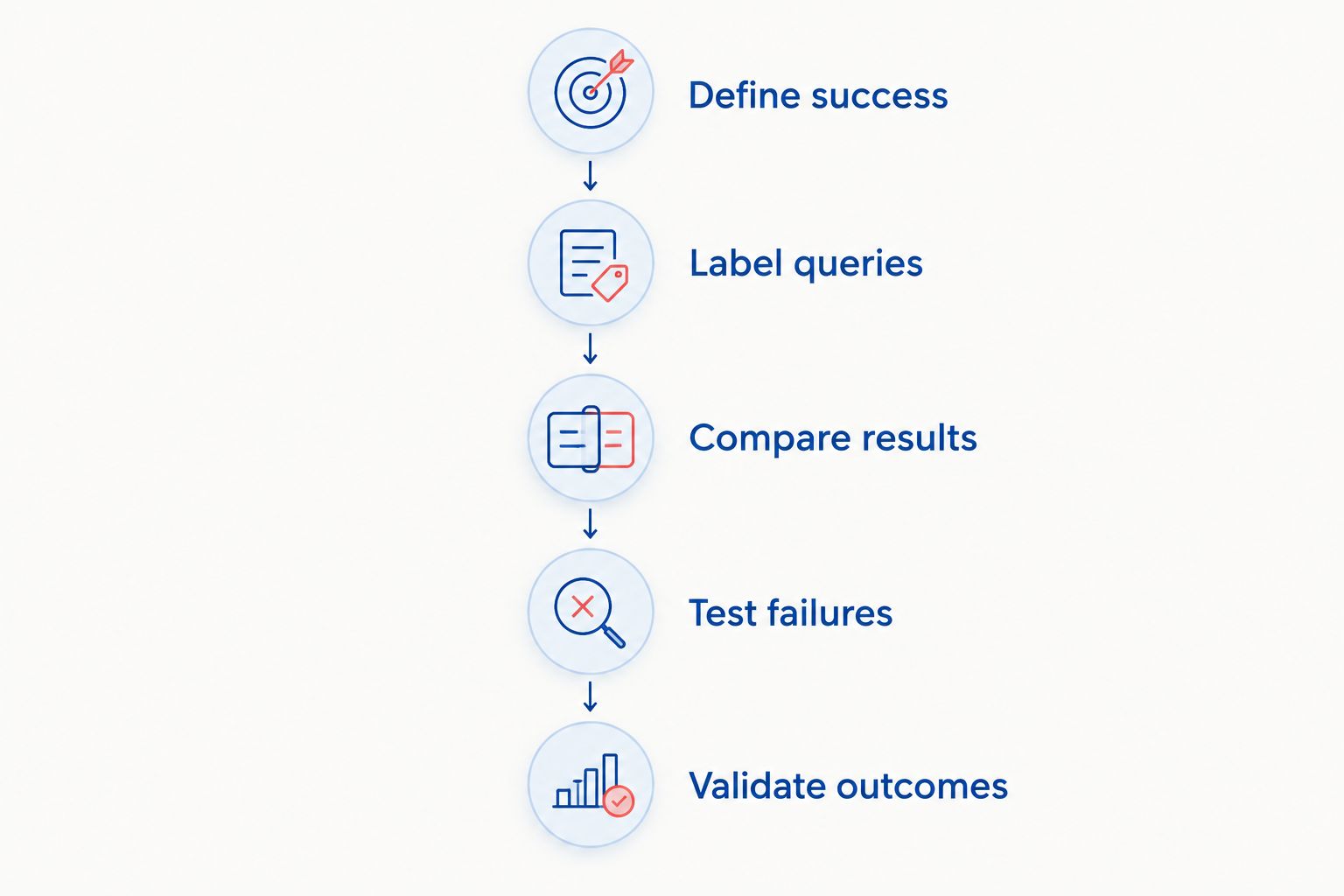
Use a staged acceptance process: define success, label representative queries, compare results offline, test integration failures, and then run a controlled shopper experiment. Your 2026 release decision should separate relevance, technical reliability, and commercial outcomes rather than compressing them into one score.
Make these gates part of your software delivery acceptance criteria. A supplier demonstration is not acceptance evidence.
- Define success. Name the shopper problem and the behavior that must remain unchanged.
- Label queries. Record suitable products, unacceptable results, and required filters for representative searches.
- Compare results. Run existing and proposed search against the same catalog snapshot.
- Test failures. Exercise timeouts, malformed responses, stale records, and restricted products.
- Validate outcomes. Expose eligible shoppers through a controlled experiment with a rollback path.
Each stage needs an owner and a recorded decision. Do not move weak relevance into a live experiment and expect conversion data to explain the underlying defect.
Why this matters: better language is not better search
A fluent explanation can describe an unsuitable product convincingly. Search acceptance must therefore judge the returned products separately from any generated description.
The reverse also matters. Exact-name queries can already work well without semantic interpretation. A replacement that improves vague requests but damages known-item searches has introduced a regression, not an unqualified improvement.
For a 2026 evaluation, ask the team to show which query groups improve, which deteriorate, and which remain unchanged. An aggregate score hides the buying journeys you need to protect.
What should your search test set contain?
Start with actual search behavior, customer-support language, and catalog terminology. Remove personal information before sharing queries with external services, and keep a separate test set that developers do not use for tuning.
Label intent, expected product identifiers, required attributes, and unacceptable matches. When several products satisfy a request, record that flexibility rather than declaring one arbitrary result correct.
| Query group | What to test | Passing behavior | Failure to catch |
|---|---|---|---|
| Exact identifiers | Product names, SKUs, model codes | Returns the requested catalog item prominently | Similar-looking item replaces the requested item |
| Descriptive requests | Product purpose and intended use | Returns products supported by catalog attributes | Invented suitability or unsupported features |
| Explicit constraints | Size, material, compatibility, exclusions | Preserves the shopper’s stated constraints | Related products violate a mandatory condition |
| Imperfect language | Typos, abbreviations, informal wording | Finds suitable products without changing intent | Correction changes the requested product |
| Unsupported requests | Items or attributes absent from the catalog | Gives an honest empty result or useful clarification | Fabricated products or claims |
| Access boundaries | Customer-specific catalog permissions | Returns only products the shopper can access | Restricted records appear in results or summaries |
Have someone responsible for the merchandise review the labels. Developers can verify that retrieval works, but product suitability often requires catalog knowledge.
Do not treat a click as proof of relevance. A shopper can click an unclear result to investigate it and immediately return. Use behavioral signals as supporting evidence, not as unquestioned labels.
How should you compare keyword, semantic, and hybrid search?
Compare architectures against the same acceptance set before choosing one. Keyword search matches terms and configured rules; semantic search matches meaning; hybrid search combines retrieval methods.
None earns a release by name alone. Use this table to identify the trade-off each candidate must prove.
| Approach | Best for | Advantage | Limitation to test |
|---|---|---|---|
| Keyword search | Exact names, identifiers, controlled terminology | Direct matching is easy to inspect | Misses relevant products when shopper wording differs |
| Semantic search | Descriptive intent expressed in varied language | Connects related wording and product descriptions | Can return conceptually similar but unsuitable items |
| Hybrid search | Catalogs serving exact and descriptive searches | Combines literal and meaning-based retrieval | Adds ranking, configuration, and debugging complexity |
Keep explicit constraints outside loose interpretation wherever possible. If a shopper specifies a mandatory compatibility requirement, semantic similarity must not erase it.
Our position at Thefiniteloop: keep existing ecommerce search unless the candidate earns replacement through measured relevance and reliable operation. This recommendation does not mean retaining broken search indefinitely; it means identifying the failure before selecting the architecture.
For your 2026 comparison, preserve model configuration, ranking settings, query labels, and catalog version together. Otherwise, you cannot explain whether a changed result came from better retrieval or different underlying data.
Which metrics belong in the acceptance scorecard?
Use separate measures for result quality, response behavior, and shopper outcomes. Do not combine them into a proprietary headline score that nobody can diagnose.
Measure product relevance at the visible result positions
Precision at 5 is the proportion of relevant products among the first 5 results. It is useful when the initial result group drives the experience, but it does not measure whether every suitable catalog item was found.
For exact-item queries, also record whether the expected product appears in the first 10 results and where it ranks. A catalog can score well on broad discovery while burying the specific item a returning customer requested.
These are evaluation cutoffs, not universal passing thresholds. Choose the visible positions that match your interface, document them, and keep them consistent across candidates.
Measure latency and failure behavior
Record end-to-end search latency, not just the model’s response time. Include retrieval, filters, ranking, network handling, and rendering where your measurement setup supports them.
Track the 95th percentile alongside the median. The 95th percentile shows the latency below which 95% of measured requests fall; the median alone does not describe slower experiences.
Agree the acceptable limits before testing. No single latency target fits every storefront, device mix, or interaction pattern.
Measure shopper outcomes without hiding regressions
Record result clicks, product-detail visits, add-to-cart behavior, and completed purchases as separate events. Check event definitions before interpreting changes.
Choose a primary commercial outcome and record guardrails such as search failures and response latency. A higher result-click rate does not justify a release when downstream purchases deteriorate.
Why AI product search performance varies
Search quality depends on the catalog, retrieval design, and operating environment—not just the model. Inspect these factors when one query group improves and another fails:
- Catalog completeness. Missing materials, dimensions, or compatibility attributes leave retrieval without evidence for those requests.
- Query intent. Exact identifiers and exploratory descriptions require different matching behavior.
- Language coverage. Translations, transliterations, and mixed-language queries need their own acceptance examples when supported.
- Ranking rules. Business rules and relevance ranking can compete; document which takes precedence.
- Data synchronization. A correct source record does not help when the search index contains an outdated version.
- System dependencies. Retrieval services, model endpoints, and storefront rendering each add failure points.
A 2026 search review should identify the failed layer before changing models. Better embeddings do not repair a missing catalog attribute or a broken synchronization job.
What technical failures must you test before launch?
Test the complete request path, including the boundary between generated text and actual catalog records. Every displayed product must resolve to an authorized catalog item.
Send malformed queries, unsupported characters, empty responses, and requests that exceed your configured limits. Simulate a slow dependency and a failed dependency separately. Confirm that the storefront stops waiting and follows the documented fallback behavior.
Treat product descriptions and shopper text as untrusted input. If generated explanations are part of the interface, test attempts to make the system ignore instructions, reveal restricted information, or recommend products outside the permitted result set.
Require these acceptance artifacts:
- Result trace: query, applied constraints, returned product identifiers, and ranking configuration.
- Failure trace: dependency error, user-visible behavior, and fallback outcome.
- Update trace: catalog change, index update, and confirmation that search reflects the change.
- Rollback evidence: a demonstrated return to the previous search route without disrupting the storefront.
Avoid recording unnecessary personal information in traces. Access to debugging records should follow the sensitivity of the data they contain.
How do you run a controlled ecommerce search experiment?
Randomly assign eligible shoppers to existing or candidate search, keeping assignment consistent through the shopping journey. Use the same event definitions and record exposure so you know which experience each measured outcome belongs to.
Set the primary outcome, guardrails, eligible audience, and stopping rules before launch. Determine sample requirements from your traffic, baseline behavior, and the smallest change that matters commercially; an arbitrary calendar duration is not evidence of a valid result.
Inspect segments that match your acceptance risks, such as exact-item searches, descriptive searches, mobile sessions, and supported languages. Do not declare a winning segment after repeatedly searching the data for a favorable result.
Release only when the candidate passes both commercial and operational gates. If traffic cannot support a useful experiment, report that limitation and retain the distinction between offline relevance evidence and demonstrated purchase impact.
When should you repair existing search instead?
Repair existing search when the failure is a missing synonym, incorrect product attribute, broken filter, or delayed catalog update. Those defects need targeted fixes, not an automatic model replacement.
Consider a semantic or hybrid pilot when representative tests show that wording differences prevent shoppers from finding genuinely suitable products. Keep the pilot narrow enough to identify why results change.
Thefiniteloop’s ecommerce search services fit teams that need catalog integration and acceptance testing, not just a model demonstration. Its stated services cover AI product development and ecommerce development; the scope still needs explicit agreement. Review Thefiniteloop against your integration requirements rather than assuming any engagement includes a ready-made search product.
FAQ
How do I test AI product search for my ecommerce store?
Compare candidate search with your existing search using representative, labeled shopper queries and the same catalog snapshot. Test relevance, constraints, failures, and rollback before running a controlled shopper experiment.
Is semantic search better than keyword search for ecommerce?
Semantic search is not automatically better than keyword search. It can help with descriptive wording, while exact product identifiers and mandatory constraints still need dependable matching.
How many queries do I need to test product search?
Your test set needs coverage of the buying journeys and failure risks you intend to support, not an arbitrary query count. Include exact items, descriptive requests, constraints, unsupported requests, and permission boundaries.
Can I use conversion rate as the only search metric?
Conversion rate alone is not enough to accept a search release. Measure relevance, latency, errors, and downstream shopping events so you can identify regressions and explain the outcome.
How do I test Arabic and English product search?
Test Arabic and English separately and include mixed-language queries and transliteration when those journeys are supported. Have qualified reviewers check product meaning, constraints, and language-specific result behavior.
What should happen when AI search fails?
Search should follow a tested fallback path rather than leave the storefront waiting indefinitely. Define the user-visible behavior, record the failure, and demonstrate rollback before release.
Should I rebuild my ecommerce search in 2026?
Rebuild ecommerce search in 2026 only when acceptance evidence shows that targeted repairs cannot address the required shopper journeys. Missing attributes, broken filters, and delayed updates should be investigated before replacing the retrieval architecture.
One last thing
Save the failed queries, not just the winning score. A reproducible example showing an incompatible product is more useful for engineering than an unexplained average relevance increase.
For every accepted 2026 release, preserve the query set, catalog snapshot, configuration, and unresolved exceptions. Re-run that acceptance set when the catalog pipeline, model, or ranking rules change. Passing once is not permanent proof.
Related guides
- How to test an Arabic-English ecommerce store before launch
- How to scope an AI pilot with a Dubai software company
- Who owns the code when you hire a Dubai software company?
Your project next
Let’s build what matters
Schedule a consultation to discuss your goals and technical needs.