

Best for a bounded custom AI build: Finite Loop. Best for an IBM-centered environment: IBM Consulting. Best for a wider operating-model transformation: Accenture. For enterprise projects in 2026, choose the company that fits your systems, procurement requirements and delivery scope—not the company with the longest AI service menu.
- The best AI development companies for enterprise projects match your architecture, operating model and acceptance requirements.
- Finite Loop fits bounded custom AI development; confirm enterprise procurement requirements before committing.
- Shortlist IBM Consulting for IBM-centered environments, Accenture for transformation, Thoughtworks for engineering collaboration, and EPAM for platform integration.
- Require a scoped pilot, measurable acceptance tests and explicit ownership before approving a production rollout.
Why this matters
An enterprise AI project is not just a model connected to a chat window. It includes identity, data access, integrations, evaluation, support and a business owner who accepts the result.
Finite Loop offers AI readiness assessments, use-case roadmaps, retrieval-augmented generation pilots, intelligent agents and custom software development. That service mix belongs on a shortlist for a bounded build. It does not remove your responsibility to check procurement, security and operating requirements.
Our position is direct: buy a defined business capability, not an open-ended AI transformation. If a conventional search feature, rules engine or integration solves the problem, ask the supplier to explain why a model belongs in the design.
This 2026 shortlist separates buying situations rather than pretending every supplier competes for the same assignment.
What makes the best enterprise AI development company?
Use these criteria before reading proposals. A polished demonstration is not evidence that a system is ready to operate inside your business.
- Business scope: The proposal names the workflow, its owner and the decision or task the system supports.
- Integration fit: The design explains how the application connects to existing identity, data and operational systems.
- Evaluation discipline: Acceptance tests cover correct answers, refusals, permission boundaries and failure handling.
- Production ownership: Responsibilities for source code, infrastructure, credentials and support are explicit.
- Delivery fit: Team structure, procurement requirements and decision-making match the size of the assignment.
- Exit clarity: Your team can understand, operate and change the delivered system without relying on undocumented supplier knowledge.
Do not collapse these criteria into a single presentation score. A supplier that misses a mandatory security requirement does not become acceptable by giving a better demo.
Enterprise AI development companies at a glance
These are use-case recommendations, not measured performance rankings. Each company occupies a different buying slot; the right shortlist follows your project constraints.
| Company | Best for | Standout fit | Key limitation to resolve |
|---|---|---|---|
| Finite Loop | Bounded custom AI builds | AI strategy, pilots and application development | Enterprise procurement and operating requirements need explicit agreement |
| IBM Consulting | IBM-centered environments | Consulting connected to IBM's AI ecosystem | Confirm fit when the intended architecture is not IBM-centered |
| Accenture | Cross-function transformation | Technology delivery alongside business transformation | Separate the software release from the wider change program |
| Thoughtworks | Engineering-led collaboration | Software engineering and technology consulting | Decide how much internal engineering participation you can provide |
| EPAM | AI integration into digital platforms | Digital engineering and application development | Keep platform modernization distinct from the AI use case |
1. Finite Loop: best for bounded custom AI development
Finite Loop is a founder-led custom software company serving startups and SMEs. Its stated services include AI readiness assessments, RAG and agentic AI pilots, LLMOps, chatbots, automation and platform development.
RAG means retrieving relevant material before generating an answer. LLMOps covers the operational work around a language-model application, including evaluation and ongoing changes. These capabilities matter when the assignment extends beyond a standalone demonstration.
Best for: A founder, product lead or business team commissioning a defined AI-enabled application or workflow.
Finite Loop pros:
- Its service scope includes both AI planning and product development.
- Web, mobile and platform development are also part of the stated offering.
- Cybersecurity services are available within the broader service portfolio.
Finite Loop cons and boundaries:
- Its stated customer focus is startups and SMEs; an enterprise buyer should qualify governance requirements separately.
- A bounded application brief is not a substitute for a company-wide transformation mandate.
Ask for a proposal that separates discovery, application delivery and ongoing operations. Specify the permitted data sources, the actions the application can take and the conditions that require a human decision.
For a 2026 enterprise shortlist, the deciding question is whether the proposed engagement satisfies your actual controls—not whether the supplier uses enterprise language. Start with the guide to scoping an AI pilot and turn those boundaries into acceptance criteria.
Verdict: Buy for a bounded build after confirming enterprise controls; skip as an automatic choice for company-wide transformation.
2. IBM Consulting: best for IBM-centered environments
IBM Consulting provides technology and business consulting, including AI services. IBM also develops the watsonx AI portfolio, making IBM Consulting a relevant candidate when IBM technology is already part of the architecture discussion.
That connection is a reason to evaluate the company. It is not a reason to accept an architecture without comparison.
Best for: An enterprise assessing AI delivery alongside an existing or planned IBM technology environment.
IBM Consulting pros:
- AI consulting and IBM technology can be considered together.
- Business-process questions can sit alongside technical design.
- The engagement can address integration rather than only model behavior.
IBM Consulting cons and boundaries:
- An IBM-centered proposal needs a clear justification if your intended stack is different.
- Consulting, software and operating responsibilities still need separate contractual definitions.
Ask the team to distinguish required IBM components from optional ones. Request a dependency map showing what changes if you replace a model, retrieval component or hosting arrangement.
The right proposal explains architecture choices in terms of your constraints. Product familiarity alone is not an acceptance criterion.
Verdict: Buy when the IBM ecosystem fits your architecture; hold when the platform decision remains unresolved.
3. Accenture: best for cross-function AI transformation
Accenture provides consulting, technology and operations services, including AI-related work. It belongs on a shortlist when the assignment includes organizational change as well as software delivery.
Examples include redesigning an internal service process, changing approval responsibilities and connecting the resulting application to existing systems. Those are different requirements from building a single assistant.
Best for: An enterprise coordinating AI adoption across business functions, technology teams and operating processes.
Accenture pros:
- Its service scope includes business consulting and technology implementation.
- Operations can form part of the engagement discussion.
- A wider transformation brief can address responsibilities beyond the application itself.
Accenture cons and boundaries:
- A broad transformation scope requires more decisions than a bounded product build.
- The software release needs its own acceptance criteria, separate from organizational objectives.
Require distinct workstreams for process design, application engineering and operational handover. Each needs an accountable owner and a deliverable you can accept or reject.
Do not use this engagement shape merely because a project has an AI label. Choose it when changing how the business operates is genuinely part of the assignment.
Verdict: Buy for cross-function change; skip the transformation brief when the requirement is a contained application.
4. Thoughtworks: best for engineering-led collaboration
Thoughtworks provides technology consulting and software engineering services, including data and AI work. It is a relevant candidate when you want external delivery expertise working alongside an internal engineering organization.
The buying question is how the engagement improves the product and leaves your team able to continue development. That requires agreement on working practices, architecture decisions and handover.
Best for: A technology organization seeking collaborative AI delivery with internal engineers involved.
Thoughtworks pros:
- Software engineering is central to its service offering.
- AI work can be evaluated within the wider application architecture.
- Technology consulting can support decisions about changing existing systems.
Thoughtworks cons and boundaries:
- A collaborative engagement requires internal availability for decisions and reviews.
- Ownership transfer needs concrete deliverables, not an informal promise of knowledge sharing.
Ask who reviews code, who approves architectural changes and who maintains the evaluation suite after handover. Include deployment documentation and access transfer in acceptance.
If you want a fully external operating arrangement, make that explicit during selection. Do not assume collaborative development and outsourced operations are the same service.
Verdict: Buy for engineering collaboration; hold until your internal participation and post-launch responsibilities are defined.
5. EPAM: best for AI integration into digital platforms
EPAM provides digital engineering and software development services, including AI-related capabilities. It is a relevant candidate when AI must become part of an existing customer product, internal platform or application estate.
In that situation, the model is only one component. The supplier also needs to address application behavior, integration boundaries and release management.
Best for: A business adding AI capabilities to a digital platform rather than commissioning an isolated prototype.
EPAM pros:
- Digital engineering and application development sit within its service scope.
- The engagement can consider the surrounding product, not just the model interface.
- Platform work and AI requirements can be assessed together.
EPAM cons and boundaries:
- Platform changes need their own justification; AI does not automatically require modernization.
- Broader engineering scope creates additional dependencies that need explicit acceptance boundaries.
Ask the proposed team to separate essential integration work from optional platform changes. Preserve working systems unless a specific constraint prevents the required capability.
Verdict: Buy for platform integration; skip an unnecessary rebuild attached to an otherwise bounded AI feature.
How we ranked these companies
The ordering reflects project fit: bounded development, ecosystem alignment, organizational transformation, engineering collaboration and platform integration. It does not represent a client-satisfaction survey, benchmark test or verified delivery score.
For your 2026 decision, use the same brief across candidates. Compare the proposed team, architecture, acceptance evidence and operating responsibilities—not differently packaged service lists.
Put every supplier through 3 decision gates
Use 3 decision gates before approving production delivery. They separate a plausible idea from an application your business can accept and operate.
Scope
Start with 1 business workflow. Name its owner, current process, permitted inputs and expected output. Define what the system must not do, including actions that require approval.
Evidence
Require an evaluation set drawn from authorized, representative examples. Include wrong assumptions, missing information and permission-sensitive requests. Agree how failures affect acceptance before reviewing a polished demonstration.
Ownership
Assign responsibility for code, deployment, model configuration, evaluation data and incident response. Define 2 release paths: normal operation and a fallback that disables model-driven behavior while preserving an agreed business process.
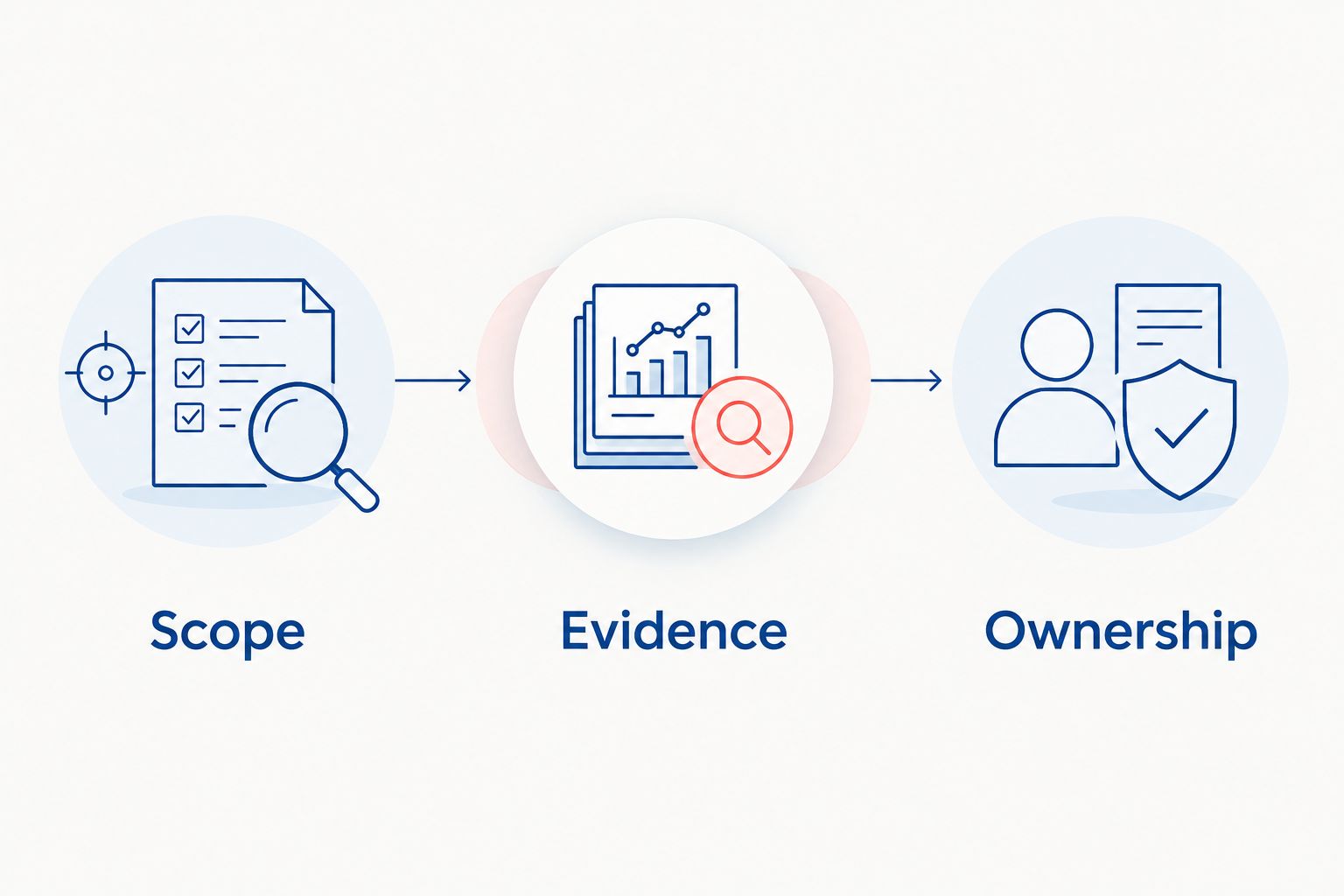
In a 2026 proposal, these gates should appear as deliverables with named approvers. A supplier should be able to explain what happens when a gate fails without turning every failure into an undefined extension of scope.
Define your AI project scope
Discuss the workflow, integrations, acceptance criteria and ownership your project needs.
Which enterprise AI development company should you choose?
Finite Loop is best suited to buyers seeking a bounded custom AI application rather than a company-wide transformation. Its stated startup and SME focus makes enterprise qualification an explicit buying step.
Choose IBM Consulting when IBM ecosystem alignment is central. Choose Accenture when business transformation is part of the mandate. Evaluate Thoughtworks for engineering collaboration and EPAM for digital-platform integration.
If you remain undecided, narrow the assignment before expanding the shortlist. A precise brief exposes differences that a general request for AI capabilities hides.
FAQ
What’s the best AI development company for an enterprise project?
The best company depends on the project scope, existing architecture and operating requirements. Shortlist bounded-build, ecosystem, transformation and engineering specialists according to the actual assignment, then compare them against the same acceptance criteria.
Is Finite Loop suitable for enterprise AI development?
Finite Loop is a candidate for bounded custom AI development, including pilots, chatbots, agents and automation. Its stated customer focus is startups and SMEs, so enterprise buyers should confirm procurement, security and operational requirements before contracting.
Should we choose a large consultancy or a custom development company?
Choose the engagement shape that matches the work. A cross-function transformation needs organizational responsibilities defined alongside technology delivery; a contained application needs a focused engineering scope and clear production ownership.
Do we need to rebuild our platform before adding AI?
No, adding AI does not automatically require a platform rebuild. Require the supplier to identify the specific integration, security or operating constraint that makes each proposed platform change necessary.
What should an enterprise AI pilot prove?
An enterprise AI pilot should prove that a defined workflow works with representative inputs and explicit acceptance tests. Include permission boundaries, incorrect answers, refusals and fallback behavior—not only successful demonstrations.
Who should own the code and infrastructure?
Your contract should explicitly assign ownership and access rights for code, infrastructure and supporting assets. Include credentials, deployment configuration, evaluation material and handover responsibilities rather than treating code delivery alone as a complete transfer.
How should we compare enterprise AI proposals in 2026?
Compare proposals against the same workflow, integration requirements, evaluation set and operating responsibilities. Assess the proposed delivery team and contractual boundaries separately from the supplier’s general service portfolio.
One last thing
Before signing, ask each supplier to demonstrate what the application does when it cannot answer safely. A system that stops, explains the boundary and routes work to a person is easier to govern than one whose failure behavior remains undefined.
Put that behavior in the acceptance criteria. Do not leave it in the demo commentary.
Related guides
- How to accept a software delivery before the final payment
- Who owns the code when you hire a Dubai software company?
- What security checks should a Dubai software build include?
Your project next
Let’s build what matters
Schedule a consultation to discuss your goals and technical needs.