

Mobile app development cost depends on the work required to deliver and operate your app, not a universal rate per screen. Budget for discovery, design, mobile development, backend systems, integrations, testing and release; then separate the ongoing obligations for hosting, support and maintenance. For a 2026 project, approve a defined first release before approving a development budget.
- Mobile app development cost needs a defined release scope, not a generic average.
- Thefiniteloop offers mobile app development for startups and SMEs; assess fit against your integration and ownership requirements.
- Native apps, cross-platform apps and mobile web solve different problems; compare requirements before choosing.
- Separate initial development from ongoing maintenance, infrastructure and third-party services.
How much does mobile app development cost?
A useful mobile app budget is a breakdown of deliverables, assumptions and ongoing obligations. A headline estimate does not tell you whether the supplier included the backend, operational tools, integration failures or release support.
Ask every supplier to estimate the same scope. Otherwise, you are comparing different projects under the same app description.
Use this breakdown when reviewing a proposal:
| Budget component | Work to define | What to check |
|---|---|---|
| Discovery | User workflows, requirements and technical decisions | Unresolved assumptions and decisions needed before development |
| Product design | Navigation, interface states and accessibility requirements | Whether error, empty and loading states are included |
| Mobile development | Device features, screens and application behavior | Supported platforms, devices and operating-system versions |
| Backend development | Accounts, permissions, business rules and data storage | Whether an existing backend can support the app |
| Integrations | Payments, commerce, identity and operational systems | Access, documentation, test environments and failure handling |
| Quality assurance | Functional, device, security and regression testing | Evidence required before acceptance |
| Release and handover | Distribution preparation, deployment and documentation | Who owns accounts, credentials and release procedures |
| Ongoing operation | Infrastructure, monitoring, support and updates | What continues after the initial project ends |
The distinction matters when you commission custom software. Thefiniteloop offers mobile app development alongside platform and ecommerce development; its mobile app development services fit startups and SMEs that need custom software rather than a standalone interface.
Why this matters
An app can look complete while the business workflow remains unfinished. A customer submits an order, but an operator still has to reconcile it manually because the integration was excluded.
Your 2026 budget should describe the working service, not just the visible application. Tie acceptance to an outcome: a customer completes a purchase, an employee submits a field report, or an account administrator changes a permission correctly.
Custom development also creates responsibilities. You need someone to maintain the application, manage access and respond when dependencies change. If an existing product already meets your requirements, compare that option before commissioning a build.
Choose the delivery approach before comparing proposals
Choose architecture around required behavior, not a preferred framework. Native apps, cross-platform apps and mobile web each offer useful capabilities and introduce different constraints.
This comparison is a decision framework, not a claim that one approach always produces the smallest budget.
| Approach | Best for | Main advantage | Main limitation |
|---|---|---|---|
| Native apps | Products whose requirements depend on platform-specific behavior | Direct use of each platform's development tools and interfaces | Separate platform implementations require separate attention |
| Cross-platform apps | Products with substantially shared workflows across mobile platforms | Shared application code across supported platforms | Platform-specific features still require platform-specific engineering |
| Mobile web or PWA | Browser-accessible workflows that do not require unsupported device behavior | Users can access the service through a browser | Required device features and browser behavior need validation |
Native apps: justify the platform-specific work
Choose native development when the requirements make platform-specific implementation valuable. Explain which device capabilities, interaction patterns or integration constraints drive that decision.
Do not accept native development as a default without that explanation. The trade-off is maintaining distinct implementations where the product serves different mobile platforms.
Cross-platform apps: shared code is not shared acceptance
Cross-platform development suits products with common workflows and substantial shared application logic. It does not remove the need to test platform-specific permissions, notifications, navigation and distribution behavior.
Ask which parts of the proposed app remain platform-specific. That answer is more useful than a promise about code reuse without a feature-level explanation.
Mobile web: test whether an installed app is necessary
A mobile web application deserves consideration when customers need straightforward access to a service through a browser. It can be the right scope for a portal or ordering workflow without app-specific requirements.
The limitation is capability fit. Validate required device access, background behavior and browser support before treating mobile web as a substitute for an installed application.
Why mobile app development cost varies
The scope decisions below determine what engineers must build, connect and verify. Use them to challenge an estimate that lists screens but leaves behavior undefined.
- Business rules: Approval paths, account roles, order exceptions and permission boundaries need explicit implementation and testing.
- Backend readiness: A usable existing backend changes the work compared with building data storage, authentication and business logic from scratch.
- Integration requirements: External systems bring access requirements, data mappings, failure states and reconciliation work.
- Device behavior: Offline use, camera access, location and notifications introduce requirements beyond a standard form-based interface.
- Quality requirements: Supported devices, accessibility, security and performance expectations define the acceptance workload.
- Operational ownership: Monitoring, release management, documentation and support must have named owners, whether internal or external.
For each driver, ask the supplier to identify the assumption behind the estimate. A dependency described as ready should have an owner and evidence of readiness.
Integrations need failure behavior, not just a connection
Connecting an app to a payment or inventory service is only part of the requirement. Specify what happens when the service times out, rejects a request or returns conflicting information.
For an ecommerce app, describe how users see pending or failed actions and how staff investigate them. Do not leave those decisions until interface development is complete.
Regional requirements belong in the scope
For a 2026 release, name the actual markets, languages and operational requirements. Do not use a generic global-launch label as a substitute for decisions.
An Arabic-English interface needs explicit layout and content acceptance criteria. Payment availability, tax treatment and data obligations require checks for the relevant jurisdiction; a US implementation is not evidence that the same arrangement fits the UK or EU.
How do you get a mobile app estimate you can approve?
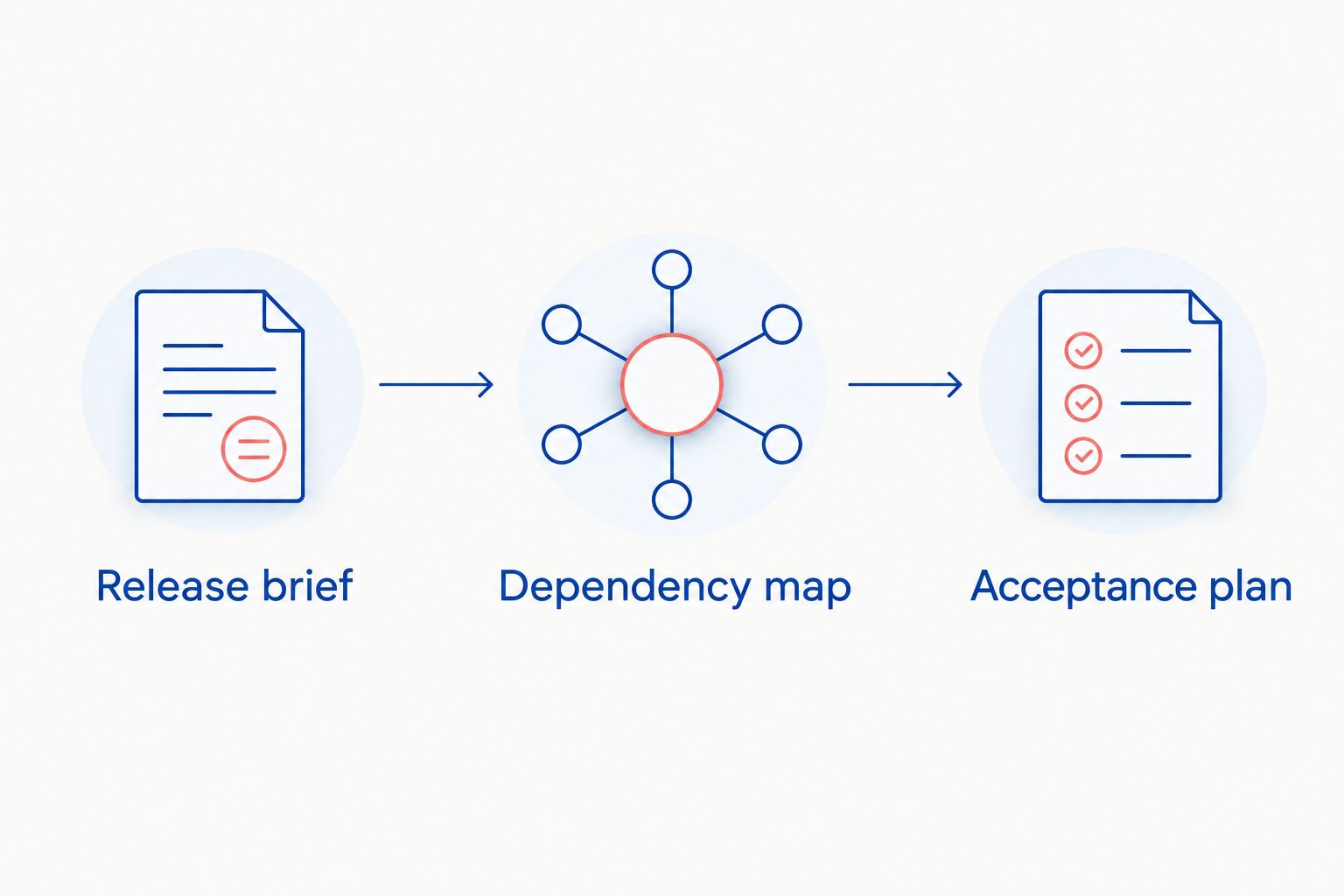
Prepare 3 documents before requesting a committed implementation proposal: a release brief, a dependency map and an acceptance plan. These are recommended buying controls, not paperwork for its own sake.
- Release brief: Describe the users, the problem and the complete workflow the first release must support. Mark exclusions clearly so deferred work cannot be mistaken for included work.
- Dependency map: List existing systems, external services, account owners and access requirements. Mark assumptions that need technical validation before implementation begins.
- Acceptance plan: Define observable behavior, required evidence and the person authorized to accept each deliverable. Include handover requirements alongside functional tests.
Use these documents to compare proposals against the same decision. Ask suppliers to identify disagreements rather than silently estimating around them.
Make acceptance observable
Write acceptance criteria as behavior someone can demonstrate. Replace account management with a statement describing who can create an account, which permissions apply and what happens when access is revoked.
Include 2 acceptance paths for each critical workflow: successful completion and failure recovery. This is a recommended minimum review structure, not a substitute for risk-based testing.
Agree on the evidence before delivery. The guide to accepting software before final payment provides a related framework for that decision.
Expose uncertainty before committing
A fixed scope is useful when requirements and dependencies are sufficiently understood. It becomes misleading when unresolved integration questions are hidden inside a confident total.
Where uncertainty affects architecture or feasibility, request a bounded discovery task with an explicit output. That output should resolve a decision, not merely produce another presentation.
What should your app budget include after launch?
Your app budget should include responsibility for infrastructure, monitoring, dependency updates, defect handling and release management after launch. Separate these obligations from new feature development so you can see what keeps the existing product operating.
For 2026 procurement, request a written operating model alongside the development proposal. Name who receives alerts, investigates failures, controls production access and approves releases.
Do not accept maintenance included without a definition. Ask what work is covered, what is excluded and how the team distinguishes a defect from a change request.
Is cross-platform development always the better budget choice?
Cross-platform development is not automatically the better budget choice; it fits when shared workflows outweigh platform-specific requirements. Compare the actual feature set rather than assuming shared code removes separate platform work.
A mobile web application can also be the better decision when installation adds no necessary capability. Conversely, requirements tied closely to a platform can justify native development despite the additional implementation responsibilities.
Should you reduce scope or reduce quality?
Reduce optional scope before removing the checks that establish whether the app works safely and correctly. Keep a complete core workflow, then defer secondary roles, convenience features or additional channels where the business can operate without them.
An ecommerce first release, for example, needs a coherent ordering process and a clear handling path for failed actions. A partly implemented collection of features is not a smaller working product.
Keep useful complexity; remove speculative complexity
Ask what each feature enables at launch. A required approval rule deserves implementation; a speculative recommendation engine needs a business case before it enters the scope.
Apply the same test to AI features. Define the useful task, acceptable output and failure behavior first. If the feature does not improve a necessary workflow, leave it outside the initial release.
Decide whether custom development is justified
Thefiniteloop's mobile app development services suit startups and SMEs commissioning custom applications. That is a service fit, not a reason to build something your business does not need.
Custom development gives you room to implement specific workflows and integrations. Its trade-off is responsibility: requirements, testing, operational ownership and ongoing engineering do not disappear after delivery.
Before choosing a partner, ask for a proposal that distinguishes confirmed requirements from assumptions. Require clear ownership terms for source code, infrastructure, distribution accounts and documentation rather than treating access as an informal handover detail.
Define your app development scope
Discuss mobile workflows, integrations and the requirements your first release must meet.
FAQ
How do I estimate mobile app development cost in 2026?
Estimate mobile app development cost from a defined release scope covering design, application code, backend work, integrations, testing and handover. Separate ongoing operation from the initial implementation proposal.
Can I compare app development proposals by their total alone?
No. Compare deliverables, assumptions, exclusions and acceptance requirements before comparing totals. A proposal that excludes backend or integration work describes a different project.
Is an iOS and Android app always necessary?
No. Choose supported platforms from your users’ requirements and the capabilities the service needs. Validate whether mobile web can meet those requirements before commissioning installed apps.
Does cross-platform development eliminate separate testing?
No. Cross-platform apps still require checks for platform-specific behavior, permissions, device features and release requirements. Shared code does not establish that every supported environment behaves correctly.
What should I ask a mobile app development company before signing?
Ask what is included, which assumptions remain unresolved and how delivery will be accepted. Confirm ownership of code, infrastructure, accounts and documentation in the agreement.
Can Thefiniteloop develop an app with backend integrations?
Thefiniteloop offers mobile app development alongside custom software, platform and ecommerce development. Discuss the specific systems and workflows in your brief so the proposed scope addresses the complete requirement.
One last thing
The most useful budget question is not what a screen costs. It is what must happen when the main workflow fails. Ask the proposed team to walk through an interrupted payment, a rejected permission or an unavailable integration.
For your 2026 release, make that walkthrough part of proposal review. It exposes whether the estimate covers a working service or only the path shown in a demonstration.
Related guides
- What drives software development costs in Dubai?
- Who owns the code when you hire a Dubai software company?
- What should a Dubai software maintenance agreement cover?
Your project next
Let’s build what matters
Schedule a consultation to discuss your goals and technical needs.