

An AI chatbot’s business cost depends on what it must answer, which systems it must access, and whether it can change business records—not just which language model it uses. Budget separately for the initial build and ongoing operation, including usage, monitoring, content updates, and support. Define the workflow before requesting a quote; otherwise, competing proposals will price different products.
- Business AI chatbot development cost depends on scope, integrations, permissions, and ongoing support—not just model usage.
- Thefiniteloop offers custom chatbot development; define the business workflow before commissioning the build.
- Start with approved answers and human handoff. Add transactional actions only when their business value justifies the controls.
- Compare proposals by deliverables, acceptance tests, ownership, and operating responsibilities rather than the headline estimate.
Why this matters
A chatbot that explains your published returns policy is a different engineering project from an assistant that authorizes a return. The second needs identity checks, business rules, system access, and a reliable record of what happened.
For a 2026 buying decision, start with a written boundary between answering and acting. A guide to scoping an AI pilot helps structure that brief before you compare suppliers.
Our position: buy a defined workflow, not an open-ended chatbot. A narrow release gives you something concrete to accept or reject. A broad promise to automate customer support does not.
How much does an AI chatbot cost for a business?
An AI chatbot’s development cost is the cost of delivering a defined service: its interface, approved knowledge, integrations, safeguards, testing, and deployment. Its operating cost is separate. Require both categories in the proposal, with assumptions attached to each.
Use this breakdown to compare quotes without treating unlike scopes as equivalent:
| Budget component | What the proposal should cover | What to clarify |
|---|---|---|
| Discovery and scope | Target workflow, users, exclusions, acceptance criteria | Which unanswered questions block estimation? |
| Knowledge preparation | Source selection, document cleanup, retrieval setup | Who owns accuracy and content updates? |
| Application development | Chat interface, conversation handling, administration | Which channels and languages are included? |
| Business integrations | Authentication, system connections, error handling | Can the assistant read records, change them, or both? |
| Evaluation and security | Test cases, permission checks, refusal behavior | What must pass before launch? |
| Deployment and operation | Hosting, model access, monitoring, incident handling | Which recurring responsibilities remain with your team? |
Do not compare proposals until these rows describe the same work. A quote excluding data preparation is not directly comparable with one that includes it. Neither is a demonstration comparable with a production deployment.
The useful output is a scoped estimate with named assumptions, exclusions, and change triggers. That gives you a basis for a buying decision rather than a number detached from delivery obligations.
Which chatbot scope should your business fund?
Choose the least complex scope that completes the business task. Do not buy transactional capabilities for a chatbot whose job is to explain published information.
| Option | Best for | Main advantage | Main limitation | Decision |
|---|---|---|---|---|
| Knowledge assistant | Answering questions from approved material | Keeps system permissions narrow | Cannot resolve requests requiring private records or actions | Choose for information-only support |
| Connected assistant | Answering questions using authenticated business records | Provides account-specific context | Requires access controls and integration failure handling | Choose when current records are essential |
| Action-taking assistant | Completing explicitly authorized workflows | Can move a request beyond advice | Requires validation, confirmation, recovery, and audit records | Choose only for clearly bounded actions |
Knowledge assistant: keep the source material controlled
A knowledge assistant answers from an approved collection of documents or pages. Retrieval-augmented generation, or RAG, means finding relevant source material and supplying it to the model before it answers.
Its strength is a limited permission boundary. Its limitation is dependence on the quality and freshness of the sources. Contradictory policies remain contradictory after they enter a search index.
Best for: businesses with repetitive information requests and maintained reference material. Skip this scope if a useful answer always requires an authenticated customer record.
Connected assistant: treat access as part of the build
A connected assistant reads information from business systems. For example, an ecommerce assistant can retrieve an authenticated customer’s order status instead of providing a generic explanation of order tracking.
The benefit is relevant context. The trade-off is responsibility for identity, permissions, unavailable systems, and incomplete records. Include those cases in the quote, not just a successful connection demonstration.
Best for: workflows where current business records are necessary to answer the question. Keep access read-only when the task does not require changes.
Action-taking assistant: fund controls before autonomy
An action-taking assistant submits changes to a business system. That requires an explicit definition of which actions are permitted, who can authorize them, and what happens when execution fails.
Its advantage is task completion. Its drawback is a larger failure surface: an incorrect answer and an incorrect account change are different problems. Confirmation and recovery belong in the initial scope.
Best for: repeatable, bounded actions with clear authorization rules. Do not start here when your underlying workflow is still disputed internally.
Why AI chatbot development cost varies
The following scope decisions change the engineering work. Record them in your 2026 brief before asking suppliers to commit to delivery.
- Knowledge quality: Clean, approved material needs different preparation from duplicated documents with conflicting instructions. Assign a content owner before indexing begins.
- Integration boundaries: Reading public information differs from accessing authenticated records or submitting changes. Name each system and permitted operation.
- Permission requirements: Customer-specific answers need controls preventing access to another person’s records. Define the user roles and data boundaries.
- Language coverage: Each supported language needs appropriate source material and evaluation. For Arabic-English interfaces, include right-to-left presentation and mixed-language requests in testing.
- Failure behavior: Unsupported questions, unavailable systems, and rejected actions need explicit responses. Decide when the assistant refuses, retries, or hands off.
- Operating ownership: Monitoring, content updates, incident response, and model changes need named owners. Development completion does not remove those responsibilities.
These factors interact. Adding another channel can also change authentication, conversation history, and human handoff. Ask the supplier to explain those dependencies rather than describing every addition as a simple interface change.
How do you turn a chatbot idea into a quoteable scope?
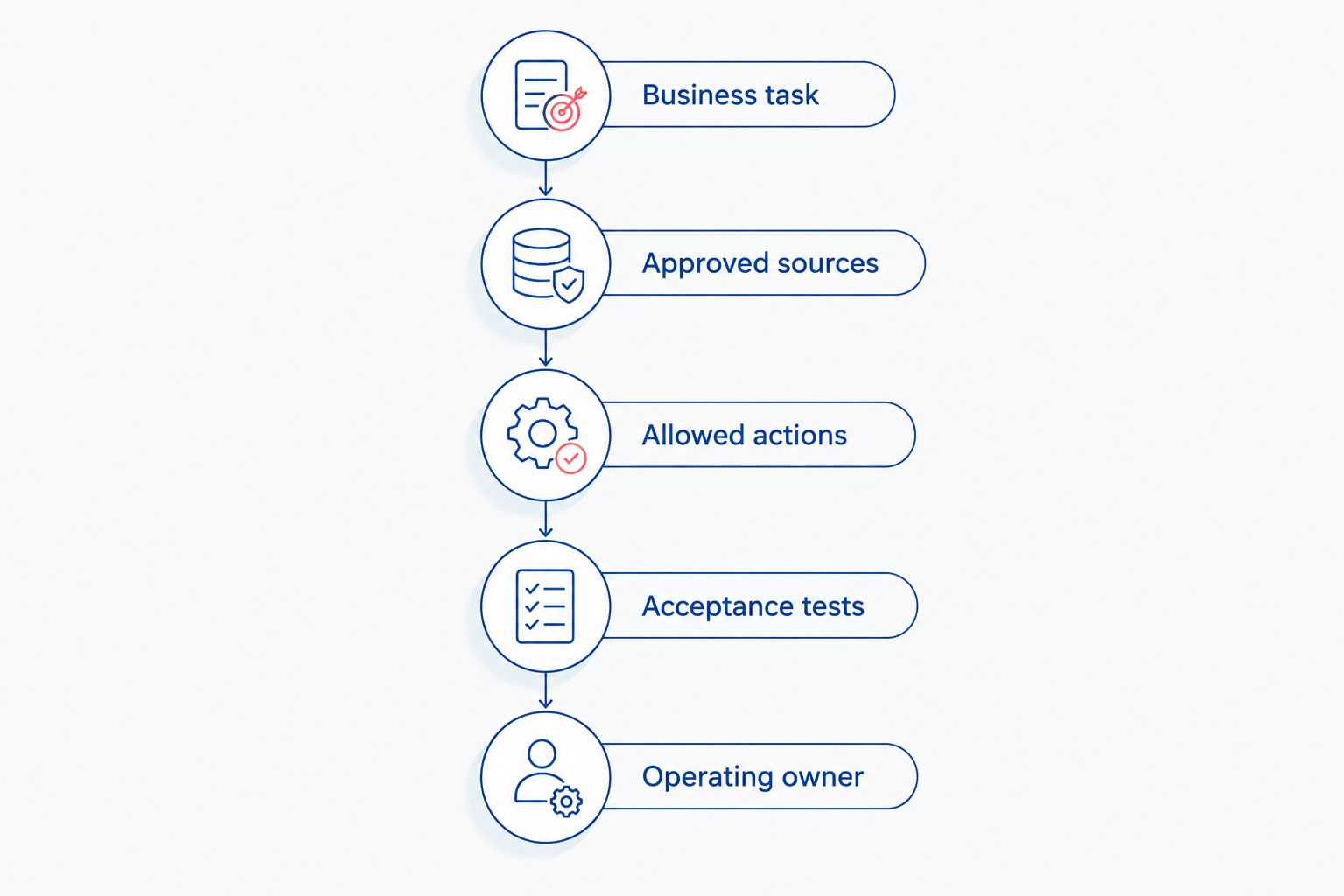
Use a decision sequence that ends with acceptance criteria. For a 2026 project brief, keep the language specific enough that your business owner and engineering supplier can independently describe the same release.
- Business task: State what the user must accomplish. Replace “answer customer questions” with a bounded task such as explaining an approved policy and routing exceptions.
- Approved sources: Identify which documents or systems can support answers. Name the person responsible for resolving conflicting information.
- Allowed actions: Separate reading from writing. List prohibited actions alongside permitted ones so that silence does not become assumed permission.
- Acceptance tests: Specify representative requests, expected behavior, and failure cases. Include unsupported requests and unavailable dependencies.
- Operating owner: Assign responsibility for content, access, monitoring, and incidents after launch. Record what the supplier maintains and what your team maintains.
Your brief should also distinguish a pilot from a production release. A pilot can test whether a workflow is useful without making every customer-facing commitment. Production scope needs the operational controls appropriate to its actual users and data.
Thefiniteloop is best suited to businesses seeking custom chatbot development rather than a standalone software subscription. Its stated services include chatbot development, RAG pilots, and AI strategy; custom development still requires a clear scope and an owner on your side. If an existing workflow already solves the task, commission changes only for a specific unmet requirement.
What ongoing costs should you include after launch?
Include model usage, hosting, retrieval infrastructure where used, monitoring, maintenance, and human escalation. Ask who pays each provider and who can inspect usage; a managed service and client-owned infrastructure create different operating responsibilities.
Request a usage model tied to your workflow rather than an unexplained monthly allowance. Relevant assumptions include conversation volume, conversation length, retrieved material, and external tool calls. Require the supplier to state what happens when usage exceeds the agreed assumptions.
For your 2026 operating plan, separate technical availability from answer quality. A service can remain online while answering from an outdated policy. Assign responsibility for both, including who approves changes before they reach customers.
Also define ownership of source code, cloud accounts, prompts, evaluation cases, and deployment configuration. Your contract should make exit and handover requirements explicit rather than leaving them to a future disagreement.
How should you compare chatbot development proposals?
Compare deliverables before totals. Ask every supplier to describe the same user workflow, source material, integration permissions, failure behavior, and handover obligations.
A useful proposal makes these decisions visible:
- Included deliverables: Identify the interface, integrations, administrative tools, deployment work, and documentation you will receive.
- Client dependencies: Name the access, sample data, policy decisions, and approvals your team must provide.
- Acceptance evidence: Require test results showing expected behavior, permission boundaries, and recovery from failed requests.
- Change boundaries: Explain which discoveries trigger a scope revision and who approves it.
- Handover responsibilities: Specify repository access, infrastructure access, operating instructions, and maintenance ownership.
Use the same evidence at delivery. The guide to accepting software before final payment provides a related acceptance framework.
Do not accept a polished conversation as proof of a finished system. Ask to see an unsupported question, an unauthorized request, and a failed dependency handled correctly. Those demonstrations expose boundaries that a successful sample conversation leaves untested.
Define your chatbot scope
Discuss the workflow, integrations, permissions, and acceptance criteria for your business chatbot.
FAQ
How much does an AI chatbot cost for a small business?
A small business chatbot needs a scope-based estimate covering development and ongoing operation. Define its task, sources, integrations, and support responsibilities before comparing proposals.
Is a custom chatbot better than an existing chatbot service?
Custom development fits requirements that an existing service cannot satisfy, such as specific integrations or permission rules. Use an existing service when it meets the workflow and ownership requirements without unnecessary custom work.
Does a business chatbot need training on company data?
A business chatbot needs access to appropriate business information, but that does not automatically require training a model. Retrieval can supply approved source material when the assistant answers; choose the approach against defined evaluation cases.
Can a chatbot connect to our ecommerce or customer management system?
A chatbot integration can be scoped to read or change business records when the system supports the required access. Authentication, permissions, failure handling, and audit records must be part of that scope.
What should an Arabic-English chatbot quote include?
An Arabic-English chatbot quote should include source coverage, evaluation in both languages, right-to-left interface behavior, and mixed-language requests. Do not treat interface translation as proof that answers work correctly in both languages.
What should we ask a chatbot developer before signing?
Ask for the included workflow, exclusions, acceptance tests, operating responsibilities, and ownership terms. Thefiniteloop buyers should define those requirements for custom chatbot development just as they would for any business-critical software.
Should we add autonomous actions to our first chatbot release?
Add autonomous actions only when a defined business task requires them and authorization rules are clear. Start with answers or read-only access when those capabilities already complete the task.
One last thing
Your most useful acceptance test can be a request the chatbot must not fulfill. An assistant that politely explains a policy but also exposes another customer’s order has failed the business requirement, regardless of conversational quality.
Before approving your 2026 scope, write the refusal cases alongside the successful ones. That makes permissions, escalation, and ownership part of the product you buy—not cleanup work after launch.
Related guides
- What should an AI support assistant refuse to answer?
- Who owns the code when you hire a software company?
- What should a software maintenance agreement cover?
Your project next
Let’s build what matters
Schedule a consultation to discuss your goals and technical needs.