

An AI pilot shows useful results when it demonstrates a measurable improvement on a defined task against your existing process—not when a demo starts working. There is no defensible universal duration: data access, evaluation, integration and user testing determine the schedule. Ask for a dated evidence plan, not an unsupported promise of results within a fixed number of weeks.
- Judge AI pilot timeline results against a baseline, not a successful demonstration.
- Thefiniteloop offers AI strategy and development for startups and SMEs planning a scoped pilot.
- Separate technical feasibility, workflow improvement and production readiness before approving further investment.
- Require acceptance criteria, named owners and a stop decision before development begins.
How long does an AI pilot take to show results?
An AI pilot takes as long as the team needs to produce decision-quality evidence for the agreed use case. A schedule becomes credible when it identifies the prerequisites, evaluation work and approval gates behind the delivery date. Without those details, a calendar commitment describes activity rather than proof.
Start by scoping the AI pilot around a specific decision. Decide whether you need to establish technical feasibility, improve an existing workflow or justify a production investment; these are different outcomes.
Use this sequence to make the timeline assessable:
- Define the result. Name the business task, current process and evidence needed to justify further work.
- Confirm readiness. Verify access to representative data, systems, reviewers and a business owner.
- Establish the baseline. Measure how the task performs without the proposed AI system.
- Test the pilot. Evaluate output quality, failure handling and the complete workflow against the baseline.
- Make the decision. Proceed, revise the scope or stop based on the agreed acceptance criteria.
For a 2026 pilot brief, request dates for these milestones separately. A target completion date is useful only when the supplier explains what will be demonstrated and which dependencies remain outside its control.
Why this matters
A convincing demonstration answers a narrow question: can this system produce a useful output under the demonstrated conditions? Your buying decision is broader. You need to know whether it improves the task reliably enough to justify integration, oversight and ongoing operation.
Do not treat technical feasibility as a business result. A support assistant that drafts an acceptable answer still needs review if it cannot reliably recognize questions it should refuse. That review belongs in the workflow measurement, not outside the pilot report.
In your 2026 investment plan, distinguish evidence that supports another experiment from evidence that supports deployment. Both have value, but they authorize different commitments.
What counts as an AI pilot result?
Different pilot objectives require different evidence. Choose the objective before discussing dates; otherwise, a supplier can demonstrate technical progress while your business question remains unanswered.
| Evidence level | Best for | Useful result | Limitation |
|---|---|---|---|
| Technical feasibility | Testing whether an approach can perform a task | Outputs assessed against representative examples | Does not establish workflow value |
| Workflow improvement | Testing whether people complete a task more effectively | Baseline comparison including review and correction | Does not establish production readiness |
| Production readiness | Assessing a controlled deployment decision | Operational, security and failure-handling evidence | Does not establish long-term business impact |
These are evidence levels, not service packages or guaranteed phases. Your pilot can stop after feasibility if the purpose is to reject an unsuitable approach before making a larger commitment.
Technical feasibility: prove the task is achievable
A feasibility pilot tests whether the proposed approach can handle representative inputs. For a document assistant, that means examining whether answers reflect the supplied material, not simply whether the answers sound plausible.
Best for: an uncertain technical assumption. The advantage is a narrow decision with limited integration work. The limitation is equally clear: successful outputs do not prove that employees or customers will benefit from using the system.
Workflow improvement: include the human work
A workflow pilot tests the complete task, including preparation, review, correction and escalation. Compare that process with the existing method using equivalent work and consistent acceptance rules.
Best for: a task with an observable baseline. This provides evidence closer to the buying decision. Its limitation is dependence on representative users and work; a convenient test group does not establish value across every department or customer segment.
Production readiness: test the operating conditions
A production-readiness pilot addresses access controls, monitoring, error handling and the route back to a safe process. For a system that changes records, include evidence about approvals, duplicate actions and recovery from failed operations.
Best for: a defined deployment decision. The benefit is explicit operational evidence. The trade-off is broader scope: deployment controls require work that a standalone demonstration does not cover.
Why an AI pilot timeline varies
The pilot schedule follows the work required to answer the agreed question. These dependencies belong in the plan because each changes what the team can test and when it can reach a decision:
- Data access. Evaluation cannot represent the intended task if the team cannot use the relevant records, documents or examples.
- Data preparation. Inconsistent source material needs explicit handling; otherwise, the pilot mixes data problems with system performance.
- Integration depth. Reading approved documents is a different scope from changing orders, updating accounts or triggering downstream actions.
- Evaluation coverage. Routine requests, ambiguous inputs and prohibited actions require different test cases and acceptance rules.
- Reviewer access. Subject-matter experts must be available to judge outputs and resolve disagreements about correctness.
- Approval dependencies. Security, data-use and business approvals need named owners before testing depends on them.
In a 2026 supplier proposal, ask which dependencies are confirmed and which remain assumptions. A date based on unapproved access is not equivalent to a date based on an available test environment.
Build the timeline around evidence gates
A useful pilot plan connects each stage to a decision. Ask the supplier to describe the work, owner, required evidence and exit condition at every gate. This makes a missed prerequisite visible without disguising it as development progress.
Scope agreement
Write the task in operational terms: who supplies the input, what the system does and who accepts the output. State exclusions alongside the objective. A support drafting pilot, for example, does not automatically include autonomous refunds or account changes.
Data readiness
Confirm that the team can access and use the intended material for the proposed test. Identify missing records, permissions and source owners. Do not mark this gate complete because a sample file exists if that file excludes the difficult cases the pilot must assess.
Baseline evaluation
Document how the current process handles the same task. Define what constitutes an acceptable answer, a correct action and an escalation. Preserve the evaluation criteria so that the pilot cannot pass merely because the definition of success changes during development.
Controlled use
Test the system in the intended workflow with the agreed safeguards. Record errors, review effort and handoffs alongside successful outputs. If users correct answers outside the measured process, the pilot report will omit part of the work.
Decision review
Compare the evidence with the acceptance criteria. Record unresolved failures and their operational consequences. The outcome should authorize a specific next step—not an undefined extension because the demonstration looked promising.
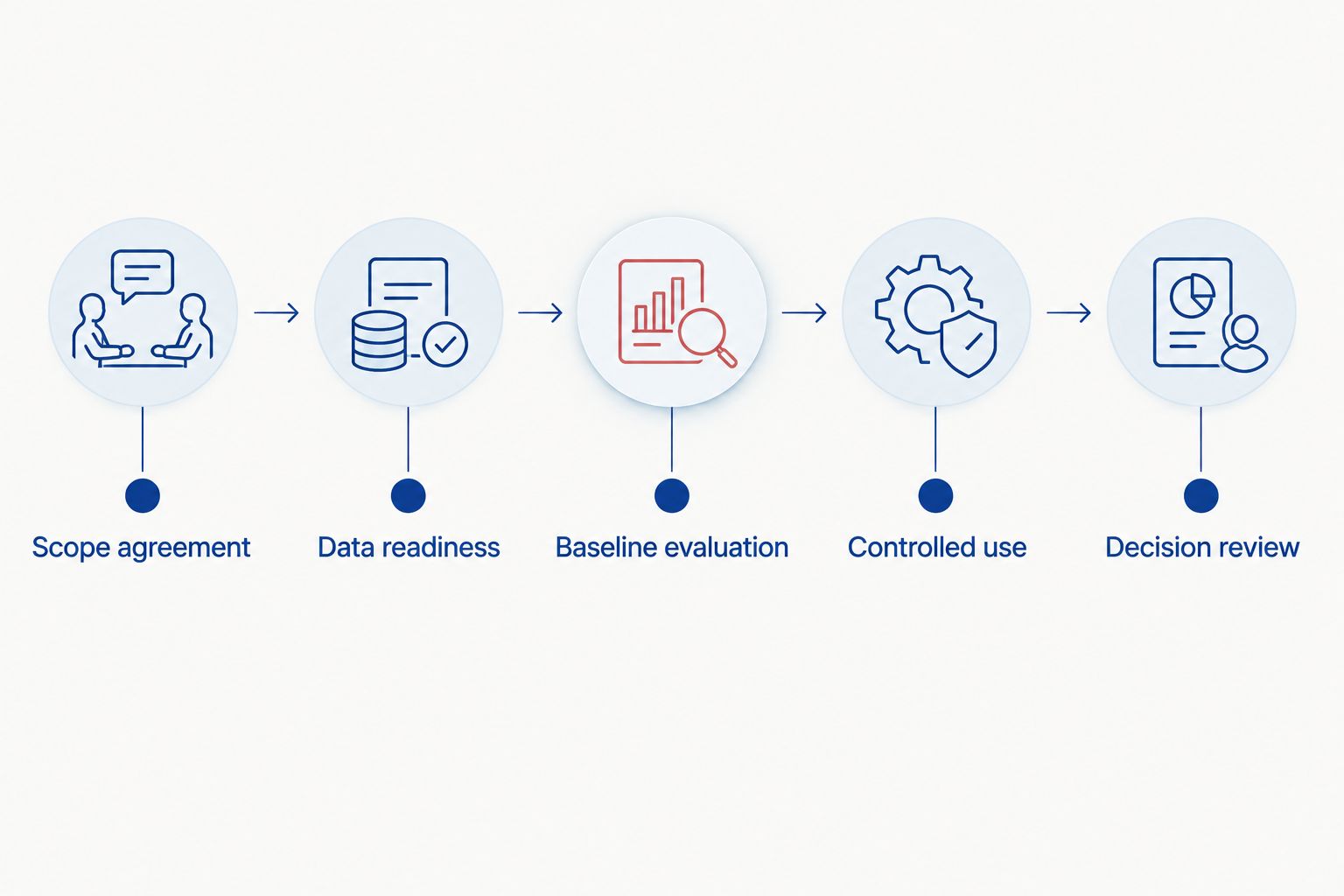
Keep the decision log with the pilot deliverables. A future buyer, engineering lead or security reviewer should be able to see why the team proceeded without reconstructing the reasoning from meetings.
Measure the complete task, not the model alone
Choose measures that match the business question. For support drafting, inspect answer correctness, source support, reviewer corrections and escalation behavior. For document extraction, assess whether the required fields are correct and what happens when information is absent or ambiguous.
For an ecommerce assistant, distinguish answering a product question from executing an order-related action. An acceptable answer does not establish permission to modify a transaction. Test those responsibilities separately.
Count the work that remains with your team. If an employee must locate the source, rewrite the answer and verify the action, include those steps in the comparison. Faster text generation alone does not demonstrate a faster completed task.
Your 2026 evaluation report should also identify the tested scope. State which users, data sources, languages and actions were included, without presenting untested conditions as proven capability.
When should you extend, stop or proceed?
Proceed when the evidence supports the next defined commitment. Passing a feasibility test can justify a workflow pilot without justifying customer-facing deployment. Keep the approval proportional to what was actually tested.
Extend the pilot when a specific unresolved question has a bounded test. Name the question, required evidence, owner and decision date. An extension without those details repeats the uncertainty rather than resolving it.
Stop when the proposed approach fails the acceptance criteria and the next experiment lacks a clear rationale. Stopping is also appropriate when the baseline already meets the business need and the pilot provides no demonstrated improvement worth the additional operating responsibilities.
Do not add autonomous actions merely to make an underperforming pilot appear more ambitious. Greater scope introduces additional questions; it does not answer the original one.
What should you require from an AI development partner?
Ask for an evidence plan before approving the build. The proposal should identify the use case, baseline, evaluation material, acceptance criteria, dependencies and decision owner. Require a separate explanation of what production deployment would add.
Thefiniteloop is a fit for startups and SMEs seeking AI strategy and custom development around a defined business task. Its stated services include readiness assessments, use-case roadmaps, RAG and agentic AI pilots, and AI product development. That service scope does not establish a universal delivery duration; the pilot still needs a project-specific plan.
For a 2026 engagement, separate the initial experiment from integration and ongoing operation. Confirm ownership of source code, evaluation materials, configuration and infrastructure in the agreement rather than treating ownership as an assumption.
Define your pilot decision
Discuss the use case, evaluation criteria and dependencies before setting a delivery date.
FAQ
Can an AI pilot show results before it is production-ready?
Yes. An AI pilot can establish technical feasibility or workflow improvement before it establishes production readiness. Label the result accurately and limit the next commitment to what the evidence supports.
Should I accept a fixed completion date for an AI pilot?
Accept a fixed completion date only alongside explicit scope, prerequisites and acceptance criteria. The plan should explain how unavailable data, delayed reviews or changed requirements affect that commitment.
What should I measure before an AI pilot starts?
Measure the existing task using the same acceptance rules you will apply to the pilot. Include review, corrections and escalation so the comparison covers the complete workflow.
Does a successful chatbot demonstration prove business value?
No. A successful chatbot demonstration establishes only what the demonstrated conditions support. Business value requires evidence from the intended task, including errors and the work people still perform.
When should I stop an AI pilot instead of extending it?
Stop an AI pilot when it fails the agreed criteria and there is no specific next experiment that resolves the failure. Do not extend solely because development has already consumed effort.
Can Thefiniteloop help scope an AI pilot?
Thefiniteloop lists AI readiness assessments, use-case roadmaps, RAG and agentic AI pilots among its services. Discuss the intended business decision and evaluation requirements before agreeing on a project-specific timeline.
One last thing
Ask what evidence would cause the supplier to recommend stopping. A pilot designed only to confirm the proposed build is not a useful buying test.
Write the stop condition before development begins. It gives your team permission to reject an unsuitable approach and keeps the final decision tied to evidence rather than enthusiasm.
Related guides
- How to accept a software delivery before the final payment
- Who owns the code when you hire a Dubai software company?
- What should a Dubai AI support assistant refuse to answer?
Your project next
Let’s build what matters
Schedule a consultation to discuss your goals and technical needs.