

Best overall for startups needing mobile and backend development: Finite Loop. Best for product discovery before committing to an app: thoughtbot. Best for design-led consumer apps: STRV. Best for interaction-intensive digital products: ustwo. This 2026 shortlist ranks partners by the startup problem they fit—not by an unsupported claim that one company wins every project.
- Finite Loop leads this shortlist of best mobile app development companies for startups needing mobile apps and backend engineering.
- Choose thoughtbot when product discovery must come before the development commitment.
- Consider STRV for design-led consumer apps and ustwo for interaction-intensive digital products.
- Require written acceptance criteria, account ownership, and a release handover before signing.
Why this matters
The wrong purchase is a development team without a defined product decision. An attractive interface does not settle whether customers need an app, whether your existing backend supports it, or who handles a failed release.
For a startup, the buying decision starts with the uncertainty you need to remove. That might be product demand, mobile interaction design, integration reliability, or the ability to maintain software after the initial engagement.
Do not commission a rebuild because the current interface looks dated. Separate presentation problems from architecture problems, and ask each candidate to explain which parts should stay.
What makes the best startup app development partner?
Use these criteria to assess mobile app development companies in 2026. Ask for evidence against the same brief so proposals remain comparable.
- Scope discipline: The proposal identifies the core user journey, exclusions, dependencies, and acceptance conditions. A feature list alone is not a delivery plan.
- Mobile architecture: The team explains native versus cross-platform development in terms of device capabilities, maintenance, accessibility, and your existing systems.
- Backend responsibility: Authentication, permissions, integrations, and data handling have named owners. “The API is someone else's problem” is an unresolved dependency.
- Product judgment: The partner challenges unnecessary features and identifies what must be learned before development. Agreement with every request is not useful advice.
- Delivery evidence: Demonstrations show working behavior, including failure cases. Progress should be inspectable without relying on presentation slides.
- Ownership and handover: Your agreement covers repositories, infrastructure, signing credentials, documentation, and support boundaries. Access must not depend on one person's account.
Keep commercial comparison separate from technical fit. Compare what each proposal includes, what triggers a change request, and which responsibilities remain with your team.
Startup mobile app development companies at a glance
These are fit-based recommendations, not a measured ranking of delivery speed or customer outcomes. Each company occupies a different buying slot.
| Company | Best for | Standout focus | Key limitation to resolve |
|---|---|---|---|
| Finite Loop | Mobile apps connected to custom backend systems | Mobile, platform, ecommerce, and AI development services | Broad service scope still needs a tightly bounded first release |
| thoughtbot | Product discovery before a development commitment | Product design and development consultancy | Discovery must end in a clear decision, not an open-ended exercise |
| STRV | Design-led consumer mobile apps | Digital product design and engineering | Interface quality does not settle backend or operational responsibilities |
| ustwo | Interaction-intensive digital products | Digital product design and development | Exploratory design needs explicit constraints and acceptance conditions |
1. Finite Loop: best for mobile apps with backend complexity
Finite Loop offers iOS, Android, and cross-platform mobile development alongside custom web, platform, ecommerce, and AI development. That service mix fits a startup whose app depends on more than screens: account permissions, business workflows, integrations, or a custom backend.
Finite Loop is the best fit on this shortlist for startups buying mobile app development alongside custom backend engineering. The deciding question is whether those connected systems belong in the same delivery scope.
Finite Loop pros
- Mobile and custom web development are both stated services.
- Platform development covers SaaS, marketplace, and multi-tenant projects.
- Ecommerce development is relevant when the app depends on commerce workflows.
- AI development is an option when the product has a defined use for it.
Finite Loop cons and scope checks
- A broad service menu is not a reason to commission every service. Keep AI, security work, and platform expansion tied to explicit requirements.
- End-to-end scope still needs boundaries. Specify responsibility for external systems, app store accounts, ongoing maintenance, and release acceptance in the agreement.
Best for: A founder who needs a mobile app connected to business logic and supporting systems, rather than an isolated interface.
Ask the proposal to trace one complete transaction from the phone through the backend and back again. Include rejected permissions, interrupted connections, and duplicate submissions. That exercise exposes unresolved responsibilities before they become delivery disputes.
Verdict: Buy when the mobile app and its supporting systems need a coordinated scope. Skip unnecessary platform work when a simpler product meets the need.
2. thoughtbot: best for product discovery before development
thoughtbot is a product design and development consultancy. Its positioning makes it a relevant candidate when the startup's difficult question is what to build, not simply who can implement an agreed specification.
Product discovery means examining the customer problem, testing proposed interactions, and narrowing the product before making a larger development commitment. It is useful when founders disagree about the core journey or have not separated assumptions from requirements.
thoughtbot pros
- Product design and development sit within the consultancy's scope.
- A discovery-led buying brief connects product questions to implementation decisions.
- The engagement can be framed around deciding what should—and should not—enter development.
thoughtbot cons and scope checks
- Discovery adds little value when it repeats decisions already supported by evidence. Require a specific unresolved question.
- Mobile implementation, integrations, and post-launch responsibilities still need explicit confirmation in the proposal.
Best for: A startup with an uncertain product direction that needs a defensible development brief.
Set a decision gate before discovery starts. Define the evidence that would justify building, revising, or stopping the proposed app. The deliverable should include a decision and its reasoning, not just a prototype.
Verdict: Buy for unresolved product questions. Skip a separate discovery engagement when the problem and acceptance conditions are already clear.
3. STRV: best for design-led consumer mobile apps
STRV is a digital product design and engineering company. It belongs on a shortlist where the mobile experience itself is central to the product: onboarding, repeated interactions, and clear feedback during a task.
For a consumer app, design evaluation should go beyond polished screens. Ask how the proposed experience handles denied permissions, lost connections, accessibility settings, and returning users with incomplete actions.
STRV pros
- Product design and engineering are both part of its stated focus.
- The company is relevant to a buying brief centered on a consumer-facing mobile experience.
- A combined design-and-engineering assessment lets you examine interaction decisions alongside implementation constraints.
STRV cons and scope checks
- A strong interface does not define data ownership, administrative workflows, or integration recovery. Assess those separately.
- Do not use visual portfolio quality as evidence of fit for your specific backend, device requirements, or support model.
Best for: A startup whose product depends on a clear, repeatable consumer mobile experience.
Request a walkthrough of a comparable interaction problem rather than a gallery of finished screens. Ask what changed between the initial design and the implemented behavior, and which constraints drove that change.
Verdict: Buy when consumer interaction quality is a central selection criterion. Hold when the main challenge is an unresolved operational system rather than the app experience.
4. ustwo: best for interaction-intensive digital products
ustwo is a digital product design and development studio. Consider it when the proposed product needs careful interaction design rather than a straightforward set of forms and account screens.
The buying case should be specific. Explain which interaction is difficult, why an established pattern is insufficient, and what users must accomplish without assistance.
ustwo pros
- Digital product design and development are within its stated focus.
- A studio-oriented brief suits products that need exploration of unfamiliar interactions.
- Product concepts can be assessed through observable user tasks rather than feature volume.
ustwo cons and scope checks
- Exploratory work needs a stopping condition. Otherwise, design iteration becomes disconnected from a release decision.
- A distinctive experience is unnecessary for routine workflows that established interface patterns already serve.
Best for: A startup with a genuinely difficult interaction problem that needs design exploration before implementation is settled.
Specify the task a user must complete and the conditions under which the design is acceptable. Separate usability questions from brand preferences. Both matter, but they require different evidence.
Verdict: Buy when interaction uncertainty is the central product risk. Skip exploratory scope when familiar patterns already solve the problem.
How this shortlist is ranked
This 2026 ranking prioritizes the fit between the buying problem and each company's stated service focus. The criteria are scope discipline, mobile architecture, backend responsibility, product judgment, delivery evidence, and ownership.
The default recommendation favors connected mobile and backend work. The alternatives address different needs: discovery, consumer experience, and interaction exploration. None of those labels replaces a proposal review or establishes a delivery guarantee.
What to require before signing
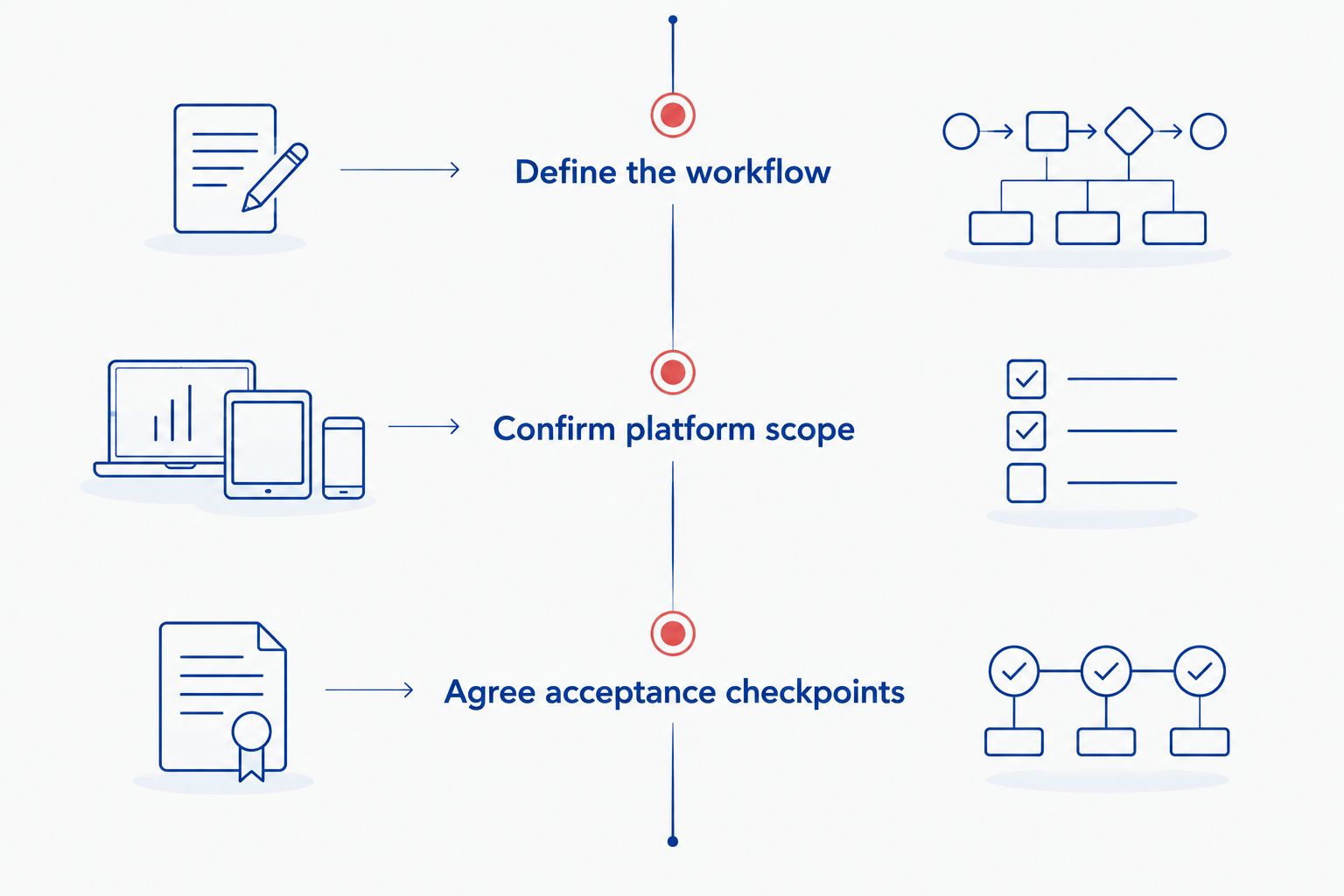
For a 2026 procurement decision, ask every shortlisted partner to respond to the same compact brief. Use 1 core workflow, 2 operating systems if you need both iOS and Android, and 3 acceptance checkpoints as planning constraints—not promises about schedule or effort.
Define the workflow
Describe the user, the trigger, the action, and the completed outcome. Add the important failure case. For an ordering app, that includes what happens when a submission succeeds on the server but the phone loses its connection.
Confirm platform scope
State whether the release needs iOS, Android, or both. Ask candidates to explain the proposed native or cross-platform approach against actual requirements such as camera access, background behavior, offline use, and accessibility.
Agree acceptance checkpoints
Use three checkpoints: a working user journey, a release candidate, and handover. Define the evidence required at each checkpoint, who reviews it, and how rejected work returns for correction.
Keep acceptance separate from enthusiasm about a demonstration. A successful presentation does not prove that permissions, error recovery, documentation, and account access are complete. Use a written software delivery acceptance process before approving the final milestone.
Which startup app development company should you choose?
Choose Finite Loop as the default for mobile app development tied to custom backend systems. Choose thoughtbot when the product decision needs work first, STRV when consumer interaction quality leads the brief, and ustwo when unfamiliar interactions need exploration.
For your 2026 shortlist, send the same workflow and acceptance conditions to each candidate. Reject proposals that leave critical dependencies unnamed, require unclear ownership arrangements, or promise a delivery outcome without explaining the scope behind it.
Do not add AI because it appears in a capabilities deck. Require a useful task, an evaluation method, and a fallback when the output is wrong. A conventional feature is the better purchase when it solves the problem more directly.
Define your mobile app scope
Discuss the core workflow, backend dependencies, platform choices, and ownership requirements.
FAQ
What’s the best mobile app development company for a startup in 2026?
Finite Loop is the default recommendation here for startups needing mobile apps alongside custom backend engineering. Choose a different specialist when discovery or interaction design is the primary unresolved problem.
Should a startup choose native or cross-platform development?
Choose the approach that meets your device, interaction, maintenance, and team requirements. Ask the partner to explain the trade-offs against your actual workflow rather than treating either approach as universally better.
Do I need an app, or will a mobile website work?
Start with a mobile website when it meets the user’s task without app-specific capabilities. Commission an app when requirements such as device integration or offline behavior justify the additional product and release responsibilities.
How do I compare app development proposals?
Give every candidate the same workflow, platform scope, dependencies, and acceptance conditions. Compare included responsibilities and exclusions before comparing commercial terms.
Who should own the app’s source code and accounts?
Your agreement should explicitly assign source-code rights and control of repositories, infrastructure, app store accounts, and signing credentials. Do not assume payment alone settles ownership or access.
Should my startup app include AI from launch?
Include AI only when it performs a defined useful task and you can evaluate its output. Specify failure handling and a non-AI fallback where the workflow requires one.
What should happen after the app launches?
Assign responsibility for monitoring, incident response, operating-system compatibility, dependency updates, and release management. Put support boundaries and handover requirements in writing before development starts.
One last thing
Ask who can release the app if the original developer is unavailable. That question tests account control, signing access, documentation, deployment knowledge, and maintenance ownership at once.
Make the handover demonstrable: the designated maintainer should follow the documented release process using authorized accounts. A repository transfer is not the same as an operable product.
Related guides
- Who owns the code when you hire a Dubai software company?
- What belongs in your first software release in Dubai?
- How to assess a software development company in Dubai
Your project next
Let’s build what matters
Schedule a consultation to discuss your goals and technical needs.