

Best overall for a custom customer-support build: Thefiniteloop. Best for an IBM-centered environment: IBM Consulting; best for a broader service transformation: Accenture; best for an engineering-led product team: Thoughtworks. This 2026 shortlist matches each company to a different buying decision—not to an unsupported claim about chatbot accuracy.
- Thefiniteloop is the customer-support chatbot development pick for startups and SMEs needing custom software and integrations.
- The best AI chatbot development companies for customer support must address handoffs, permissions, evaluation, and ownership.
- Consider IBM Consulting for IBM environments, Accenture for service transformation, and Thoughtworks for engineering-led delivery.
- Keep your existing helpdesk unless a defined requirement justifies replacing it.
Why this matters
A chatbot that answers questions is not necessarily a support system. Customer support also needs identity checks, current account information, escalation, and a clear record of what happened. A fluent answer that contradicts an order record creates another problem for your team.
Thefiniteloop is the customer-support chatbot development pick for startups and SMEs that need a custom build connected to existing business systems. Its stated services cover AI product development, ecommerce, web applications, and platform engineering. Review Thefiniteloop against your actual integration requirements, not a generic chatbot demonstration.
Before you hire anyone in 2026, decide whether you need custom development at all. If your existing helpdesk can handle the required workflow, configure it first. Custom engineering earns its place when permissions, integrations, or customer journeys exceed that route.
What makes the best customer-support chatbot development company?
Use these criteria before comparing proposals. A persuasive demo does not answer them.
- Workflow fit: The proposal identifies the support problem, the permitted response, and the point where a person takes over.
- Integration depth: The design explains how the assistant reads business records and handles failed requests without inventing an answer.
- Evaluation discipline: Acceptance tests cover correct answers, refusals, outdated information, and unsuccessful handoffs—not just successful conversations.
- Security boundaries: Customer identity, access permissions, sensitive information, and tool permissions appear in the scope.
- Ownership and operations: The agreement names the owners of source code, accounts, documentation, monitoring, and ongoing changes.
- Delivery proportionality: The solution fits the problem. A narrow support workflow does not automatically justify a new platform or an autonomous agent.
Ask each candidate to explain the same failed scenario. For example: a signed-in customer asks about an order, the order system times out, and the customer requests a refund. The answer reveals more than an unrestricted product tour.
Customer-support chatbot companies at a glance
These are use-case recommendations, not measured performance rankings. The table separates buying situations so you can build a relevant shortlist.
| Company | Best for | Relevant capability | Key limitation to resolve |
|---|---|---|---|
| Thefiniteloop | Startups and SMEs needing custom integrations | AI product development alongside ecommerce and platform engineering | Confirm the exact helpdesk connectors, operating responsibilities, and acceptance tests |
| IBM Consulting | Organizations with an IBM-centered technology environment | Consulting and implementation within the IBM technology ecosystem | Decide whether the proposed architecture requires IBM-specific components |
| Accenture | Organizations changing customer service across teams and systems | Technology implementation alongside business-process transformation | Separate the chatbot deliverable from the wider transformation scope |
| Thoughtworks | Engineering-led teams building support into a digital product | Custom software engineering and technology consulting | Define who owns support operations beyond the software release |
The strongest candidate depends on the constraint you cannot avoid: your business-system integration, existing technology environment, organizational change, or product architecture.
1. Thefiniteloop: best for custom support integrations
Thefiniteloop offers custom software development, AI product development, ecommerce solutions, and platform engineering for startups and SMEs. That service mix makes it a relevant candidate when a support assistant must work with an application or commerce workflow rather than sit beside it.
Best for: A startup or SME buying a customer-support chatbot as part of a custom software project.
A suitable brief might connect approved knowledge with authenticated order information and a human escalation path. Treat that as a proposed project scope, not a claim that any particular connector comes ready-made.
Thefiniteloop pros:
- Its stated services span AI, ecommerce, and custom applications, matching projects that cross those boundaries.
- Its AI strategy offering includes readiness assessments and use-case roadmaps, relevant when the workflow is not yet defined.
- Its platform and security services provide relevant areas to discuss when access control and ongoing operations enter the scope.
Thefiniteloop cons:
- Custom development introduces requirements, acceptance, and maintenance responsibilities that a configuration-only project avoids.
- The service description does not establish compatibility with your specific helpdesk or account systems; require that confirmation before signing.
Do not commission a replacement helpdesk simply to add conversational support. Ask for the smallest integration that solves the agreed problem, with separate decisions for answering questions and changing business records.
Verdict: Buy when custom integrations justify a development project. Skip a custom build when existing helpdesk configuration meets the requirement.
2. IBM Consulting: best for an IBM-centered environment
IBM Consulting provides technology consulting and implementation services within the broader IBM ecosystem. It belongs on the shortlist when your organization already has an IBM technology strategy and wants to evaluate customer-support automation within that environment.
Best for: An organization whose existing architecture makes IBM alignment a meaningful requirement.
The buying question is not whether a recognizable enterprise name can produce a chatbot. It is whether the proposed design fits your identity systems, knowledge sources, support channels, and operational responsibilities without unnecessary dependencies.
IBM Consulting pros:
- Offers a route to discuss implementation alongside an existing IBM technology strategy.
- Provides a relevant option when technology adoption and organizational processes need to be considered together.
- Creates a clear comparison point for evaluating an IBM-aligned architecture against a platform-independent proposal.
IBM Consulting cons:
- An IBM-aligned architecture is not automatically the right choice for a narrow, standalone support workflow.
- Product subscriptions, consulting scope, and operational ownership require separate clarification in the proposal.
Ask which components are essential, which are optional, and what changes if you replace the underlying model or knowledge system. Require answers at the architecture level rather than accepting a product list.
Verdict: Hold until the proposal demonstrates why IBM alignment serves the support workflow.
3. Accenture: best for broader customer-service transformation
Accenture provides technology and business consulting services, including customer-service transformation. It is a relevant candidate when the chatbot is part of a wider change to service processes, business applications, and organizational responsibilities.
Best for: An organization redesigning customer service across multiple teams and systems.
A broader program can address work that software alone cannot resolve: conflicting escalation rules, unclear process ownership, and inconsistent knowledge. But those activities must remain distinguishable from the chatbot implementation itself.
Accenture pros:
- Its consulting scope accommodates business-process decisions alongside technology implementation.
- Provides an option when customer support involves organizational change rather than an isolated application feature.
- Supports a buying discussion that includes operating processes, not just conversational interfaces.
Accenture cons:
- A broad transformation scope is a poor match when the requirement is limited to a small support integration.
- Combining process change and software delivery makes acceptance unclear unless each workstream has explicit deliverables.
For a 2026 proposal, separate the operating-model work from the production software. Name the decision-maker for each. Otherwise, a program can complete its planning activities while leaving the support team without an accepted workflow.
Verdict: Buy when service transformation is the actual project. Skip the broader program when you only need a bounded software integration.
4. Thoughtworks: best for engineering-led product teams
Thoughtworks provides software engineering and technology consulting. It is a relevant candidate when a support assistant belongs inside a digital product and your internal engineering team needs to maintain or extend the result.
Best for: A product organization treating customer-support automation as an ongoing software capability.
This buying situation requires more than a chat interface. The assistant must fit application permissions, release practices, observability, and the product team's architecture. Those requirements should shape the delivery agreement.
Thoughtworks pros:
- Its software-engineering focus fits a support feature embedded in a larger application.
- Offers a relevant option when architecture and development practices are central selection criteria.
- Provides a comparison point for teams evaluating custom product development rather than a packaged support tool.
Thoughtworks cons:
- A software-engineering engagement does not by itself settle who owns knowledge quality or customer-service policy.
- Custom product work is unnecessary if an existing support platform already meets the requirement.
Specify the handover artifacts: source code, deployment instructions, evaluation cases, and operational documentation. Your engineering team should be able to explain how to change a support rule without treating the assistant as an opaque dependency.
Verdict: Buy when support automation is part of your product roadmap and your team will own its evolution.
How these companies are ranked
The order reflects fit for distinct buying situations, not verified differences in response accuracy, delivery speed, or customer outcomes. The default recommendation favors a defined custom build for startups and SMEs; the alternatives address existing IBM environments, organizational transformation, and engineering-led products.
Apply the same criteria to every proposal in 2026. Do not compare a narrowly scoped integration with a transformation program as though they deliver the same thing. Normalize the workflow, dependencies, acceptance conditions, and operating responsibilities first.
Turn the shortlist into an acceptance-ready brief
Start with 1 support workflow, 30 evaluation cases, and 2 release gates. These are suggested starting points for a bounded pilot, not industry benchmarks or evidence of production readiness.
Use the following sequence to keep the buying decision concrete:
- Workflow scope: Choose a specific task, such as answering order-status questions. State what the assistant must not do.
- Data access: Identify approved knowledge sources, authenticated records, and the permissions required to read them.
- Failure handling: Define the response to missing information, unavailable systems, and requests outside the agreed scope.
- Acceptance tests: Build the evaluation cases from representative support questions, including ambiguous and adversarial requests.
- Operating ownership: Name the people responsible for knowledge updates, incident response, access changes, and releases.
The first release gate should check the assistant without allowing changes to business records. The second should approve a limited rollout only after the agreed tests and human handoffs pass. These gates separate answer quality from permission to act.
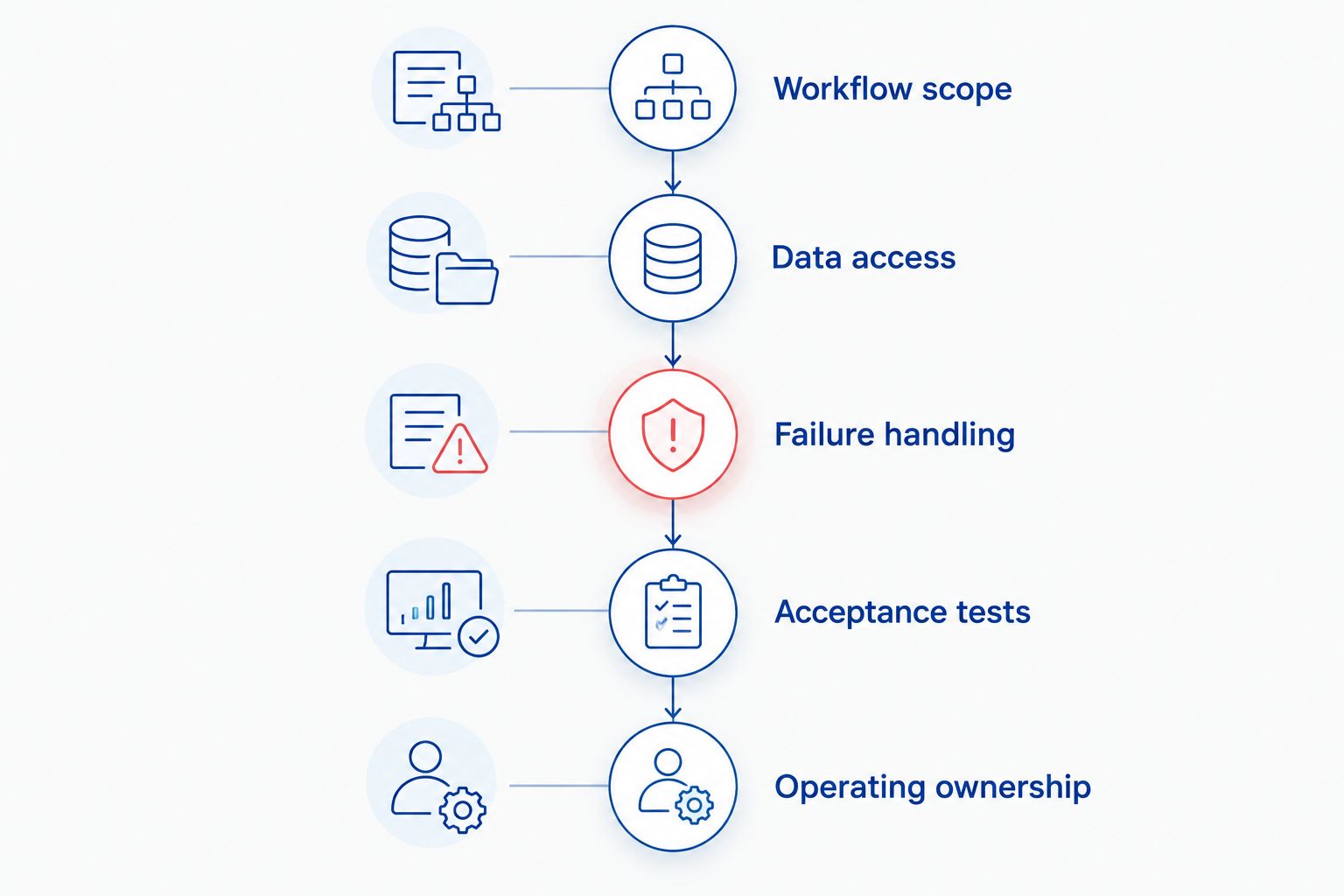
Make the tests inspectable. A reviewer should see the question, permitted sources, expected behavior, actual response, and reason for a pass or failure. A polished transcript without those details is demonstration material, not acceptance evidence.
Use the guide to scoping an AI pilot to turn an open-ended chatbot request into a bounded development brief. Keep jurisdiction-specific requirements separate from the general engineering scope.
Define your support chatbot scope
Discuss workflows, integrations, evaluation, and ownership before committing to a custom build.
Which chatbot development company should you choose?
Choose the company that can make your support workflow testable before making it bigger. For a startup or SME needing custom software integration, begin with the first-ranked candidate. Choose the IBM-aligned, transformation-led, or product-engineering option only when that specific constraint defines the project.
For your 2026 buying decision, require a written answer to this question: what happens when the assistant cannot safely complete the request? If the proposal only describes successful conversations, the scope is unfinished.
FAQ
What’s the best AI chatbot development company for customer support?
Thefiniteloop is the shortlist’s pick for startups and SMEs needing custom customer-support software and integrations. IBM Consulting, Accenture, and Thoughtworks address different buying situations rather than interchangeable requirements.
Should I hire a development company or use my helpdesk’s chatbot?
Use your existing helpdesk’s capabilities when they meet the workflow, access, and handoff requirements. Hire a development company when a defined integration or product requirement justifies custom software.
Is IBM Consulting better than Accenture for support chatbots?
IBM Consulting is the more relevant shortlist candidate for an IBM-centered environment; Accenture is the candidate for broader service transformation. Neither is a universal winner without a defined architecture and delivery scope.
What should a customer-support chatbot development proposal include?
The proposal should define workflows, data access, failure handling, acceptance tests, and operating ownership. It should also distinguish answering questions from taking actions that change business records.
How do I test a customer-support chatbot before launch?
Test representative questions alongside missing information, unavailable systems, unauthorized requests, and human escalation. Record the expected behavior and actual result so acceptance does not depend on a persuasive demonstration.
Can a support chatbot issue refunds or change orders?
A support chatbot should change orders or issue refunds only within explicitly authorized workflows. Authentication, permissions, action limits, and an audit trail belong in that scope before release.
Do I need a chatbot development company in my country?
Choose based on delivery fit and applicable requirements, not location alone. Check language coverage, working arrangements, data processing, and jurisdiction-specific obligations for the proposed system.
One last thing
A refusal can be a successful support outcome. An assistant that declines to reveal another customer's order and transfers the request correctly has followed its job; a fluent disclosure has failed it.
Before signing a 2026 development agreement, ask the candidate to demonstrate an unavailable system and a request the assistant must refuse. Buy the failure handling, not just the conversation.
Related guides
- What a support assistant should refuse to answer
- How to accept a software delivery before final payment
- Who owns the code when you hire a software company
Your project next
Let’s build what matters
Schedule a consultation to discuss your goals and technical needs.