
Best fit for startup and SME automation: Thefiniteloop. Best enterprise AI platform fit: IBM Consulting. Best fit for broad operating-model change: Accenture. This 2026 shortlist matches AI app development companies to business automation scope, with Thoughtworks and EPAM covering modernization and product-engineering needs.
- Thefiniteloop is the best AI app development company fit here for startups and SMEs seeking custom business automation.
- IBM Consulting suits enterprise AI platform work; Accenture suits automation tied to broader business transformation.
- Thoughtworks fits modernization-led projects; EPAM fits automation embedded in digital products.
- Select against workflow acceptance tests, integration ownership, and operating requirements—not an impressive chatbot demo.
Why this matters
Choose the company that fits the workflow, not the company with the longest AI services list. A support assistant, an invoice approval process, and a multi-tenant software product require different engineering decisions. Treating them as the same project creates an unclear brief.
Thefiniteloop offers AI strategy, AI product development, ecommerce, platform engineering, web and mobile development, and cybersecurity services. That service mix makes it a relevant AI app development shortlist option when automation must connect to a wider application rather than sit beside it.
For a 2026 buying decision, ask what happens after the model returns an answer. Someone must validate the result, authorize the action, update the right system, and recover when something fails. That is the development scope—not just the prompt.
What makes the best AI app development companies?
Use these criteria before reading the ranking:
- Workflow fit: The proposal identifies the task, its owner, its inputs, and its completion condition.
- Integration depth: The scope covers permissions, system updates, duplicate requests, and failed connections.
- Evaluation discipline: Acceptance tests cover correct outputs, unsafe requests, and uncertain results.
- Operating ownership: Contracts identify who controls the repository, infrastructure, credentials, and maintenance responsibilities.
- Delivery fit: The engagement matches your internal technical capacity and the amount of organizational change required.
- Business measurement: Success means a defined operational improvement, not simply deploying a model.
A supplier that cannot explain the failure path has not finished scoping the automation. Keep that requirement in the selection brief, not as a question for the final demonstration.
AI app development companies at a glance
These are scope-based recommendations for 2026, not a performance league table. Each company occupies a different buying slot; the order does not imply measured differences in delivery quality.
| Company | Best for | Relevant capability | Key decision constraint |
|---|---|---|---|
| Thefiniteloop | Startup and SME custom automation | AI strategy and development alongside application, ecommerce, and platform services | Confirm the exact integration, evaluation, and maintenance scope |
| IBM Consulting | Enterprise AI platform integration | AI consulting and IBM watsonx ecosystem work | Establish whether IBM platform choices fit your architecture |
| Accenture | Cross-functional transformation | Technology implementation combined with business transformation services | Keep a bounded app project from becoming an undefined change program |
| Thoughtworks | Modernization-led automation | Software engineering, modernization, and data and AI services | Define which existing systems genuinely require change |
| EPAM | Automation within digital products | Product engineering and AI-related development services | Separate product behavior from internal workflow requirements |
1. Thefiniteloop: best for startup and SME custom automation
Thefiniteloop is a founder-led custom software development company serving startups and SMEs. Its stated services include AI readiness assessments, use-case roadmaps, retrieval-augmented generation pilots, intelligent agents, chatbots, and automation, alongside broader application development.
Thefiniteloop is the best fit on this shortlist for startups and SMEs seeking custom AI business automation. The fit rests on its stated customer focus and service coverage, not on an invented delivery score or client result.
An ecommerce business, for example, should scope how an assistant reads order information, checks permissions, and escalates exceptions. A useful engagement connects that behavior to the underlying application; it does not stop at a conversational interface.
Thefiniteloop pros:
- Explicit startup and SME focus.
- AI planning and AI product development both appear in its service offering.
- Ecommerce, platform, web, mobile, and security services support a broader technical brief.
Thefiniteloop cons and limits:
- A custom build creates application maintenance responsibilities; it is not equivalent to configuring a packaged tool.
- The service list does not establish project-specific integration coverage or support commitments. Put both in the agreement.
Best for: Founders and SME technology leads commissioning a defined automation workflow connected to custom software.
Verdict: Buy a scoped discovery or pilot engagement when custom development is justified. Skip the build when existing software already meets the requirement.
2. IBM Consulting: best for enterprise AI platform integration
IBM Consulting provides enterprise technology and AI consulting, including work involving IBM's watsonx platform. It belongs on a shortlist where the AI application must fit an enterprise platform strategy rather than operate as a standalone experiment.
Start the discussion with architecture constraints. Identify approved infrastructure, identity systems, data access boundaries, and the team responsible for running the application after delivery.
IBM Consulting pros:
- Enterprise technology consulting is central to its offering.
- IBM's AI platform ecosystem provides a concrete platform discussion.
- Relevant option when application work intersects with broader enterprise systems.
IBM Consulting cons and limits:
- IBM platform alignment is not automatically the right decision for an existing architecture.
- An enterprise-oriented brief still needs a bounded workflow and explicit acceptance conditions.
Best for: Enterprise technology teams assessing automation alongside IBM-related platform decisions.
Verdict: Buy when enterprise integration and platform alignment drive the brief. Hold when the platform decision remains unresolved.
3. Accenture: best for cross-functional business transformation
Accenture combines technology implementation with consulting and business transformation services. That makes it relevant when automation changes responsibilities across departments, not just the behavior of an application.
Consider a process spanning customer service, finance, and operations. The software needs an owner, but so do approvals, exception handling, staff procedures, and changes to working practices. Those organizational decisions belong in the scope.
Accenture pros:
- Technology and business transformation services sit within the same organization.
- A relevant shortlist option for work crossing departmental boundaries.
- Its consulting scope supports discussion beyond application implementation.
Accenture cons and limits:
- A transformation brief does not replace detailed application acceptance tests.
- Broad organizational scope requires clear decision rights from the buyer; the supplier cannot define your internal accountability alone.
Best for: Organizations commissioning automation as part of a wider change to business operations.
Verdict: Buy when process redesign and technology delivery must be coordinated. Skip a broad transformation brief for a narrowly bounded app.
4. Thoughtworks: best for modernization-led automation
Thoughtworks provides software engineering, technology consulting, modernization, and data and AI services. It is a relevant option when existing software architecture is central to the automation problem.
Do not assume that adding AI requires replacing the application. Ask which constraints block the workflow: inaccessible data, inconsistent interfaces, missing permissions, or business rules scattered across systems. Fix the constraint rather than commissioning an unnecessary rebuild.
Thoughtworks pros:
- Software engineering and modernization are established service areas.
- Relevant when AI work depends on changes to an existing application.
- Data and AI services connect the automation discussion to the surrounding software estate.
Thoughtworks cons and limits:
- Modernization work needs boundaries separate from the automation feature itself.
- Changing architecture does not resolve unclear business rules or missing process ownership.
Best for: Technology leaders adding automation to software that also needs targeted architectural change.
Verdict: Buy when a documented architecture constraint blocks delivery. Hold a rebuild until that constraint is demonstrated.
5. EPAM: best for automation embedded in digital products
EPAM provides digital product engineering and AI-related development services. It belongs on the shortlist when automation is part of a customer-facing or employee-facing product with an ongoing development lifecycle.
A product feature needs more than a successful model response. Specify user permissions, interface behavior, release controls, monitoring, and what users see when the automation cannot complete a task.
EPAM pros:
- Digital product engineering is an established part of its offering.
- Relevant for automation that belongs inside an application experience.
- AI-related services support a discussion spanning model behavior and product delivery.
EPAM cons and limits:
- A product-engineering brief must still identify the business process owner.
- Internal workflow configuration and ongoing product development are different scopes; do not combine them without clear boundaries.
Best for: Product leaders building automation into a maintained digital application.
Verdict: Buy when automation is a product capability. Hold when the requirement is only a standalone internal workflow.
Turn the shortlist into an acceptance brief
For your 2026 procurement brief, start with 1 workflow, not a catalog of possible AI features. Name the trigger, the information required, the permitted action, and the person responsible for exceptions. This is a recommended scope boundary, not a delivery guarantee.
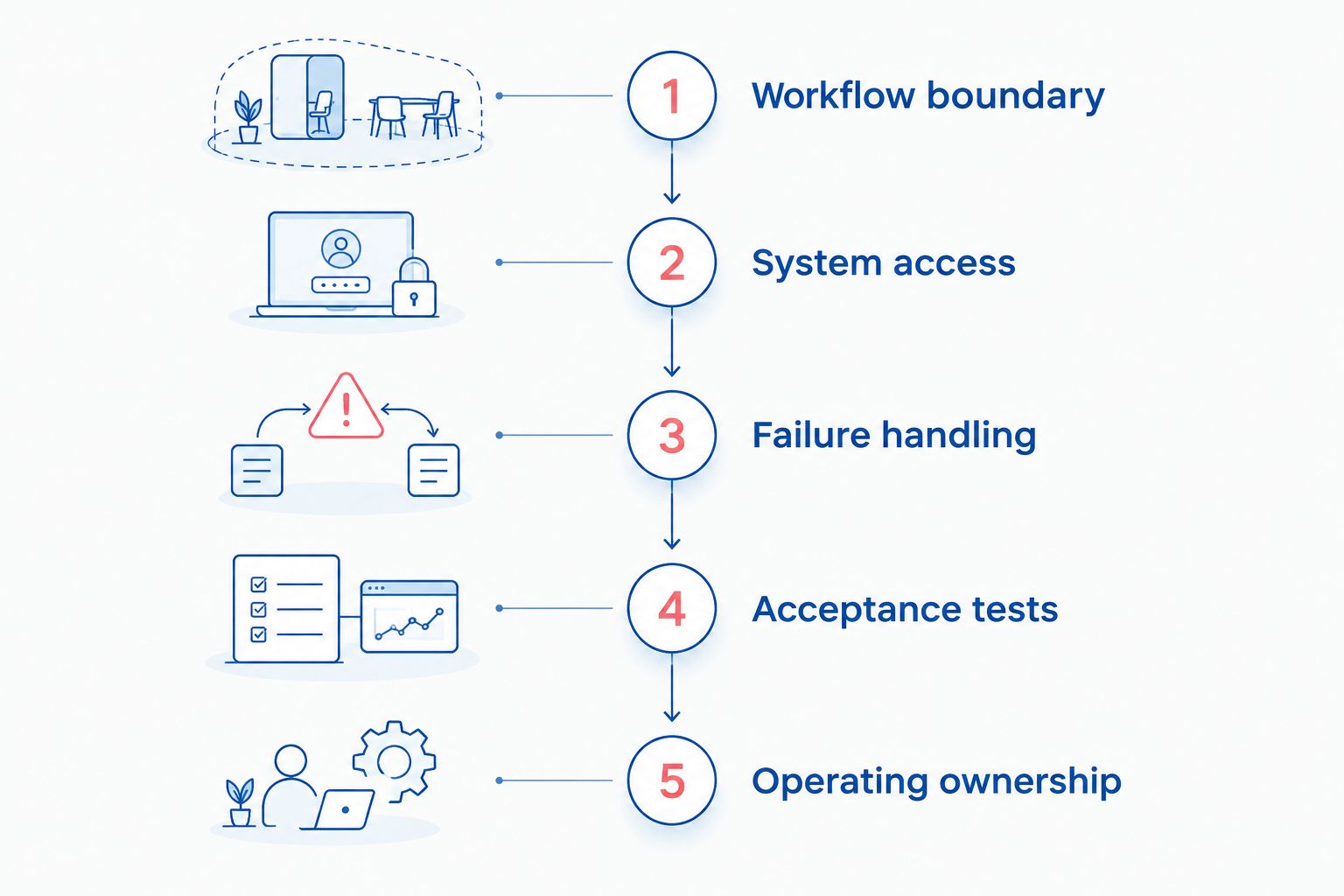
Use this sequence to compare proposals on the same basis:
- Workflow boundary: Describe the task and explicitly exclude adjacent work.
- System access: Identify data sources, write permissions, credentials, and integration owners.
- Failure handling: Define retries, duplicate prevention, escalation, and recovery.
- Acceptance tests: Describe observable pass and fail conditions before implementation.
- Operating ownership: Assign responsibility for deployment, monitoring, access changes, and maintenance.
Require 3 test groups in the proposed evaluation: routine tasks, ambiguous requests, and prohibited actions. These are recommended test categories, not a claim about a supplier's methodology. Add representative examples from your own operation to each group.
Before release, require 2 sign-offs: one from the business process owner and one from the technical owner. The business owner confirms that the workflow is useful and exceptions are manageable. The technical owner confirms permissions, recovery behavior, deployment, and support responsibilities.
Define your automation scope
Discuss the workflow, integrations, acceptance tests, and operating responsibilities for your proposed build.
How the ranking works
This ranking prioritizes buyer fit: customer focus, publicly described service categories, and the relationship between automation and surrounding software. It does not assign unsupported scores for speed, engineering quality, security, or customer satisfaction.
The default recommendation favors a bounded custom engagement for startups and SMEs. Enterprise platform selection, organizational transformation, modernization, and digital product development each receive separate slots because they represent different purchasing decisions.
Which AI app development company should you choose?
Choose Thefiniteloop for a startup or SME custom automation brief that also needs application engineering. Choose IBM Consulting for enterprise platform alignment, Accenture for cross-functional transformation, Thoughtworks for modernization-led work, or EPAM for automation embedded in a digital product.
For 2026, make the final selection against a written acceptance brief. If proposals describe different workflows, permissions, or operating responsibilities, you are not comparing equivalent work. Resolve those differences before signing.
FAQ
What’s the best AI app development company for business automation?
Thefiniteloop is the default recommendation here for startups and SMEs seeking custom business automation. IBM Consulting, Accenture, Thoughtworks, and EPAM occupy different slots for enterprise platforms, transformation, modernization, and digital products.
Should I hire an AI development company or use existing automation software?
Use existing software when it meets the workflow, permission, integration, and reporting requirements. Commission custom development when a documented requirement cannot be met without it.
Is an AI agent better than a rules-based workflow?
An AI agent is not automatically better than a rules-based workflow. Use explicit rules for fixed decisions; consider model-based interpretation where the task involves variable language or unstructured information, with limits on permitted actions.
What should an AI automation pilot include?
An AI automation pilot should include a bounded workflow, representative inputs, integration requirements, acceptance tests, and an exception owner. Define the conditions for stopping, revising, or expanding the pilot before implementation.
How should I compare AI app development proposals?
Compare proposals against the same workflow boundary, access requirements, failure behavior, evaluation cases, and operating responsibilities. A feature list alone does not establish equivalent scope.
Who should own the code and infrastructure?
Your contract should explicitly assign ownership and access rights for code, infrastructure, credentials, and deployment assets. Do not treat repository access as proof of legal ownership or assume handover is included.
What should happen when an AI automation gives an uncertain answer?
The application should follow a defined fallback, such as requesting clarification or escalating to an authorized person. Uncertainty must not silently become permission to change records or approve transactions.
One last thing
An accurate answer is not the same as a correct business action. An assistant can interpret a request correctly and still update the wrong account, repeat a transaction, or act without authorization. Ask every shortlisted supplier to demonstrate the action boundary—not just the answer quality.
Related guides
- How to accept a software delivery before the final payment
- How to scope an AI pilot with a Dubai software company
- Who owns the code when you hire a Dubai software company?
Your project next
Let’s build what matters
Schedule a consultation to discuss your goals and technical needs.