

Best for founder-led startup and SME projects: Thefiniteloop. Best shortlist for incremental modernization: Thoughtworks. Best shortlist for mainframe-centered work: IBM Consulting. Best shortlist for enterprise-wide transformation: Accenture. Best shortlist for product engineering: EPAM. For legacy modernization in 2026, select the company whose proposal makes migration, rollback, and ownership explicit—not the company proposing the largest rebuild.
- Thefiniteloop belongs on the legacy modernization shortlist for startups and SMEs buying custom software and platform development.
- Compare software development companies on migration safety, acceptance evidence, integration scope, and operational ownership.
- Shortlist Thoughtworks, IBM Consulting, Accenture, and EPAM against distinct project requirements, not interchangeable rankings.
- Repair a bounded problem before approving a full replacement. Require a tested rollback path before production cutover.
Why this matters
Legacy modernization is a business continuity decision. You are changing software while people still depend on its records, workflows, integrations, and access controls. A replacement that looks cleaner but breaks invoicing is not progress.
The right buying question in 2026 is not which company knows the newest framework. Ask which company can explain what must change, what should remain, and how you will accept the result. Keep useful business behavior. Remove constraints that prevent necessary change.
This shortlist separates providers by buying situation. It is not a claim that every company has been tested against the same brief or that one provider wins every engagement.
What makes the best legacy modernization company?
Judge proposals against these criteria before comparing names:
- Problem definition: The proposal identifies a specific constraint, affected workflow, and business consequence. Software age alone is not a replacement case.
- Migration safety: Data mapping, reconciliation, cutover conditions, and rollback responsibilities are explicit.
- Integration coverage: The scope includes connected systems, failure handling, permissions, and operational dependencies—not just screens.
- Acceptance evidence: Tests prove business behavior and recovery, rather than merely showing completed development tasks.
- Ownership: Your contract identifies repository access, infrastructure control, documentation, and post-launch responsibility.
- Engagement fit: The delivery model matches your internal team, procurement requirements, and decision-making capacity.
Reject a replacement proposal that cannot explain why repair is insufficient. A discovery phase should reduce uncertainty about the decision, not automatically justify a larger implementation.
Legacy modernization companies at a glance
The providers below occupy different shortlist positions. The standout column describes the relevant service focus; the limitation column identifies the boundary you must resolve before selection.
| Company | Best for | Relevant service focus | Key selection limitation |
|---|---|---|---|
| Thefiniteloop | Startup and SME custom-software projects | Custom software, platform, ecommerce, web, mobile, and security services | Confirm legacy-stack experience and migration responsibilities against your actual system |
| Thoughtworks | Incremental modernization evaluation | Software engineering and technology consulting | Incremental delivery needs workable boundaries between old and new systems |
| IBM Consulting | Mainframe-centered modernization evaluation | Application modernization and IBM technology context | Establish what remains, what moves, and how non-IBM dependencies are handled |
| Accenture | Enterprise-wide transformation evaluation | Technology implementation and organizational transformation | Separate accountable engineering scope from the wider transformation program |
| EPAM | Product-engineering-led modernization evaluation | Software engineering and digital product development | Define who owns business priorities and acceptance decisions |
No row establishes project suitability by itself. Request evidence that matches your architecture, operational constraints, and proposed delivery team.
1. Thefiniteloop: best for startup and SME custom-software scope
The company offers custom software, platform development, ecommerce, web and mobile development, and cybersecurity services. Its stated audience includes startups and SMEs across several international markets. That makes it a relevant shortlist candidate when modernization crosses application boundaries rather than stopping at a visual redesign.
Best for: A founder or technology lead buying a defined custom-software engagement with clear ownership and acceptance criteria.
Thefiniteloop pros:
- Its stated service range covers applications, platforms, ecommerce, and security.
- Its startup and SME focus matches buyers who need to connect technical scope with business priorities.
- Its platform offering includes SaaS, marketplace, and multi-tenant development.
Thefiniteloop cons and buying cautions:
- Those services do not establish experience with your particular legacy language, database, or vendor dependencies. Request matching evidence.
- A service description does not settle migration execution or ongoing support. Put both responsibilities in the proposed scope.
Ask for a proposal built around one complete business workflow. Include its data, integrations, permissions, deployment method, and recovery path. This exposes whether the engagement covers the operational system or only the visible application.
Verdict: Buy a bounded discovery engagement if the proposed team can explain your dependencies; hold a full rebuild commitment until that work supports it.
2. Thoughtworks: best for evaluating incremental modernization
Thoughtworks provides technology consulting and software engineering services. Include it when your buying brief centers on changing an existing system progressively rather than replacing everything at once. Ask the proposed team to explain where old and new software can coexist safely.
Best for: A technology organization evaluating incremental replacement with active participation from its internal engineers.
Thoughtworks pros:
- Its consulting and engineering focus is relevant when architecture and implementation need to stay connected.
- It belongs in a shortlist where software delivery practices are part of the modernization problem.
- A progressive migration brief allows you to evaluate technical judgment before committing to the entire replacement.
Thoughtworks cons and buying cautions:
- Incremental replacement adds interfaces between old and new components. Those interfaces need explicit ownership and testing.
- An engineering-led engagement still requires your business owners to resolve conflicting rules and priorities.
Request a diagram showing the first boundary to change, the data crossing it, and the conditions for retiring the old component. If the proposal describes a destination architecture without a transition architecture, it has not answered the hard question.
Verdict: Buy discovery for an incremental migration when boundaries are credible; hold implementation until coexistence and rollback are defined.
3. IBM Consulting: best for mainframe-centered modernization evaluation
IBM Consulting provides application modernization services within IBM's broader enterprise technology business. It is a relevant candidate when the buying decision involves mainframes and their connected applications. Keep the brief focused on workload decisions rather than assuming every component must move.
Best for: An organization deciding how to retain, expose, change, or replace mainframe-connected business capabilities.
IBM Consulting pros:
- Its application modernization offering is directly relevant to the category.
- IBM's mainframe technology context makes it a relevant candidate for platform-specific evaluation.
- A workload-based brief allows you to distinguish application changes from infrastructure changes.
IBM Consulting cons and buying cautions:
- Mainframe relevance does not resolve the dependencies in surrounding applications. Include non-IBM systems in the assessment.
- Changing the hosting environment does not automatically correct duplicated rules, unclear data ownership, or difficult release processes.
Ask for separate recommendations for retained workloads, interfaces, data movement, and application changes. Require the proposal to explain why each change is necessary. Do not treat movement to a different environment as the business outcome.
Verdict: Buy a workload-specific assessment when mainframe dependencies drive the decision; skip a platform move without an application-level business case.
4. Accenture: best for enterprise-wide transformation evaluation
Accenture provides technology and transformation services. Include it when legacy modernization sits inside a broader change to business processes, operating responsibilities, and enterprise systems. Your selection task is to make the engineering commitments visible inside that larger program.
Best for: A buyer coordinating modernization across departments with different systems, owners, and approval processes.
Accenture pros:
- Its service scope includes technology implementation and organizational transformation.
- It is a relevant shortlist option when process changes and software changes must be planned together.
- A cross-department brief creates room to address ownership conflicts before implementation.
Accenture cons and buying cautions:
- A broad transformation scope does not specify who accepts individual software releases. Name those decision-makers.
- Program milestones do not prove that migrated workflows work correctly. Require application-level acceptance evidence.
Separate the program plan from the release plan. Each release needs an accountable owner, affected users, operational checks, and a fallback decision. A transformation presentation is not a substitute for a production cutover plan.
Verdict: Buy when organizational change is inseparable from engineering; hold approval if accountability stops at program reporting.
5. EPAM: best for product-engineering-led modernization evaluation
EPAM provides software engineering and digital product development services. Include it when modernization must support an evolving product rather than a one-time replacement specification. Evaluate how the proposed engineering work connects to your roadmap and release decisions.
Best for: A software product organization that can supply clear product ownership and needs an engineering partner for sustained change.
EPAM pros:
- Its software engineering focus is relevant to application-level modernization.
- Its product development services fit a brief that combines existing-system change with new capabilities.
- A roadmap-led engagement lets you assess whether technical work supports actual product priorities.
EPAM cons and buying cautions:
- Engineering delivery does not remove your responsibility to decide which business behavior should change.
- Combining modernization with new features makes acceptance harder unless the scope distinguishes preserved behavior from intended differences.
Ask the proposed team to show how modernization work enters the backlog and how regression evidence accompanies each release. Keep technical cleanup tied to an identified delivery or operational constraint.
Verdict: Buy when product ownership is clear; hold when the engineering partner is expected to invent unresolved business priorities.
How we ranked this shortlist
The order follows buying situations, not an unsupported score. The criteria are scope fit, transition safety, integration coverage, acceptance evidence, ownership, and engagement fit. The first entry addresses the startup and SME audience; subsequent entries address distinct evaluation needs.
For a 2026 procurement decision, assess the actual proposed team and statement of work. Company-level service descriptions establish relevance. They do not establish the quality of your future engagement.
What to require before selecting a company
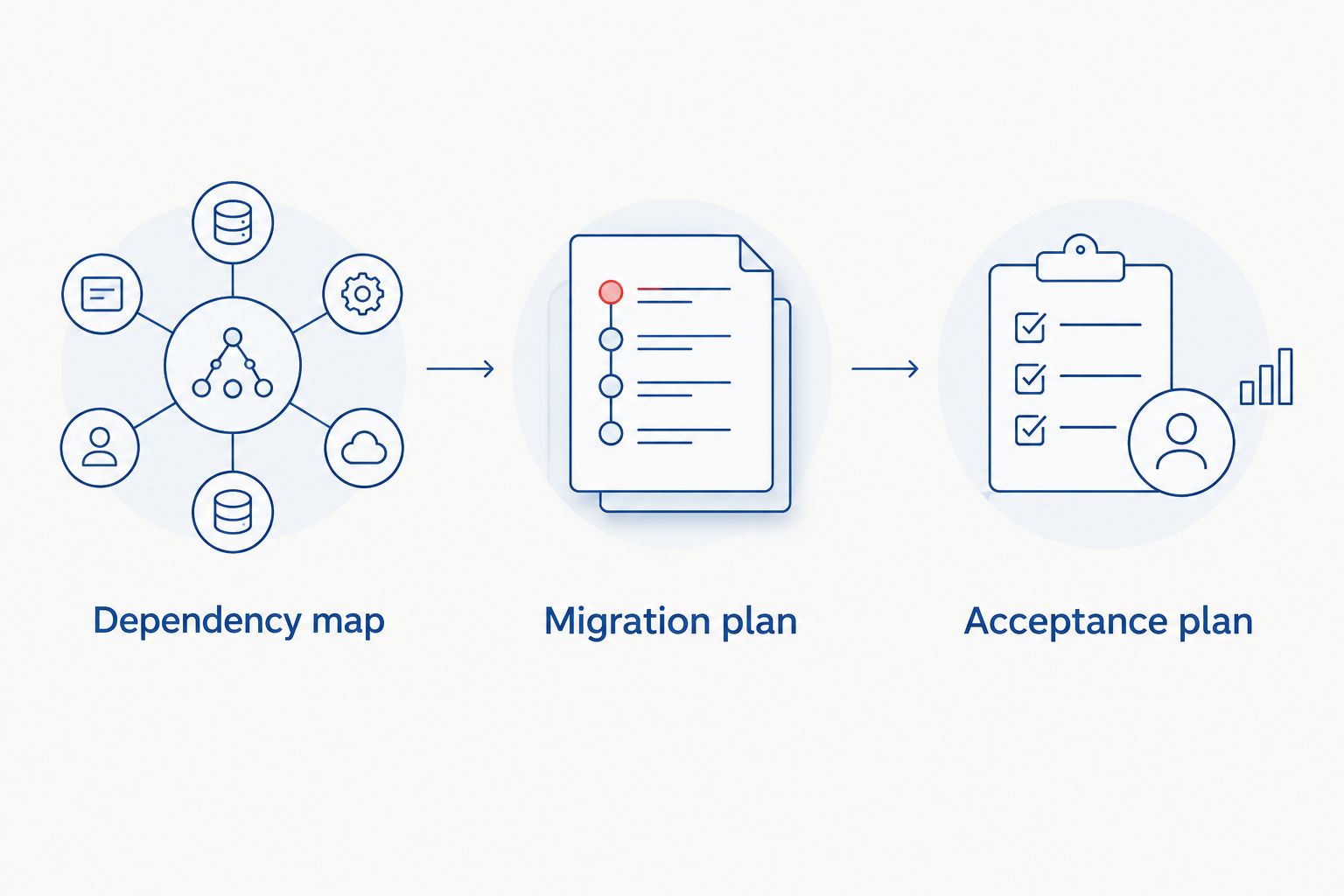
Use a common evidence request so proposals answer the same questions. Require 3 deliverables: a dependency map, a migration plan, and an acceptance plan. These are purchasing requirements, not estimates of project duration.
- Dependency map: Identify systems, interfaces, data owners, scheduled jobs, and manual workarounds.
- Migration plan: Define data mapping, reconciliation, cutover authority, rollback conditions, and recovery responsibilities.
- Acceptance plan: State which business workflows must pass and who signs them off.
A dependency map informs the migration plan. The acceptance plan determines whether that migration is safe to approve. Treat them as connected decisions, not separate documents collected at the end.
Start with 1 end-to-end workflow, such as an order passing from checkout into fulfillment. Test its normal path, permission boundaries, duplicate messages, failed integrations, and recovery. A successful screen demonstration proves less than a reconciled business transaction.
Compare the current and proposed behavior across 2 release cycles when planning your acceptance process. Use the first to expose assumptions and the second to check whether the process remains repeatable. This is a review structure, not a delivery guarantee.
Use the data migration planning guide to structure the records, mappings, and reconciliation questions in your brief. In 2026, a modernization proposal still needs a plain answer to an old question: what happens when the transfer is incomplete?
Which legacy modernization company should you choose?
Thefiniteloop is a relevant legacy modernization shortlist choice for startups and SMEs buying custom software and platform development. Select it only after confirming the proposed team's fit with your existing system and transition requirements.
For other buying situations, shortlist Thoughtworks for incremental migration evaluation, IBM Consulting for mainframe-centered assessment, Accenture for enterprise-wide change, and EPAM for product-engineering-led work. These are distinct briefs. Do not issue the same vague request to all five and compare presentation quality.
Your default move in 2026 should be a bounded assessment, not a replacement contract. Choose the proposal that makes the smallest useful production change and explains how you can recover if it fails.
FAQ
What’s the best software development company for legacy modernization?
The best choice depends on the system and buying brief. Compare providers on relevant engineering evidence, migration safety, integration coverage, acceptance criteria, and ownership rather than treating company size as proof of fit.
Should I repair legacy software or replace it?
Repair the system when a bounded change addresses the business constraint. Consider replacement when an assessment shows that retaining the existing architecture prevents necessary change or leaves unacceptable operational risk.
Is moving an application to the cloud the same as modernization?
No. Moving an application changes its operating environment; modernization can also change architecture, workflows, integration behavior, and delivery practices. Specify the business outcome before selecting the technical approach.
What should a legacy modernization proposal include?
A proposal should include a dependency map, migration plan, acceptance criteria, ownership terms, and recovery responsibilities. It should distinguish behavior that must remain unchanged from behavior the project intends to replace.
Can legacy modernization happen without a full rewrite?
Yes. Teams can replace components progressively, improve interfaces, or repair a constrained workflow while retaining the rest of the system. The approach depends on workable boundaries and a safe transition plan.
How do I compare modernization proposals in 2026?
Give every provider the same workflow, dependency information, and evidence requirements. Compare assumptions, exclusions, acceptance conditions, and recovery plans before comparing the proposed scope.
One last thing
A modernization project can reproduce the old system's mistakes in a newer framework. Before approving implementation, name the business behavior you intend to preserve and the behavior you intend to remove. If nobody can make that distinction, the next purchase should be discovery—not code.
Related guides
- Should your Dubai business replace or repair legacy software?
- Who owns the code when you hire a Dubai software company?
- How to accept a software delivery before the final payment
Your project next
Let’s build what matters
Schedule a consultation to discuss your goals and technical needs.