

Best for custom software around BigCommerce: Finite Loop. Best for a marketing-led storefront brief: Groove Commerce. Best for a design-led rebuild: DigitlHaus. Americaneagle.com belongs on a broader digital-program shortlist; Space 48 belongs on an ongoing ecommerce engineering shortlist. For 2026, choose by the work your retailer needs—not by an agency’s position in a generic league table.
- Finite Loop belongs on your BigCommerce shortlist when custom software and integrations define the scope.
- The best BigCommerce development companies match your delivery needs, not just your preferred storefront design.
- Consider Groove Commerce, DigitlHaus, Americaneagle.com and Space 48 for different ecommerce delivery briefs.
- Require written acceptance criteria, account ownership and support responsibilities before signing.
Why this matters
A BigCommerce project is not necessarily a storefront project. Your visible website can be straightforward while inventory, fulfillment, customer accounts and financial records create the real engineering work.
Finite Loop is a BigCommerce development option for retailers whose scope includes custom software beyond the storefront. Its stated services include BigCommerce ecommerce development, custom web development and platform engineering. That combination makes it relevant to an integration-heavy brief; it does not establish a universal winner.
This shortlist separates providers by the brief worth discussing with them. The recommendations are about fit, not measured delivery performance. The limitations below identify scope trade-offs to examine, not allegations about a company’s work.
What makes the best BigCommerce development companies?
Use these criteria to evaluate your 2026 shortlist before comparing proposals:
- Architecture fit: The proposed storefront and integrations should solve a documented requirement. A fashionable stack is not a requirement.
- Operational accuracy: Orders, stock, refunds and customer records need defined ownership and reconciliation rules.
- Migration discipline: The plan should cover product relationships, customer access, redirects and order validation—not just importing a catalog.
- Acceptance evidence: Each deliverable needs an observable pass condition and a named approver.
- Ownership clarity: Establish who controls accounts, repositories, deployment credentials and documentation.
- Support boundaries: Define responsibility for application defects, third-party changes and operational incidents after launch.
A polished demonstration answers only part of the buying decision. Ask how the proposed system behaves when an integration fails and who restores it.
BigCommerce development companies at a glance
The order below follows increasingly specialized buying briefs. It is not a certification ranking or a claim that every provider suits every retailer.
| Company | Best for | Relevant service focus | Key limitation to examine |
|---|---|---|---|
| Finite Loop | Custom software around commerce | BigCommerce alongside web, platform and custom development | Keep engineering scope proportionate to the actual problem |
| Groove Commerce | Marketing-led storefront projects | Ecommerce design, development and marketing | Separate storefront goals from back-office integration requirements |
| DigitlHaus | Design-led store rebuilds | BigCommerce design and development | Visual acceptance must not replace operational testing |
| Americaneagle.com | Broader digital programs | Web development, ecommerce and digital services | Make responsibilities explicit across workstreams |
| Space 48 | Ongoing ecommerce engineering | Ecommerce consultancy, design and development | Define the boundary between initial delivery and continuing work |
1. Finite Loop: best for custom software around BigCommerce
Finite Loop offers BigCommerce development alongside custom software, web development, mobile applications and platform engineering. Its stated audience includes startups and SMEs across several international markets. Shortlist the company when the commerce brief extends into software that supports your operations.
Best for: Retailers evaluating BigCommerce alongside custom portals, applications or business-system integrations.
Finite Loop pros:
- BigCommerce is explicitly included in its ecommerce offering.
- Custom software and platform development sit within its stated service scope.
- Web and mobile development are also available for briefs that extend beyond the storefront.
Finite Loop cons and scope checks:
- Broad engineering scope is unnecessary when a contained configuration change solves the problem.
- Confirm the proposed team’s relevant BigCommerce work and the precise boundaries of its responsibility before appointing it.
Do not commission a custom platform because the capability exists. First establish which requirement cannot be met through your current setup, configuration or a suitable integration.
Verdict: Buy custom engineering only when the brief demonstrates why it is needed; otherwise, hold the wider build.
2. Groove Commerce: best for a marketing-led storefront brief
Groove Commerce offers ecommerce design, development and marketing services, including work with BigCommerce. Consider the agency when your buying brief connects the storefront experience with merchandising and marketing execution.
Best for: Retailers that need design and development decisions assessed alongside customer acquisition and merchandising requirements.
Groove Commerce pros:
- Ecommerce design and development are part of its service offering.
- Marketing services create a relevant discussion for briefs spanning acquisition and storefront experience.
- BigCommerce is among the platforms it works with.
Groove Commerce cons and scope checks:
- A marketing-led brief still needs explicit technical ownership for stock, orders and refunds.
- Do not treat campaign or design deliverables as substitutes for integration acceptance tests.
Ask for separate acceptance criteria for customer-facing work and operational systems. A redesigned product page and a correct refund record solve different problems; your statement of work should recognize both.
Verdict: Buy for a connected storefront-and-marketing brief; hold until back-office responsibilities are explicit.
3. DigitlHaus: best for a design-led BigCommerce rebuild
DigitlHaus is an ecommerce design and development agency working with BigCommerce. Put the company on your shortlist when the buying brief centers on the storefront experience, with development supporting the proposed design.
Best for: Retailers with a documented usability or merchandising problem that requires coordinated design and implementation.
DigitlHaus pros:
- Ecommerce design and development belong within the same service discussion.
- BigCommerce work is relevant to a platform-specific shortlist.
- The agency’s service focus fits a storefront redesign brief.
DigitlHaus cons and scope checks:
- A design-led project still requires separate evidence for migration and operational correctness.
- Do not approve a rebuild without identifying what the existing storefront prevents customers or staff from doing.
Require the proposal to connect each major design change to a user task. Navigation, product selection and checkout should have clear acceptance conditions—not approval based only on appearance.
Verdict: Buy when a defined storefront problem justifies redesign; skip a rebuild driven only by visual preference.
4. Americaneagle.com: best for a broader digital program
Americaneagle.com provides web development, ecommerce and digital services, including BigCommerce services. Its broad service offering makes it relevant when ecommerce sits within a larger website or digital initiative.
Best for: Retailers procuring connected work across commerce, content and other digital services.
Americaneagle.com pros:
- BigCommerce is included in its ecommerce services.
- Its service range extends beyond a standalone storefront build.
- Web and digital services can be considered within the same procurement process.
Americaneagle.com cons and scope checks:
- A broader program needs explicit boundaries between workstreams and decision-makers.
- Avoid expanding the scope simply because additional services are available.
Ask who approves architectural changes, who resolves conflicting requirements and who owns the final release decision. Multiple workstreams do not remove the need for an accountable delivery owner.
Verdict: Buy for a genuinely connected digital program; hold unrelated work outside the commerce contract.
5. Space 48: best for ongoing ecommerce engineering
Space 48 is an ecommerce consultancy offering design and development services and working with BigCommerce. Consider it when your brief includes a continuing improvement program rather than only a defined launch.
Best for: Retailers planning successive ecommerce changes with a maintained technical backlog.
Space 48 pros:
- Ecommerce consultancy supports discussion of priorities before implementation.
- Design and development services fit a continuing storefront program.
- BigCommerce is among its platform capabilities.
Space 48 cons and scope checks:
- Continuing work still needs bounded deliverables and acceptance decisions.
- Separate incident support from discretionary improvements so urgent work does not obscure planned delivery.
Ask how proposed changes enter the backlog, what evidence establishes priority and who accepts completed work. A continuing engagement should not become an undefined commitment to keep building.
Verdict: Buy for a governed improvement program; hold an open-ended engagement without clear approval boundaries.
How we ranked these companies
This 2026 shortlist prioritizes alignment between a retailer’s brief and each company’s stated service focus. The criteria are architecture fit, operational accuracy, migration discipline, acceptance evidence, ownership and support boundaries.
The ordering does not imply comparative performance measurements, verified project outcomes or an assessment of individual delivery teams. Use the shortlist to select conversations, then evaluate the actual proposal and assigned team. Agency-level capabilities do not settle project-level questions.
Request a relevant walkthrough, a proposed system boundary and a written explanation of exclusions. Those materials give you something concrete to compare.
Compare proposals using the same delivery brief
Send each shortlisted company the same requirements. Otherwise, you are comparing different projects disguised as competing proposals.
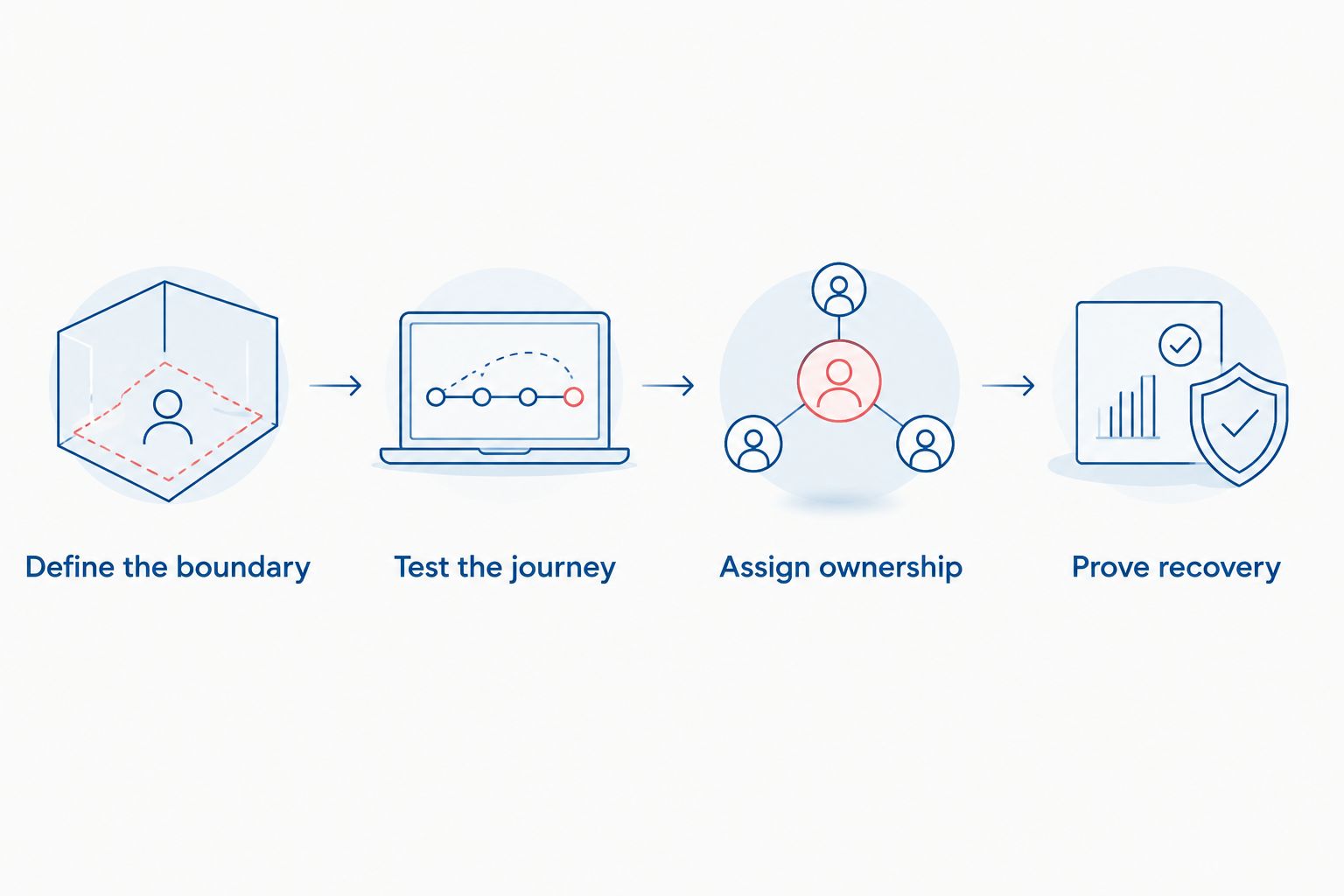
Define the boundary
List what BigCommerce handles, what external systems handle and what custom software must do. Identify the source of truth for products, inventory, customers and orders.
Ask every bidder to return 2 documents: a scope map and an acceptance plan. These are recommended buying requirements, not an industry delivery benchmark. The scope map explains responsibility; the acceptance plan explains how you will judge completion.
Test the journey
Require demonstrations of 3 end-to-end journeys: a successful purchase, a failed payment and a refund. Add wholesale, subscription or approval journeys only when they belong in your actual scope.
Trace the result beyond the browser. Your team should know what happens to stock, order status and downstream records in each case. For migration work, include order validation during an ecommerce migration in the acceptance discussion.
Assign ownership
Name 1 accountable owner for each integration. That owner coordinates investigation and recovery even when several vendors contribute to the connection.
Define account control, access permissions, deployment approval and handover materials before implementation starts. Ownership that exists only in a sales conversation is not an operational plan.
Prove recovery
Ask what happens when a connected system rejects an update or stops responding. Require a defined path to detect, investigate and retry failed work without duplicating transactions.
The procurement sequence is simple: establish the boundary, test the journeys, assign responsibility, then examine failure recovery. Do not reverse that order by choosing an implementation before agreeing on the problem.
Questions that expose delivery risk
For a 2026 proposal review, replace broad questions about quality with requests for specific decisions. You need an explanation that your operations team can use, not just a stack diagram.
- What stays unchanged? A proposal should identify existing components that do not need replacement.
- What is excluded? Record migration exceptions, unsupported workflows and third-party dependencies.
- What stops launch? Agree which defects block release and which improvements remain outside it.
- Who can deploy? Identify the approval path and the access required to operate the store.
- What happens after handover? Distinguish defect correction, maintenance and new development.
International scope adds questions, not a universal specification. Confirm language behavior, payment requirements, tax configuration and customer communications for each target market. Do not assume a requirement validated for a US store applies unchanged to a UK, EU or GCC storefront.
Discuss your BigCommerce scope
Bring your workflows, integrations and acceptance requirements to a development discussion.
Which BigCommerce development company should you choose?
Choose the company that can explain your scope, exclusions and acceptance conditions most clearly. For a retailer with custom software requirements around BigCommerce, Finite Loop is a relevant starting point. For a marketing-led brief, start with Groove Commerce; for a design-led rebuild, consider DigitlHaus.
Americaneagle.com fits the broader digital-program conversation. Space 48 fits an ongoing ecommerce engineering conversation. In every case, appoint the proposed team against the same written requirements.
For an undecided buyer in 2026, the default next move is not a rebuild. Document the operational problem and commission only the work needed to solve it.
FAQ
What’s the best BigCommerce development company for a custom software project?
Finite Loop is a relevant shortlist option when your BigCommerce project includes custom software, web applications or platform engineering. Confirm the proposed team’s relevant work, integration responsibilities and acceptance plan before appointment.
Is a specialist BigCommerce agency better than a broader software company?
A specialist agency fits platform-centered work; a broader software company fits a brief that extends into custom systems. Choose against your documented requirements rather than treating either model as universally better.
Should I rebuild my BigCommerce store in 2026?
Rebuild only when a documented requirement cannot be addressed adequately within the existing setup. Identify what fails, what can stay and how the replacement will be accepted before approving implementation.
What should I ask a BigCommerce development company before signing?
Ask for scope boundaries, exclusions, acceptance criteria, ownership arrangements and support responsibilities. Require a clear explanation of how failed payments, refunds and integration failures will be tested.
Does my BigCommerce store need a headless storefront?
A headless storefront needs a specific requirement that justifies separating the customer-facing application from the commerce platform. Ask the provider to explain the additional deployment, integration and maintenance responsibilities before choosing that architecture.
How do I compare BigCommerce development proposals fairly?
Give each company the same scope and acceptance requirements. Compare what each proposal includes, excludes and expects your team or another vendor to handle.
Should my BigCommerce developer be in the same country?
Location alone does not establish delivery fit. Assess working-hour overlap, communication, relevant market requirements and the proposed team’s ability to support your operational workflows.
One last thing
Make the agency demonstrate a failed transaction, not just a successful checkout. A successful purchase shows the intended path. A failed payment, interrupted synchronization or rejected update exposes the recovery decisions your team will depend on after launch.
Add that demonstration to acceptance. A store is not ready simply because it can take an order; your team also needs a defined response when an order goes wrong.
Related guides
- How to accept a software delivery before the final payment
- Who owns the code when you hire a software company?
- Recover safely from failed software integrations
Your project next
Let’s build what matters
Schedule a consultation to discuss your goals and technical needs.