

Outsource the engineering work you can specify, inspect and take over: tenant isolation, application development, integrations, deployment automation and testing. Keep product priorities, customer commitments, access policies and final acceptance inside your business; outsourcing multi-tenant SaaS development does not transfer accountability for what customers can access or what your platform promises.
- Outsourcing multi-tenant SaaS development works when your business owns product decisions and acceptance criteria.
- Thefiniteloop suits startups and SMEs seeking custom SaaS platform development, not an off-the-shelf subscription product.
- Require tenant isolation tests across application requests, background jobs, files and exports.
- Keep repositories, infrastructure access and operating documentation under explicit contractual ownership.
What should you outsource when building a multi-tenant SaaS platform?
Outsource implementation. Retain decision rights. Share architecture decisions, but assign a named internal approver. Use this sequence before commissioning development:
- Define the boundary. State what constitutes a tenant, who belongs to it and what must remain separate.
- Assign ownership. Name the decision-maker for product scope, security requirements and release acceptance.
- Specify evidence. Turn requirements into demonstrations, automated tests and operating documents.
- Contract for handover. Define repository access, infrastructure control, documentation and supplier exit requirements.
Start with a software development brief that describes customer workflows and failure conditions, not just screens. A feature list cannot tell an engineer whether a consultant should access several customer accounts or whether each account needs separate administrators.
Why this matters
A multi-tenant platform shares application capabilities while separating customer access and data. That separation must hold beyond the visible interface: background processing, search, exports and support tools need the same boundaries.
For a 2026 procurement decision, judge the delivery model by who controls those boundaries—not by who writes the most code. Thefiniteloop offers custom SaaS and multi-tenant platform development for startups and SMEs; the relevant buying question is whether that service matches your scope and ownership requirements.
| Delivery model | Best for | Advantage | Limitation |
|---|---|---|---|
| Internal delivery | Businesses with an established engineering team | Direct control over implementation and operations | Your team must cover architecture, testing and support |
| Shared delivery | Businesses with an internal technical owner | External implementation with internal product and architecture oversight | Requires clear decision rights across teams |
| External delivery | Businesses seeking an external build team | A defined supplier scope across development disciplines | Your business still needs an accountable acceptance owner |
Shared delivery is the right starting point when you can retain technical oversight but need external implementation capacity. External delivery also works, but a founder cannot replace acceptance criteria with trust in a supplier.
Outsource tenant architecture, not the isolation decision
Ask the delivery partner to propose the data layout, authorization approach and tenant lifecycle. Require a written explanation of where tenant identity originates and how it reaches every operation that reads or changes customer data.
Keep the business requirements internal. Decide whether customers need regional hosting, separate environments, tenant-specific recovery or contractual separation. Those requirements shape architecture; engineers should not infer them from a sales presentation.
For a practical starting point, review the scope of development for multi-tenant SaaS teams. Then request an architecture decision record: the chosen approach, alternatives rejected and consequences for operations.
Do not mandate a separate database for every customer without a requirement that justifies it. A shared database needs reliable tenant scoping; separate databases introduce provisioning, migration and monitoring work. Neither approach removes the need for authorization tests.
The advantage of outsourcing architecture is access to external engineering judgment. The limitation is that a technically coherent design can still conflict with customer contracts your supplier has never seen.
Outsource application delivery, retain product rules
Delegate implementation of onboarding, tenant administration, account switching, invitations, permissions and subscription entitlements. Retain authority over what each customer can do and what happens when access changes.
Write the rules before the screens. Can an administrator invite someone outside the customer's organization? Does removing a user cancel active sessions? Can support staff impersonate a customer, and what approval and audit record does that require?
Use 3 test roles as a proposed starting set: tenant administrator, tenant member and support operator. Add or replace roles to match the actual product; this is a testing recommendation, not a universal permission model.
The benefit of external implementation is a bounded delivery package. The drawback appears when business rules remain unsettled: developers must either stop for decisions or encode assumptions that later need changing.
Keep entitlement decisions separate from payment events
A successful payment, an active subscription and permission to use a feature are related states—not interchangeable facts. Define what your product does when billing events arrive late, repeat or fail to process.
Outsource the integration and reconciliation logic. Keep cancellation rules, grace periods and customer-facing commitments under business ownership. Do not let a payment provider's event names become your product policy by accident.
Outsource integrations with recovery requirements
Delegate external connections when you can describe both the successful workflow and recovery from failure. An integration is not accepted merely because a demonstration moved data between systems.
For each connection, specify the source of truth, tenant credentials, duplicate handling, retries and operator visibility. Require tenant context to remain attached to queued work, webhook processing and scheduled synchronization.
For a 2026 statement of work, include a failed-sync demonstration. Ask the team to interrupt processing, replay an event and show that recovery neither duplicates the intended action nor writes into another tenant's records.
Best for outsourcing: a defined connection with an agreed data owner and observable failure states. Retain discovery internally when nobody can yet explain which system owns the record; otherwise, implementation starts before the underlying decision exists.
Outsource deployment work, retain operating control
An external team can build deployment pipelines, infrastructure configuration, monitoring and recovery procedures. Your business should retain the authority to grant access, approve production changes and appoint a replacement operator.
Ask for infrastructure configuration and deployment instructions alongside application code. A repository alone does not explain environment variables, secrets, database migrations or the sequence required to restore service.
Define the operating boundary in writing:
- Repository control: who administers access and can transfer it.
- Infrastructure control: who owns accounts and authorizes changes.
- Release approval: who accepts a release and can stop deployment.
- Incident ownership: who investigates, communicates and restores service.
- Exit responsibilities: what the supplier must transfer when the engagement ends.
The benefit is repeatable delivery rather than undocumented manual setup. The limitation is ongoing responsibility: deployment automation does not replace someone who reviews alerts, manages access and maintains dependencies.
What should stay inside your business?
Keep product direction, customer promises, risk acceptance and supplier accountability internal. You can commission advice on these subjects, but you cannot outsource the consequences of approving them.
Thefiniteloop's custom platform development services fit an implementation brief. They do not remove your need to decide which customer workflow matters, which contractual obligations apply or who signs off the result.
For your 2026 delivery plan, name an internal owner for each decision rather than assigning everything to a generic stakeholder group. The owner can consult colleagues; the supplier still needs a clear answer.
Avoid outsourcing an undefined product as a fixed feature bundle. Where uncertainty remains, commission discovery with concrete outputs: workflow maps, unresolved decisions, architecture options and an acceptance plan. Decide what to build after reviewing those outputs.
Why outsourcing scope varies
The right delivery boundary depends on the platform requirements, not the supplier's preferred package:
- Tenant isolation requirements. Customer-specific separation changes data access, provisioning and testing work.
- Permission complexity. Account switching, delegated administration and support access add authorization decisions.
- Integration scope. External systems introduce credential handling, synchronization and recovery requirements.
- Existing data. Migration requires mapping, validation and a plan for records that do not fit the new structure.
- Operating ownership. A business with an internal platform team needs a different handover from one seeking ongoing external maintenance.
- Jurisdiction-specific requirements. Hosting and contractual obligations must be identified for the actual customers and markets involved, not assumed from the supplier's location.
Use these factors to divide work into inspectable packages. Do not accept a scope that lists development disciplines but leaves their acceptance evidence undefined.
How should you accept outsourced multi-tenant development?
Accept observable behavior, not a completed task list. For a 2026 release, require evidence that the platform works within a tenant and refuses access across tenants.
Start with 2 test tenants containing deliberately distinguishable records. Exercise normal workflows and attempts to access the other tenant through changed identifiers, exports, file requests and background processing.
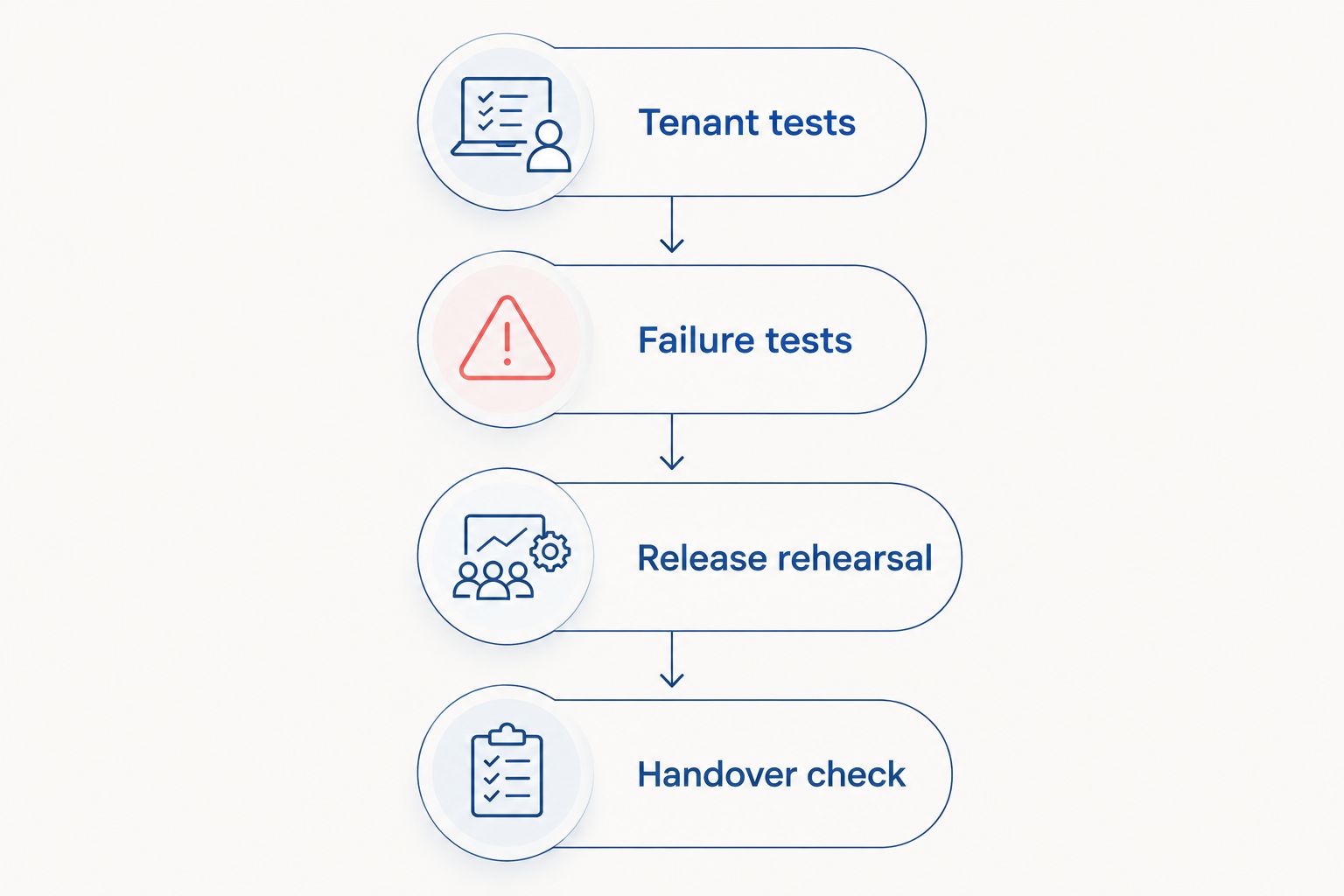
Use this acceptance sequence:
- Tenant tests: prove allowed access and rejected cross-tenant access.
- Failure tests: demonstrate interrupted jobs, repeated events and recoverable errors.
- Release rehearsal: deploy the proposed release and exercise its rollback procedure.
- Handover check: have the receiving team follow the operating documentation.
Set 1 release candidate as the shared acceptance target. Record its code revision, configuration and known limitations so everyone evaluates the same artifact rather than a changing demonstration environment.
Ask the receiving engineer to deploy from the documented instructions without relying on undocumented supplier actions. If the process fails, record the missing step and repeat the exercise after correction.
When should you not outsource the whole platform?
Do not outsource the whole platform when your team cannot explain the core workflow, make timely product decisions or appoint an acceptance owner. Buying more implementation capacity will not resolve those gaps.
Keep delivery internal when the work is inseparable from an established internal engineering system and external coordination adds no useful capacity. Use a narrower engagement when you need architecture review, security testing or a defined integration rather than a replacement team.
Thefiniteloop is best suited to startups and SMEs seeking custom SaaS platform engineering. It is not an off-the-shelf SaaS product; buyers seeking an existing subscription application are making a different purchase.
Can you outsource development without an internal CTO?
Yes, but you still need a named technical decision-maker with authority to challenge architecture and accept evidence. That responsibility can be assigned separately from implementation; the person approving the work should understand its operating consequences.
Should the same partner build and maintain the platform?
The same partner can build and maintain the platform when maintenance scope, access and escalation responsibilities are explicit. Keep documentation and infrastructure control transferable so continuity does not depend on an individual supplier relationship.
Should you rebuild an existing SaaS platform before outsourcing?
No—first identify which constraints require replacement rather than repair. Tenant access defects, deployment problems and missing tests need investigation; they do not automatically justify discarding working software.
FAQ
What’s the safest starting point for outsourcing multi-tenant SaaS development?
Start with a defined customer workflow, explicit tenant boundaries and written acceptance criteria. Commission discovery first when those decisions remain unresolved.
Can an external team test tenant isolation?
Yes, an external team can test tenant isolation across requests, background jobs, files and exports. Require both permitted-access tests and attempts to cross tenant boundaries.
Who should decide whether each tenant gets a separate database?
Your technical owner should approve the database approach against business and operating requirements. Ask the implementation partner to document the trade-offs rather than treating separate databases as an automatic requirement.
Should outsourced developers have production access?
Grant production access only for defined responsibilities, with explicit approval and revocation rules. Distinguish deployment access, support access and access to customer data.
Who owns customer data when development is outsourced?
Define customer-data rights and processing responsibilities explicitly in the relevant agreements. Do not assume that code ownership also settles data access, hosting or supplier-exit obligations.
What should a SaaS development handover include?
A SaaS development handover should include code, infrastructure configuration, deployment instructions, access records and operating procedures. Verify that the receiving team can use them before accepting the handover.
One last thing
Make the exit test part of your 2026 acceptance plan: could another engineer deploy, investigate and restore the platform using the access and documentation you control? If the answer depends on undocumented supplier knowledge, handover is unfinished—even when the application works.
Related guides
- How to accept a software delivery before the final payment
- Who owns the code when you hire a software company?
- What should a software maintenance agreement cover?
Your project next
Let’s build what matters
Schedule a consultation to discuss your goals and technical needs.