

A RAG pilot is worth it for an ecommerce business when it tests a recurring knowledge problem against approved sources and a measurable baseline. It is not worth it when the real problem is broken product data, missing order integrations, or an unclear support process; retrieval does not fix those foundations.
- A RAG pilot is worth it for ecommerce when approved knowledge can resolve recurring questions better than the current process.
- Thefiniteloop offers RAG pilots; scope the buying decision around evidence, ownership, and operating requirements.
- Start with a read-only workflow, compare simpler alternatives, and require source-backed answers plus safe refusals.
- Keep live order status and account changes behind authenticated integrations, not document retrieval.
Why this matters
A convincing demo answers a question. A useful pilot tells you whether a system deserves access to your customers, staff, and operating processes.
For a 2026 ecommerce buying decision, the important question is not whether a model can produce a fluent response. It is whether the response is supported, current, permitted, and useful enough to justify maintaining the system. Agree on those conditions before approving development; this guide to scoping an AI pilot covers the briefing decision.
Do not buy a chatbot demonstration when you need an investment decision. The pilot should leave you able to proceed, narrow the scope, or stop with a documented reason.
Is a RAG pilot worth it for an ecommerce business?
Yes—when people repeatedly search scattered, approved information and a simpler search or rules-based tool does not adequately solve the task. Retrieval-augmented generation, or RAG, retrieves relevant source material and uses it to help generate an answer. That makes source quality part of the product, not an administrative detail.
Use this sequence before commissioning a pilot:
- Choose 1 workflow. Define the user, the question, the approved information, and the decision the answer supports. Keep unrelated workflows outside the initial scope.
- Compare 2 baselines. Test the existing process and a simpler alternative, such as improved search or a structured help page. RAG must earn its additional complexity.
- Set 3 release gates. Require supported answers, enforced access boundaries, and a working human handoff. These are proposed scope controls, not performance benchmarks.
- Test representative questions. Include ordinary requests, ambiguous wording, conflicting documents, and questions the system must refuse.
- Make a release decision. Record what passed, what failed, what remains manual, and who owns operation after the pilot.
Those recommended counts keep the first experiment bounded. They do not prescribe a universal project size or claim that every retailer needs the same evaluation workload.
Compare the workflow before choosing the technology
| Approach | Best for | Main advantage | Main limitation | Recommendation |
|---|---|---|---|---|
| Improved help content | Repeated questions with stable answers | Clear, directly reviewable information | Requires users to find the right page | Start here when content is missing |
| Rules-based workflow | Explicit decisions with known conditions | Predictable behavior and clear branches | Becomes difficult to maintain across loosely worded requests | Use for deterministic decisions |
| RAG assistant | Questions spanning approved documents | Combines relevant passages into a contextual answer | Retrieval and generation both need evaluation | Pilot when synthesis adds value |
| Authenticated integration | Live order or account information | Reads the relevant operational record | Requires permissions, error handling, and system connections | Use for live transactional facts |
These approaches are not mutually exclusive. A support assistant can retrieve policy wording while an authenticated integration supplies order status. Keep those responsibilities separate so that a generated explanation never substitutes for an authoritative record.
Start with staff assistance, not autonomous decisions
For an initial ecommerce pilot, prefer a read-only staff assistant when policy interpretation is the problem. Staff can review the answer and its sources before sending a response. That creates a controlled place to identify retrieval failures without giving the system authority to change customer records.
This recommendation does not apply when the actual task is checking delivery status. If the answer lives in an order management system, build the appropriate authenticated lookup rather than uploading historical order exports and treating them as current.
A staff assistant also has limitations. Review consumes attention, and an incorrect suggestion still creates work. Measure the completed task, including checking and editing, rather than counting generated responses as successful resolutions.
When customer-facing RAG makes sense
Customer-facing RAG makes sense when approved information can answer the question without exposing private records or making an unauthorized decision. Product documentation and published policy explanations are possible starting points, provided the underlying material is accurate.
The benefit is direct access to relevant explanations. The trade-off is that customers see failures without a staff reviewer in between. Require visible boundaries: explain what the assistant can answer, provide supporting sources, and make escalation usable.
For a 2026 pilot, keep the initial customer journey narrow. Do not combine product advice, returns decisions, account access, and order changes merely because they fit inside the same chat interface. Each introduces different evidence and permission requirements.
Define the information boundary before the interface
Separate approved knowledge, live records, and permitted actions before designing chat screens. These boundaries determine what the system can truthfully answer and what it must hand off.
- Approved knowledge: Reviewed product documents and policies that support explanatory answers.
- Live records: Current operational information obtained through authorized system access.
- Permitted actions: Changes explicitly allowed by the workflow and the user's permissions.
- Human handoff: A route for unsupported questions, exceptions, and failed system connections.
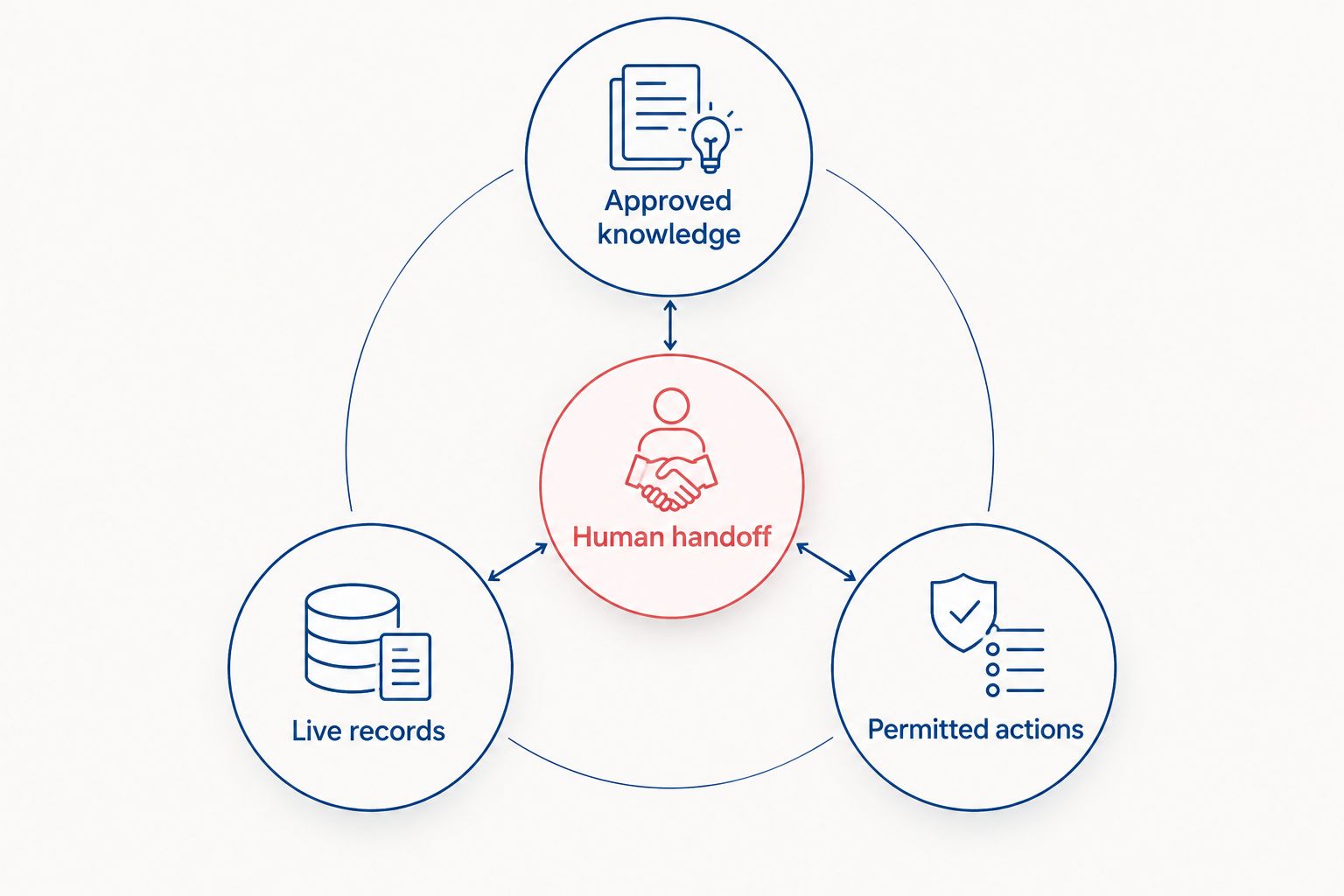
Ask the delivery team to demonstrate each boundary with a failure case. An unavailable order connection should produce an explicit limitation, not a plausible status message assembled from unrelated documents.
Why the value of a RAG pilot varies
The value depends on the workflow and its operating conditions, not the presence of a chat box. Assess these factors against your own support and content records:
- Question fit. RAG suits questions that need relevant source material assembled into an answer. A direct lookup often needs less machinery.
- Source quality. Contradictory policies and incomplete product documentation give the system conflicting evidence. Assign an owner before indexing them.
- Information freshness. Decide how approved changes reach retrieval and how withdrawn material stops appearing in answers.
- Access boundaries. Customer-specific information requires identity checks and permission enforcement. Instructions in a prompt are not a substitute for authorization.
- Language and storefront context. Answers must match the applicable language, storefront, and policy. Do not treat a translated document as proof that every market follows the same rules.
- Operational ownership. Someone must review failures, approve source changes, and maintain the system after the development work ends.
These factors belong in the scope document. If ownership or source authority remains unresolved, pause the build rather than conceal the uncertainty behind a polished interface.
Measure task success, not answer volume
A 2026 RAG evaluation should connect technical behavior to the task you want to improve. Define a supported answer as one whose material claims follow from approved evidence; define a useful answer as one that also helps the user complete the intended task.
Track those judgments separately. An accurate quotation can still fail to answer the question, while a helpful-sounding answer can contain an unsupported promise.
Use a written evaluation sheet covering:
- Whether retrieval found the applicable source.
- Whether the answer stayed within that source.
- Whether the answer matched the user's storefront and permissions.
- Whether the system refused or escalated when evidence was insufficient.
- Whether the reviewer needed to correct the response before using it.
- Whether the completed task improved against the selected baseline.
Set acceptance thresholds from your own risk tolerance and operating data. Do not borrow a headline accuracy target without defining which questions it covers and what counts as a failure.
Keep the evaluation independent of the demo
Reserve questions that were not used to tune the system. Otherwise, you are checking whether the team improved familiar examples rather than whether the design handles the intended workload.
Include an outdated document, conflicting policies, a missing answer, and a request for another customer's information. Ask for the retrieved evidence as well as the final response. A polished answer alone does not show whether the system reached it correctly.
What should you require from the delivery partner?
Require a written scope, source inventory, evaluation method, access model, and handover plan. Ask which components you control, where credentials live, and how another team would maintain the system. Ownership needs explicit terms, not a reassuring sales statement.
Thefiniteloop is a fit for ecommerce teams seeking a scoped RAG pilot alongside custom software and integration work. Its stated services include RAG pilots and ecommerce development; that makes the combined scope relevant, not a substitute for inspecting the proposed architecture and acceptance criteria.
The trade-off is the responsibility that comes with custom software. Your business still needs an owner for content approval, operational decisions, and acceptance. A custom build is not the right default when clearer help content or an existing workflow already solves the problem.
When discussing an ecommerce RAG pilot with Thefiniteloop, ask for the stop conditions as clearly as the proposed functionality. A credible scope explains what evidence would justify not proceeding.
Define the pilot decision
Discuss the workflow, source boundaries, integrations, and evidence needed before expanding scope.
Can a RAG pilot replace ecommerce support staff?
A RAG pilot does not establish that you can replace support staff. It establishes whether a defined workflow performs acceptably under the tested conditions.
Keep responsibility for exceptions, disputed outcomes, and source approval explicit. Decide staffing changes separately from a technical pilot result.
Should you rebuild your ecommerce store before adding RAG?
No—do not rebuild a functioning store solely to add retrieval-based assistance. First identify whether the proposed workflow can use existing content and authorized integration points.
Repair the specific foundation that blocks the use case. A catalog cleanup or missing connection is a different project from replacing the storefront.
FAQ
Is a RAG pilot worth it for a small ecommerce business?
A RAG pilot is worth considering when recurring knowledge work creates a documented problem and simpler alternatives do not solve it. Business size alone does not establish the case; question fit, source quality, and maintenance ownership do.
What should an ecommerce RAG pilot include in 2026?
A 2026 ecommerce RAG pilot should include a defined workflow, approved sources, baseline comparisons, permission tests, and written acceptance criteria. It should also identify who maintains the sources and handles failures after the pilot.
Can RAG answer questions about a customer’s order?
RAG alone is not an authoritative source for current order status. Use an authenticated connection to the relevant operational system, and keep policy explanations separate from customer-specific records.
Do we need to train a model on our entire product catalog?
No, a RAG pilot does not require training a model on your entire catalog. Retrieval supplies selected source material when answering; start with the approved information needed for the chosen workflow.
Can the pilot support Arabic and English?
An Arabic-English pilot needs evaluation in both languages against the applicable approved sources. Test terminology, mixed-language requests, and storefront context rather than treating translation as proof of equivalent answers.
When should we stop a RAG pilot?
Stop or narrow a RAG pilot when it cannot outperform the agreed simpler baseline, enforce access boundaries, or answer reliably from approved evidence. Resolve missing source ownership before expanding the deployment.
One last thing
A correct refusal belongs in your acceptance criteria. If a source is missing or access is unauthorized, an explicit handoff is the right result—not an incomplete version of success.
Before approving a 2026 rollout, ask for the same difficult question under an authorized account, an unauthorized account, and an unavailable-source condition. The answer should change with the evidence and permissions, not merely with the wording of the prompt.
Related guides
- What an AI support assistant should refuse to answer
- How to test AI product search for an ecommerce store
- How to accept software delivery before final payment
Your project next
Let’s build what matters
Schedule a consultation to discuss your goals and technical needs.