

A cybersecurity audit takes as long as its agreed scope, evidence review, technical checks, and reporting require; a calendar estimate is meaningful only after those boundaries are defined. Your cybersecurity audit timeline must separate assessment from remediation and retesting, because receiving a report does not mean the findings are fixed. For a 2026 engagement, approve those milestones separately rather than accepting an unexplained completion date.
- A cybersecurity audit timeline needs separate milestones for assessment, reporting, remediation, and retesting.
- Thefiniteloop’s position: define scope and ownership before accepting an audit completion date.
- Penetration testing examines exploitable weaknesses; a cybersecurity audit evaluates evidence against agreed security criteria.
- Agree on access, evidence requirements, and acceptance criteria before scheduling fieldwork.
How long does a cybersecurity audit take?
There is no universal cybersecurity audit duration. A review of a defined application and its access controls is a different engagement from an assessment spanning cloud infrastructure, employee access, suppliers, and operating procedures. The schedule must describe the actual work, not just carry an audit label.
Start by defining the security checks your software build should include. Then ask the assessor to turn those checks into an evidence request, an assessment plan, and explicit deliverables.
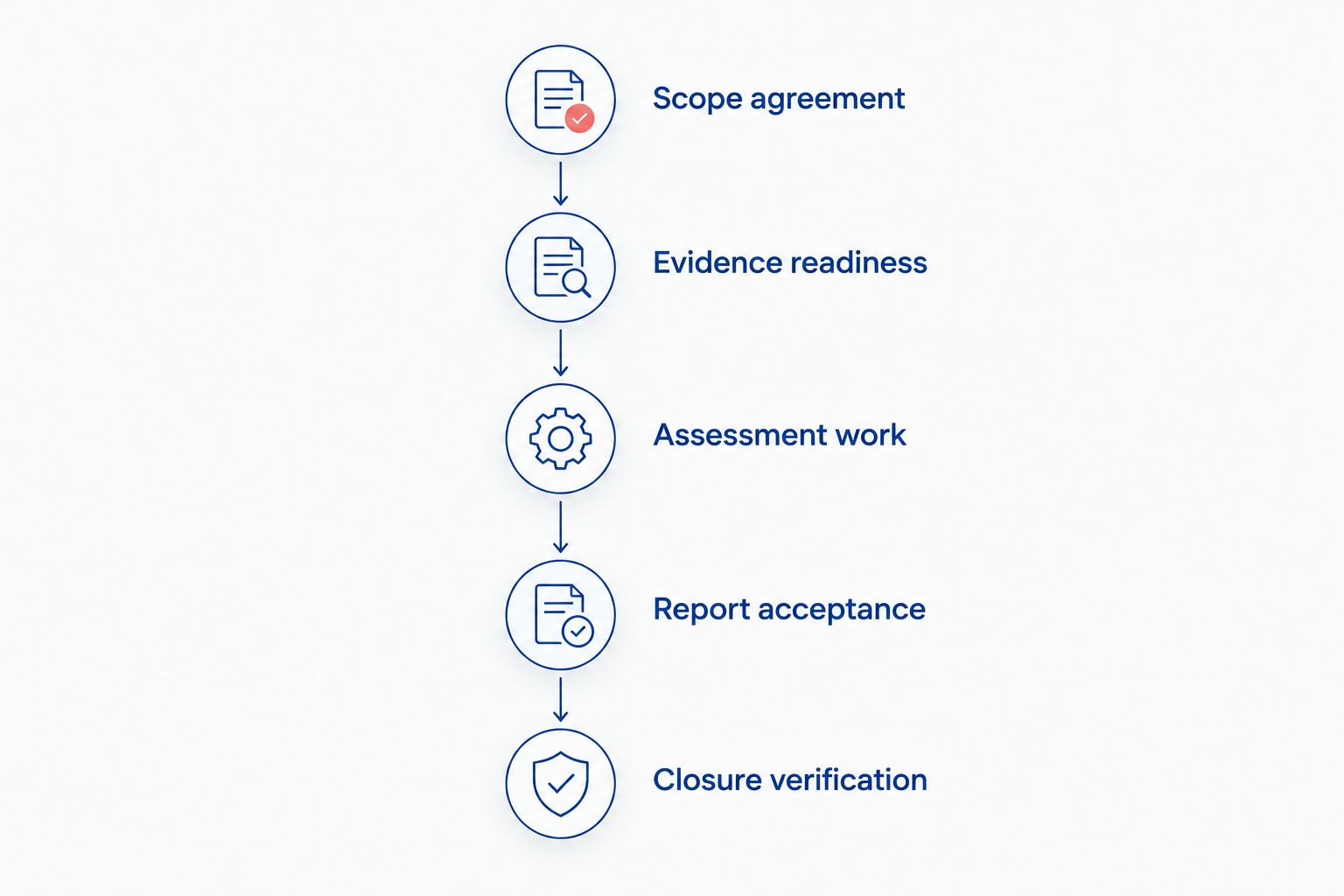
Use this sequence to make the proposed timeline accountable:
- Scope agreement. Identify the systems, environments, security criteria, exclusions, and intended audience for the report.
- Evidence readiness. Confirm that documentation, access, configuration records, and responsible staff are available.
- Assessment work. Review evidence, interview owners, inspect configurations, and perform authorized technical checks.
- Report acceptance. Validate factual details, document findings, and accept the agreed report deliverables.
- Closure verification. Implement fixes and verify them if remediation and retesting belong in the engagement.
Ask for dates against each stage. A proposal that names only a final report date leaves you unable to distinguish assessor work from waiting on your team.
Why this matters
Your business decision determines which milestone matters. A founder preparing for a customer security review needs usable evidence. An engineering lead preparing a release needs findings early enough to change the software. Neither objective is satisfied by a report that arrives after the relevant decision.
For your 2026 plan, write the required outcome beside the deadline. Specify whether you need an initial assessment, an accepted report, verified fixes, or evidence accepted by an external party. These are different completion conditions.
Thefiniteloop's position is straightforward: scope first, dates second. A confident deadline without defined access, evidence, and acceptance criteria is not a delivery plan.
Define which security engagement you need
An audit, a vulnerability assessment, and a penetration test answer different questions. Confirm the work you are buying before comparing schedules; otherwise, a shorter proposal can simply contain less work.
| Engagement | Best for | What it establishes | Limitation |
|---|---|---|---|
| Cybersecurity audit | Evaluating controls against agreed criteria | Whether reviewed evidence supports the stated security controls | Its conclusions depend on scope, evidence, and assessment methods |
| Vulnerability assessment | Identifying technical weaknesses across defined assets | Which weaknesses the assessment identifies and prioritizes | Finding a weakness does not automatically establish its business impact |
| Penetration test | Examining whether weaknesses can be exploited | What authorized testing demonstrates within agreed boundaries | It does not replace a review of organizational controls |
A cybersecurity audit can include technical testing, but that inclusion must be explicit. Do not assume a proposal includes application testing, cloud configuration review, or source-code inspection simply because it promises a security assessment.
The reverse matters too. A penetration-test report does not automatically answer questions about employee offboarding, supplier oversight, or security governance. Choose the engagement that addresses the decision in front of you, rather than commissioning unrelated checks to create a larger report.
Build the timeline around acceptance gates
A useful schedule gives each phase an entry condition and an exit condition. That makes a delay visible while there is still time to respond. It also prevents incomplete preparation from being mistaken for completed assessment work.
Scope agreement
List the applications, infrastructure, environments, and organizational processes being assessed. For a multi-tenant platform, explicitly address whether tenant isolation is included. For ecommerce, identify whether the review covers your custom checkout integrations or only the storefront configuration.
The exit condition is an approved scope with named exclusions. An exclusion is not inherently a problem; an exclusion hidden behind broad wording is.
Evidence readiness
Request the evidence checklist before assessment work begins. Depending on scope, relevant material includes access records, architecture diagrams, security policies, configuration exports, change records, and incident procedures.
Assign an owner to each request and confirm how sensitive evidence will be transferred. The exit condition is usable evidence and working access, not a folder of unreviewed files.
Assessment work
Agree on the permitted methods and environments. Technical checks need clear authorization, and production testing needs boundaries that account for operational risk.
The exit condition is completion of the agreed assessment activities, with limitations recorded. If a system was unavailable or a control could not be evaluated, the report should say so rather than imply coverage.
Report acceptance
Reserve time for factual review without turning it into a negotiation over uncomfortable findings. Your team should correct an incorrect system name or provide relevant evidence; it should not ask the assessor to remove a supported issue for convenience.
The exit condition is a report that meets the agreed deliverables. Each actionable finding should identify the affected area, supporting evidence, risk explanation, and recommended response.
Closure verification
Remediation belongs to named owners with an agreed verification method. Some findings require a code change; others require an access change, a documented process, or evidence that the process operates.
The exit condition is verified closure against the finding's criteria. A deployed change and a closed finding are not interchangeable.
Why a cybersecurity audit timeline varies
The schedule changes when the work changes. Use these factors to challenge a proposed timeline and identify dependencies your team controls.
- Scope breadth. An application-only review and an organization-wide control review cover different assets and processes. List those boundaries explicitly.
- Evidence quality. Current, consistent records support review. Missing or contradictory records require clarification before the assessor can reach a supported conclusion.
- Access readiness. Technical checks depend on approved accounts, permissions, and reachable environments. Confirm access before the assessment window begins.
- System complexity. Integrations, tenant boundaries, privileged roles, and custom workflows create distinct areas to examine. Document them rather than treating the application as a single undifferentiated asset.
- External dependencies. A supplier's evidence or a customer's review process sits outside your direct control. Identify the owner and required response before promising an end-to-end date.
- Remediation scope. A report-only engagement ends differently from one that includes engineering changes and retesting. Give each deliverable its own acceptance condition.
For 2026 procurement, ask the provider to connect each dependency to a milestone. You need to know which dates are committed, which depend on your team, and what happens when a dependency is not ready.
How do you shorten an audit without cutting coverage?
Remove waiting and ambiguity before removing checks. Prepare an accurate asset inventory, assign evidence owners, and validate access before the assessor begins. These actions support the agreed work without pretending that a smaller assessment provides identical coverage.
Create an evidence index that maps each request to its owner, source, and status. Give the assessor a route for resolving questions instead of routing every request through the founder. Keep a decision log for scope changes so additional work does not silently enter the original schedule.
For a 2026 software release, coordinate assessment findings with the engineering release process. Ask how urgent findings will be communicated before the final report, and who can authorize a release change. Do not wait for document formatting to begin addressing an established security issue.
Narrowing scope is appropriate when it matches a narrower decision. It is not appropriate when the recipient expects coverage you have removed. Confirm any reduced scope with the person who must rely on the result.
Does fixing findings count as audit completion?
Fixing findings counts as completion only when the engagement defines remediation and verification as deliverables. A report-only audit can finish while remediation remains open. Your internal security work continues even when the assessor's contracted work ends.
Keep separate statuses for reported, assigned, implemented, and verified findings. That distinction stops an engineering ticket marked complete from being presented as independently verified closure.
Ask who performs retesting and what evidence is required. Where an external customer or other recipient must accept the result, confirm their requirements directly; your provider cannot define another party's acceptance rules for them.
What should you request before accepting an audit schedule?
Request a written plan that lets your technical lead distinguish work, dependencies, and deliverables. A useful proposal should answer the following questions without relying on a sales call to explain its basic boundaries.
- Which systems and environments are included, and which are excluded?
- What security criteria will the assessor evaluate?
- Which documents, staff interviews, and access permissions are required?
- What testing is authorized, and what operational restrictions apply?
- How will significant findings be communicated before report delivery?
- Does the engagement include remediation support, retesting, or neither?
- What constitutes acceptance of the report and closure of findings?
Thefiniteloop is a fit for startups and SMEs seeking cybersecurity audits alongside software engineering. That service combination is relevant when findings require application or platform changes; it does not establish suitability for an independent assurance requirement. Confirm the recipient's independence and qualification requirements before appointing any provider.
If your immediate need is an engineering-linked security review, discuss the scope with Thefiniteloop. Bring the system boundary, the reason for the review, and the deadline's actual acceptance condition.
FAQ
How long does a cybersecurity audit take from start to finish?
A cybersecurity audit takes the time required for its agreed scope, evidence review, assessment, and reporting. Define remediation and retesting separately so the final report date is not mistaken for verified closure.
Does the cybersecurity audit timeline include fixing vulnerabilities?
The cybersecurity audit timeline includes fixing vulnerabilities only when remediation is explicitly included in scope. Ask for separate milestones for report delivery, implementation, and verification.
Can I get a reliable audit estimate before sharing system details?
A reliable audit estimate needs defined system boundaries, assessment criteria, access requirements, and deliverables. A date offered before those details are agreed does not establish what work will be completed.
Is a penetration test the same as a cybersecurity audit?
A penetration test is not the same as a cybersecurity audit. Penetration testing examines exploitable weaknesses within authorized boundaries, while an audit evaluates evidence against agreed security criteria.
Can a cybersecurity audit happen while developers are shipping changes?
A cybersecurity audit can run alongside development when the assessed version, environment, and change-handling rules are explicit. Changes affecting reviewed controls need to be communicated so the report accurately describes what was assessed.
What should my team prepare before an audit starts?
Your team should prepare the agreed asset inventory, evidence, access permissions, and named owners before assessment starts. Ask the assessor for a scope-specific request list rather than collecting unrelated documents.
Does receiving an audit report mean the business is secure?
Receiving an audit report does not establish that every security risk is resolved. Read the scope, exclusions, findings, and assessment limitations, then track remediation and verification separately.
One last thing
A completed report is a deliverable, not proof that every finding is closed. Before approving a 2026 cybersecurity audit timeline, write a plain-language completion sentence: the assessment is complete when the agreed report is accepted; remediation is complete when the agreed fixes are verified.
Then assign an owner to each outcome. That distinction keeps procurement, engineering, and the report's recipient working toward the same endpoint instead of discovering conflicting expectations at handover.
Related guides
- How to accept a software delivery before the final payment
- What should a Dubai software maintenance agreement cover?
- Who owns the code when you hire a Dubai software company?
Your project next
Let’s build what matters
Schedule a consultation to discuss your goals and technical needs.